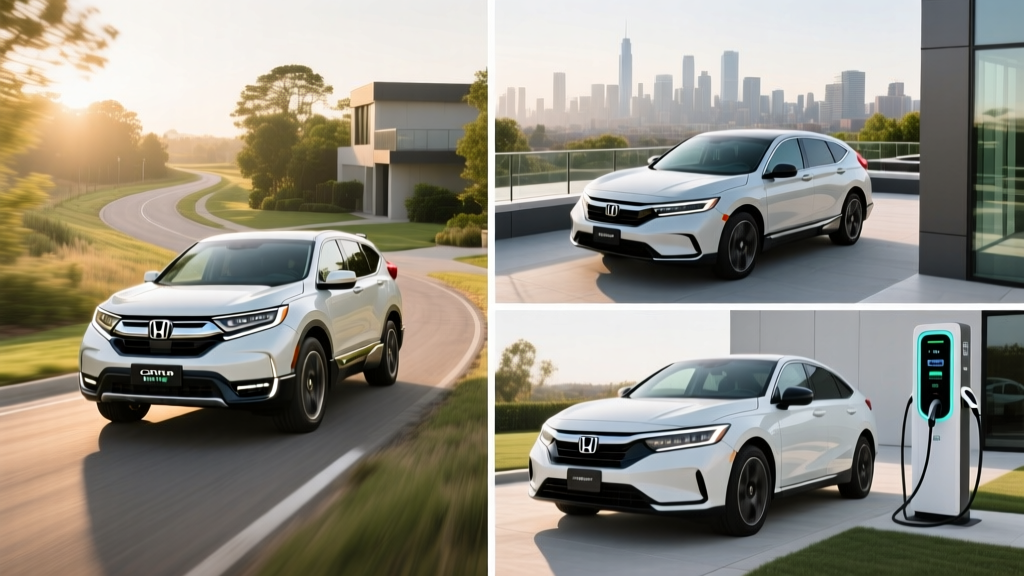
Honda's hybrid lineup has expanded significantly by 2026, offering conventional hybrid (HEV) powertrains across its most popular models. Unlike plug-in hybrids or full EVs, these Honda hybrids never need to be plugged in — they regenerate energy through braking and engine operation, making them ideal for drivers who want better fuel economy without changing their refueling habits. This guide covers every current Honda hybrid modelle with exact EPA figures, real-world expectations, battery warranty details, and pricing.
Honda's 2026 Hybrid Lineup: Which Models Offer Electrification?
Honda currently offers three core hybrid models in the US market, all using the brand's two-motor hybrid system. None of these are plug-in hybrids — they are all self-charging conventional hybrids (HEVs). Here's the full roster:
| Model | Body Style | Combined HP | EPA Combined MPG | Base MSRP |
|---|---|---|---|---|
| CR-V Hybrid (Sport/Sport Touring) | Compact SUV | 204 hp | 40 MPG (FWD) / 37 MPG (AWD) | $36,395 |
| Accord Hybrid (Sport-L, EX-L, Sport Touring) | Midsize Sedan | 204 hp | 44 MPG (Sport-L/EX-L) / 43 MPG (Sport Touring) | $33,990 |
| Civic Hybrid (Sport, Sport Touring) | Compact Sedan | 200 hp | 49 MPG (Sport) / 47 MPG (Sport Touring) | $30,395 |
All three models use Honda's fourth-generation two-motor hybrid system, which pairs a 2.0-liter Atkinson-cycle four-cylinder engine with two electric motors and a lithium-ion battery pack. The system operates primarily in electric-drive mode at low and moderate speeds, with the engine acting as a generator. At highway speeds, a lock-up clutch connects the engine directly to the wheels for optimal efficiency.
Fuel Economy Breakdown: EPA Numbers and Real-World MPG
Honda's hybrid system excels in city driving, where the electric motors handle most propulsion duties. Here's the detailed EPA breakdown for each model, sourced from fueleconomy.gov:
| Model / Trim | City MPG | Highway MPG | Combined MPG | Annual Fuel Cost* |
|---|---|---|---|---|
| CR-V Hybrid FWD | 43 | 36 | 40 | $1,350 |
| CR-V Hybrid AWD | 40 | 34 | 37 | $1,450 |
| Accord Hybrid (Sport-L/EX-L) | 51 | 40 | 44 | $1,200 |
| Accord Hybrid Sport Touring | 46 | 41 | 43 | $1,250 |
| Civic Hybrid Sport | 50 | 47 | 49 | $1,100 |
| Civic Hybrid Sport Touring | 50 | 45 | 47 | $1,150 |
*Annual fuel cost estimates based on 15,000 miles/year, 55% city driving, and $3.50/gallon regular unleaded (2026 national average).
HEV vs PHEV vs EV: Which Honda Is Right for You?
Understanding the difference between hybrid types is essential before choosing a Honda hybrid modelle:
Conventional Hybrid (HEV)
What it is: Gas engine + electric motor + small battery. Never plugs in. Regenerates energy from braking.
Honda examples: CR-V Hybrid, Accord Hybrid, Civic Hybrid
Best for: Drivers without home charging access who want better MPG with zero behavior change.
Plug-in Hybrid (PHEV)
What it is: Larger battery you can plug in for 20-40 miles of electric-only range, then gas engine kicks in.
Honda examples: None currently offered in the US for 2026 (Honda discontinued the Clarity PHEV after 2021).
Best for: Drivers with home charging who want short EV commutes plus gas flexibility.
Full Electric (BEV)
What it is: Battery only — no gas engine. Must plug in to recharge. 200-350+ miles range.
Honda examples: Prologue (289-mile EPA range)
Best for: Drivers with reliable home/workplace charging who want zero tailpipe emissions and lowest fuel cost.
Powertrain Deep Dive: Honda's Two-Motor Hybrid System
All three 2026 Honda hybrid models share Honda's fourth-generation Intelligent Multi-Mode Drive (i-MMD) system. Here's the technical breakdown:
| Specification | CR-V Hybrid | Accord Hybrid | Civic Hybrid |
|---|---|---|---|
| Engine | 2.0L Atkinson I-4 | 2.0L Atkinson I-4 | 2.0L Atkinson I-4 |
| Engine HP | 145 hp | 146 hp | 143 hp |
| Drive Motor Output | 181 hp / 247 lb-ft | 181 hp / 247 lb-ft | 174 hp / 232 lb-ft |
| Combined System HP | 204 hp | 204 hp | 200 hp |
| Battery Type | Lithium-ion | Lithium-ion | Lithium-ion |
| Drivetrain | FWD or AWD | FWD | FWD |
| Transmission | Direct-drive (e-CVT) | Direct-drive (e-CVT) | Direct-drive (e-CVT) |
| 0-60 mph (est.) | 7.6 sec | 7.1 sec | 7.3 sec |
The system operates in three modes seamlessly: EV Drive (battery powers the drive motor alone at low speeds), Hybrid Drive (engine generates electricity to power the drive motor, with excess charging the battery), and Engine Drive (engine connects directly to wheels via lock-up clutch at steady highway speeds). Most city driving happens in EV Drive and Hybrid Drive modes, which is why Honda hybrids achieve such strong city MPG numbers.
Pricing, Trims, and Tax Credit Eligibility
Here's the 2026 MSRP breakdown by model and trim:
| Model | Trim | MSRP | Federal Tax Credit |
|---|---|---|---|
| CR-V Hybrid | Sport FWD | $36,395 | Not eligible |
| CR-V Hybrid | Sport AWD | $37,895 | Not eligible |
| CR-V Hybrid | Sport Touring AWD | $41,295 | Not eligible |
| Accord Hybrid | Sport-L | $33,990 | Not eligible |
| Accord Hybrid | EX-L | $35,285 | Not eligible |
| Accord Hybrid | Sport Touring | $39,490 | Not eligible |
| Civic Hybrid | Sport | $30,395 | Not eligible |
| Civic Hybrid | Sport Touring | $33,395 | Not eligible |
Battery Warranty, Reliability, and Replacement Costs
Hybrid battery longevity remains the top concern for buyers considering any Honda hybrid modelle. Here's what you need to know:
Based on long-term data from Honda's hybrid vehicles (the Accord Hybrid has used a two-motor system since 2014, and the Insight before it since 2010), Honda hybrid batteries have proven highly durable. The lithium-ion packs in these HEVs are relatively small (approximately 1.0-1.3 kWh usable) and are never deeply cycled — the system keeps the battery in a narrow state-of-charge window (roughly 40-80%) to minimize degradation. This means:
- Expected battery lifespan: 150,000-200,000+ miles before any notable capacity loss
- Real-world failure rate: Low — Honda hybrid battery replacements are uncommon within the first 10 years
- Replacement cost (out of warranty): $2,000-$4,000 for the battery pack, plus $500-$1,000 labor, depending on model. This is significantly less than full EV battery replacements ($8,000-$20,000+) because the HEV battery is much smaller.
- Other hybrid components: The power control unit (inverter) and electric motors are also covered under the hybrid system warranty and rarely fail.
For broader reliability context, Honda consistently ranks in the top third of Consumer Reports reliability surveys, and the hybrid powertrain adds minimal complexity compared to a conventional automatic transmission (which Honda's e-CVT effectively replaces with a simpler direct-drive system).
Pros and Cons of Honda's Hybrid Modelle
Pros
- Class-leading city MPG (Civic Hybrid: 50 city)
- No plug-in required — zero behavior change from gas cars
- Strong low-end torque from electric motors (responsive city driving)
- 8-10 year hybrid battery warranty
- Available AWD on CR-V Hybrid
- Lower starting price than equivalent PHEVs or EVs
- Proven reliability with over a decade of hybrid system refinement
- Regenerative braking reduces brake pad wear
Cons
- No federal tax credit for conventional hybrids
- No PHEV option in Honda's US lineup (no electric-only commuting)
- Highway MPG drops below city numbers (less benefit on long trips)
- AWD only available on CR-V Hybrid (not Accord or Civic)
- Hybrid trims carry a $1,500-$3,000 premium over gas-only equivalents
- Engine drone under hard acceleration (e-CVT characteristic)
- No DC fast charging capability (not applicable to HEVs)
Who Should Choose a Honda Hybrid vs. a Full EV or Gas Car?
- Choose a Honda Hybrid if: You don't have access to home or workplace charging, you drive 10,000-15,000 miles/year with a mix of city and highway, and you want to reduce fuel costs without any lifestyle changes. The Civic Hybrid at 49 MPG combined saves roughly $700-$900/year vs. a comparable gas-only compact sedan.
- Choose a PHEV (from another brand) if: You have Level 2 home charging and your daily commute is under 30 miles. A PHEV like the Toyota RAV4 Prime (42 miles electric) lets you drive most days on electricity while keeping gas flexibility. Honda doesn't currently offer a PHEV in the US.
- Choose a full EV if: You have reliable home charging, your daily driving is under 250 miles, and you want the lowest per-mile fuel cost ($0.04-$0.06/mile on home electricity vs. $0.10-$0.12/mile in a Honda hybrid). Consider Honda's own Prologue (289-mile EPA range) or competitors like the Hyundai Ioniq 5 or Tesla Model Y.
- Stick with gas-only if: You drive fewer than 8,000 miles/year and the hybrid premium ($1,500-$3,000) wouldn't be recouped through fuel savings within your ownership period.
Frequently Asked Questions
How many MPG does a Honda hybrid get in real-world driving?
The 2026 Civic Hybrid achieves 49 MPG combined (50 city / 47 highway) per the EPA. In real-world testing, city drivers often see 50-53 MPG thanks to frequent regenerative braking. Highway-only driving at 75+ mph typically yields 42-45 MPG. The CR-V Hybrid AWD averages 35-38 MPG combined in mixed driving, close to its 37 MPG EPA rating.
Does any Honda hybrid have electric-only range?
No. Honda's current US hybrid models are all conventional HEVs — they cannot drive on electricity alone for any meaningful distance. The small battery provides electric assist at low speeds but the engine is always available. If you need electric-only commuting range, you'll need a PHEV from another brand (Toyota, Hyundai, Jeep) or a full EV.
Is the Honda hybrid system reliable long-term?
Yes. Honda's two-motor hybrid system has been in production since 2014 (Accord Hybrid) with incremental improvements. The hybrid battery is warrantied for 8 years/100,000 miles (10 years/150,000 miles in CARB states). Real-world data shows these batteries routinely last 150,000+ miles. The e-CVT design is simpler than a conventional automatic transmission, with fewer wear components.
What does it cost to replace a Honda hybrid battery?
Out-of-warranty replacement runs $2,000-$4,000 for the battery pack plus $500-$1,000 labor, depending on the model. Given the battery's small size (roughly 1.0-1.3 kWh) and conservative state-of-charge management, replacements are uncommon within the first 150,000 miles. Compare this to EV battery replacements at $8,000-$20,000+.
Do Honda hybrids qualify for any tax credits?
No. Under current IRS §30D rules, conventional hybrids that cannot be plugged in do not qualify for the federal Clean Vehicle Credit. Only plug-in hybrids and full EVs are eligible. Some states may offer separate hybrid incentives — check your state energy office or AFDC state incentive database for details.
Which Honda hybrid model gets the best fuel economy?
The 2026 Civic Hybrid Sport leads the lineup at 49 MPG combined (50 city / 47 highway EPA). If you need an SUV, the CR-V Hybrid FWD achieves 40 MPG combined. For a midsize sedan, the Accord Hybrid Sport-L and EX-L deliver 44 MPG combined.
Can I tow with a Honda hybrid?
The CR-V Hybrid has a maximum towing capacity of 1,000 pounds (suitable for a small utility trailer). The Accord Hybrid and Civic Hybrid are not rated for towing. If you need serious towing capacity (3,500+ lbs), you'll need to look at truck-based hybrids or conventional powertrains.