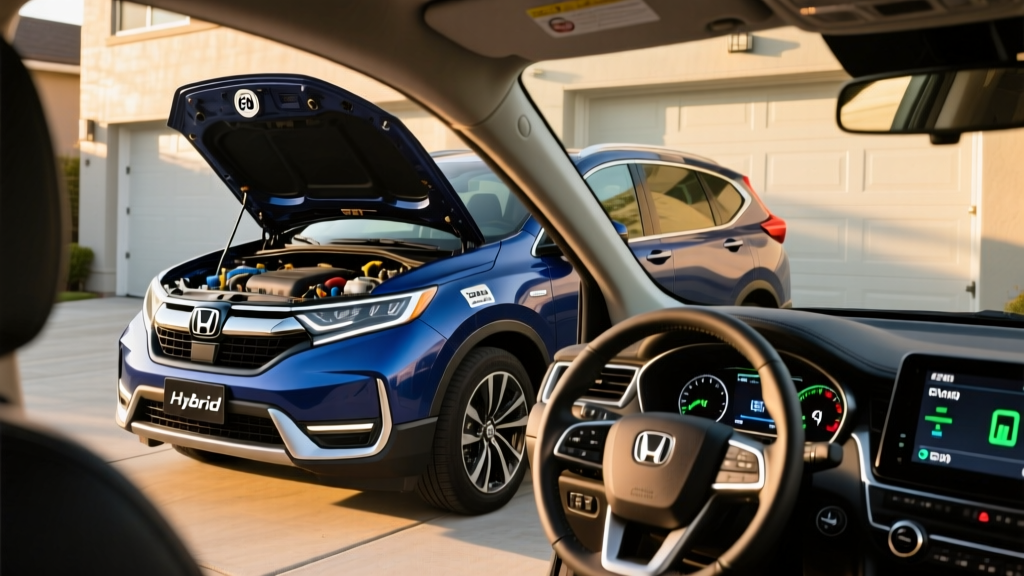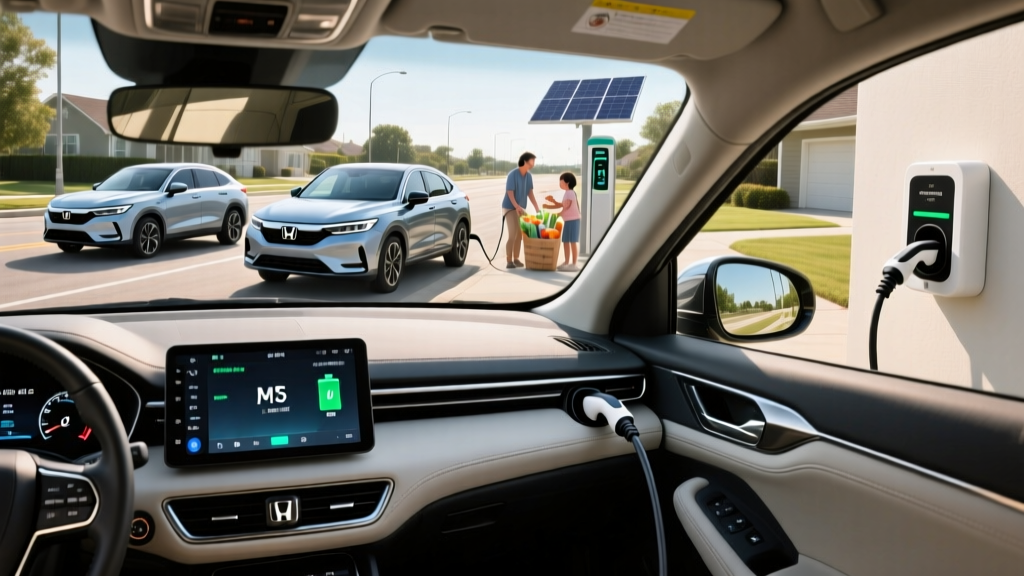
Honda currently sells hybrid versions of some of its most popular vehicles, but the answer to "does Honda have a hybrid" depends on what kind of electrification you're looking for. Honda offers conventional hybrids (HEVs) that never need plugging in, but as of the 2026 model year, the brand does not sell a plug-in hybrid (PHEV) in the United States. If you need electric-only driving range and a charging port, you'll have to look elsewhere — but if you want excellent fuel economy with zero lifestyle change, Honda's hybrid lineup deserves serious attention.
This guide breaks down every 2026 Honda hybrid available, with exact EPA figures, real-world MPG expectations, powertrain specs, pricing, tax credit eligibility, and battery warranty details. We'll also help you decide whether a Honda HEV, a competitor's PHEV, or a full battery-electric vehicle (BEV) fits your driving pattern.
Does Honda Have a Hybrid? The 2026 Lineup at a Glance
Honda's U.S. hybrid strategy for 2026 centers on its two-row midsize SUV and its compact sedan. Both use Honda's fourth-generation two-motor hybrid system, which pairs a 2.0-liter Atkinson-cycle four-cylinder engine with two electric motors — one primarily for propulsion and one for regeneration and engine starting. Unlike Toyota's planetary-gear eCVT, Honda's system operates mostly in electric-drive mode at low and moderate speeds, with the gasoline engine acting as a generator. At highway cruising speeds, a lock-up clutch connects the engine directly to the wheels for efficiency.
| Model | Type | Powertrain | Combined HP | EPA MPG (City/Hwy/Combined) | Starting MSRP |
|---|---|---|---|---|---|
| CR-V Hybrid (Sport / Sport Touring) | HEV | 2.0L I4 + 2 motors | 204 hp | 43 / 36 / 40 (FWD) 40 / 34 / 37 (AWD) |
~$36,300 |
| Accord Hybrid (Sport / EX-L / Sport-L / Touring) | HEV | 2.0L I4 + 2 motors | 204 hp | 51 / 44 / 48 (Sport/EX-L) 48 / 41 / 44 (Sport-L/Touring) |
~$34,490 |
Note that Honda discontinued the Insight after the 2022 model year and folded its hybrid-sedan mission into the Accord lineup. The Civic Hybrid returned for the 2025 model year with a 1.5-liter Atkinson-cycle system producing around 200 hp combined and an EPA rating of approximately 50/47/49 MPG — it continues into 2026 with minimal changes. We've focused on the CR-V and Accord here as the core volume sellers, but the Civic Hybrid is a strong option for compact-sedan buyers.
HEV vs PHEV: Why Honda Chose Conventional Hybrids
Understanding the Difference
Conventional Hybrid (HEV): A small battery (typically 1–2 kWh) recharges through regenerative braking and the gasoline engine. You never plug it in. The electric motor assists the engine and enables brief electric-only driving at very low speeds, but the primary energy source is gasoline. Examples: Honda CR-V Hybrid, Toyota Camry Hybrid, Hyundai Tucson Hybrid.
Plug-in Hybrid (PHEV): A larger battery (typically 12–25 kWh) can be charged from a wall outlet or public charger, enabling 25–50 miles of electric-only driving before the gasoline engine takes over. Once the battery depletes, it operates like a conventional hybrid. Examples: Toyota RAV4 Prime, Jeep Wrangler 4xe, Hyundai Tucson PHEV.
Battery Electric Vehicle (BEV): No gasoline engine at all. Runs entirely on a large battery pack (60–100+ kWh) charged from the grid. Examples: Tesla Model Y, Hyundai Ioniq 5, Honda Prologue.
Honda's U.S. strategy has been to offer conventional hybrids for buyers who want better fuel economy without changing their fueling habits, while positioning the all-electric Honda Prologue (a BEV built on GM's Ultium platform) for those ready to plug in. Honda has not sold a PHEV in the U.S. since the Clarity Plug-in Hybrid was discontinued after the 2021 model year. If Honda introduces a PHEV variant of the CR-V or Accord for the U.S. market, it has not been announced as of early 2026.
EPA MPG vs Real-World: What to Actually Expect
One advantage of conventional hybrids is that real-world fuel economy often matches or even exceeds EPA estimates in city driving — the opposite of what you see with most gasoline-only cars. That's because hybrids recapture braking energy and shut off the engine at stops, which matters most in stop-and-go traffic.
| Model | EPA Combined | Real-World City | Real-World Highway | Real-World Combined (Est.) |
|---|---|---|---|---|
| CR-V Hybrid FWD | 40 MPG | 42–46 MPG | 33–36 MPG | 37–40 MPG |
| CR-V Hybrid AWD | 37 MPG | 38–42 MPG | 31–34 MPG | 34–37 MPG |
| Accord Hybrid Sport | 48 MPG | 49–54 MPG | 40–44 MPG | 44–48 MPG |
| Accord Hybrid Touring | 44 MPG | 45–50 MPG | 38–41 MPG | 41–45 MPG |
Key real-world factors: Highway MPG drops more noticeably in hybrids than in city driving because regenerative braking provides less benefit at sustained speeds, and aerodynamic drag dominates. Cold weather reduces MPG by roughly 5–10% due to increased engine operation for cabin heat and reduced battery efficiency. Drivers who do mostly city and suburban driving consistently report exceeding EPA combined estimates, while those who drive predominantly highway miles at 75+ mph should expect to fall a few MPG short of the sticker.
For detailed EPA figures, you can verify ratings at fueleconomy.gov.
Powertrain Deep Dive: Honda's Two-Motor Hybrid System
Honda's fourth-generation hybrid system is one of the most sophisticated on the market, and understanding how it works helps explain the strong real-world efficiency.
Engine: A 2.0-liter direct-injection Atkinson-cycle four-cylinder producing 146 hp and 134 lb-ft of torque. The Atkinson cycle delays intake-valve closing to improve thermal efficiency at the expense of peak power — acceptable because the electric motors fill in the torque gap.
Electric Motors: The primary propulsion motor delivers 181 hp and 247 lb-ft of torque. A smaller secondary motor handles regeneration, engine starting, and acts as a generator when the engine is producing electricity to feed the drive motor.
Combined Output: 204 hp and 247 lb-ft of torque. The combined figure is less than a simple addition of engine and motor peak outputs because they don't reach peak power at the same RPM.
Drive Modes: The system seamlessly switches between EV Drive (battery-only, low speeds and light loads), Hybrid Drive (engine generates electricity, motor drives wheels), and Engine Drive (engine directly connected to wheels via lock-up clutch at highway cruising). The driver doesn't select these — the system manages transitions automatically based on speed, throttle position, and battery state of charge.
AWD Availability: The CR-V Hybrid offers available real-time AWD with a mechanical connection to the rear axle. The Accord Hybrid is front-wheel drive only. AWD models carry a 2–3 MPG penalty across the board due to the added weight and driveline losses.
Pricing, Trims, and Tax Credit Eligibility
Here's where Honda hybrid buyers need clear expectations. The federal EV tax credit under IRS §30D applies only to battery-electric vehicles (BEVs) and plug-in hybrids (PHEVs) that meet battery-sourcing and critical-mineral requirements. Because Honda's current U.S. hybrids are conventional HEVs — not plug-in vehicles — they do not qualify for the federal §30D new clean vehicle credit.
Tax Credit and Incentive Summary
- Federal §30D credit: Not eligible — HEVs do not qualify (PHEVs and BEVs only)
- State incentives: Some states offer rebates or reduced registration fees for hybrids, but these vary widely. Check your state's energy or DMV website for current programs.
- Dealer incentives: Honda periodically offers financing promotions or cash-back on hybrid trims — check the Honda website for current offers.
- Fuel savings as incentive: At $3.50/gallon and 12,000 miles/year, the Accord Hybrid saves roughly $650–$800/year vs. a comparable gasoline-only midsize sedan getting 30 MPG combined.
| Model / Trim | MSRP (approx.) | Notable Features |
|---|---|---|
| CR-V Hybrid Sport (FWD) | $36,300 | Wireless CarPlay/Android Auto, Honda Sensing suite |
| CR-V Hybrid Sport (AWD) | $37,800 | Real-time AWD, heated front seats |
| CR-V Hybrid Sport Touring (AWD) | $41,800 | Leather, Bose audio, wireless charging, hands-free liftgate |
| Accord Hybrid Sport | $34,490 | 12.3" touchscreen, sport styling, paddle shifters |
| Accord Hybrid EX-L | $36,200 | Leather seats, heated rear seats, power moonroof |
| Accord Hybrid Touring | $39,990 | Google built-in, Bose 12-speaker, HUD, ventilated front seats |
Hybrid trims typically carry a $1,200–$1,800 premium over equivalent gasoline-only trims. With annual fuel savings of $500–$800 depending on driving patterns and local fuel prices, most buyers will recoup the hybrid premium within 2–4 years of ownership.
Battery Warranty, Reliability, and Replacement Cost
Honda Hybrid Battery Warranty
Coverage: 8 years / 100,000 miles (10 years / 150,000 miles in CARB states including California, New York, Massachusetts, and others that follow California emissions standards).
What's covered: Defects and capacity loss below a functional threshold. Honda's hybrid battery warranty covers the high-voltage battery pack, power control unit, and related hybrid-system components.
Replacement cost (out of warranty): $2,000–$4,000 for the high-voltage battery pack depending on model and labor rates. This is significantly less than BEV battery replacements, which can exceed $10,000–$20,000, because Honda's HEV battery is small (~1.3 kWh usable).
Honda's hybrid system has proven highly reliable in long-term ownership. The two-motor architecture has fewer mechanical wear points than some competitors — there's no traditional transmission (no planetary gearset, no belt-driven CVT) to service or fail. The lithium-ion battery pack is small and operates within a narrow state-of-charge window managed by the power control unit, which significantly reduces degradation compared to BEV batteries that regularly cycle from 10% to 90%.
Real-world data from high-mileage Honda hybrid owners (Accord and CR-V) shows minimal capacity loss over 100,000+ miles. Unlike the first-generation Honda IMA (Integrated Motor Assist) systems in early-2000s Insights and Civics, which had notable battery failure rates, the current two-motor system is a mature, well-proven design.
For reliability ratings and crash-test scores, consult IIHS and NHTSA. Both the CR-V and Accord have historically earned top safety ratings, and the hybrid variants share the same structural platform.
Honda Hybrid vs PHEV vs EV: Which Should You Choose?
Choose a Honda Hybrid (HEV) If:
- You don't have access to home or workplace charging
- You want better MPG without changing how you fuel up
- You drive a mix of city and highway miles and want strong real-world city efficiency
- You want a lower purchase price than a PHEV or BEV
- You frequently take long road trips and don't want to plan around charging stops
Choose a Plug-in Hybrid (PHEV) If:
- You can charge at home (Level 1 or Level 2) and want 25–50 miles of daily electric-only driving
- Your commute is under 40 miles round-trip and you want to drive mostly on electricity
- You want to reduce gasoline consumption dramatically while keeping a gas engine for road trips
- You're willing to pay a $3,000–$8,000 premium over a conventional hybrid
- Consider: Toyota RAV4 Prime (42 mi electric), Hyundai Tucson PHEV (33 mi electric)
Choose a Full EV (BEV) If:
- You have reliable home Level 2 charging (240V)
- You want zero tailpipe emissions and minimal maintenance (no oil changes, no spark plugs)
- You qualify for the federal §30D tax credit (up to $7,500) and/or state rebates
- Your daily driving is under 250 miles and you're comfortable with public DC fast charging for road trips
- Consider: Honda Prologue (302 mi EPA), Tesla Model Y, Hyundai Ioniq 5
The honest calculus: if you can install a Level 2 charger at home and your commute is under 40 miles, a PHEV delivers the best of both worlds — daily electric driving with no range anxiety on road trips. But if you live in an apartment without charging access, or you simply want to keep life as simple as possible while cutting fuel costs by 30–50%, a Honda HEV is the pragmatic choice.
Pros and Cons of Honda's Hybrid Lineup
Pros
- Excellent real-world city MPG — often exceeds EPA estimates in stop-and-go driving
- No plug-in charging required — zero lifestyle change from a gas car
- Strong, smooth acceleration from electric motor torque (247 lb-ft)
- Proven reliability with 8–10 year battery warranty
- Competitive pricing — hybrid premium recouped in 2–4 years via fuel savings
- Top safety ratings from IIHS and NHTSA
- Available AWD on CR-V Hybrid
Cons
- No PHEV option in the U.S. — no electric-only commuting range
- No federal tax credit eligibility for HEVs
- Highway MPG falls short of city MPG (less regenerative benefit at speed)
- Hybrid trims not available on Pilot, Passport, or Ridgeline (gas-only)
- Engine drone under hard acceleration (CVT-like behavior at high RPM)
- AWD hybrid penalty of 2–3 MPG vs FWD
Frequently Asked Questions
How many MPG does the Honda CR-V Hybrid get?
The 2026 CR-V Hybrid with front-wheel drive is EPA-rated at 43 city / 36 highway / 40 combined MPG. The AWD version drops to 40/34/37 MPG. In real-world city driving, many owners report 42–46 MPG thanks to regenerative braking. Highway driving at 70+ mph typically yields 33–36 MPG.
Does Honda make a plug-in hybrid?
Not in the United States as of 2026. Honda discontinued the Clarity Plug-in Hybrid after the 2021 model year and has not announced a replacement PHEV for the U.S. market. Honda offers PHEV variants in some international markets, but American buyers looking for a plug-in Honda will need to consider the all-electric Honda Prologue or look at PHEV offerings from Toyota, Hyundai, or Stellantis brands.
Does the Honda hybrid qualify for a tax credit?
No. The federal §30D clean vehicle credit applies only to plug-in electric vehicles (BEVs and PHEVs). Honda's conventional hybrids do not have a charging port and do not qualify. Some states may offer modest incentives for hybrid purchases — check your state's energy office for current programs.
How long will the Honda hybrid battery last?
Honda warranties the hybrid battery for 8 years / 100,000 miles (10 years / 150,000 miles in CARB states). In practice, Honda's current-generation hybrid batteries have shown excellent longevity well beyond the warranty period because the system keeps the battery in a narrow state-of-charge window, avoiding the deep cycles that accelerate degradation. Out-of-warranty replacement costs approximately $2,000–$4,000.
Is the Honda hybrid reliable compared to Toyota?
Both Honda and Toyota have mature, well-proven hybrid systems with strong long-term reliability records. Toyota has a longer hybrid history (the Prius launched in 1997) and a larger hybrid lineup, but Honda's current two-motor system is in its fourth generation and has demonstrated comparable durability. The key difference is philosophy: Toyota uses a planetary gearset power-split device, while Honda uses a predominantly series-hybrid architecture with a direct-drive clutch for highway cruising. Both approaches are reliable; the driving experience differs slightly, with Honda's system feeling more electric in daily driving.
Does the Honda hybrid need to be plugged in?
No. Honda's current U.S. hybrids are conventional HEVs. The battery recharges automatically through regenerative braking and the gasoline engine. You fuel up at any gas station exactly as you would with a non-hybrid vehicle.
What is the total cost of ownership for a Honda hybrid vs a gas model?
Over five years and 60,000 miles, a Honda hybrid saves approximately $2,500–$4,000 in fuel compared to its gasoline-only counterpart (assuming $3.50/gallon and 12,000 miles/year). The hybrid trim premium of $1,200–$1,800 is typically offset within the first two years. Maintenance costs are comparable — Honda hybrids still require oil changes, but brake pad life is often extended due to regenerative braking handling much of the deceleration load.