Honda's hybrid electric strategy in 2026 is pragmatic: instead of chasing pure EV dominance, the automaker offers a lineup of conventional hybrids (HEVs) that deliver exceptional fuel economy without requiring a plug, alongside limited plug-in hybrid (PHEV) availability for drivers who want short electric-only commutes. If you're researching a Honda hybrid electric vehicle, this guide covers every current model's real-world efficiency, powertrain specs, battery longevity, and whether Honda's approach fits your driving needs better than a full battery-electric vehicle (BEV).
Honda Hybrid Electric Models Available in 2026
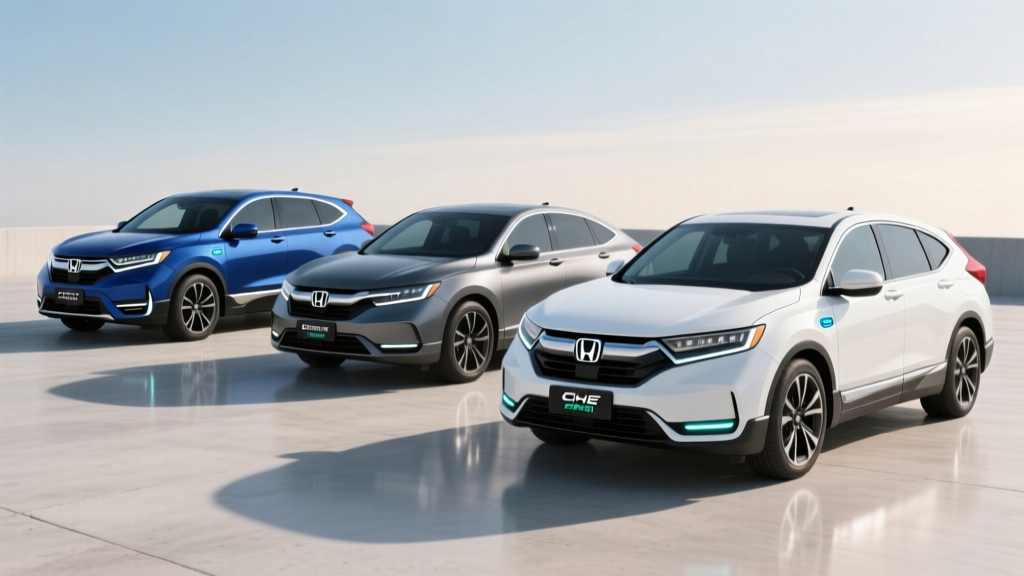
Honda currently sells two core hybrid electric models in the U.S. market, both using the brand's two-motor hybrid system. Neither requires plug-in charging — they are conventional HEVs that recapture energy through regenerative braking and the gasoline engine.
- 2026 Honda CR-V Hybrid — Compact SUV, available in Sport and Sport Touring trims (AWD standard on Sport Touring)
- 2026 Honda Accord Hybrid — Midsize sedan, available in Sport, EX-L, Sport-L, and Touring trims
Honda discontinued the Clarity Plug-In Hybrid after the 2021 model year. As of 2026, Honda does not sell a new PHEV in the United States. The company has signaled future PHEV and BEV products based on its next-generation platform, but nothing is currently available for purchase. If plug-in capability is a priority, you'll need to look at competitors like the Toyota RAV4 Prime or Hyundai Tucson PHEV — or wait for Honda's next product cycle.
HEV vs PHEV: Understanding Honda's Hybrid Approach
| Feature | Conventional Hybrid (HEV) | Plug-In Hybrid (PHEV) |
|---|---|---|
| Plug-in charging | No — refuels via gas + regen | Yes — plugs into Level 1 or Level 2 |
| Battery size | ~1.0–1.3 kWh (small buffer) | Typically 13–20 kWh |
| Electric-only range | Less than 1 mile at low speed | 20–45 miles (model dependent) |
| Fuel economy | Consistent MPG all the time | High MPGe on battery; MPG after depletion |
| Federal tax credit (§30D) | Not eligible | Up to $7,500 if criteria met |
| Current Honda availability | CR-V Hybrid, Accord Hybrid | None (Clarity discontinued 2021) |
Honda's current hybrid electric lineup is exclusively HEV. This means zero lifestyle change from a gas car: you fill up at a gas station, and the hybrid system automatically optimizes between the gasoline engine and electric motors. The trade-off is that you never drive on electricity alone for meaningful distances, and you don't qualify for the federal EV tax credit.
Fuel Economy: EPA MPG and Real-World Results
| Model | City MPG | Highway MPG | Combined MPG | Real-World Note |
|---|---|---|---|---|
| 2026 CR-V Hybrid AWD | 40 | 34 | 37 | Owners report 35–42 combined; excels in city stop-and-go |
| 2026 Accord Hybrid (FWD) | 51 | 44 | 48 | City drivers often see 50+; highway drops to ~40 at 75+ mph |
Source: fueleconomy.gov (EPA estimates).
The Accord Hybrid's 48 MPG combined is among the best of any midsize sedan sold in America. Honda's two-motor system operates primarily in electric-drive mode at low and moderate speeds, with the 2.0-liter Atkinson-cycle engine acting as a generator. At highway speeds, a lock-up clutch connects the engine directly to the wheels for efficiency. This means Honda hybrids perform best in city and suburban driving, where regenerative braking and electric-only propulsion dominate. Sustained 80-mph highway cruising narrows the advantage over a conventional gas engine.
In cold weather (below 32°F), expect a 5–10% MPG reduction in both models as the engine runs more frequently to provide cabin heat and maintain battery temperature. This is far less severe than the 20–40% range loss a full BEV experiences in winter, making Honda's hybrids a strong choice for cold-climate drivers who lack home charging.
Powertrain Specs: Horsepower, Engine, and Motor Details
| Specification | 2026 CR-V Hybrid | 2026 Accord Hybrid |
|---|---|---|
| Engine | 2.0L DOHC Atkinson-cycle 4-cylinder | 2.0L DOHC Atkinson-cycle 4-cylinder |
| Engine HP | 145 hp | 146 hp |
| Electric Motors | Two-motor system | Two-motor system |
| Combined System HP | 204 hp | 204 hp |
| Combined Torque | 247 lb-ft (motor peak) | 247 lb-ft (motor peak) |
| Drivetrain | AWD (standard on Sport Touring; available on Sport) | FWD (all trims) |
| 0–60 mph (est.) | ~7.6 seconds | ~7.0 seconds |
| Transmission | e-CVT (direct drive + lock-up clutch) | e-CVT (direct drive + lock-up clutch) |
Honda's fourth-generation two-motor hybrid system is one of the most refined in the industry. Unlike Toyota's planetary-gear power-split device, Honda uses a series-parallel architecture: the primary traction motor drives the wheels most of the time, while the secondary motor primarily functions as a generator. The gasoline engine only directly drives the wheels at steady highway speeds via a lock-up clutch. This gives Honda hybrids a smoother, more EV-like feel around town compared to competitors.
Battery Technology, Warranty, and Replacement Cost
Honda Hybrid Battery Warranty
Coverage: 8 years / 100,000 miles (10 years / 150,000 miles in CARB states including California, New York, Massachusetts, and others that follow California emissions standards).
What's covered: Hybrid battery pack and hybrid system components including the power control unit and electric motors.
Capacity threshold: Honda does not publish a specific degradation percentage trigger, but dealerships typically replace under warranty if the battery cannot hold sufficient charge to operate the hybrid system effectively.
Honda's hybrid battery packs use lithium-ion cells, typically in the 1.0–1.3 kWh range — far smaller than a BEV's 60–100 kWh pack. Because the battery is small and the hybrid system keeps it within a narrow state-of-charge window (roughly 40–60%), degradation is minimal. Real-world data from earlier Honda hybrid models (Insight, previous-gen Accord Hybrid) shows most original hybrid batteries lasting well beyond 150,000 miles with only modest capacity loss.
Replacement cost: If the hybrid battery fails out of warranty, a replacement pack for the CR-V Hybrid or Accord Hybrid typically costs between $2,000 and $4,000 including labor at a dealership. Independent hybrid-battery specialists can often refurbish or replace individual cells for $1,000–$2,500. This is dramatically less expensive than a BEV battery replacement, which can exceed $10,000–$15,000.
For comparison, a Toyota RAV4 Hybrid battery replacement runs a similar $2,500–$4,500 range. Hybrid battery anxiety, while understandable, is largely overstated given current lithium-ion durability and Honda's generous warranty window.
Pricing, Trims, and Tax Credit Eligibility
| Model & Trim | 2026 MSRP | Federal Tax Credit (§30D) | Effective Price |
|---|---|---|---|
| CR-V Hybrid Sport AWD | $36,395 | $0 — not eligible (HEV) | $36,395 |
| CR-V Hybrid Sport Touring AWD | $40,895 | $0 — not eligible (HEV) | $40,895 |
| Accord Hybrid Sport | $34,395 | $0 — not eligible (HEV) | $34,395 |
| Accord Hybrid EX-L | $36,395 | $0 — not eligible (HEV) | $36,395 |
| Accord Hybrid Touring | $40,395 | $0 — not eligible (HEV) | $40,395 |
Tax credit reality: Honda's current hybrid electric vehicles are conventional HEVs, which do not qualify for the IRS §30D Clean Vehicle Credit. That credit — up to $7,500 — applies only to plug-in vehicles (BEVs and PHEVs) that meet battery sourcing, critical mineral, MSRP cap, and buyer income requirements. Since Honda hybrids have no plug and no meaningful electric-only range, they fall outside the credit's scope entirely.
Some states offer separate incentives for hybrids, but these are increasingly rare as state programs shift focus to zero-emission vehicles. Check your state's energy or environmental agency website for current hybrid rebates, but do not count on them.
Reliability, Ownership Costs, and Long-Term Value
Honda's hybrid system has a strong reliability track record. The two-motor architecture has fewer moving parts than a traditional automatic transmission (there's no multi-speed gearbox — just a single fixed ratio with a lock-up clutch), and the e-CVT design eliminates the belt-and-cone wear associated with older CVT designs. Consumer Reports and J.D. Power consistently rate Honda's hybrid powertrains among the most dependable in the segment.
Pros: Honda Hybrid Electric
- Accord Hybrid achieves 48 MPG combined — best-in-class midsize sedan efficiency
- No charging infrastructure required — identical ownership to a gas car
- Minimal cold-weather efficiency penalty compared to full EVs
- Strong 8-year/100,000-mile hybrid battery warranty (10/150k in CARB states)
- EV-like driving feel around town with smooth electric motor torque
- Battery replacement cost ($2,000–$4,000) far below BEV batteries
- Honda Sensing ADAS suite standard on all trims
Cons: Honda Hybrid Electric
- No PHEV option available — cannot drive on electricity alone for commutes
- Zero federal tax credit eligibility (HEVs excluded from §30D)
- CR-V Hybrid highway MPG (34) trails its city rating (40) noticeably
- No DC fast charging (not applicable to HEV, but limits all-electric utility)
- AWD only available on CR-V Hybrid; Accord Hybrid is FWD only
- Hybrid trims carry a ~$1,500–$2,000 premium over equivalent gas trims
Who Should Choose a Honda Hybrid vs. a Full EV or Gas Car?
Choose a Honda Hybrid (HEV) If:
- You cannot install a home Level 2 charger (apartment, street parking, no garage)
- Your commute involves heavy stop-and-go traffic where hybrid efficiency shines
- You want 40–50 MPG without changing any refueling habits
- You live in a cold climate where BEV range loss would be frustrating
- You plan to keep the car 8–12 years and want proven long-term reliability
Choose a Plug-In Hybrid (PHEV) From Another Brand If:
- You have home charging and a short commute (under 30 miles) you want to drive electric
- You want to qualify for the $7,500 federal tax credit (if income and sourcing rules allow)
- You want electric-only driving most days with gas backup for road trips
- Consider the Toyota RAV4 Prime (42 miles EV), Hyundai Tucson PHEV (33 miles EV), or Jeep Wrangler 4xe (22 miles EV)
Choose a Full BEV If:
- You have reliable home charging (Level 2) and your daily driving is under 250 miles
- You want zero tailpipe emissions and the lowest per-mile fuel cost
- You want to maximize federal and state incentives
- Consider the Tesla Model Y, Hyundai Ioniq 5, Honda Prologue, or Chevrolet Equinox EV
Honda also sells the Prologue, a fully electric SUV developed in partnership with General Motors using the Ultium platform. If you want a Honda badge with a plug, the Prologue offers an EPA-estimated 296 miles of range and may qualify for the federal tax credit depending on your income and the vehicle's battery sourcing. But it's a distinct product from Honda's hybrid electric lineup and requires charging infrastructure.
Frequently Asked Questions
How many MPG does the Honda hybrid get?
The 2026 Honda Accord Hybrid achieves an EPA-estimated 51 city / 44 highway / 48 combined MPG. The 2026 CR-V Hybrid AWD achieves 40 city / 34 highway / 37 combined. In real-world driving, city and suburban commuters often exceed EPA estimates in the Accord Hybrid (50+ MPG is common), while sustained highway driving above 75 mph can reduce both models' efficiency by 5–8 MPG.
Does Honda make a plug-in hybrid?
Not as of 2026. Honda discontinued the Clarity Plug-In Hybrid after the 2021 model year. All current Honda hybrid electric vehicles are conventional HEVs that do not plug in. Honda has announced plans for future electrified models but has not confirmed a PHEV for the U.S. market.
How far can a Honda hybrid go on electric only?
Because Honda's current hybrids are HEVs (not PHEVs), they cannot drive meaningful distances on electric power alone. The small ~1.3 kWh battery assists the gasoline engine and enables brief low-speed electric-only movement (typically under 1 mile at parking-lot speeds). For substantial electric-only range, you would need a PHEV from another manufacturer or Honda's all-electric Prologue.
Is the Honda hybrid reliable, and what does battery replacement cost?
Yes. Honda's two-motor hybrid system has a strong reliability record, with the hybrid battery covered by an 8-year/100,000-mile warranty (10 years/150,000 miles in CARB states). Out-of-warranty battery replacement typically costs $2,000–$4,000 at a dealership, or $1,000–$2,500 through an independent hybrid specialist. Most Honda hybrid batteries last well beyond 150,000 miles based on historical data from previous-generation models.
Does a Honda hybrid qualify for any tax credit?
No. The IRS §30D Clean Vehicle Credit applies only to plug-in electric vehicles (BEVs and PHEVs). Honda's current hybrid models are conventional HEVs with no plug-in capability and are not eligible for the federal credit. Some states may offer small hybrid rebates, but these are increasingly uncommon. Consult a tax professional for personalized guidance on EV and hybrid incentives.
How does the Honda hybrid system work?
Honda uses a two-motor hybrid system. The primary electric motor drives the wheels most of the time, drawing power from the battery or the secondary motor (which acts as a generator powered by the gasoline engine). At steady highway speeds, a lock-up clutch directly connects the 2.0L engine to the wheels for maximum efficiency. The system automatically switches between EV Drive, Hybrid Drive, and Engine Drive modes without driver input. Regenerative braking recaptures energy during deceleration, keeping the small battery charged without any plug-in requirement.
Should I buy a Honda hybrid or a Toyota hybrid?
Both are excellent choices. The Accord Hybrid (48 MPG combined) edges out the Toyota Camry Hybrid (52 MPG combined) in driving refinement, while Toyota's AWD hybrid system in the RAV4 Hybrid is slightly more established. For compact SUVs, the CR-V Hybrid (37 MPG combined AWD) and RAV4 Hybrid (39 MPG combined AWD) are closely matched — the CR-V offers a more modern interior, while the RAV4 edges ahead on fuel economy. Toyota also offers the RAV4 Prime PHEV if you want plug-in capability, which Honda currently cannot match.