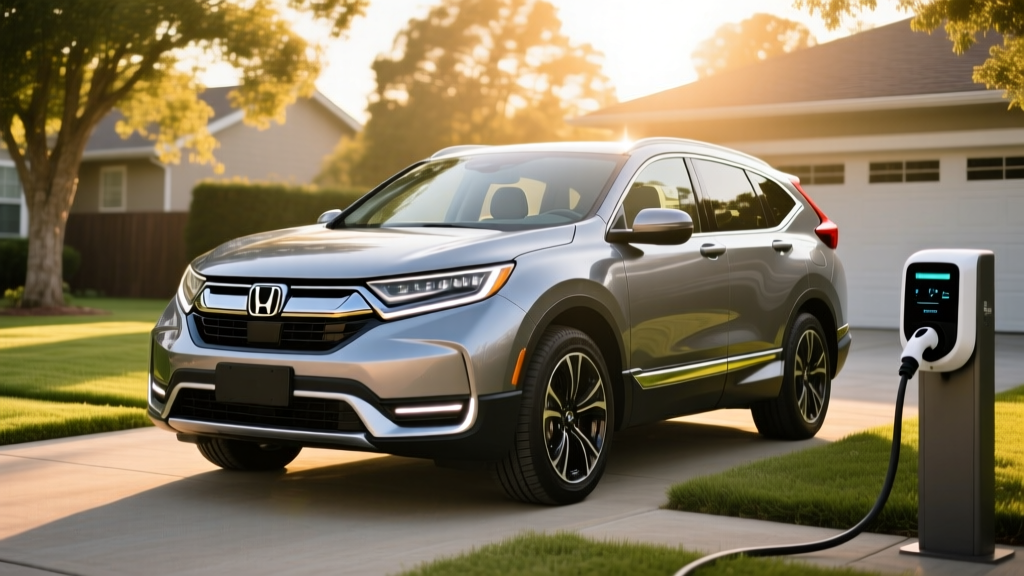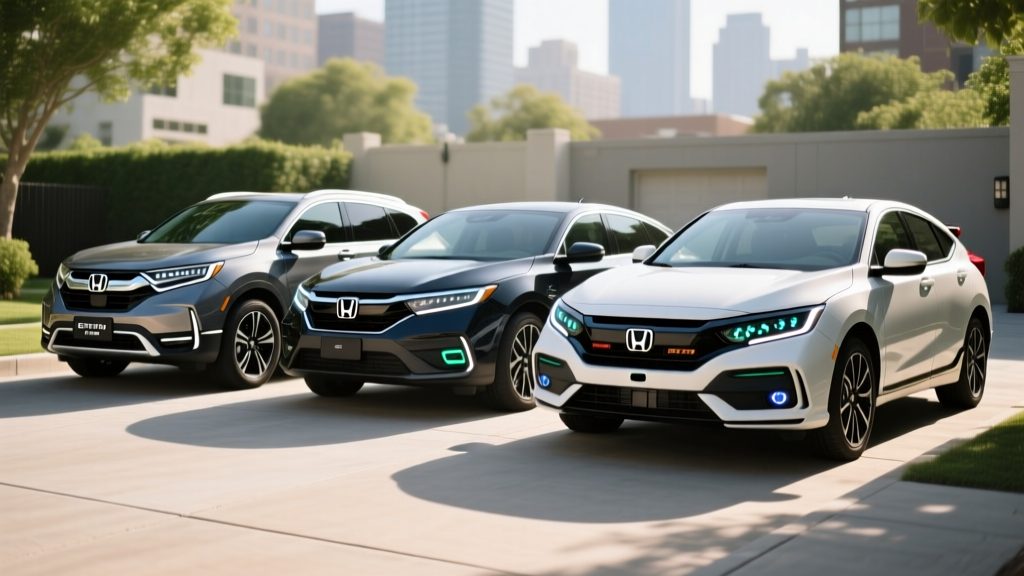
Honda's 2026 lineup leans heavily on conventional hybrid (HEV) powertrains rather than plug-in hybrids. If you're researching hybrid cars Honda offers, you'll find three core models: the CR-V Hybrid compact SUV, the Accord Hybrid midsize sedan, and the newly reintroduced Civic Hybrid. None of them plug in — they're self-charging series-parallel hybrids that squeeze maximum efficiency from regenerative braking and a small lithium-ion battery pack. This guide breaks down exactly what each delivers in EPA MPG, powertrain output, pricing, and long-term battery reliability.
HEV vs PHEV: What Honda Actually Sells
Conventional Hybrid (HEV): Honda's entire 2026 hybrid lineup. A small battery (typically 1.0–1.8 kWh) is recharged by the engine and regenerative braking. No plug required. You simply fuel up at any gas station. The electric motor assists the gasoline engine and can propel the car at low speeds for very short distances.
Plug-in Hybrid (PHEV): Honda does not currently sell a PHEV in the US market for 2026. The Clarity PHEV was discontinued after 2021. If you need electric-only commuting range (20–40 miles) and can charge at home, you'll need to look at competitors like the Toyota RAV4 Prime or Hyundai Tucson PHEV — or consider a full battery-electric vehicle (BEV).
This distinction matters because buyers often search for "Honda plug-in hybrid" and find outdated information. As of 2026, every Honda hybrid is an HEV. That's a deliberate engineering choice: Honda's e:HEV two-motor system prioritizes seamless efficiency without requiring any change to your fueling habits.
2026 Honda CR-V Hybrid: MPG, Specs & Pricing
The CR-V Hybrid remains Honda's best-selling electrified vehicle in the US. For 2026, it pairs a 2.0-liter Atkinson-cycle four-cylinder engine with Honda's two-motor hybrid system.
| Spec | 2026 CR-V Hybrid AWD |
|---|---|
| EPA MPG (City / Highway / Combined) | 40 / 34 / 37 |
| Combined Horsepower | 204 hp |
| Engine | 2.0L Atkinson-cycle I4 |
| Electric Motors | Dual-motor (propulsion + generator) |
| Battery Type / Capacity | Lithium-ion / ~1.06 kWh |
| Drivetrain | AWD (standard on Hybrid trims) |
| 0–60 mph | ~7.6 seconds |
| Cargo Volume | 36.3 cu ft (rear seats up) |
| Starting MSRP | $36,395 (Sport trim) |
| Battery Warranty | 8 years / 100,000 miles |
Source: fueleconomy.gov — 2026 Honda CR-V Hybrid AWD
Real-world MPG note: Honda's two-motor hybrid system excels in city driving, where the electric propulsion motor handles most low-speed work. Many owners report 42–44 MPG in stop-and-go urban commutes — exceeding the EPA city rating. Highway driving at 70–80 mph yields closer to 32–34 MPG because the engine bears more load. In cold weather (below 30°F), expect a 5–8% efficiency drop as the engine runs more frequently for cabin heat.
2026 Honda Accord Hybrid: MPG, Specs & Pricing
The Accord Hybrid targets buyers who want midsize sedan comfort with SUV-rivaling fuel economy. The 2026 model uses an updated version of Honda's two-motor system paired with the same 2.0L Atkinson-cycle engine.
| Spec | 2026 Accord Hybrid |
|---|---|
| EPA MPG (City / Highway / Combined) | 51 / 44 / 48 |
| Combined Horsepower | 204 hp |
| Engine | 2.0L Atkinson-cycle I4 |
| Electric Motors | Dual-motor (propulsion + generator) |
| Battery Type / Capacity | Lithium-ion / ~1.06 kWh |
| Drivetrain | FWD |
| 0–60 mph | ~7.0 seconds |
| Trunk Volume | 16.7 cu ft |
| Starting MSRP | $34,295 (Sport-L trim) |
| Battery Warranty | 8 years / 100,000 miles |
Source: fueleconomy.gov — 2026 Honda Accord Hybrid
Real-world MPG note: The Accord Hybrid is one of the most efficient midsize sedans on the market. In city driving, owners regularly see 50–55 MPG thanks to the electric motor handling most acceleration. On the highway at sustained 75 mph, expect 42–44 MPG. The combined 48 MPG EPA rating is one of the highest of any non-plug-in vehicle sold in the US. Over 15,000 annual miles, that translates to roughly $1,100 in fuel costs — about $800 less per year than a comparable 30 MPG gas-only sedan.
2026 Honda Civic Hybrid: MPG, Specs & Pricing
Reintroduced for 2025 and carried into 2026, the Civic Hybrid fills the gap for buyers wanting a compact sedan with outstanding efficiency. It uses a smaller-displacement 2.0L engine with the same two-motor hybrid architecture.
| Spec | 2026 Civic Hybrid |
|---|---|
| EPA MPG (City / Highway / Combined) | 50 / 47 / 49 |
| Combined Horsepower | 200 hp |
| Engine | 2.0L Atkinson-cycle I4 |
| Electric Motors | Dual-motor (propulsion + generator) |
| Battery Type / Capacity | Lithium-ion / ~1.06 kWh |
| Drivetrain | FWD |
| 0–60 mph | ~6.5 seconds |
| Trunk Volume | 14.8 cu ft |
| Starting MSRP | $30,695 (Sport Hybrid trim) |
| Battery Warranty | 8 years / 100,000 miles |
Source: fueleconomy.gov — 2026 Honda Civic Hybrid
Real-world MPG note: The Civic Hybrid's lighter curb weight gives it a slight real-world edge over the Accord in mixed driving. Expect 48–52 MPG in combined suburban and city use. Highway-only trips at 70 mph yield around 45–47 MPG. This is genuinely one of the most fuel-efficient non-plug-in cars you can buy in 2026.
Honda Hybrid MPG Comparison Table
| Model | City MPG | Highway MPG | Combined MPG | Est. Annual Fuel Cost |
|---|---|---|---|---|
| 2026 Civic Hybrid | 50 | 47 | 49 | ~$1,050 |
| 2026 Accord Hybrid | 51 | 44 | 48 | ~$1,100 |
| 2026 CR-V Hybrid AWD | 40 | 34 | 37 | ~$1,450 |
Annual fuel cost estimates based on 15,000 miles/year, 55% city / 45% highway, at $3.40/gallon regular unleaded. Your costs will vary with local fuel prices and driving patterns.
Honda Hybrid Powertrain: How the Two-Motor System Works
Honda's e:HEV hybrid system is a series-parallel design that operates differently from Toyota's planetary-gear power-split approach. Here's the practical breakdown:
- Low-speed / city driving: The gasoline engine runs as a generator, producing electricity that powers the propulsion motor. The engine is not mechanically connected to the wheels. This is effectively series-hybrid operation, which is why Honda hybrids feel smooth and responsive in stop-and-go traffic.
- Cruising / highway: A lock-up clutch mechanically connects the engine directly to the front wheels, bypassing the electric motor for maximum efficiency at steady speeds.
- Hard acceleration: Both the engine and propulsion motor work together, delivering the full 200–204 combined horsepower.
- Deceleration / braking: The propulsion motor acts as a generator, converting kinetic energy back into battery charge (regenerative braking). You can adjust regen intensity using paddle shifters.
The result is a powertrain that prioritizes electric-motor smoothness where it matters most (city driving) while avoiding the efficiency losses of running everything through a generator at highway speeds. Honda's system does not have a traditional geared transmission — there are no shift points to feel.
Battery Reliability, Warranty & Replacement Cost
Honda Hybrid Battery Warranty: 8 years or 100,000 miles (whichever comes first) across all 50 states. In California Air Resources Board (CARB) states, the warranty extends to 10 years or 150,000 miles for the hybrid battery.
Expected lifespan: Honda's hybrid battery packs are designed to last the life of the vehicle. Real-world data from earlier-generation Honda hybrids (Insight, early Accord Hybrids) shows battery packs routinely exceeding 150,000–200,000 miles before significant degradation. The small ~1 kWh battery in current models cycles shallowly — it rarely fully charges or fully depletes — which is ideal for lithium-ion longevity.
Replacement cost: If a battery does fail outside warranty, replacement runs approximately $2,000–$4,000 including labor at a Honda dealership. Independent hybrid specialists may offer refurbished packs for $1,500–$2,500. Given the shallow cycling and robust warranty, battery replacement is uncommon on current-generation Honda hybrids.
Source: Honda Warranty Information
Honda's hybrid system has fewer high-wear components than a conventional automatic transmission — there's no torque converter, no multi-speed gearbox, and no starter motor (the hybrid system starts the engine). The e-CVT design is mechanically simpler than a traditional transmission, which contributes to long-term reliability.
Tax Credits & Incentives for Honda Hybrids
This is where Honda's HEV-only strategy has a downside. Under current IRS §30D rules, the federal Clean Vehicle Credit of up to $7,500 applies only to plug-in electric vehicles (BEVs and PHEVs) with battery capacities of at least 7 kWh. Since Honda's hybrids use ~1 kWh batteries and don't plug in, none of the 2026 Honda hybrid models qualify for the federal EV tax credit.
However, there are still financial considerations:
- Fuel savings: A Civic Hybrid at 49 combined MPG versus a comparable gas compact at 30 MPG saves approximately $650–$800 per year in fuel at 15,000 miles annually.
- State incentives: A few states offer rebates or HOV lane access for hybrids, though most have shifted incentives toward plug-in vehicles. Check your state's energy office for current programs.
- Lower maintenance costs: No plug-in means no home charger installation ($500–$2,000), no public charging fees, and no battery preconditioning routines. You fuel up at any gas station.
- Resale value: Honda hybrids typically retain strong resale value, with the CR-V Hybrid often commanding a premium over gas-only trims on the used market.
If the federal tax credit is a priority for your purchase, you'd need to look at plug-in vehicles. But if your goal is simply lower fuel costs without changing your fueling habits, Honda's HEVs deliver strong economics without the complexity.
Who Should Choose a Honda Hybrid vs. a Full EV or Gas Car?
Pros
- 48–49 combined MPG (Accord/Civic) — among the best non-plug-in vehicles available
- No plug-in required — no home charger needed, no range anxiety
- Strong real-world city MPG that often exceeds EPA ratings
- Simple ownership: fuel at any gas station, standard maintenance
- AWD standard on CR-V Hybrid (rare in this segment)
- Proven hybrid reliability with 8-year/100k-mile battery warranty
Cons
- No plug-in option — no electric-only commuting, no federal tax credit
- Highway MPG drops notably vs. city (especially CR-V Hybrid at 34 highway)
- Hybrid battery adds ~$2,000–$4,000 replacement risk post-warranty
- Less power than turbocharged gas trims (204 hp vs. 204 hp on Accord turbo — but less peak torque feel)
- No PHEV variant available for buyers who want both electric range and gas flexibility
Choose a Honda Hybrid if: You want 40–50 MPG without changing your fueling routine, you lack access to home or workplace charging, you drive a mix of city and highway miles, or you live in an area with limited public charging infrastructure. The CR-V Hybrid is ideal for families needing AWD and cargo space with strong efficiency.
Choose a plug-in hybrid (PHEV) from another brand if: You have home charging, a short commute (under 30 miles), and want electric-only daily driving with gas backup for road trips. Look at the Toyota RAV4 Prime (42 miles electric-only) or Hyundai Tucson PHEV (33 miles).
Choose a full BEV if: You have reliable home Level 2 charging, want to eliminate gasoline entirely, and qualify for the $7,500 federal tax credit. Vehicles like the Hyundai Ioniq 5 or Tesla Model Y offer 300+ miles of range and dramatically lower per-mile energy costs (~$0.04/mile vs. ~$0.07/mile for a Honda Hybrid at current prices).
Frequently Asked Questions
How many MPG does a Honda hybrid get?
The 2026 Honda Civic Hybrid achieves 50 city / 47 highway / 49 combined MPG. The Accord Hybrid gets 51 city / 44 highway / 48 combined. The CR-V Hybrid AWD achieves 40 city / 34 highway / 37 combined. Real-world city MPG often exceeds EPA ratings by 2–5 MPG due to the electric motor handling low-speed driving.
Does Honda make a plug-in hybrid in 2026?
No. Honda discontinued the Clarity PHEV after the 2021 model year and does not currently offer any plug-in hybrid in the US market for 2026. All Honda hybrids are conventional (HEV) models that do not require plug-in charging.
Is the Honda hybrid system reliable?
Yes. Honda's two-motor hybrid system has been in production since 2014 (Accord Hybrid) and has demonstrated strong long-term reliability. The system has fewer moving parts than a traditional automatic transmission. The hybrid battery carries an 8-year/100,000-mile warranty (10 years/150,000 miles in CARB states), and battery failures before 150,000 miles are uncommon based on historical data.
What does it cost to replace a Honda hybrid battery?
Out-of-warranty replacement costs approximately $2,000–$4,000 at a Honda dealership, including labor. Independent hybrid shops may offer refurbished packs for $1,500–$2,500. Given the shallow charge-discharge cycling and robust warranty, most Honda hybrid owners never need a battery replacement.
Do Honda hybrids qualify for any tax credit?
No. The federal §30D Clean Vehicle Credit requires a plug-in vehicle with at least 7 kWh of battery capacity. Honda's hybrids use ~1 kWh batteries and do not plug in, so they do not qualify for the federal credit. Some states may offer minor incentives for hybrids — check your state energy office. The fuel savings alone ($650–$800/year vs. a gas-only car) still make Honda hybrids economically compelling.
Do I need to plug in a Honda hybrid?
No. All 2026 Honda hybrids are conventional (HEV) models. The battery recharges automatically through regenerative braking and the gasoline engine. You fuel up at any gas station exactly as you would with a regular car.
Which Honda hybrid gets the best gas mileage?
The 2026 Honda Civic Hybrid leads the lineup at 49 combined MPG, followed closely by the Accord Hybrid at 48 combined. The CR-V Hybrid achieves 37 combined, which is still competitive for an AWD compact SUV.