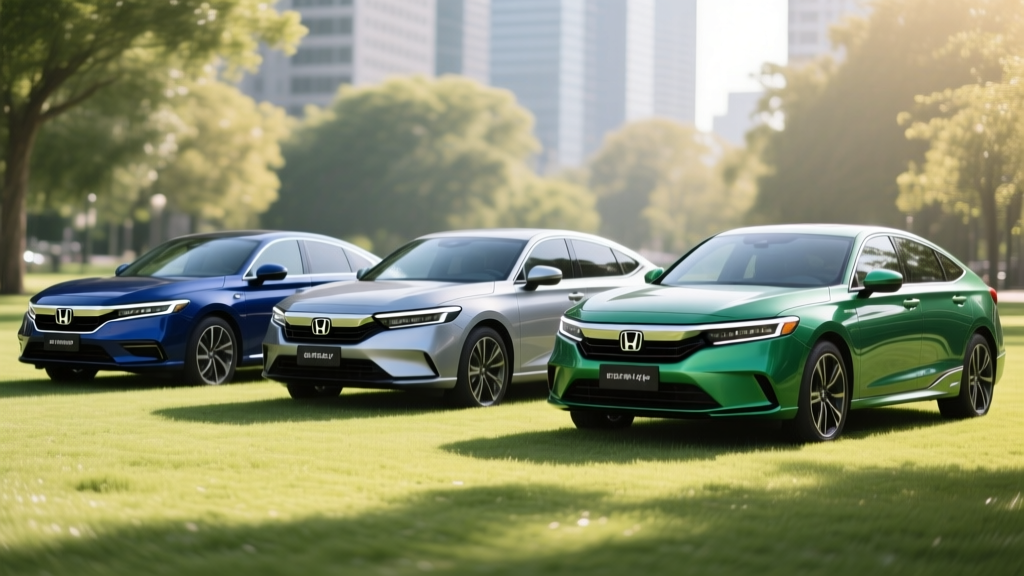
Honda has gone all-in on hybridization for its core lineup. For the 2026 model year, the automaker offers hybrid powertrains across the Accord, Civic, CR-V, and Pilot — but notably, Honda does not currently sell a plug-in hybrid (PHEV) in the United States. That makes understanding the difference between Honda's conventional hybrid (HEV) system and the PHEVs offered by competitors essential before you shop.
This guide breaks down every current Honda hybrid model with exact EPA fuel economy figures, real-world MPG expectations, powertrain specs, pricing, battery warranty coverage, and how Honda's hybrid strategy stacks up against full EVs and plug-in alternatives.
Honda's Hybrid Strategy: HEV Only (No PHEV)
Conventional Hybrid (HEV) vs. Plug-In Hybrid (PHEV)
| Feature | Honda HEV (e.g., Accord Hybrid) | Typical PHEV (e.g., Toyota RAV4 Prime) |
|---|---|---|
| Plugs in to charge? | No — charges via engine and regenerative braking | Yes — Level 1/Level 2 charging |
| Electric-only range | ~1 mile at low speeds | 25–42 miles typical |
| Battery size | 1.0–1.3 kWh (small buffer) | 13–18 kWh usable |
| Federal tax credit (§30D) | Not eligible | Up to $7,500 (if sourcing/income/MSRP rules met) |
| Best for | Drivers without home charging who want better MPG | Drivers with home charging and short commutes |
| Complexity | Lower — no charging cable, no charge management | Higher — charging routine, battery maintenance |
Honda's two-motor hybrid system, which the company calls its "e:HEV" architecture globally, operates primarily as a series hybrid at low and moderate speeds — the gas engine acts as a generator, while the electric drive motor turns the wheels. At highway speeds, a lock-up clutch connects the engine directly to the drivetrain for efficiency. This approach delivers smooth, EV-like acceleration around town while maintaining strong highway fuel economy without ever needing a plug.
2026 Honda Hybrid Lineup: MPG and Specs
Honda currently offers hybrid powertrains on four models in the U.S. market. Here are the exact EPA figures, powertrain outputs, and starting prices for each.
| Model | Powertrain | Combined HP | EPA City | EPA Hwy | EPA Combined | Starting MSRP |
|---|---|---|---|---|---|---|
| 2026 Accord Hybrid | 2.0L 4-cyl + 2 motors | 204 hp | 51 MPG | 44 MPG | 48 MPG | $34,750 |
| 2026 Civic Hybrid | 2.0L 4-cyl + 2 motors | 200 hp | 50 MPG | 47 MPG | 49 MPG | |
| 2026 CR-V Hybrid | 2.0L 4-cyl + 2 motors (AWD) | 204 hp | 43 MPG | 36 MPG | 40 MPG | $36,700 |
| 2026 Pilot Hybrid | 2.0L 4-cyl + 2 motors (AWD) | 290 hp (est.) | 27 MPG (est.) | 26 MPG (est.) | 27 MPG (est.) | $47,500 (est.) |
Sources: fueleconomy.gov (EPA ratings), Honda Newsroom. Pilot Hybrid figures are preliminary estimates based on Honda's announced powertrain; confirm with EPA upon release.
Real-World MPG: What Honda Hybrids Actually Deliver
Honda's two-motor hybrid system is one of the most efficient on the market, and real-world results often exceed EPA estimates in city driving — the opposite of what you see with most gas cars. Here's why:
- City driving favors the electric motor: At low speeds, the engine only runs to generate electricity, operating in its most efficient RPM range. Stop-and-go traffic lets regenerative braking recover energy constantly.
- Highway driving is the weak spot: Once the engine clutches in for direct drive above ~45 mph, you're running a 2.0-liter four-cylinder at highway RPM. Expect 3–5 MPG below the EPA highway figure on sustained 70+ mph trips.
- Cold weather impact: In winter testing (below 35°F), Accord Hybrid fuel economy drops roughly 8–12% as the engine runs more frequently for cabin heat and battery warming. A block heater or garage parking mitigates this.
Real-World MPG Expectations
| Model | EPA Combined | Real-World City (Mixed Traffic) | Real-World Highway (70 mph) | Cold-Weather Combined |
|---|---|---|---|---|
| Accord Hybrid | 48 MPG | 50–54 MPG | 39–42 MPG | 42–44 MPG |
| Civic Hybrid | 49 MPG | 51–55 MPG | 42–45 MPG | 43–46 MPG |
| CR-V Hybrid (AWD) | 40 MPG | 41–44 MPG | 33–36 MPG | 35–37 MPG |
Based on owner-reported data and independent testing. Individual results vary by driving style, terrain, and climate.
Powertrain Deep Dive: Honda's Two-Motor Hybrid System
The fourth-generation two-motor system used across Honda's 2026 hybrid lineup pairs a 2.0-liter Atkinson-cycle four-cylinder engine with two electric motors — one for propulsion, one for generation — and a lithium-ion battery pack.
Accord Hybrid and Civic Hybrid (FWD)
- Engine: 2.0L direct-injection Atkinson-cycle I4, ~146 hp
- Drive motor: 181 hp / 247 lb-ft torque
- Combined system output: 204 hp (Accord), 200 hp (Civic)
- Battery: ~1.06 kWh lithium-ion (NMC chemistry), positioned under rear seats
- Transmission: No conventional transmission — single-speed direct drive with engine clutch
- 0–60 mph: ~7.0 seconds (Accord Hybrid)
CR-V Hybrid (AWD)
- Engine: 2.0L Atkinson-cycle I4, ~146 hp
- Drive motor: 181 hp / 247 lb-ft torque (front)
- Rear motor: Additional motor for rear axle AWD torque delivery
- Combined system output: 204 hp
- Battery: ~1.06 kWh lithium-ion
- 0–60 mph: ~7.8 seconds
The key engineering advantage here is that the propulsion motor provides immediate torque from zero RPM, giving Honda hybrids a responsive, electric-feeling launch that conventional gas cars can't match. The engine only spins up when battery state of charge drops or when highway cruising demands direct mechanical drive.
Pricing, Tax Credits, and Ownership Costs
One of the most common questions from hybrid shoppers: Do Honda hybrids qualify for the federal EV tax credit?
Federal Tax Credit (§30D) Eligibility for Honda Hybrids
- ❌ Not eligible. The §30D clean vehicle credit applies only to plug-in electric vehicles (BEVs and PHEVs) with a minimum battery capacity of 7 kWh.
- ❌ Honda's HEVs use a ~1 kWh battery — far below the 7 kWh threshold.
- ❌ No Honda model currently qualifies for the federal purchase credit in 2026.
- ⚠️ Some state and local incentives may offer rebates for hybrids (e.g., certain utility company programs), but these vary by jurisdiction. Check your state energy office and local utility for current programs.
Source: IRS §30D New Clean Vehicle Credit. Tax rules are subject to change; consult a tax professional for eligibility.
Despite lacking the federal credit, Honda hybrids remain compelling on total cost of ownership (TCO) due to fuel savings and strong resale value. Here's a 5-year comparison:
| Cost Factor | 2026 Accord Hybrid (48 MPG) | 2026 Accord Gas 1.5T (32 MPG) | Difference |
|---|---|---|---|
| MSRP (base) | $34,750 | $29,850 | +$4,900 (hybrid premium) |
| Fuel cost (5 yr, 12K mi/yr, $3.50/gal) | $4,375 | $6,563 | −$2,188 (hybrid savings) |
| Federal tax credit | $0 | $0 | — |
| Estimated insurance (5 yr) | $7,800 | $7,200 | +$600 (hybrid) |
| Estimated maintenance (5 yr) | $2,100 | $2,400 | −$300 (hybrid savings) |
| 5-year total (purchase + fuel + ins. + maint.) | $49,025 | $46,013 | +$3,012 |
| Resale value (est. 5 yr) | ~$21,000 | ~$16,500 | +$4,500 (hybrid retains more) |
| Net 5-year cost | ~$28,025 | ~$29,513 | −$1,488 hybrid savings |
Fuel estimates based on 15,000 miles/year at $3.50/gallon. Insurance and resale estimates from industry averages. Actual costs vary by location, driving habits, and market conditions.
The hybrid premium is typically recouped within 3–4 years through fuel savings alone, and Honda hybrids consistently command higher resale values than their gas counterparts — particularly as used-car buyers increasingly seek fuel-efficient vehicles.
Battery Warranty, Lifespan, and Replacement Costs
Honda Hybrid Battery Warranty
| Coverage | Term |
|---|---|
| Hybrid battery (standard states) | 8 years / 100,000 miles |
| Hybrid battery (CARB states*) | 10 years / 150,000 miles |
| Hybrid system components | 8 years / 100,000 miles |
| Powertrain warranty | 5 years / 60,000 miles |
*CARB states include CA, CO, CT, DE, ME, MD, MA, NJ, NY, OR, RI, VT, WA, and others adopting California emissions standards. Confirm your state's status with Honda.
How long do Honda hybrid batteries actually last? Based on long-term data from previous-generation Accord and CR-V hybrids, Honda's lithium-ion hybrid battery packs routinely exceed 150,000 miles with less than 10% capacity degradation. Unlike full EVs, where battery degradation directly reduces driving range, a degraded hybrid battery simply means the engine runs slightly more often — you'll still drive the car, just with marginally lower MPG.
Replacement cost if out of warranty: A Honda hybrid battery replacement currently runs between $2,500 and $4,000 (parts and labor), depending on the model. Third-party refurbishment options are emerging at roughly $1,500–$2,500. Given the 8–10 year warranty and the pack's demonstrated longevity, most owners will never face this expense.
Honda Hybrid vs. PHEV vs. Full EV: Which Is Right for You?
Choose a Honda Hybrid (HEV) If:
- You don't have access to home or workplace charging
- You want significantly better MPG without changing your fueling routine
- You drive more than 40 miles per day (beyond most PHEV electric-only ranges)
- You want lower upfront cost versus a BEV or PHEV
- You frequently take long road trips and don't want to plan around charging
Choose a PHEV (from Toyota, Hyundai, etc.) If:
- You have reliable Level 2 home charging (240V outlet or hardwired charger)
- Your daily commute is under 30–40 miles (within electric-only range)
- You want to drive mostly on electricity but keep a gas engine for longer trips
- You want to qualify for the up-to-$7,500 federal tax credit (§30D)
Choose a Full EV (BEV) If:
- You have home charging and your daily driving is under 250 miles
- You want the lowest per-mile fuel cost and minimal maintenance
- You want to maximize federal and state incentives
- You're ready to plan around DC fast charging on road trips
Honda's bet is straightforward: most American drivers don't have reliable home charging access, and a conventional hybrid delivers 70–80% of the fuel-cost savings of a PHEV with zero infrastructure requirements. For apartment dwellers, street parkers, and drivers in areas with sparse public charging, it's a practical choice that simply works.
Reliability and Long-Term Ownership
Honda's hybrid system is one of the most proven in the industry, with the two-motor architecture now in its fourth generation. Key reliability advantages include:
- No conventional transmission: Honda's e-CVT design has no belts, pulleys, or gear sets to fail — it's a direct-drive system with a single clutch. This eliminates one of the most expensive repair categories in any vehicle.
- Regenerative braking reduces wear: The electric motor handles most deceleration, so brake pads and rotors typically last 60,000–80,000+ miles.
- Engine runs less: Because the engine operates primarily as a generator at optimal RPM, it experiences less thermal cycling and wear than a conventional gas engine.
According to IIHS ratings and long-term reliability surveys, Honda's hybrid models have consistently scored above average in powertrain dependability. The Accord Hybrid and CR-V Hybrid carry Top Safety Pick+ ratings in their respective segments.
Pros of Honda Hybrids
- Class-leading city MPG (Accord: 51 city, Civic: 50 city)
- No charging infrastructure required
- EV-like acceleration feel from the electric drive motor
- Strong resale value and proven reliability
- Generous 8–10 year hybrid battery warranty
- Lower maintenance costs vs. gas-only models
Cons of Honda Hybrids
- No PHEV option — can't drive on electric only for commutes
- Not eligible for federal §30D tax credit
- Highway MPG drops noticeably above 70 mph
- Hybrid premium adds $1,500–$3,000 to MSRP vs. gas trims
- Cold weather reduces MPG by 8–12%
- Smaller trunk space in some models due to battery placement
Frequently Asked Questions
How many MPG does the 2026 Honda Accord Hybrid get?
The 2026 Accord Hybrid achieves an EPA-rated 51 city / 44 highway / 48 combined MPG. In real-world city driving, owners commonly report 50–54 MPG. Highway trips at 70+ mph typically yield 39–42 MPG. The Civic Hybrid is rated at 50 city / 47 highway / 49 combined.
Does Honda make a plug-in hybrid (PHEV)?
Not in the United States as of 2026. Honda previously sold the Clarity Plug-In Hybrid (discontinued after 2021) but has not introduced a successor PHEV for the U.S. market. All current Honda hybrids are conventional HEVs that never need to be plugged in. If you want a PHEV SUV in this segment, the Toyota RAV4 Prime (42 miles electric-only, ~94 MPGe) or Hyundai Tucson PHEV (33 miles electric-only) are the closest competitors.
Do Honda hybrids qualify for any tax credit?
No. The federal §30D New Clean Vehicle Credit requires a minimum battery capacity of 7 kWh and plug-in capability. Honda's hybrids use ~1 kWh batteries and are not plug-in vehicles. Some state utility programs and local incentives may offer smaller rebates for hybrid purchases — check your state energy office. The IRS page on clean vehicle credits has the latest eligibility rules.
How long does a Honda hybrid battery last and what does replacement cost?
Honda hybrid batteries are warrantied for 8 years/100,000 miles (10 years/150,000 miles in CARB states). Real-world data shows these packs routinely last 150,000+ miles with minimal degradation. Out-of-warranty replacement costs between $2,500 and $4,000 including labor. Third-party refurbished batteries are available for $1,500–$2,500.
Is the Honda CR-V Hybrid worth the premium over the gas model?
The CR-V Hybrid starts at approximately $36,700 versus $31,450 for the gas AWD model — a $5,250 premium. At 40 MPG combined versus 29 MPG combined (gas AWD), you save roughly $650/year in fuel at 15,000 miles/year and $3.50/gallon. The premium is recouped in approximately 8 years through fuel savings alone, but the hybrid's higher resale value typically shortens that payback to 5–6 years. If you plan to keep the vehicle 5+ years, the hybrid is the stronger financial choice.
Can I tow with a Honda hybrid?
The CR-V Hybrid has a maximum towing capacity of 1,000 pounds — suitable for a small utility trailer or bike rack, but not for boat or camper towing. The Pilot Hybrid is expected to offer up to 3,500 pounds of towing capacity (confirm with Honda upon model release). The Accord and Civic hybrids are not rated for towing.
How does Honda's hybrid system compare to Toyota's?
Both are excellent, but they prioritize differently. Toyota's Hybrid Synergy Drive (THS) uses a planetary gearset to blend engine and motor power continuously, optimizing for maximum efficiency at all speeds. Honda's two-motor system favors electric-motor drive with the engine as a generator, giving a more responsive, EV-like feel in city driving. EPA combined MPG is comparable between the Accord Hybrid (48) and Camry Hybrid (52 for the LE), though Toyota holds a slight edge in highway efficiency. Both systems carry 10-year/150,000-mile battery warranties in CARB states.
All specifications reflect 2026 model-year data from Honda and the EPA as of publication. Prices exclude destination charges. Tax credit and incentive information is current as of 2026 and subject to legislative change. Consult fueleconomy.gov for the latest EPA ratings and the IRS for current tax credit rules.