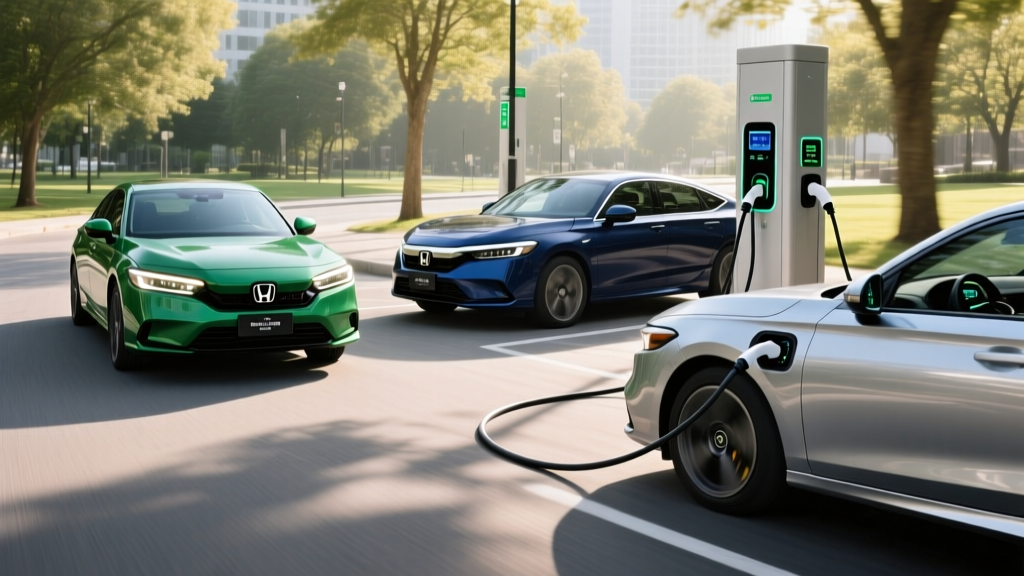
Honda's hybrid automatic lineup has quietly become one of the most practical paths to electrification without the charging-cable lifestyle. For 2026, Honda offers its two-motor hybrid system across three core models — the Accord, CR-V, and Civic — all paired exclusively with an electronically controlled continuously variable transmission (e-CVT). There is no conventional geared automatic in a Honda hybrid; instead, the e-CVT manages the relationship between the gasoline engine and electric motors seamlessly, with no shift shock and no driver intervention required.
If you've been searching for a honda hybrid automatic, this guide breaks down every current model's EPA fuel economy, real-world efficiency, powertrain output, battery warranty, and pricing — and explains exactly who should choose a conventional hybrid (HEV) over a plug-in hybrid (PHEV) or full battery-electric vehicle (BEV).
HEV vs PHEV vs EV: Which Honda Fits Your Life?
Before diving into individual models, it's critical to understand the three electrification tiers Honda offers — because the wrong choice can cost you thousands in missed savings or unnecessary complexity.
| Category | HEV (Conventional Hybrid) | PHEV (Plug-In Hybrid) | BEV (Full Electric) |
|---|---|---|---|
| Plug in to charge? | No — regenerative braking & engine charge the battery | Yes — Level 1 or Level 2 | Yes — Level 2 or DC fast charge |
| Electric-only driving | Limited (~1 mi at low speed) | 20–50 miles typical | 200–400+ miles |
| Gas engine | Yes — always available | Yes — kicks in after battery depletes | None |
| Home charging needed | No | Recommended for full benefit | Essential |
| Federal tax credit (§30D) | Not eligible | Up to $7,500 if eligible | Up to $7,500 if eligible |
| Best for | No home charging, long commutes, simplicity | Home charging + short daily commute + road trips | Home charging, lower fuel cost, zero tailpipe |
Honda's 2026 US lineup focuses on conventional hybrids (HEVs). Honda currently does not sell a PHEV in the United States (the Clarity Plug-In Hybrid was discontinued after 2021). If you need plug-in electric range from Honda, you'd need to look at competitors like the Toyota RAV4 Prime or Hyundai Tucson PHEV — or wait for Honda's next-generation PHEV plans, which remain unannounced for the US market.
2026 Honda Accord Hybrid: The Efficiency Sedan Benchmark
The Accord Hybrid remains Honda's most refined application of its two-motor hybrid system. For 2026, the Accord Hybrid is available in Sport, Sport-L, EX-L, and Touring trims — all using the same powertrain with an electronically controlled e-CVT automatic.
| Spec | 2026 Accord Hybrid |
|---|---|
| Powertrain | 2.0L 4-cyl Atkinson + 2 electric motors |
| Combined Horsepower | 204 hp |
| Combined Torque | 247 lb-ft (electric motor) |
| Transmission | e-CVT (automatic, no gears) |
| EPA City MPG | 51 mpg |
| EPA Highway MPG | 44 mpg |
| EPA Combined MPG | 48 mpg |
| Fuel Tank | 12.8 gal |
| Total Range | ~614 miles |
| Hybrid Battery | Lithium-ion, ~1.1 kWh (small buffer) |
| 0–60 mph | ~7.1 seconds |
| Starting MSRP | ~$34,990 (Sport trim) |
Real-world MPG: The Accord Hybrid's EPA rating of 51 city / 44 highway is one of the cases where real-world driving often exceeds the EPA city figure. In stop-and-go urban traffic, the two-motor system runs predominantly on electric power, with the engine acting as a generator rather than driving the wheels directly. Owners consistently report 50–55 mpg in city driving. Highway efficiency, however, tends to land closer to 40–43 mpg at sustained 70–75 mph speeds — slightly below the EPA sticker — because the engine must do more direct work at higher velocities where aerodynamic drag dominates.
Honda Hybrid Battery Warranty: The Accord Hybrid's lithium-ion battery pack is covered under Honda's hybrid system warranty: 8 years / 100,000 miles (10 years / 150,000 miles in CARB states including California, New York, Massachusetts, and others that follow California emissions standards). This covers battery capacity loss below a functional threshold and hybrid-system component failures.
2026 Honda CR-V Hybrid: The Family SUV Sweet Spot
The CR-V Hybrid accounts for roughly half of all CR-V sales, and for good reason: it adds meaningful fuel savings over the gas-only model with no compromise in cargo space or all-wheel-drive capability. For 2026, the CR-V Hybrid is available in Sport, Sport-L, and Sport Touring trims.
| Spec | 2026 CR-V Hybrid (AWD) |
|---|---|
| Powertrain | 2.0L 4-cyl Atkinson + 2 electric motors |
| Combined Horsepower | 204 hp |
| Combined Torque | 247 lb-ft (electric motor) |
| Transmission | e-CVT (automatic) |
| Drivetrain | AWD standard on all Hybrid trims |
| EPA City MPG | 40 mpg |
| EPA Highway MPG | 34 mpg |
| EPA Combined MPG | 37 mpg |
| Fuel Tank | 14.0 gal |
| Total Range | ~518 miles |
| Hybrid Battery | Lithium-ion, ~1.1 kWh |
| 0–60 mph | ~7.8 seconds |
| Towing Capacity | 1,000 lbs |
| Starting MSRP | ~$37,990 (Sport AWD) |
Real-world MPG: The CR-V Hybrid's 40 city / 34 highway EPA ratings hold up well in mixed suburban driving, where owners typically see 35–39 mpg combined. In cold weather (below 35°F), expect a 3–5 mpg drop because the engine runs more frequently to provide cabin heat — a characteristic of all hybrids without dedicated heat-pump systems. Highway driving at 75+ mph may return as low as 30–32 mpg, consistent with the boxy SUV aerodynamic profile.
One practical note: the CR-V Hybrid comes exclusively with all-wheel drive, which eliminates a decision point but also means you can't opt for a lighter, more efficient FWD-only configuration. The AWD system uses a rear-mounted electric motor rather than a mechanical driveshaft, so there's no traditional drivetrain loss.
2026 Honda Civic Hybrid: The Entry-Level Efficiency Pick
Reintroduced for the 2025 model year and continuing into 2026, the Civic Hybrid brings Honda's two-motor system to its most affordable platform. Available in Sport Hybrid and Sport Touring Hybrid trims, it delivers the highest MPG in the Honda lineup.
| Spec | 2026 Civic Hybrid |
|---|---|
| Powertrain | 2.0L 4-cyl Atkinson + 2 electric motors |
| Combined Horsepower | 200 hp |
| Combined Torque | 232 lb-ft (electric motor) |
| Transmission | e-CVT (automatic) |
| EPA City MPG | 50 mpg |
| EPA Highway MPG | 47 mpg |
| EPA Combined MPG | 49 mpg |
| Fuel Tank | 10.6 gal |
| Total Range | ~519 miles |
| Hybrid Battery | Lithium-ion, ~1.1 kWh |
| 0–60 mph | ~6.5 seconds |
| Starting MSRP | ~$30,490 (Sport Hybrid) |
Real-world MPG: The Civic Hybrid's near-50 mpg combined rating is achievable in real-world mixed driving. City-heavy commuters often report 50–54 mpg, while sustained highway trips at 70 mph return roughly 44–47 mpg. The Civic's lower weight and sleeker aerodynamic profile give it a narrower gap between EPA and real-world numbers than the CR-V Hybrid. Source: fueleconomy.gov.
Fuel Economy Compared: Every 2026 Honda Hybrid Automatic
| Model | City MPG | Highway MPG | Combined MPG | Total Range | Real-World Expectation |
|---|---|---|---|---|---|
| Civic Hybrid | 50 | 47 | 49 | ~519 mi | 46–54 mpg combined |
| Accord Hybrid | 51 | 44 | 48 | ~614 mi | 44–53 mpg combined |
| CR-V Hybrid AWD | 40 | 34 | 37 | ~518 mi | 33–39 mpg combined |
A pattern worth noting: Honda's two-motor system excels in city driving, where the electric motors handle most propulsion and the engine acts primarily as a generator. Highway efficiency is solid but less class-leading — if your commute is 90% interstate at 75+ mph, the gap between a Honda Hybrid and a conventional gas model narrows. The hybrid advantage is largest in urban and suburban traffic patterns.
How Honda's e-CVT Automatic Actually Works
When buyers search for a "honda hybrid automatic," some expect a traditional geared automatic transmission. Honda's hybrid system uses something fundamentally different — and it's worth understanding why.
Honda's two-motor hybrid system operates in three modes, managed automatically with no driver input:
- EV Drive: The electric motor drives the wheels using battery energy. The engine is off. Used at low speeds and light loads (parking lots, stoplights, gentle acceleration up to ~30 mph).
- Hybrid Drive: The engine runs but does not drive the wheels. Instead, it spins a generator that produces electricity to power the drive motor. This is the dominant mode in city and suburban driving. The engine runs at its most efficient RPM regardless of vehicle speed.
- Engine Drive: At highway cruising speeds, a lock-up clutch connects the engine directly to the wheels through a single fixed gear ratio. This avoids the efficiency loss of converting mechanical energy to electrical and back again. The electric motor can still add torque for passing.
The result feels like a smooth, continuously variable automatic — hence the "e-CVT" label — but there is no belt-and-pulley CVT involved. The smoothness comes from the electric motor's inherently stepless power delivery. There are no shift points, no gear hunting on hills, and no torque-converter lag.
Pricing, Tax Credits, and Total Cost of Ownership
Honda's 2026 hybrid lineup starts at approximately $30,490 for the Civic Hybrid and tops out around $42,000 for a loaded Accord Hybrid Touring. Here's the pricing landscape and what you need to know about incentives:
Federal tax credit (§30D): Conventional hybrids (HEVs) like the Accord Hybrid, CR-V Hybrid, and Civic Hybrid do not qualify for the federal §30D new clean vehicle credit. That credit applies only to plug-in electric vehicles (PHEVs and BEVs) with sufficient battery capacity and meeting critical-mineral and battery-component sourcing requirements per IRS guidelines. Since Honda's current US hybrids cannot be plugged in, they are ineligible.
State incentives: Some states offer modest rebates or HOV-lane access for hybrids, but these vary widely and change frequently. Check your state's energy office or DMV for current programs.
Total cost of ownership advantage: Even without a tax credit, Honda hybrids deliver meaningful savings at the pump. At $3.40/gallon and 12,000 miles/year:
- A gas-only CR-V AWD (~28 mpg combined) costs ~$1,457/year in fuel.
- The CR-V Hybrid AWD (~37 mpg combined) costs ~$1,103/year in fuel.
- Annual savings: ~$354/year, or ~$1,770 over 5 years — partially offsetting the ~$1,500 hybrid premium over the gas model.
The Accord Hybrid's savings are even more dramatic compared to the gas Accord, given the wider MPG gap. Factor in lower brake wear (regenerative braking extends pad life by 30–50%) and the hybrid typically reaches cost parity within 3–4 years for average drivers.
Battery Longevity, Warranty, and Replacement Cost
The single most common question from hybrid buyers: How long will the hybrid battery last, and what does it cost to replace?
Honda's hybrid battery packs are small (~1.1 kWh usable) compared to a full EV's 60–100 kWh pack. This small size means the battery cycles less deeply and experiences less thermal stress — key factors in longevity. Honda's two-motor system also maintains a generous buffer, never fully charging or fully depleting the pack, which significantly extends cycle life.
Warranty coverage:
- Standard: 8 years / 100,000 miles (all 50 states)
- CARB states: 10 years / 150,000 miles (CA, NY, MA, NJ, CT, RI, VT, ME, NH, OR, WA, CO, MD, MN, NM, NV, and others adopting California emissions standards)
- What's covered: Hybrid battery assembly, power control unit, electric motors, and related components against defects and abnormal capacity loss
Real-world longevity data: Honda's hybrid systems (dating back to the 2006 Civic Hybrid and the 2014 Accord Hybrid) have shown strong durability. It's common for Honda hybrid batteries to reach 150,000–200,000+ miles before requiring replacement. Degradation is gradual — you'll notice slightly reduced EV-mode range and marginally lower MPG over time, not sudden failure.
Replacement cost: If a hybrid battery does need replacement out of warranty, expect to pay between $2,000 and $4,000 for a new OEM pack (parts and labor) at a Honda dealer. Refurbished/remanufactured packs are available for $1,000–$2,500. This is dramatically less than a full EV battery replacement ($8,000–$20,000+) because the hybrid pack is so much smaller. Safety data from NHTSA and IIHS show no battery-related safety concerns across Honda's hybrid models.
Who Should Choose a Honda Hybrid vs a Full EV or Gas Car?
Choose a Honda Hybrid (HEV) if:
- You don't have reliable access to home or workplace charging
- You take frequent road trips exceeding 300+ miles and don't want to plan around charging stops
- You want lower fuel costs without changing any habits — just fill up with gas as usual
- You live in an apartment or rent and can't install a Level 2 charger
- You want the lowest-complexity path to better efficiency
Choose a PHEV (from another brand) if:
- You can charge at home and your daily commute is under 30–40 miles round trip
- You want electric-only daily driving but gas flexibility for road trips
- You want to qualify for the §30D federal tax credit (up to $7,500, subject to income and sourcing rules)
Choose a full BEV if:
- You have home charging (Level 2) and your daily driving is under 250 miles
- You want the lowest per-mile fuel cost (~$0.04–$0.06/mi on home electricity vs ~$0.12–$0.15/mi in a hybrid)
- You want zero tailpipe emissions and minimal maintenance (no oil changes, no spark plugs)
- You qualify for federal/state incentives that close the price gap
Pros and Cons: Honda's 2026 Hybrid Lineup
Pros
- Class-leading city MPG, especially Accord (51) and Civic (50)
- No charging infrastructure needed — works with existing gas stations
- Smooth e-CVT with no gear hunting or shift shock
- Strong reliability track record; 8–10 year battery warranty
- Small hybrid battery = lower eventual replacement cost ($2K–$4K)
- AWD standard on CR-V Hybrid with no efficiency penalty vs mechanical AWD
- Regenerative braking extends brake pad life significantly
Cons
- No PHEV option in Honda's US lineup — can't drive on electric only for commutes
- Not eligible for the $7,500 federal §30D tax credit
- Highway MPG less impressive than city; gap narrows vs gas models at 75+ mph
- Cold-weather MPG penalty of 3–5 mpg due to engine running for cabin heat
- Towing capacity limited (CR-V Hybrid: 1,000 lbs; Accord/Civic: not rated for towing)
- Hybrid premium of ~$1,000–$1,500 over gas-only trims (though payback is typically 3–4 years)
Frequently Asked Questions
How many MPG does a Honda hybrid automatic get?
It depends on the model. The 2026 Civic Hybrid achieves 50 city / 47 highway / 49 combined mpg. The Accord Hybrid rates at 51 city / 44 highway / 48 combined mpg. The CR-V Hybrid AWD achieves 40 city / 34 highway / 37 combined mpg. Real-world results often match or exceed EPA city figures in stop-and-go traffic but may fall 3–5 mpg below EPA highway estimates at sustained high speeds.
Does the Honda hybrid need to be plugged in?
No. All current Honda hybrids sold in the US are conventional hybrids (HEVs). The battery charges through regenerative braking and the gasoline engine. You never plug it in — just fill up at a gas station as you would with any conventional car.
Is Honda's hybrid automatic transmission reliable?
Yes. Honda's e-CVT hybrid system has no traditional transmission gears, belts, or torque converter — the components most prone to failure in conventional automatics. The two-motor system is mechanically simpler than a geared automatic. Combined with the 8-year/100,000-mile hybrid warranty (10 years in CARB states), long-term reliability is well-established across Honda's hybrid fleet.
Does a Honda hybrid qualify for any tax credit?
Conventional Honda hybrids (Accord, CR-V, Civic) do not qualify for the federal §30D clean vehicle credit, which requires plug-in capability and minimum battery capacity. Some states may offer small rebates or incentives for hybrids — check your state's energy office. If federal tax credit eligibility is a priority, you'll need to look at PHEVs or BEVs from other manufacturers.
How long does a Honda hybrid battery last and what does replacement cost?
Honda hybrid batteries commonly last 150,000–200,000+ miles. The battery is warranted for 8 years/100,000 miles (10 years/150,000 miles in CARB states). Out-of-warranty replacement costs range from $2,000–$4,000 for a new OEM pack, or $1,000–$2,500 for a refurbished unit — far less than a full EV battery replacement.
Can I get a Honda hybrid with AWD?
Yes, but only on the CR-V Hybrid, where AWD is standard on all trims. The Accord Hybrid and Civic Hybrid are front-wheel drive only.
Is a Honda hybrid better than a full EV for my situation?
If you can charge at home and drive under 250 miles daily, a full EV will cost less per mile and require less maintenance. If you lack home charging, take frequent long road trips, or live in an apartment without charging access, a Honda hybrid delivers strong efficiency without any lifestyle changes. The hybrid is the pragmatic choice when charging access is uncertain.