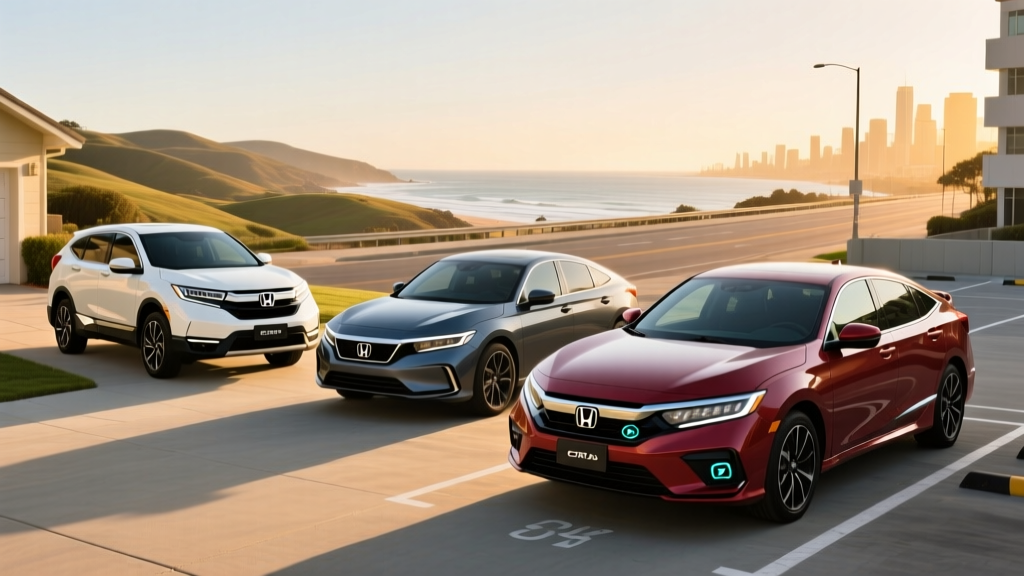
Honda's hybrid strategy in 2026 is straightforward: electrify its highest-volume nameplates with conventional hybrid (HEV) powertrains that require no plug and no behavior change from the driver. The automaker currently offers three hybrid models in the U.S. — the CR-V Hybrid, Accord Hybrid, and Civic Hybrid — all using variants of Honda's fourth-generation two-motor hybrid system. None are plug-in hybrids (PHEVs), and none are full EVs. They are purpose-built for buyers who want 40+ MPG without charging infrastructure.
If you're researching a Honda hybrid auto, this guide breaks down every current model with exact EPA fuel economy, powertrain output, pricing, real-world efficiency expectations, and battery longevity data — the numbers Honda's marketing materials often gloss over.
HEV vs PHEV: Where Honda Stands in 2026
Before comparing trims, it's essential to understand what Honda does — and doesn't — offer. Every Honda hybrid sold in the U.S. today is a conventional hybrid (HEV), not a plug-in hybrid (PHEV). This distinction matters for your wallet, your daily routine, and your tax situation.
| Feature | Honda HEV (Current Models) | PHEV (e.g., Toyota RAV4 Prime) | Full EV (BEV) |
|---|---|---|---|
| Plug-in required? | No — charges via regenerative braking and engine | Yes — 120V or 240V outlet | Yes — Level 2 or DC fast charger |
| Electric-only range | ~1 mile at low speeds | 25–42 miles typical | 200–400+ miles |
| EPA MPG (combined) | 37–48 MPG | 38–94 MPGe combined | N/A (MPGe only) |
| Federal tax credit (§30D) | Not eligible | Up to $7,500 if sourcing/income rules met | Up to $7,500 if sourcing/income rules met |
| Battery size | ~1.0–1.1 kWh (small buffer) | 13–18 kWh usable | 60–100+ kWh |
| Home charging install | Not needed | Recommended (240V Level 2) | Required (240V Level 2) |
Honda has not announced a PHEV for the U.S. market as of the 2026 model year. If you need electric-only commuting range or want to chase the federal tax credit, you'll need to look at competitors like the Toyota RAV4 Prime or a full EV like the Hyundai Ioniq 5. But if your goal is maximum MPG with zero lifestyle change, Honda's HEV lineup is among the strongest available.
2026 Honda CR-V Hybrid: Compact SUV Efficiency
The CR-V Hybrid is Honda's best-selling electrified vehicle and the most practical entry point into the lineup. It pairs a 2.0-liter Atkinson-cycle four-cylinder engine with two electric motors in Honda's e-CVT hybrid system, routing power to either the front wheels or all four via available Real Time AWD.
| Spec | 2026 CR-V Hybrid (Sport/L Sport Touring) |
|---|---|
| Combined horsepower | 204 hp |
| Engine | 2.0L Atkinson-cycle I-4 |
| Electric motors | Two-motor hybrid system (propulsion + generation) |
| Drivetrain | FWD or Real Time AWD |
| EPA MPG (FWD city/hwy/combined) | 43 / 36 / 40 |
| EPA MPG (AWD city/hwy/combined) | 40 / 34 / 37 |
| Battery capacity | ~1.06 kWh lithium-ion |
| Cargo volume (behind 2nd row) | 36.3 cu ft |
| Base MSRP (Sport FWD) | ~$36,795 |
| Base MSRP (Sport Touring AWD) | ~$42,295 |
| Hybrid battery warranty | 8 years / 100,000 miles (10 yr/150k in CARB states) |
According to fueleconomy.gov, the FWD CR-V Hybrid returns 40 MPG combined. In real-world driving, the CR-V Hybrid tends to meet or slightly exceed its EPA city rating — hybrids recover the most energy in stop-and-go traffic where regenerative braking is constant. Highway efficiency drops more noticeably; expect 33–35 MPG at sustained 75 mph speeds on the AWD model, a few MPG below the sticker.
The AWD system on the CR-V Hybrid is worth noting: unlike some competitors that use a dedicated rear electric motor, Honda's Real Time AWD uses a mechanical driveshaft from the hybrid transaxle. This means the rear wheels engage only when the system detects slip, and there is a small efficiency penalty (about 3 MPG combined) compared to FWD.
2026 Honda Accord Hybrid: Midsize Sedan MPG Leader
The Accord Hybrid targets buyers who prioritize fuel economy over ride height. Honda offers the hybrid powertrain exclusively on the Sport, EX-L, Sport-L, and Touring trims — the base Accord LX and SE use a conventional 1.5L turbo. The hybrid system is mechanically similar to the CR-V's but tuned for a lower, lighter chassis.
| Spec | 2026 Accord Hybrid |
|---|---|
| Combined horsepower | 204 hp |
| Engine | 2.0L Atkinson-cycle I-4 (direct injection) |
| EPA MPG (city/hwy/combined) | 51 / 44 / 48 (Sport/EX-L) |
| EPA MPG (Sport-L/Touring) | 46 / 41 / 44 |
| Drivetrain | FWD only (no AWD option) |
| 0–60 mph (est.) | ~7.5 seconds |
| Base MSRP (Sport Hybrid) | ~$34,395 |
| Base MSRP (Touring Hybrid) | ~$40,090 |
| Hybrid battery warranty | 8 years / 100,000 miles (10 yr/150k in CARB states) |
The Accord Hybrid Sport and EX-L achieve an EPA-rated 48 MPG combined — one of the highest figures of any midsize sedan sold in the U.S. The heavier Sport-L and Touring trims drop to 44 MPG combined due to larger wheels, additional sound insulation, and more equipment. Real-world city driving routinely yields 48–55 MPG for the lighter trims, as EPA data and owner reports confirm that Honda's hybrid system excels in urban conditions where the electric motor handles most low-speed propulsion.
Highway numbers tell a different story. At 70–80 mph, the 2.0L engine is doing most of the work directly (Honda's system uses a clutch to lock the engine to the wheels at highway speed for efficiency). Expect 40–43 MPG highway for the Sport/EX-L and 37–40 for the Touring — respectable, but noticeably lower than the city figures.
2026 Honda Civic Hybrid: The Budget MPG Play
Reintroduced for the 2025 model year and carried into 2026, the Civic Hybrid is Honda's most affordable hybrid and its most fuel-efficient vehicle overall. It uses the same two-motor hybrid architecture but pairs it with a smaller, lighter platform.
| Spec | 2026 Civic Hybrid |
|---|---|
| Combined horsepower | 200 hp |
| Engine | 2.0L Atkinson-cycle I-4 |
| EPA MPG (Sport city/hwy/combined) | 50 / 47 / 49 |
| EPA MPG (Sport Touring city/hwy/combined) | 50 / 45 / 47 |
| Drivetrain | FWD only |
| 0–60 mph (est.) | ~7.1 seconds |
| Body styles | Sedan and Hatchback |
| Base MSRP (Sport Sedan) | ~$30,695 |
| Base MSRP (Sport Touring Hatchback) | ~$34,295 |
| Hybrid battery warranty | 8 years / 100,000 miles (10 yr/150k in CARB states) |
The Civic Hybrid Sport sedan achieves 49 MPG combined — within striking distance of the Toyota Prius (57 MPG combined for the LE FWD). Where the Civic Hybrid differentiates itself is driving feel: 200 hp from the combined system, a stiffer chassis, and Honda's tuning philosophy give it more engagement than most hypermilers. The hatchback variant adds 25.0 cu ft of cargo space behind the rear seats for buyers who need utility without stepping up to the CR-V.
Real-World MPG: What the EPA Stickers Don't Tell You
EPA fuel economy estimates are standardized laboratory tests — useful for comparison, but not always predictive of your actual fuel bill. With Honda's hybrid system, the real-world picture has consistent patterns:
| Model | EPA Combined | Real-World City (observed) | Real-World Highway 75 mph | Cold Weather (<32°F) |
|---|---|---|---|---|
| Civic Hybrid Sport | 49 MPG | 50–56 MPG | 42–46 MPG | 39–44 MPG |
| Accord Hybrid Sport | 48 MPG | 48–55 MPG | 40–43 MPG | 38–43 MPG |
| CR-V Hybrid Sport FWD | 40 MPG | 39–44 MPG | 33–36 MPG | 32–37 MPG |
| CR-V Hybrid Sport AWD | 37 MPG | 36–40 MPG | 30–34 MPG | 30–35 MPG |
Three patterns emerge. First, city MPG often exceeds the EPA sticker because regenerative braking recovers kinetic energy that gas-only cars waste as heat. Second, highway MPG tends to fall 4–7 MPG below the combined rating because aerodynamic drag dominates at speed and the electric motor contributes less. Third, cold weather reduces efficiency by 10–15% due to increased engine runtime for cabin heat, thicker fluids, and reduced battery output. These losses are smaller than a full EV's cold-weather range reduction (20–30%), but they're real.
Battery Longevity, Warranty, and Replacement Costs
Honda Hybrid Battery Warranty: 8 years / 100,000 miles in standard states; 10 years / 150,000 miles in CARB-adopting states (CA, CO, CT, ME, MD, MA, NJ, NM, NY, OR, RI, VT, WA). The warranty covers defects and capacity loss below a defined threshold (typically ~70% state of health).
Honda's hybrid batteries are small — roughly 1.0–1.1 kWh of lithium-ion capacity — and the system manages them conservatively. The battery never fully charges or fully depletes during normal operation; Honda's hybrid control system keeps the state of charge in a narrow middle band (roughly 40–80%) to minimize stress. This is a key reason Honda hybrid batteries have a strong longevity record: many first-generation Insight and Civic Hybrid owners reported 150,000–200,000+ miles on the original pack.
If replacement is needed out of warranty, costs for a Honda hybrid battery pack typically range from $2,000 to $4,000 depending on the model, including labor. Refurbished packs from third-party suppliers can reduce this to $1,200–$2,500. This is significantly cheaper than a full EV battery replacement ($8,000–$20,000+), reflecting the much smaller capacity.
The hybrid system's power electronics — the inverter, DC-DC converter, and electric motors — carry the same powertrain warranty as the engine (5 years / 60,000 miles standard). Failures of these components are rare but not unheard of; they're covered under the powertrain warranty period.
Tax Credits, Pricing, and Ownership Economics
Because Honda's current hybrids are conventional HEVs (not PHEVs or BEVs), they do not qualify for the federal §30D Clean Vehicle Credit. The IRS restricts this credit to plug-in vehicles with at least 7 kWh of battery capacity and meeting critical-mineral and battery-component sourcing requirements (see IRS §30D guidelines). Honda's ~1 kWh hybrid packs fall well below this threshold.
Some states offer their own incentives for hybrids, though these have largely been phased out in favor of PHEV and BEV incentives. Check your state's energy or DMV website for current programs.
Despite the lack of tax credits, the total cost of ownership for a Honda hybrid is compelling. Here's why:
- Low upfront premium: The Civic Hybrid Sport starts only ~$1,700 above the equivalent gas-only Civic Sport. The Accord Hybrid Sport is similarly close to its turbo counterpart.
- No charging infrastructure cost: Unlike a PHEV or BEV, there's no $500–$2,000 home charger installation.
- Fuel savings: At 48 MPG combined vs. a comparable gas-only Accord (30 MPG combined), driving 15,000 miles/year at $3.40/gallon saves approximately $850/year in fuel.
- Maintenance parity: Honda hybrids use the same oil, filters, brakes (with less wear due to regen), and tires as their gas counterparts. There's no additional maintenance item for the hybrid system.
- Insurance: Hybrid insurance premiums are typically within 5% of gas-only equivalents — far less than the 15–25% premium some EVs carry.
Who Should Choose a Honda Hybrid (and Who Shouldn't)
Choose a Honda Hybrid If:
- You want 40–49 MPG without plugging in or changing habits
- You lack access to home or workplace charging (apartment, street parking)
- Your commute is city-heavy with stop-and-go traffic
- You want Honda's reliability record and dealer network
- You prefer a lower purchase price over chasing tax credits
- You drive 12,000–20,000 miles/year and want to minimize fuel cost
Look at a PHEV or EV Instead If:
- You want electric-only commuting (zero tailpipe emissions on daily drives)
- You qualify for the $7,500 federal tax credit and want to offset a higher purchase price
- You have reliable home Level 2 charging and a short commute (<40 miles)
- You want the lowest possible per-mile energy cost (electricity at ~$0.04/mi vs. hybrid gas at ~$0.08/mi)
- You need AWD with electric-only capability (RAV4 Prime, etc.)
Honda Hybrid Lineup at a Glance: Side-by-Side
| Civic Hybrid | Accord Hybrid | CR-V Hybrid | |
|---|---|---|---|
| Best EPA Combined MPG | 49 | 48 | 40 (FWD) / 37 (AWD) |
| Combined HP | 200 | 204 | 204 |
| AWD Available? | No | No | Yes |
| Starting MSRP | ~$30,695 | ~$34,395 | ~$36,795 |
| Body Styles | Sedan, Hatchback | Sedan | SUV |
| Cargo (max) | 25.0 cu ft (hatch) | 16.7 cu ft (trunk) | 76.5 cu ft (seats folded) |
| Towing | Not rated | Not rated | 1,000 lbs |
| Federal Tax Credit | None | None | None |
Frequently Asked Questions
How many MPG does a Honda hybrid get?
It depends on the model and trim. The 2026 Civic Hybrid Sport achieves 49 MPG combined (50 city / 47 highway). The Accord Hybrid Sport/EX-L achieves 48 MPG combined (51 city / 44 highway). The CR-V Hybrid FWD achieves 40 MPG combined (43 city / 36 highway). Real-world city driving often exceeds these figures; highway driving typically falls 4–7 MPG below the combined rating.
Do Honda hybrids need to be plugged in?
No. All current Honda hybrids are conventional HEVs. The small battery charges automatically through regenerative braking and the gasoline engine. There is no plug, no charging cable, and no need for home charging infrastructure.
Does any Honda hybrid qualify for a federal tax credit?
No. The federal §30D Clean Vehicle Credit requires a plug-in vehicle with at least 7 kWh of battery capacity. Honda's hybrid batteries are approximately 1.0–1.1 kWh. No current Honda hybrid qualifies. If Honda introduces a PHEV in the future, eligibility would depend on battery sourcing, MSRP caps, and buyer income limits per current IRS rules.
How long will the Honda hybrid battery last?
Honda's hybrid batteries are warrantied for 8 years / 100,000 miles (10 years / 150,000 miles in CARB states). In practice, the conservative charge management strategy — keeping the battery between roughly 40–80% state of charge — means many packs last 150,000–200,000+ miles before significant degradation. Out-of-warranty replacement costs $2,000–$4,000 depending on model and source.
Is the Honda hybrid system reliable compared to Toyota's?
Both Honda and Toyota have strong hybrid reliability records spanning two decades. Honda's two-motor system is mechanically simpler than some competitors — it uses no traditional geared transmission, instead relying on the electric motor for propulsion and a clutch for direct engine drive at highway speeds. Long-term reliability data from Consumer Reports and owner forums places Honda hybrids in the "above average" category, though Toyota's Hybrid Synergy Drive has a slightly longer track record at higher mileages.
Should I buy a Honda hybrid or a full EV?
Choose a Honda hybrid if you lack reliable home charging, drive long highway distances regularly, or want the lowest upfront cost with no behavior change. Choose a full EV if you have home Level 2 charging, your daily driving is under 250 miles, you want to minimize per-mile energy cost (electricity is roughly half the cost of gasoline per mile), and you want to take advantage of the $7,500 federal tax credit. A Honda hybrid is the pragmatic middle ground — significant fuel savings with zero infrastructure requirement.
Can I tow with a Honda hybrid?
Only the CR-V Hybrid is rated for towing, at 1,000 lbs — enough for a small utility trailer or a pair of dirt bikes, but not a boat or camper. The Civic and Accord hybrids are not rated for towing. If you need serious towing capacity with electrification, you'll need to look at hybrid trucks (Ford Maverick Hybrid, 2,000 lbs) or a PHEV SUV with a higher rating.