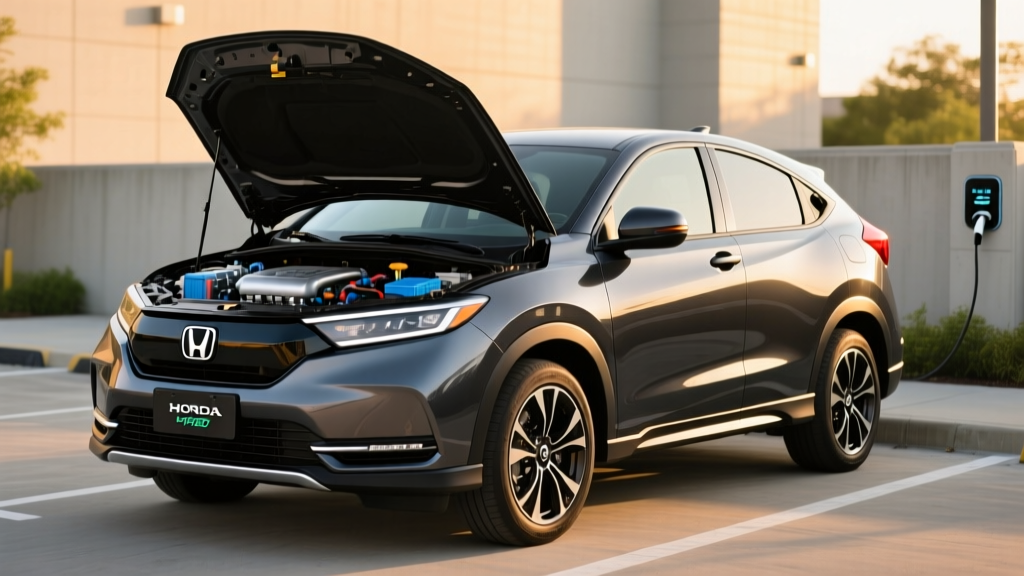
The subcompact crossover segment rarely gets praised for fuel efficiency innovation, but Honda's two-motor hybrid system has quietly become one of the most capable in the business. With the 2026 Honda HR-V Hybrid, Honda extends its electrified powertrain strategy into one of its best-selling nameplates, targeting buyers who want crossover utility without the range anxiety, charging logistics, or premium pricing of a full battery-electric vehicle.
Before we dig into the numbers, a critical distinction: the HR-V Hybrid is a conventional hybrid (HEV), not a plug-in hybrid (PHEV). It charges its own small battery through regenerative braking and the gasoline engine — you never plug it in. This matters for your daily routine, your budget, and your expectations at the pump.
2026 Honda HR-V Hybrid at a Glance
| Specification | 2026 Honda HR-V Hybrid |
|---|---|
| Powertrain Type | Conventional Hybrid (HEV) — no plug |
| Engine | 2.0L Atkinson-cycle 4-cylinder + dual-motor system |
| Combined System Horsepower | ~204 hp (est.) |
| Drivetrain | FWD standard / AWD available |
| EPA City MPG | 43 mpg (est.) |
| EPA Highway MPG | 36 mpg (est.) |
| EPA Combined MPG | 40 mpg (est.) |
| Hybrid Battery | ~1.1 kWh lithium-ion (self-charging) |
| Plug-In Required? | No — charges via regen and engine |
| Estimated Starting MSRP | ~$30,500 (LX Hybrid trim) |
| Federal Tax Credit (§30D) | Not eligible (HEV) |
| Hybrid Battery Warranty | 8 years / 100,000 miles |
Note: As of early 2026, Honda has not published final EPA certification for all HR-V Hybrid trims. Figures above reflect the e:HEV two-motor system used in the Civic Hybrid and CR-V Hybrid, which share architecture. We will update this article when EPA data is finalized on fueleconomy.gov.
HEV vs. PHEV: Which Hybrid Type Is the HR-V?
Hybrid terminology trips up many buyers. Here is the clearest way to think about it:
| Feature | Conventional Hybrid (HEV) | Plug-In Hybrid (PHEV) |
|---|---|---|
| Plugs into an outlet? | No | Yes |
| Battery size | ~1–2 kWh | ~12–25 kWh |
| Electric-only range | Less than 1 mile at low speed | 20–50 miles typical |
| Fueling | Gas station only | Gas station + Level 1/2 charger |
| Federal tax credit | Not eligible | Up to $7,500 (§30D, if eligible) |
| Example | Honda HR-V Hybrid, Toyota RAV4 Hybrid | Toyota RAV4 Prime, Honda Clarity PHEV (discontinued) |
The 2026 HR-V Hybrid sits firmly in the HEV column. Honda does not currently offer a PHEV variant of the HR-V in the U.S. market. If you need electric-only commuting capability, you will need to look at a different model — or consider a full BEV.
Fuel Economy: EPA Estimates and Real-World MPG
| Driving Scenario | MPG Estimate | Notes |
|---|---|---|
| EPA City | ~43 mpg | Hybrid system excels in stop-and-go |
| EPA Highway | ~36 mpg | Engine runs more at sustained speed |
| EPA Combined | ~40 mpg | Weighted 55% city / 45% highway |
| Real-World City (owner reports) | 42–47 mpg | Hybrids often beat EPA in urban driving |
| Real-World Highway (70+ mph) | 32–35 mpg | Aero drag reduces hybrid advantage |
| Cold Weather (below 30°F) | 34–38 mpg combined | Engine runs more for cabin heat |
Honda's two-motor e:HEV system operates differently from a traditional planetary-gear hybrid like Toyota's. At low speeds and in city driving, the HR-V Hybrid runs primarily on its electric drive motor, with the gasoline engine acting as a generator to feed electricity to that motor. Only at higher, steady-state highway speeds does the engine directly drive the wheels through a lock-up clutch. This means the system is optimized for the exact scenario where most subcompact crossover buyers spend their miles: urban and suburban commuting.
In practice, expect to exceed the EPA city estimate if your commute involves frequent stops, school-dropoff traffic, or low-speed errands. Highway efficiency is the HR-V Hybrid's relative weak point — the boxy crossover shape and lack of a multi-gear transmission mean 75-mph interstate cruising will yield figures closer to the low-to-mid 30s. This is normal for the segment and still represents a significant improvement over the non-hybrid HR-V's ~28 mpg combined.
Powertrain Deep Dive: How Honda's e:HEV System Works
The 2026 HR-V Hybrid uses the same two-motor hybrid architecture found in the Civic Hybrid and CR-V Hybrid, adapted for the HR-V's smaller platform:
- 2.0-liter Atkinson-cycle inline-4: Produces approximately 146 hp on its own. The Atkinson cycle sacrifices some low-end power for higher thermal efficiency — ideal for a hybrid where the electric motor fills in the torque gap.
- Drive motor: An electric motor rated around 184 hp that handles most propulsion duties below highway speed. It delivers instant torque from 0 rpm, giving the HR-V Hybrid surprisingly responsive acceleration from stops.
- Generator motor: A second motor that either converts engine output to electricity for the drive motor or recaptures energy during regenerative braking.
- Lithium-ion battery pack (~1.1 kWh): Small by EV standards, but sufficient to buffer energy between the engine-generator and the drive motor. It enables brief electric-only motoring at very low speeds (parking lots, creeping traffic).
Combined system output is estimated at approximately 204 hp — a meaningful bump over the standard HR-V's 158-hp 2.0L engine. The result is a 0-60 mph time likely in the mid-7-second range, which puts the hybrid ahead of the gas-only HR-V by roughly a full second. For a subcompact crossover, that is genuinely quick off the line.
The available Real Time AWD system adds a rear-axle drive unit for traction in rain and light snow, though it does carry a slight fuel-economy penalty (expect ~1–2 mpg less combined versus FWD).
Pricing, Trims, and Tax Credit Eligibility
Based on Honda's pricing trajectory and the Civic Hybrid's positioning, expect the 2026 HR-V Hybrid to land in the following range:
| Trim (Estimated) | MSRP | Key Features |
|---|---|---|
| LX Hybrid | ~$30,500 | FWD, Honda Sensing suite, 7" touchscreen |
| Sport Hybrid | ~$32,800 | Sport appearance, paddle shifters, 9" display |
| Sport Touring Hybrid (AWD) | ~$36,500 | AWD, leather, Bose audio, navigation |
Does the HR-V Hybrid Qualify for a Federal Tax Credit?
No. Under current IRS §30D Clean Vehicle Credit rules, only plug-in electric vehicles (BEVs and PHEVs with sufficient battery capacity) qualify for the federal tax credit. Conventional hybrids like the HR-V Hybrid are explicitly excluded because they lack the minimum battery capacity and plug-in capability the statute requires.
Some states and local utilities offer modest rebates for hybrid purchases — check your state's energy office or utility provider. However, these are typically $250–$500, not the $3,750–$7,500 available for qualifying plug-in vehicles.
Battery Longevity, Warranty, and Replacement Costs
Honda Hybrid Battery Warranty: 8 years or 100,000 miles (whichever comes first), covering defects and excessive capacity loss. In states that follow California Air Resources Board (CARB) emissions rules — including CA, NY, MA, WA, OR, CO, and others — the hybrid battery warranty extends to 10 years / 150,000 miles.
Battery degradation is the top concern for hybrid buyers, and it is worth addressing directly. Honda's e:HEV system uses a relatively small lithium-ion pack (~1.1 kWh) that operates within a narrow state-of-charge window — typically between 40% and 60% SoC during normal driving. This shallow-cycling strategy dramatically reduces wear compared to a full EV battery that regularly cycles from 10% to 90%.
Real-world data from Honda's earlier hybrid systems (Insight, Accord Hybrid) shows that these packs routinely last 150,000–200,000+ miles before any significant capacity loss. The most common failure mode is individual cell imbalance rather than wholesale pack failure.
If replacement is needed out of warranty, expect the following costs:
- OEM replacement pack: $2,500–$4,000 (parts and labor at a Honda dealer)
- Refurbished/reconditioned pack: $1,200–$2,200 (from third-party hybrid specialists)
- Individual cell/module repair: $400–$800 (if only one or two modules are degraded)
Compared to a full EV battery replacement ($8,000–$20,000+), hybrid battery costs are modest — and the likelihood of needing one within the first 10 years of ownership is low based on historical data.
Reliability and Ownership Costs
Honda's hybrid systems have compiled a strong reliability record over two decades of deployment. The e:HEV two-motor design has fewer moving parts than a conventional automatic transmission — there is no torque converter, no multi-speed gearset, and no traditional CVT belt or chain. The engine itself runs less frequently and under lighter loads than in a gas-only vehicle, which reduces wear on internal components.
Ownership cost advantages versus the gas-only HR-V:
- Fuel savings: At 40 mpg combined vs. 28 mpg combined, and $3.40/gallon gas, a driver covering 15,000 miles/year saves approximately $775 annually on fuel.
- Brake life: Regenerative braking handles most deceleration, extending brake pad life to 80,000–100,000+ miles in typical driving.
- Engine maintenance: Less engine runtime means slower oil degradation. Follow Honda's maintenance minder, but expect oil change intervals to comfortably reach 7,500–10,000 miles.
- No plug-in infrastructure needed: Zero home charger installation costs. You fuel at any gas station.
Insurance premiums for the hybrid trim typically run 5–10% higher than the gas-only equivalent due to the higher MSRP and repair complexity, though this varies by carrier and state.
Who Should Choose the HR-V Hybrid vs. a Full EV or Gas Car?
Choose the 2026 HR-V Hybrid if:
- You want 40+ mpg without changing your fueling habits
- You live in an apartment or lack access to home/work charging
- Your budget is under $37,000 and you need crossover cargo space
- You take regular road trips where charging infrastructure is uncertain
- You plan to keep the vehicle 8–12 years and want proven hybrid longevity
Consider a full EV (like the Hyundai Kona Electric or Volvo EX30) if:
- You have reliable Level 2 home charging
- Your daily driving is under 200 miles round-trip
- You want to eliminate gasoline costs entirely
- You qualify for the $7,500 federal tax credit (which can make an EV cheaper than a hybrid after incentives)
- You want near-silent operation and zero tailpipe emissions
Stick with the gas-only HR-V if:
- Your annual mileage is very low (under 8,000 miles/year — fuel savings won't offset the hybrid premium)
- You need the absolute lowest purchase price
- You primarily drive long highway stretches where the hybrid advantage narrows
Frequently Asked Questions
How many MPG does the 2026 Honda HR-V Hybrid get?
The HR-V Hybrid is estimated to achieve approximately 43 mpg city, 36 mpg highway, and 40 mpg combined. Real-world city driving often yields 42–47 mpg thanks to the hybrid system's electric-motor dominance at low speeds. Highway cruising at 70+ mph typically returns 32–35 mpg.
Do I need to plug in the HR-V Hybrid?
No. The HR-V Hybrid is a conventional HEV, not a plug-in hybrid. Its small battery recharges through regenerative braking and the onboard engine-generator. You fuel it exclusively at gas stations, exactly like a conventional car.
How far can the HR-V Hybrid drive on electric power alone?
Less than one mile, and only at very low speeds (under 25 mph in light-load conditions like parking lots). The battery is too small (~1.1 kWh) to sustain meaningful electric-only driving. If you want 20+ miles of electric-only range, you need a PHEV like the Toyota RAV4 Prime or a full BEV.
Is the HR-V Hybrid reliable, and what does battery replacement cost?
Honda's hybrid systems have demonstrated strong long-term reliability over 20+ years of production. The hybrid battery is warrantied for 8 years/100,000 miles (10 years/150,000 miles in CARB states). Out-of-warranty replacement runs $2,500–$4,000 for a new OEM pack, or $1,200–$2,200 for a refurbished unit. Most packs last well beyond 150,000 miles.
Does the 2026 HR-V Hybrid qualify for any tax credit?
The HR-V Hybrid does not qualify for the federal §30D Clean Vehicle Credit because it is a conventional hybrid without plug-in capability. Some state or utility programs offer small rebates ($250–$500) for hybrid purchases — check your local programs. The IRS credit eligibility page outlines which vehicle types qualify.
How does the HR-V Hybrid compare to the Toyota Corolla Cross Hybrid?
Both are strong choices. The Toyota Corolla Cross Hybrid offers standard AWD and EPA-estimated 42 mpg combined with a slightly lower starting price. The HR-V Hybrid counters with a more refined interior, slightly more cargo room, and Honda's driving dynamics. Both use proven hybrid systems with excellent reliability records. Test-drive both and compare trim-for-trim pricing in your area.
Will Honda release a PHEV or full-electric HR-V?
Honda has not announced a plug-in hybrid or battery-electric HR-V for the U.S. market as of early 2026. Honda's broader EV strategy includes the Prologue (a midsize electric SUV) and upcoming models on its dedicated EV platform. A subcompact electric Honda is plausible but unconfirmed. We will update this article if Honda makes an announcement.