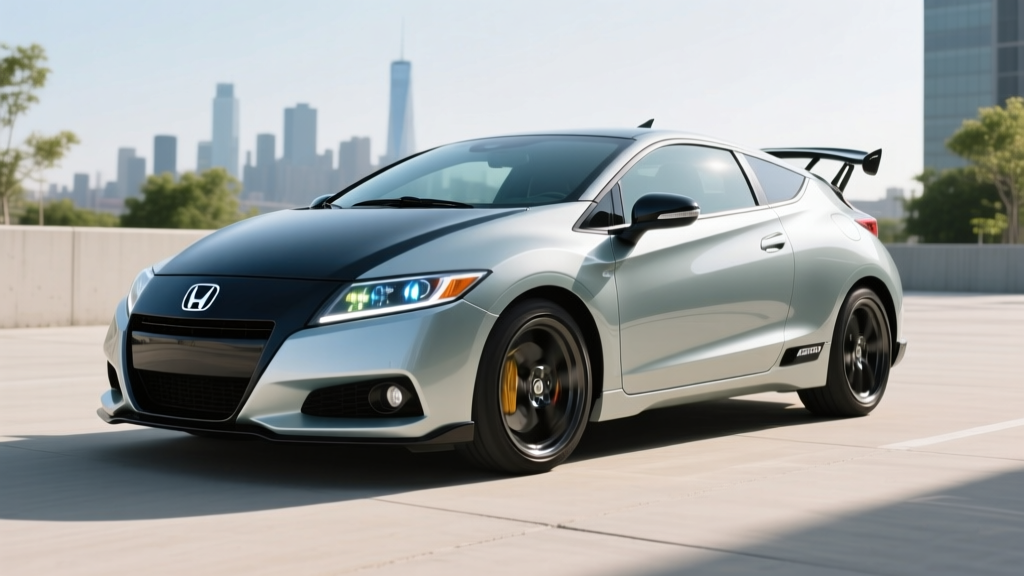
The Honda CR-Z was Honda's attempt at proving a hybrid could be fun to drive. Produced from 2011 to 2016, this two-seat sport coupe paired a 1.5-liter four-cylinder engine with Honda's Integrated Motor Assist (IMA) system — a mild hybrid setup that prioritized fuel efficiency without completely abandoning the brand's sporting heritage. If you're researching the hybrid Honda CR-Z as a used purchase in 2026, this guide covers everything from real-world MPG to battery replacement costs and how it compares to the hybrids and EVs available today.
Honda CR-Z Hybrid Powertrain and Specifications
The CR-Z uses Honda's IMA system, which is a conventional hybrid (HEV) — not a plug-in hybrid. The gasoline engine does most of the work, with a small electric motor providing supplemental torque during acceleration. The battery recharges through regenerative braking and engine power; you never plug it in.
| Specification | Value |
|---|---|
| Powertrain Type | Conventional Hybrid (HEV) — IMA system |
| Gas Engine | 1.5L inline-4, SOHC i-VTEC |
| Engine Horsepower | 111 hp @ 6,000 rpm |
| Electric Motor Output | 10 kW (13 hp) |
| Combined System Horsepower | 122 hp @ 6,000 rpm |
| Combined System Torque | 128 lb-ft (CVT) / 123 lb-ft (6MT) |
| Transmission Options | 6-speed manual or CVT |
| Hybrid Battery | Nickel-Metal Hydride (NiMH), ~0.5 kWh usable |
| Drivetrain | Front-wheel drive |
| Curb Weight | ~2,690–2,800 lbs |
The IMA system in the CR-Z is fundamentally different from the full hybrid systems found in the Toyota Prius or modern Honda Accord Hybrid. The electric motor alone cannot propel the car — it only assists the gas engine. This makes the CR-Z a mild hybrid, not a full parallel hybrid. The practical result is that electric-only driving is nonexistent, and fuel economy gains are moderate compared to full hybrid systems.
CR-Z Fuel Economy: EPA Ratings vs. Real-World MPG
Fuel economy varies by transmission choice and model year. The CVT-equipped models deliver the best numbers, while the 6-speed manual sacrifices a small amount of efficiency for driving engagement.
| Configuration | City MPG | Highway MPG | Combined MPG |
|---|---|---|---|
| CVT (2011–2012) | 35 | 39 | 37 |
| CVT (2013–2016) | 36 | 39 | 37 |
| 6-Speed Manual | 31 | 39 | 34 |
Source: fueleconomy.gov
Real-World MPG Expectations
The CR-Z's real-world fuel economy tends to track closely with EPA estimates, which is common for conventional hybrids driven in mixed conditions. Owners frequently report 36–40 MPG combined in temperate climates with moderate driving. However, several factors affect the numbers:
- City driving advantage: Like most hybrids, the CR-Z benefits from regenerative braking in stop-and-go traffic. Expect city MPG to match or slightly exceed the EPA rating of 35–36 MPG.
- Highway driving: At sustained 70–80 mph highway speeds, the IMA system provides minimal assistance. Expect 36–38 MPG on the highway, slightly below the EPA highway estimate.
- Cold weather penalty: In freezing temperatures, expect a 10–15% reduction in fuel economy (roughly 30–33 MPG combined) as the engine runs more frequently to maintain cabin heat and battery temperature.
- Sport mode impact: Using the CR-Z's Sport driving mode sharpens throttle response but reduces fuel economy by 2–4 MPG in mixed driving.
HEV vs. PHEV vs. EV: Where Does the CR-Z Fit?
Understanding the CR-Z's place in the electrified vehicle landscape requires distinguishing between the three main categories. The CR-Z is a conventional hybrid — here's how that compares to what's available in 2026.
| Feature | Conventional Hybrid (HEV) e.g., Honda CR-Z | Plug-In Hybrid (PHEV) e.g., Toyota Prius Prime | Battery Electric (BEV) e.g., Tesla Model 3 |
|---|---|---|---|
| Plug-in charging? | No — self-charging | Yes — plugs in for EV range | Yes — plugs in exclusively |
| Electric-only range | 0 miles (motor assists only) | 25–50 miles typical | 250–400 miles typical |
| Battery size | ~0.5–1.5 kWh | 8–20 kWh | 50–100 kWh |
| Uses gasoline? | Yes — primary fuel | Yes — after EV range depletes | No — fully electric |
| Federal tax credit (§30D)? | No | Up to $7,500 (if eligible) | Up to $7,500 (if eligible) |
| Typical fuel cost | Gas only (~$0.10–0.12/mi) | Electric + gas (~$0.05–0.10/mi) | Electric only (~$0.03–0.06/mi) |
The CR-Z's mild hybrid system delivers a modest fuel economy improvement over a conventional gas car of similar performance, but it does not offer any electric-only driving capability. Modern PHEVs like the 2026 Toyota Prius Prime (44 miles electric-only, 52 MPG combined after depletion) and BEVs like the Hyundai Ioniq 6 (361 miles EPA range) deliver dramatically lower operating costs — but at higher purchase prices.
Honda CR-Z Hybrid Battery: Lifespan, Warranty, and Replacement Cost
Battery reliability is the most common concern for used hybrid buyers. The CR-Z uses a nickel-metal hydride (NiMH) battery pack, which is a mature and well-understood technology. Here's what you need to know about longevity and replacement.
IMA Battery Replacement Cost
If the CR-Z's IMA battery fails, here are the typical replacement options and costs:
- New OEM Honda IMA battery: $2,000–$3,000 (parts and labor at a dealership)
- Refurbished/remanufactured IMA battery: $1,000–$1,800 from aftermarket suppliers
- Used IMA battery from salvage: $500–$900 (risky — unknown remaining lifespan)
- Grid charger reconditioning: $200–$400 for a DIY grid charger that can sometimes restore a degraded NiMH pack by balancing cells
The CR-Z's IMA battery is significantly smaller and less expensive to replace than the large lithium-ion packs in modern PHEVs and BEVs. A full replacement at $1,500–$2,500 is manageable relative to the car's used market value of $7,000–$14,000, depending on mileage and condition.
Signs of IMA Battery Degradation
Before purchasing a used CR-Z, look for these warning signs of battery issues:
- IMA warning light on the dashboard — indicates a hybrid system fault, often battery-related
- Reduced assist: The car feels sluggish during acceleration, suggesting the electric motor is not contributing
- Frequent recalibration: The state-of-charge gauge drops rapidly and the engine runs to recharge more often than normal
- Poor fuel economy: A degraded IMA battery forces the gas engine to do all the work, dropping MPG to 28–32
Request an OBD-II diagnostic scan before purchase. A healthy IMA battery should show cell voltages within 0.1V of each other across all modules.
Pricing and Tax Credit Eligibility
The Honda CR-Z is only available on the used market. Here's what to expect for pricing in early 2026:
| Model Year | Mileage Range | Typical Price Range |
|---|---|---|
| 2011–2012 | 90,000–140,000 mi | $6,500–$9,500 |
| 2013–2014 | 70,000–110,000 mi | $8,500–$12,000 |
| 2015–2016 | 50,000–90,000 mi | $10,000–$14,500 |
Federal Tax Credit Status
The CR-Z does not qualify for the federal §30D new clean vehicle tax credit because it is a conventional hybrid — not a plug-in vehicle. Under current IRS §30D rules, only plug-in electric vehicles (PHEVs and BEVs) with a minimum battery capacity of 7 kWh are eligible. The CR-Z's ~0.5 kWh NiMH pack falls far short of this threshold.
Additionally, the used clean vehicle credit (§25E) — which offers up to $4,000 or 30% of the sale price for qualifying used EVs and PHEVs — does not apply to conventional hybrids like the CR-Z. You will pay the full purchase price with no federal tax incentive.
Who Should Buy the Honda CR-Z Hybrid?
The CR-Z occupies a narrow niche. It makes sense for specific buyers and is the wrong choice for others.
✓ Choose the CR-Z If:
- You want an affordable, fuel-efficient sport coupe under $12,000
- You enjoy manual transmissions — the CR-Z is one of the last hybrids offered with a 6-speed stick
- You don't have access to plug-in charging at home or work
- You prioritize low running costs and Honda reliability over cutting-edge technology
- You want a lightweight, nimble car for commuting and weekend drives
✗ Look Elsewhere If:
- You need rear seats — the CR-Z is strictly a two-seater
- You want significant fuel savings — modern PHEVs and BEVs deliver far lower per-mile costs
- You want federal tax credits — only plug-in vehicles qualify under §30D and §25E
- You need cargo space — the CR-Z's hatch is small (~25 cu ft max with seats folded)
- You want modern ADAS features — the CR-Z predates widespread automatic emergency braking, lane-keeping, and adaptive cruise
CR-Z vs. Modern Hybrids and Alternatives
If you're cross-shopping the CR-Z against what's available today, here's how the numbers compare:
| Vehicle | Combined MPG / MPGe | Combined HP | Starting Price (2026) | Tax Credit? |
|---|---|---|---|---|
| Honda CR-Z (2013–2016, used) | 37 MPG | 122 hp | $8,500–$14,500 (used) | No |
| Toyota Prius (2026) | 57 MPG | 196 hp | $29,450 | No |
| Toyota Prius Prime PHEV (2026) | 52 MPG + 44 mi EV | 220 hp | $34,070 | Up to $7,500* |
| Honda Accord Hybrid (2026) | 48 MPG | 204 hp | $33,655 | No |
| Hyundai Ioniq 6 SE (2026, BEV) | 140 MPGe / 361 mi range | 168 hp | $38,650 | Up to $7,500* |
*Tax credit eligibility depends on MSRP caps, buyer income limits, battery sourcing requirements, and point-of-sale transfer availability. Verify current eligibility at fueleconomy.gov and consult a tax professional.
The CR-Z's 37 MPG combined was impressive in 2013 but has been eclipsed by modern hybrids. The 2026 Toyota Prius delivers 57 MPG combined with 196 horsepower — a massive leap in both efficiency and performance. However, the CR-Z's used-market price of $8,500–$14,500 is dramatically lower than any new hybrid or EV, making it an attractive budget option.
Reliability and Ownership Costs
Honda's IMA system has a solid reliability track record, though it is not without known issues. Here's a realistic look at long-term ownership:
Known Reliability Concerns
- IMA battery degradation: The most significant potential expense. NiMH batteries degrade over time, especially in hot climates. Expect 10–15 years of service life before replacement may be needed.
- 12V auxiliary battery: Like all hybrids, the CR-Z has a conventional 12V battery that can fail independently of the IMA system. Standard replacement every 4–6 years.
- CVT longevity: Honda's CVT in the CR-Z has been generally reliable, but fluid changes every 30,000–60,000 miles are recommended to prevent premature wear.
- A/C compressor: Electrically driven A/C compressors on hybrids can be expensive to replace ($800–$1,400) if they fail out of warranty.
Estimated Annual Ownership Costs
- Fuel: At 37 MPG and $3.40/gallon, driving 12,000 miles/year costs approximately $1,100/year
- Insurance: $800–$1,400/year depending on state and driver profile (relatively low for a sport coupe)
- Maintenance: $400–$700/year (oil changes, brakes, tires — hybrid maintenance is generally lower than gas-only cars due to regenerative braking extending pad life)
- Total estimated annual cost: $2,300–$3,200/year (excluding potential IMA battery replacement)
Frequently Asked Questions
How many MPG does the Honda CR-Z hybrid get?
The CR-Z with CVT gets an EPA-rated 36 city / 39 highway / 37 combined MPG. The 6-speed manual version is rated at 31 city / 39 highway / 34 combined. Real-world fuel economy typically ranges from 35–39 MPG combined depending on driving conditions and style.
Is the Honda CR-Z a plug-in hybrid?
No. The CR-Z is a conventional hybrid (HEV) using Honda's IMA system. It cannot be plugged in and has no electric-only driving range. The small NiMH battery charges exclusively through regenerative braking and the gasoline engine. If you want plug-in capability, look at PHEVs like the Toyota Prius Prime or Ford Escape PHEV.
How much does it cost to replace the CR-Z hybrid battery?
A new OEM IMA battery replacement costs $2,000–$3,000 at a Honda dealership. Refurbished aftermarket batteries run $1,000–$1,800. Given the car's used value of $7,000–$14,500, a battery replacement is a significant but not catastrophic expense. Many owners opt for refurbished units or grid-charger reconditioning to extend the original battery's life.
Does the Honda CR-Z qualify for any tax credit?
No. The CR-Z does not qualify for the federal §30D new vehicle credit or the §25E used clean vehicle credit because it is a conventional hybrid, not a plug-in vehicle. Only PHEVs and BEVs with sufficient battery capacity are eligible for federal EV tax incentives. Check IRS.gov for current rules on qualifying vehicles.
Is the Honda CR-Z reliable?
Overall, yes. The CR-Z shares Honda's reputation for mechanical reliability. The gasoline engine is a proven design, and the IMA system is simpler and less stressed than full hybrid systems. The primary reliability concern is eventual NiMH battery degradation, which is a known cost to budget for on any 10+ year-old hybrid. The manual transmission variant is particularly robust.
Should I buy a used CR-Z or a new hybrid?
If your budget is under $15,000 and you want an engaging, efficient two-seat coupe with no plug-in requirement, the CR-Z is a solid used buy. If you can spend $28,000+ and want dramatically better fuel economy (57 MPG in the new Prius), modern safety features, a warranty, and more space, a new hybrid is the better long-term value. For maximum fuel savings and tax credit eligibility, a PHEV or BEV makes more financial sense — but at a significantly higher upfront cost.