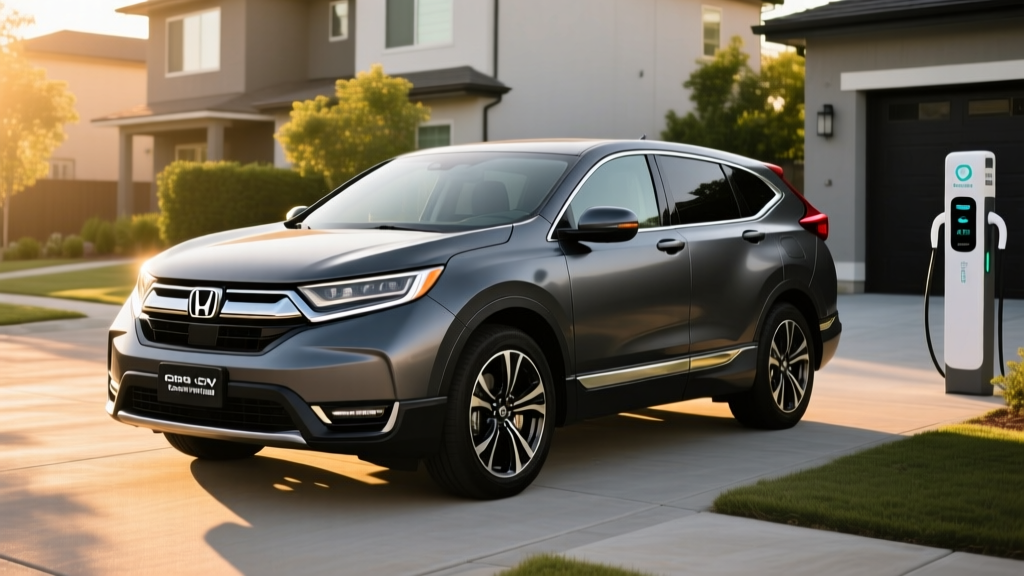
The Honda CR-V has long been the default compact SUV for pragmatic families, and the top-tier Touring Hybrid trim represents the most equipped, most efficient version Honda sells. For 2026, the CR-V Touring Hybrid pairs a turbocharged engine with a two-motor hybrid system that prioritizes electric propulsion at low speeds while delivering confident passing power. This guide covers everything a buyer needs: real-world MPG, the powertrain beneath the hood, battery longevity, and whether this HEV makes more sense than a PHEV or full EV for your daily routine.
HEV vs PHEV: What the CR-V Touring Hybrid Actually Is
Before diving into specs, it's essential to understand what the CR-V Touring Hybrid is—and what it isn't. Honda offers the CR-V in two electrified flavors:
- CR-V Hybrid (HEV): A conventional, self-charging hybrid. The battery recharges through regenerative braking and the gasoline engine. You never plug it in. The Touring Hybrid falls into this category.
- CR-V e:PHEV (Plug-in Hybrid): Available in select markets (primarily Europe and China), this version carries a larger battery and can travel roughly 30–40 miles on electric power alone before the engine engages. As of 2026, Honda does not sell the CR-V e:PHEV in the United States.
If you're shopping in the U.S., the CR-V Touring Hybrid is an HEV. It requires no charging infrastructure, no lifestyle adjustment—just fill it with gas and drive. The trade-off versus a PHEV is that you don't get electric-only commuting. The trade-off versus a full BEV is that you still buy gasoline, but you avoid range anxiety entirely and skip the home charger installation.
Fuel Economy: EPA Ratings and Real-World MPG
The 2026 Honda CR-V Touring Hybrid uses the same fourth-generation two-motor hybrid system found across the CR-V Hybrid lineup. Equipped with all-wheel drive (standard on Touring), it carries the following EPA estimates according to fueleconomy.gov:
| Metric | Value |
|---|---|
| City MPG | 40 |
| Highway MPG | 34 |
| Combined MPG | 37 |
| Fuel Tank Capacity | 14.0 gallons |
| Total Driving Range | ~518 miles |
Front-wheel-drive Hybrid trims (Sport, Sport-L) bump combined to 40 MPG, but the Touring is AWD-only, which accounts for the slight efficiency penalty.
Real-World MPG: What Owners Actually See
Honda's hybrid system excels in city driving, where the electric motors handle most low-speed propulsion and the engine acts primarily as a generator. In real-world use:
- City / suburban driving: Many owners report exceeding the 40 MPG city estimate, seeing 41–44 MPG in warm weather with moderate traffic. Hybrids benefit from stop-and-go conditions that would tank a conventional car's efficiency.
- Highway cruising (70–80 mph): Expect 30–33 MPG. The hybrid advantage diminishes at sustained high speed, where the engine directly drives the wheels and aerodynamic drag dominates.
- Cold weather (below 30°F): Fuel economy typically drops 3–5 MPG combined. The engine runs more frequently to generate cabin heat and warm the catalytic converter.
- Mountainous terrain: Regenerative braking on descents recovers energy, but sustained climbs can push instantaneous consumption well below 25 MPG.
Net result: if your commute is mostly city and suburban, 38–42 MPG combined is realistic. If you drive 80% highway miles, plan on 32–35 MPG combined. These are honest numbers—not disappointing, but not the 40 MPG sticker that FWD trims advertise.
Powertrain and Performance Specs
| Specification | Value |
|---|---|
| Engine | 2.0L DOHC 4-cylinder (Atkinson cycle) |
| Hybrid System | Two-motor (drive + generator) |
| Combined System Horsepower | 204 hp |
| Combined System Torque | 247 lb-ft (motor torque) |
| Drivetrain | AWD (standard on Touring) |
| Transmission | e-CVT (no traditional gears) |
| 0–60 mph | ~7.6 seconds |
| Towing Capacity | 1,000 lbs |
| Cargo Volume (rear seats up / down) | 36.3 / 76.5 cu ft |
Honda's hybrid system operates in three modes: EV Drive (battery powers the drive motor at low speeds), Hybrid Drive (engine generates electricity for the drive motor), and Engine Drive (engine directly drives the wheels via a lock-up clutch at highway cruising speeds). The transitions are nearly imperceptible—a hallmark of Honda's system refinement.
The 204 combined horsepower is competitive with the Toyota RAV4 Hybrid (219 hp) and edges past the Hyundai Tucson Hybrid (230 hp in its latest generation). The CR-V Hybrid prioritizes smoothness and efficiency over sportiness; the e-CVT delivers linear acceleration without the drone typical of older CVT designs.
Battery Technology, Warranty, and Replacement Cost
The CR-V Touring Hybrid uses a lithium-ion battery pack mounted beneath the cargo floor. Honda does not publish the exact kWh capacity for its HEV batteries—they are small (typically 1.0–1.5 kWh usable) by design, since the battery serves as a buffer for regenerative energy and brief electric-only bursts, not sustained EV driving.
Honda Hybrid Battery Warranty
- Hybrid Battery: 8 years / 100,000 miles (10 years / 150,000 miles in CARB states including CA, NY, MA, and others)
- Powertrain Warranty: 5 years / 60,000 miles
- Limited Vehicle Warranty: 3 years / 36,000 miles
The warranty covers battery capacity loss below a functional threshold and defects. It does not cover gradual, normal degradation that doesn't affect vehicle operation.
Battery Lifespan and Replacement Cost
Honda's lithium-ion hybrid batteries have proven durable. Based on long-term data from previous-generation CR-V Hybrids and Accord Hybrids, most batteries retain functional capacity well beyond 150,000 miles. Complete failure within the warranty period is uncommon.
If replacement is needed out of warranty, expect the following:
- OEM battery replacement: $2,000–$3,500 (parts + labor at a Honda dealer)
- Refurbished / aftermarket battery: $1,200–$2,000
- Individual cell/module repair: $500–$1,200 (specialist hybrid shops)
For context, hybrid battery replacement is far less expensive than BEV battery replacement ($8,000–$20,000+), because the HEV battery is small. The risk of needing replacement in the first 10 years is low based on Honda's track record.
Pricing, Trims, and Tax Credit Eligibility
The 2026 Honda CR-V Touring Hybrid AWD starts at approximately $42,350 MSRP (including destination). This is the top trim, so it comes fully loaded:
- Leather-trimmed seats with heated front and rear seats
- 10.2-inch touchscreen with wireless Apple CarPlay and Android Auto
- Bose 12-speaker premium audio system
- Wireless phone charger
- Hands-free power tailgate
- Honda Sensing suite (adaptive cruise, lane-keeping, collision mitigation)
- Heated steering wheel
- Rain-sensing wipers
Federal Tax Credit: Does the CR-V Hybrid Qualify?
No. Under current IRS §30D rules, the federal clean vehicle credit applies only to plug-in electric vehicles (BEVs and PHEVs) with a minimum battery capacity of 7 kWh and external charging capability. The CR-V Hybrid is a conventional HEV—it does not plug in and its battery is far below the 7 kWh threshold.
This means no $7,500 federal credit, no point-of-sale transfer, and no state EV rebates that are tied to plug-in vehicles. Some states or municipalities offer small incentives ($250–$500) for any hybrid purchase, but these are local and vary widely. Check your state's energy office or IRS.gov for current rules.
The practical implication: the CR-V Touring Hybrid's value proposition rests entirely on fuel savings and low running costs, not government incentives. Over five years and 75,000 miles at 37 MPG combined and $3.40/gallon gas, you'd spend roughly $6,900 on fuel. A comparable non-hybrid compact SUV at 28 MPG combined would cost about $9,100—a $2,200 savings that partially offsets the hybrid premium.
CR-V Touring Hybrid vs. RAV4 Hybrid vs. Tucson Hybrid
| Attribute | Honda CR-V Touring Hybrid AWD | Toyota RAV4 Hybrid Limited AWD | Hyundai Tucson Hybrid Limited AWD |
|---|---|---|---|
| Combined MPG (EPA) | 37 | 39 | 37 |
| City / Highway MPG | 40 / 34 | 41 / 38 | 38 / 36 |
| Combined Horsepower | 204 hp | 219 hp | 230 hp |
| 0–60 mph | ~7.6 sec | ~7.4 sec | ~7.1 sec |
| Cargo Volume (behind rear seats) | 36.3 cu ft | 37.6 cu ft | 38.7 cu ft |
| Top Trim MSRP (AWD) | ~$42,350 | ~$42,500 | ~$41,800 |
| Hybrid Battery Warranty | 8 yr / 100k mi | 10 yr / 150k mi | 10 yr / 100k mi |
The RAV4 Hybrid leads on EPA MPG and offers a longer battery warranty. The Tucson Hybrid is the quickest and most spacious. The CR-V Touring Hybrid differentiates itself with interior refinement, a quieter cabin at highway speed, and Honda's reputation for long-term powertrain reliability. None of these three is a wrong choice—the decision comes down to which attributes you prioritize.
Who Should Buy the CR-V Touring Hybrid?
Choose the CR-V Touring Hybrid If:
- You want maximum fuel efficiency without plugging in or changing your routine
- Your commute is primarily city and suburban (where hybrid efficiency peaks)
- You value a premium, well-equipped interior with Honda Sensing safety tech
- You plan to keep the vehicle 8+ years and want proven hybrid reliability
- You lack access to home or workplace charging (apartment, street parking)
Look Elsewhere If:
- You want electric-only commuting (consider a PHEV like the Toyota RAV4 Prime or a BEV)
- You drive mostly highway miles at 75+ mph (the hybrid advantage shrinks; a diesel or efficient gas SUV may match it)
- You need to tow more than 1,000 lbs (the hybrid isn't rated for heavy towing)
- You want to qualify for the $7,500 federal tax credit (only PHEVs and BEVs qualify under §30D)
Hybrid vs PHEV vs EV: Which Fits Your Life?
The CR-V Touring Hybrid sits on one end of the electrification spectrum. Here's how to decide which category fits:
- HEV (like the CR-V Touring Hybrid): Best for buyers who want better fuel economy with zero behavior change. No plug, no range anxiety, no charging apps. You sacrifice the ability to drive on electricity alone, but you gain simplicity and a lower purchase price than PHEVs or BEVs.
- PHEV (like the Toyota RAV4 Prime): Best for buyers with home charging who commute 25–40 miles round-trip. You get electric-only daily driving and a gas engine for road trips. You pay more upfront ($5,000–$8,000 premium over HEV) but may qualify for the $7,500 federal credit, which can make the math work. Downside: PHEV availability is limited and waitlists are common.
- BEV (like the Tesla Model Y or Hyundai Ioniq 5): Best for buyers with reliable home Level 2 charging who want the lowest per-mile energy cost, instant torque, and zero tailpipe emissions. You need to accept public charging for road trips and a higher upfront price, partially offset by the federal tax credit and lower maintenance (no oil changes, fewer brake replacements due to regen).
If you can charge at home and your daily commute is under 40 miles, a PHEV or BEV will save more money long-term. If you can't charge at home—or you simply don't want to think about it—the CR-V Touring Hybrid delivers meaningful fuel savings with the fill-up-and-go convenience of a gas car.
Frequently Asked Questions
How many MPG does the 2026 CR-V Touring Hybrid get?
The EPA rates the AWD Touring Hybrid at 40 city / 34 highway / 37 combined MPG. In real-world city driving, many owners see 38–44 MPG. Highway-heavy drivers should expect 32–35 MPG combined.
Does the CR-V Touring Hybrid need to be plugged in?
No. It is a conventional hybrid (HEV). The battery charges itself through regenerative braking and the gasoline engine. You never plug it in.
Is the CR-V Hybrid reliable?
Honda's hybrid powertrain has a strong reliability record. The hybrid battery carries an 8-year/100,000-mile warranty (10 years/150,000 miles in CARB states). Out-of-warranty replacement costs $2,000–$3,500, but most batteries last well beyond 150,000 miles based on historical data.
Does the CR-V Hybrid qualify for a federal tax credit?
No. Under IRS §30D rules, only plug-in vehicles (BEVs and PHEVs) with at least 7 kWh of battery capacity qualify for the federal clean vehicle credit. The CR-V Hybrid is a self-charging HEV and is not eligible.
How does the CR-V Touring Hybrid compare to the RAV4 Hybrid?
The RAV4 Hybrid gets slightly better EPA MPG (39 vs 37 combined) and has a longer battery warranty (10 yr/150k mi). The CR-V Touring Hybrid offers a more refined interior, a quieter cabin, and comparable reliability. Both are strong choices—the decision comes down to brand preference and which features matter most to you.
What's the towing capacity of the CR-V Touring Hybrid?
The CR-V Hybrid is rated for 1,000 lbs of towing. This is sufficient for a small utility trailer or a couple of dirt bikes, but not for a boat or camper. If you need to tow 1,500+ lbs, consider the non-hybrid CR-V (1,500 lbs) or a larger SUV.