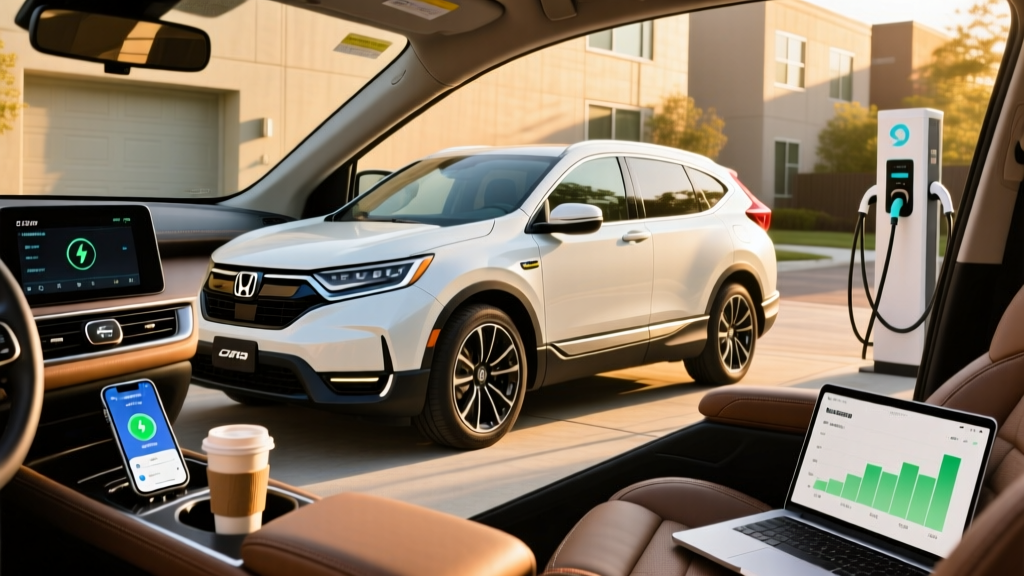
The Honda CR-V Sport Touring Hybrid sits at the top of Honda's compact SUV lineup, pairing a turbo-free 2.0-liter four-cylinder with a two-motor hybrid system for a combined 204 horsepower and all-wheel drive. For buyers who want the efficiency of electrification without the range anxiety or charging infrastructure demands of a full battery-electric vehicle, this trim represents Honda's most feature-complete hybrid offering. But how does the EPA sticker translate to real-world driving, and does the Sport Touring's premium price justify the fuel savings? Here's the data-driven breakdown.
Quick Verdict: Who the CR-V Sport Touring Hybrid Is For
The 2026 Honda CR-V Sport Touring Hybrid targets suburban families and commuters who drive 12,000–18,000 miles annually, want AWD confidence in inclement weather, and prefer to refuel at any gas station rather than plan around charging stops. It delivers genuine fuel savings over the gas-only CR-V (roughly 30% better combined MPG) while adding premium features — Bose 12-speaker audio, wireless Apple CarPlay/Android Auto, heated rear seats, and a hands-free power tailgate — that justify its position at the top of the range. If you can charge at home and drive under 35 miles daily, a PHEV or full EV may save you more. If you can't charge at home or regularly road-trip beyond 300 miles, this conventional hybrid (HEV) is the pragmatic sweet spot.
| Specification | Value |
|---|---|
| Powertrain | 2.0L Atkinson-cycle 4-cyl + 2-motor hybrid system |
| Combined Horsepower | 204 hp |
| Combined Torque | 247 lb-ft (electric motor) |
| Drivetrain | AWD (standard on Sport Touring Hybrid) |
| EPA MPG (City / Hwy / Combined) | 40 / 34 / 37 |
| Fuel Tank Capacity | 14.0 gallons |
| Total Driving Range | ~518 miles (EPA est.) |
| 0–60 mph | ~7.8 seconds |
| Cargo Volume (behind rear seats) | 36.3 cu ft |
| Cargo Volume (rear seats folded) | 76.5 cu ft |
| Towing Capacity | 1,000 lbs |
| Base MSRP (Sport Touring Hybrid AWD) | $40,850 |
| Hybrid Battery Warranty | 8 years / 100,000 miles |
| Federal Tax Credit (§30D) | Not eligible (HEV) |
Fuel Economy: EPA Numbers vs. Real-World MPG
The EPA rates the 2026 CR-V Sport Touring Hybrid AWD at 40 mpg city / 34 mpg highway / 37 mpg combined, according to fueleconomy.gov. These figures apply across all CR-V Hybrid trims with AWD. The front-wheel-drive hybrid variant achieves slightly higher numbers (43/36/40), but the Sport Touring Hybrid is AWD-only.
| Configuration | City MPG | Highway MPG | Combined MPG |
|---|---|---|---|
| Hybrid FWD (Sport, EX-L) | 43 | 36 | 40 |
| Hybrid AWD (Sport, Sport Touring) | 40 | 34 | 37 |
| Gas 1.5T AWD (EX, EX-L) | 27 | 32 | 29 |
Real-World MPG: What Owners Actually See
Hybrids consistently outperform their EPA city ratings in stop-and-go traffic because regenerative braking recovers energy that gas cars waste as heat. In mixed suburban driving with moderate traffic, owners commonly report 38–42 mpg in warm weather. Highway-only driving at 70–75 mph typically yields 31–34 mpg — the electric motors contribute less at sustained high speeds, and the Atkinson-cycle engine operates closer to its efficiency floor.
In cold weather (below 30°F), expect a 5–10% reduction in fuel economy. The engine runs more frequently to provide cabin heat and maintain operating temperature, and battery internal resistance increases, reducing regen effectiveness. Winter combined MPG of 33–35 mpg is realistic for northern-climate drivers.
HEV vs. PHEV vs. Full EV: Which Powertrain Fits Your Life?
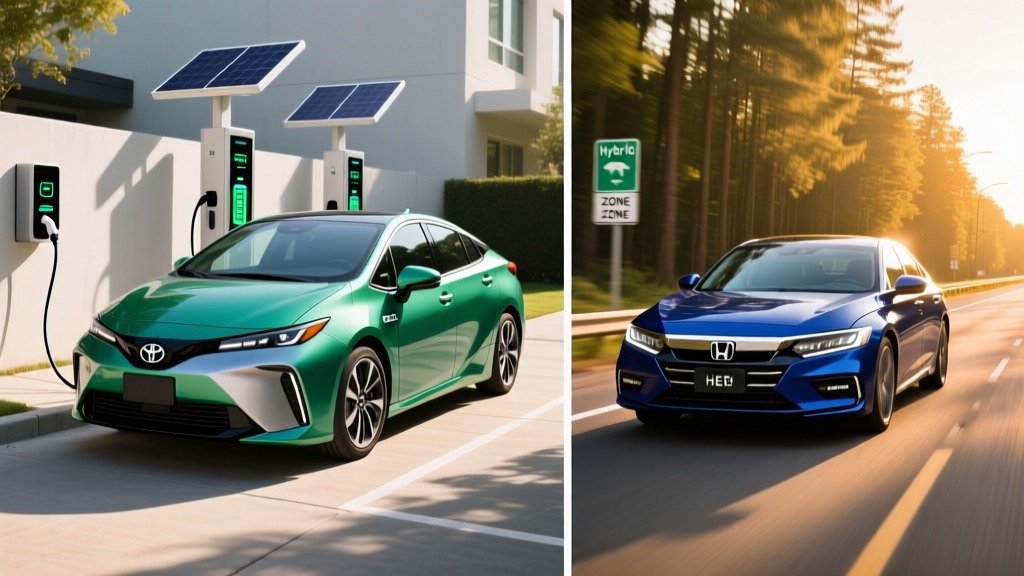
The CR-V Sport Touring Hybrid is a conventional hybrid (HEV) — it does not plug in, has no electric-only driving range, and refuels exclusively at gas stations. Honda does not currently offer a CR-V plug-in hybrid (PHEV) in the US market. Here's how the three electrified powertrain types compare for a compact SUV buyer:
| Factor | HEV (CR-V Hybrid) | PHEV (e.g., Toyota RAV4 Prime) | BEV (e.g., Hyundai Ioniq 5) |
|---|---|---|---|
| Plug-In Required? | No | Yes (for max savings) | Yes |
| Electric-Only Range | 0 miles | 25–42 miles typical | 250–320 miles typical |
| Total Range | ~518 miles | ~580+ miles | 250–320 miles |
| Home Charging Needed? | No | Recommended (Level 2) | Essential (Level 2) |
| Federal Tax Credit (§30D) | Not eligible | Up to $7,500 (if eligible) | Up to $7,500 (if eligible) |
| Best For | No home charging, road trips | Short commutes + home charging | Home charging + mostly <250 mi trips |
| Fuel Cost (per mile, avg) | ~$0.10–$0.12 | ~$0.04–$0.10 | ~$0.03–$0.06 |
Choose the CR-V Sport Touring Hybrid (HEV) if: You lack reliable home charging access, you regularly drive more than 300 miles between fill-ups, you live in an apartment or street-park, or you want electrified efficiency without behavioral changes.
Consider a PHEV instead if: You have a garage or driveway with a 120V or 240V outlet, your daily commute is under 40 miles round-trip, and you want to drive mostly on electricity while keeping gas as a backup.
Consider a full EV if: You can install a Level 2 home charger, your daily driving is under 250 miles, and you want the lowest per-mile fuel cost and zero tailpipe emissions.
Powertrain Deep Dive: How the Two-Motor Hybrid System Works
Honda's hybrid system pairs a 2.0-liter Atkinson-cycle four-cylinder engine (producing 146 hp and 134 lb-ft on its own) with a two-motor hybrid system that contributes up to 181 hp and 247 lb-ft from the drive motor. Combined system output is 204 horsepower.
Unlike Toyota's planetary-gear hybrid system, Honda's setup operates primarily in series-hybrid mode at low and moderate speeds: the gasoline engine drives a generator motor, which produces electricity to power the drive motor or charge the small lithium-ion battery pack. At highway speeds (typically above 45–50 mph), a lock-up clutch engages to connect the engine directly to the front wheels for more efficient cruising.
The AWD system uses a rear-mounted electric motor that engages when front-wheel slip is detected or during hard acceleration. This is not a mechanical driveshaft system — there is no physical connection between the engine and the rear wheels. The result is responsive AWD engagement with minimal weight and drivetrain loss, though it limits towing capacity to 1,000 pounds.
The hybrid battery pack is a lithium-ion unit (approximately 1.1 kWh usable capacity) mounted under the cargo floor. It is not designed for electric-only driving — its role is to buffer energy from regenerative braking and provide short bursts of electric assist. This small capacity is why HEVs do not plug in and do not qualify for federal EV tax credits.
Pricing, Trims, and Tax Credit Eligibility
The 2026 Honda CR-V Sport Touring Hybrid carries a starting MSRP of approximately $40,850 (including destination charge). This positions it roughly $4,000–$5,000 above the gas-only Sport Touring and about $7,000 above the entry-level Hybrid Sport trim.
Federal Tax Credit Status
The CR-V Sport Touring Hybrid does not qualify for the federal §30D clean vehicle tax credit. Under current IRS rules, the §30D credit applies only to plug-in electric vehicles (BEVs and PHEVs) with a battery capacity of at least 7 kWh that meet critical-mineral and battery-component sourcing requirements. Conventional hybrids (HEVs) with small battery packs are categorically excluded.
Some states and municipalities offer rebates or HOV-lane access for hybrids, but these vary by jurisdiction. Check your state energy office or the Alternative Fuels Data Center for local incentive availability.
Value Equation: Hybrid Premium vs. Fuel Savings
At 37 mpg combined versus 29 mpg combined for the gas AWD CR-V, the hybrid saves approximately 2.7 gallons per 100 miles. At $3.40/gallon (national average), that's roughly $920 per year in fuel savings for a driver covering 15,000 miles annually. The hybrid premium over the equivalent gas AWD Sport Touring is approximately $2,500–$3,000, meaning the fuel savings pay back the price difference in roughly 3 years. Beyond that, every mile driven is net savings — and the hybrid's lower brake wear (thanks to regen) adds modest maintenance savings.
Battery Longevity, Warranty, and Replacement Cost
Hybrid battery degradation is the top concern among first-time hybrid buyers. Here's what the data shows for Honda's system:
Honda Hybrid Battery Warranty
- Coverage: 8 years or 100,000 miles (whichever comes first)
- Extended in CARB states: 10 years or 150,000 miles in California and states adopting CARB emissions standards
- What's covered: Battery capacity loss below a defined threshold, cell failures, hybrid system component defects
- What's not covered: Damage from accidents, modifications, or improper service
Real-World Battery Lifespan
Honda's hybrid battery packs are designed for the life of the vehicle under normal use. Unlike full EVs that cycle their batteries deeply (0–100%), HEV batteries operate in a narrow state-of-charge window (typically 40–80%), which dramatically reduces degradation stress. Real-world data from high-mileage Honda hybrid owners (Accord Hybrid, CR-V Hybrid) shows minimal capacity loss at 150,000+ miles in most cases.
If a replacement is needed out of warranty, a new OEM hybrid battery pack for the CR-V Hybrid costs approximately $2,000–$3,500 including labor. Third-party refurbishment services offer rebuilt packs for $1,200–$2,000. This is a fraction of full EV battery replacement costs ($8,000–$20,000+), reflecting the HEV pack's much smaller capacity.
Reliability, Safety, and Owner Satisfaction
The Honda CR-V has historically scored well in reliability surveys, and the hybrid powertrain adds complexity that has proven durable in Honda's long-running Accord Hybrid and Insight platforms. The two-motor system has fewer moving parts than a conventional automatic transmission (no torque converter, no multi-speed gear sets), and the Atkinson-cycle engine operates under lower thermal stress than a turbocharged engine.
The 2026 CR-V earned top marks from the IIHS, including a Top Safety Pick designation when equipped with specific headlights. Standard Honda Sensing suite features include adaptive cruise control, lane-keeping assist, forward collision warning with automatic emergency braking, and traffic sign recognition.
One reliability note: some owners of earlier CR-V Hybrid model years reported occasional 12V auxiliary battery drain when the vehicle sat unused for extended periods. Honda issued software updates to address parasitic draw from the telematics module. If you plan to leave the vehicle parked for more than two weeks, a battery tender is recommended.
Pros and Cons at a Glance
Pros
- 37 mpg combined AWD — best-in-class efficiency for an AWD compact SUV
- No plug-in required; refuel at any gas station
- Strong low-end torque (247 lb-ft from electric motor) for confident merging
- Premium Sport Touring features: Bose audio, wireless charging, heated rear seats
- Proven hybrid system with 8yr/100k-mile battery warranty
- Excellent IIHS safety ratings
- Strong resale value — Honda hybrids hold premium over gas variants
Cons
- No federal tax credit eligibility (HEV exclusion)
- AWD towing limited to 1,000 lbs (class low; RAV4 Hybrid tows 1,750 lbs)
- Highway MPG drops to ~31–33 in real-world 75 mph driving
- Sport Touring price pushes $42K+ with options — near luxury territory
- No PHEV option available if you want electric-only commuting
- Engine drone under hard acceleration (CVT-like behavior from e-CVT)
Frequently Asked Questions
How many MPG does the Honda CR-V Sport Touring Hybrid get?
The EPA rates it at 40 mpg city, 34 mpg highway, and 37 mpg combined with AWD. Real-world mixed driving typically yields 35–40 mpg depending on temperature, terrain, and driving style. City driving often exceeds the EPA estimate thanks to regenerative braking.
Does the CR-V Sport Touring Hybrid need to be plugged in?
No. It is a conventional hybrid (HEV), not a plug-in hybrid. The battery charges through regenerative braking and the gasoline engine. You refuel it exclusively at gas stations, just like a conventional car.
How far can the CR-V Hybrid drive on electricity alone?
Effectively zero miles in sustained electric-only mode. The hybrid system can creep at very low speeds (parking lots, traffic jams) on battery power for brief distances, but the engine engages for any meaningful acceleration or speed above ~25 mph. If electric-only driving is a priority, you need a PHEV or full EV.
Is the CR-V Hybrid battery reliable, and what does replacement cost?
Honda's hybrid batteries are designed for the vehicle's lifetime, operating in a narrow charge window that minimizes degradation. The battery is warranted for 8 years/100,000 miles (10 years/150,000 in CARB states). Out-of-warranty replacement costs approximately $2,000–$3,500 for an OEM pack — far less than a full EV battery.
Does the CR-V Sport Touring Hybrid qualify for any tax credit?
It does not qualify for the federal §30D clean vehicle tax credit, which requires a plug-in vehicle with at least 7 kWh of battery capacity. Some states may offer minor hybrid incentives, but these vary widely. Check the Alternative Fuels Data Center for state-specific programs.
How does the CR-V Hybrid compare to the Toyota RAV4 Hybrid?
The RAV4 Hybrid AWD is rated at 41 mpg combined (slightly higher than the CR-V's 37) and offers a 1,750-lb towing capacity versus the CR-V's 1,000 lbs. However, the CR-V Sport Touring Hybrid offers a more premium interior, more rear-seat legroom (41.3 inches vs. 37.8), and a quieter cabin at highway speeds. Both are class leaders; the choice often comes down to feature preference and dealer proximity.
What is the total driving range on a full tank?
With a 14.0-gallon fuel tank and 37 mpg combined EPA rating, the CR-V Sport Touring Hybrid delivers approximately 518 miles of total range. In real-world driving with mixed conditions, expect 450–500 miles between fill-ups.
The 2026 Honda CR-V Sport Touring Hybrid occupies a clear niche: maximum efficiency without lifestyle compromise. It doesn't require a home charger, doesn't demand route planning, and doesn't leave you stranded in a charging desert. For buyers who want electrified efficiency on their own terms, it remains one of the most data-backed choices in the compact SUV segment.