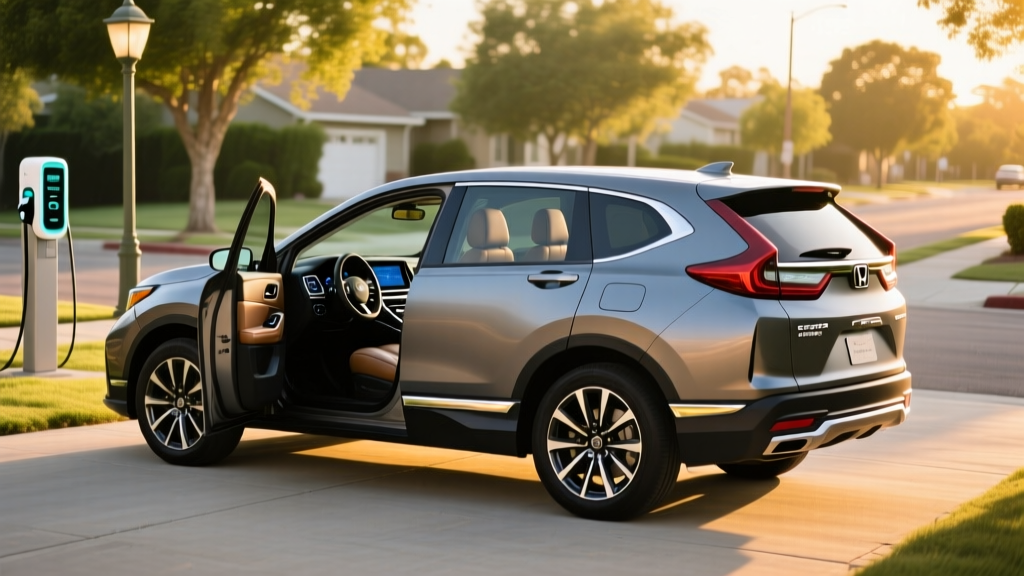
The Honda CR-V Sport Touring Hybrid sits at the top of Honda's compact SUV lineup, pairing a turbocharged gasoline engine with a two-motor hybrid system that prioritizes electric propulsion in everyday driving. For buyers weighing a conventional hybrid against a plug-in hybrid (PHEV) or a full battery-electric vehicle (BEV), the Sport Touring Hybrid occupies a specific niche: maximum fuel efficiency with zero plug-in hassle, wrapped in Honda's most feature-rich trim.
This guide breaks down the 2026 Honda CR-V Sport Touring Hybrid's powertrain, real-world MPG expectations, battery longevity, warranty coverage, and total ownership picture so you can decide whether it's the right electrified SUV for your garage.
HEV vs PHEV vs EV: Where the CR-V Sport Touring Hybrid Fits
Before examining the numbers, it's worth clarifying what the CR-V Sport Touring Hybrid is — and what it isn't. This is a conventional hybrid electric vehicle (HEV), not a plug-in hybrid. You never plug it in. The 1.3 kWh lithium-ion battery recharges exclusively through regenerative braking and the gasoline engine. Honda does not currently offer a plug-in hybrid (PHEV) version of the CR-V in the United States, which distinguishes it from competitors like the Toyota RAV4 Prime (PHEV) or the Hyundai Tucson PHEV.
Quick Reference: Hybrid Types Compared
| Feature | HEV (CR-V Sport Touring Hybrid) | PHEV (e.g., RAV4 Prime) | BEV (e.g., Ioniq 5) |
|---|---|---|---|
| Plug-in charging required? | No | Yes (Level 1/2) | Yes (Level 1/2/DC) |
| Electric-only range | ~1 mi at low speed | 25–42 mi typical | 200–350+ mi |
| Battery capacity | ~1.3 kWh | 14–18 kWh | 58–84 kWh |
| Federal tax credit (§30D) | No | Up to $7,500* | Up to $7,500* |
| Typical combined MPG / MPGe | 37–40 MPG | 94 MPGe (elec) / 38 MPG (gas) | 100–130 MPGe |
* §30D credit eligibility depends on MSRP caps, buyer income limits, and battery mineral sourcing. See IRS.gov for current rules.
The CR-V Sport Touring Hybrid makes sense for drivers who want better fuel economy than a gas-only SUV but don't have access to home charging, don't want to manage plug-in routines, or simply prefer the simplicity of a fill-up-and-go vehicle that still slashes fuel consumption by 30–40% compared to a non-hybrid equivalent.
Powertrain Specs: What Moves the CR-V Sport Touring Hybrid
Honda's fourth-generation two-motor hybrid system powers the Sport Touring Hybrid. Here's the exact hardware:
| Specification | Detail |
|---|---|
| Engine | 2.0L Atkinson-cycle 4-cylinder |
| Engine output | 145 hp / 134 lb-ft torque |
| Drive motors | Two-motor hybrid system (traction + generator) |
| Electric motor output | 184 hp / 247 lb-ft torque |
| Combined system output | 204 hp / 247 lb-ft |
| Drivetrain | AWD standard (Sport Touring trim) |
| Transmission | e-CVT (no traditional gearbox) |
| Hybrid battery | ~1.3 kWh lithium-ion |
| 0–60 mph (est.) | ~7.6 seconds |
| Towing capacity | 1,000 lbs |
Honda's system operates primarily in EV Drive mode at low and moderate speeds, using the traction motor to propel the vehicle while the engine acts as a generator. At highway speeds, a lock-up clutch connects the engine directly to the wheels for efficiency. This architecture means the CR-V Sport Touring Hybrid drives more like an EV around town than a traditional gas car — smooth, quiet, and responsive off the line thanks to 247 lb-ft of electric torque available from zero RPM.
Fuel Economy: EPA Ratings and Real-World MPG
According to fueleconomy.gov, the 2026 Honda CR-V Sport Touring Hybrid AWD carries the following EPA estimates:
| Cycle | MPG |
|---|---|
| City | 40 |
| Highway | 34 |
| Combined | 37 |
Real-World MPG: What to Actually Expect
Honda's hybrid system tends to deliver close to — or even above — its EPA city rating in real-world suburban and urban driving, because stop-and-go traffic maximizes regenerative braking and electric-motor usage. In mixed city/suburban commuting, owners commonly report 38–42 MPG. Highway driving is a different story: sustained speeds above 70 mph reduce the hybrid system's advantage, and real-world highway fuel economy typically falls to 30–33 MPG, especially with roof racks, cargo, or headwinds.
For context, the non-hybrid 2026 CR-V AWD with the 1.5L turbo earns an EPA 28 MPG combined — meaning the hybrid saves roughly 9 MPG, or about 105 gallons per year at 12,000 miles. At $3.40/gallon, that's approximately $357 in annual fuel savings over the gas model.
Pricing, Trims, and Tax Credit Eligibility
The 2026 Honda CR-V Sport Touring Hybrid is the top-tier hybrid trim. Pricing (including destination):
- CR-V Sport Touring Hybrid AWD: ~$41,845 MSRP
Standard equipment at this price includes leather-trimmed seats, a 9-inch touchscreen with wireless Apple CarPlay/Android Auto, Bose 12-speaker audio, a heated steering wheel, wireless phone charging, a power tailgate with hands-free access, Honda Sensing suite (adaptive cruise, lane-keeping, collision mitigation), and a 10.2-inch digital instrument cluster.
Does the CR-V Sport Touring Hybrid Qualify for a Federal Tax Credit?
No. The federal §30D clean vehicle credit applies only to plug-in electric vehicles (PHEVs and BEVs) with sufficient battery capacity and qualifying battery sourcing. Because the CR-V Sport Touring Hybrid is a conventional HEV with a ~1.3 kWh battery that cannot be plugged in, it does not qualify for any federal purchase incentive. Some states or utilities offer modest rebates for hybrids, but these vary by jurisdiction — check your state energy office or utility provider for current programs.
Battery Longevity, Warranty, and Replacement Cost
Hybrid battery anxiety is the single most common concern among first-time hybrid buyers. Here's what the data shows for Honda's system:
Honda Hybrid Battery Warranty
- Hybrid battery warranty: 8 years / 100,000 miles (10 years / 150,000 miles in CARB states including CA, NY, MA, and others)
- Capacity threshold: Honda warrants the battery against defects and abnormal capacity loss
- Powertrain warranty: 5 years / 60,000 miles
- Limited vehicle warranty: 3 years / 36,000 miles
How Long Will the Hybrid Battery Last?
Honda's lithium-ion hybrid batteries are engineered for shallow cycling — they never fully charge or fully discharge, which dramatically extends cell life. Real-world data from Honda hybrids (Accord Hybrid, Insight, CR-V Hybrid) suggests most hybrid batteries last 150,000–200,000+ miles before any meaningful capacity loss. Many first-generation Insight and Civic Hybrid owners have exceeded 200,000 miles on the original battery pack.
Battery Replacement Cost
If the hybrid battery does eventually need replacement outside warranty, expect a dealer-installed replacement to cost between $2,000 and $4,000 depending on labor rates and parts availability. Independent hybrid specialists can often refurbish or replace individual modules for $1,000–$2,000. For context, this is far less than a BEV traction battery replacement, which can exceed $10,000–$15,000.
Reliability and Safety Ratings
Honda's hybrid powertrain has a strong reliability track record. The two-motor system eliminates the conventional transmission entirely — there is no torque converter, no gear sets to wear, and no transmission fluid to change. The e-CVT is fundamentally simpler than a traditional automatic.
The CR-V earned top marks from the IIHS, typically achieving a Top Safety Pick or Top Safety Pick+ designation when equipped with the standard Honda Sensing suite. NHTSA ratings (available at nhtsa.gov) generally place the CR-V at 5 stars overall.
Key reliability considerations for the Sport Touring Hybrid specifically:
- The 2.0L Atkinson-cycle engine is naturally aspirated and lightly stressed — fewer failure points than the turbocharged 1.5L in non-hybrid trims.
- AWD system uses a rear-mounted electric motor with no mechanical driveshaft — fewer moving parts.
- Brake pad life is extended significantly by regenerative braking; many hybrid owners report 60,000–80,000 miles on original brake pads.
Who Should Buy the CR-V Sport Touring Hybrid (and Who Shouldn't)
Choose This Hybrid If…
- You want 37–40 MPG without plugging in or changing habits
- You live in an apartment or lack home/workplace charging access
- You frequently take long road trips and don't want to plan around chargers
- You value Honda Sensing safety tech, Bose audio, and premium features at a mainstream price
- You drive 12,000+ miles/year and want meaningful fuel savings over gas
Look at a PHEV or BEV Instead If…
- You have home Level 2 charging and want electric-only daily commuting
- You want federal tax credit eligibility (up to $7,500 for qualifying PHEVs/BEVs)
- You want to eliminate gasoline entirely for daily driving
- Your commute is under 30 miles and you want zero tailpipe emissions on most trips
- You want stronger acceleration (BEVs typically deliver 0–60 in 4–6 seconds)
Ownership Costs: 5-Year Snapshot
Here's a practical look at what owning the CR-V Sport Touring Hybrid costs over five years compared to the gas-only CR-V EX-L AWD:
| Category (5-year) | Sport Touring Hybrid | EX-L AWD (Gas) |
|---|---|---|
| MSRP (approx.) | $41,845 | $38,050 |
| Fuel cost (60,000 mi @ $3.40/gal) | $5,100 | $7,286 |
| Federal tax credit | $0 | $0 |
| Estimated maintenance (5 yr) | $2,200 | $2,800 |
| Net 5-year cost delta | Hybrid saves ~$2,786 in fuel + maintenance, offset by ~$3,795 higher MSRP | |
The hybrid's fuel savings narrow the price gap substantially, and the premium Sport Touring trim includes features (Bose, leather, heated steering wheel, navigation) that would cost extra on lower trims. Resale values for Honda hybrids also tend to hold well due to strong demand.
Frequently Asked Questions
How many MPG does the Honda CR-V Sport Touring Hybrid get?
The EPA rates the 2026 CR-V Sport Touring Hybrid AWD at 40 MPG city, 34 MPG highway, and 37 MPG combined. Real-world mixed driving typically yields 38–40 MPG combined, with city-heavy commutes sometimes exceeding the EPA city figure and sustained highway driving dropping to 30–33 MPG.
Can the CR-V Sport Touring Hybrid drive on electric power only?
Only at very low speeds (under ~25 mph) for short distances — typically less than a mile. The ~1.3 kWh battery is too small for meaningful electric-only range. This is a key distinction from PHEVs, which offer 25–42 miles of electric-only driving. If electric-only commuting matters to you, consider a plug-in hybrid or a full BEV.
Does the CR-V Sport Touring Hybrid qualify for any tax credit?
No. The federal §30D clean vehicle credit requires a plug-in vehicle with a battery capacity of at least 7 kWh (for the full credit structure) and qualifying battery sourcing. The CR-V Hybrid's ~1.3 kWh battery and non-plug-in design make it ineligible. Check your state and utility for possible hybrid rebates, which vary by location.
Is the hybrid battery reliable, and what does replacement cost?
Honda's hybrid batteries are engineered for shallow cycling and typically last 150,000–200,000+ miles. The battery is warranted for 8 years/100,000 miles (10 years/150,000 miles in CARB states). Out-of-warranty replacement costs $2,000–$4,000 at a dealer, or $1,000–$2,000 through an independent hybrid specialist.
Hybrid vs PHEV vs EV — which is right for me?
Choose the CR-V Sport Touring Hybrid (HEV) if you want better MPG without plugging in and take frequent road trips. Choose a PHEV if you have home charging and want 25–40 miles of electric-only commuting with a gas backup. Choose a BEV if you want zero tailpipe emissions, have reliable charging access, and want the lowest per-mile fuel cost. The CR-V Hybrid is the simplest path to significantly better fuel economy with zero lifestyle change.
Does the Sport Touring Hybrid have AWD?
Yes. All 2026 CR-V Sport Touring Hybrid models come with AWD standard, using a rear-mounted electric motor that engages the rear wheels when needed for traction. There is no mechanical driveshaft connecting the front and rear axles.
Sources: fueleconomy.gov (EPA ratings), Honda CR-V official specs, IRS §30D clean vehicle credit rules. Pricing and specifications reflect 2026 model year data and are subject to change. Verify tax credit eligibility with a tax professional.