Quick Verdict: The CR-V Sport Hybrid Sweet Spot
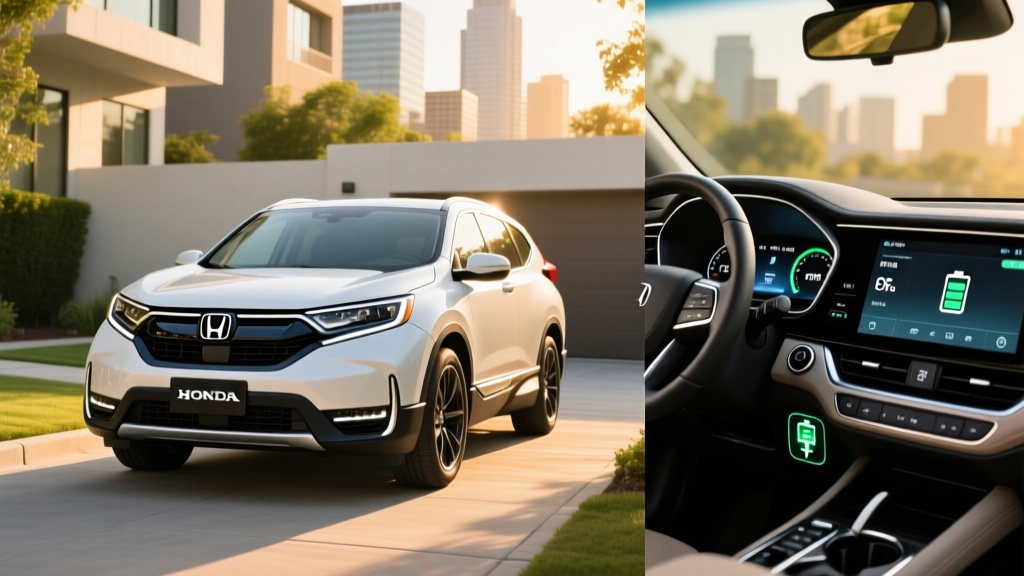
The 2026 Honda CR-V Sport Hybrid occupies a pragmatic middle ground: it delivers the cargo space and ride comfort of a compact SUV while returning fuel economy that undercuts many sedans. Honda's two-motor hybrid system prioritizes smoothness and low-speed efficiency over outright power, making the Sport Hybrid trim a compelling daily driver for commuters who aren't ready—or able—to plug in. At roughly $36,400 to start, it also undercuts plug-in hybrid and full-EV competitors by a wide margin, with no charging infrastructure required.
Before we get into the numbers, a critical distinction: the CR-V Sport Hybrid is a conventional hybrid (HEV), not a plug-in hybrid (PHEV). It charges its own battery through regenerative braking and the gasoline engine. You never plug it in. If you're looking for electric-only driving, you'd need to look at Honda's discontinued Clarity PHEV or competitors like the Toyota RAV4 Prime.
EPA Fuel Economy and Real-World MPG
The 2026 CR-V Sport Hybrid carries over the powertrain introduced with the sixth-generation CR-V refresh. EPA figures remain strong for the compact SUV segment, with front-wheel drive models achieving slightly better numbers than all-wheel drive variants.
| Drivetrain | City MPG | Highway MPG | Combined MPG |
|---|---|---|---|
| FWD | 43 | 36 | 40 |
| AWD | 40 | 34 | 37 |
Source: fueleconomy.gov
Honda's two-motor hybrid system excels in stop-and-go city driving, where the electric motor handles most low-speed propulsion. In real-world city commuting, many owners report 42–45 MPG on the FWD model — slightly exceeding the EPA city estimate. Highway driving tells a different story: at sustained 70–75 mph speeds, expect 32–35 MPG on the AWD variant, as the gasoline engine bears more of the load and aerodynamic drag increases. Cold weather (below 35°F) typically drops combined economy by 3–5 MPG due to reduced battery efficiency, cabin heating demands, and winter fuel blends.
For a driver covering 15,000 miles per year with a 60/40 city-highway split, the AWD CR-V Sport Hybrid would consume roughly 405 gallons of fuel annually — about 140 fewer gallons than a comparably sized gas-only compact SUV rated at 28 MPG combined.
Powertrain: How the Two-Motor System Works
Honda's hybrid system in the CR-V Sport uses a 2.0-liter Atkinson-cycle four-cylinder engine paired with two electric motors in a series-parallel configuration. Here's the hardware breakdown:
| Specification | Value |
|---|---|
| Engine | 2.0L Atkinson-cycle 4-cylinder |
| Engine Output | 145 hp / 138 lb-ft torque |
| Drive Motor Output | 184 hp / 247 lb-ft torque |
| Combined System Output | 204 hp / 247 lb-ft torque |
| Hybrid Battery | ~1.06 kWh lithium-ion (not plug-in) |
| Transmission | e-CVT (no traditional gearbox) |
| 0–60 mph (est.) | ~7.8 seconds |
| Drivetrain | FWD standard; AWD available |
| Towing Capacity | 1,000 lbs |
The system operates in three modes depending on conditions:
- EV Drive: Battery powers the drive motor alone at low speeds and light loads (typically under 30 mph for short distances).
- Hybrid Drive: The engine spins a generator motor to produce electricity, which feeds the drive motor. The engine doesn't directly turn the wheels.
- Engine Drive: At steady highway cruising speeds, a lock-up clutch connects the engine directly to the front wheels for maximum efficiency.
The AWD variant adds a rear-mounted electric motor that provides torque to the rear axle when traction demands it — there's no mechanical driveshaft connecting the engine to the rear wheels.
HEV vs. PHEV vs. EV: Which Fits Your Situation?
| Factor | HEV (CR-V Sport Hybrid) | PHEV (e.g., RAV4 Prime) | BEV (e.g., Ioniq 5) |
|---|---|---|---|
| Plug-in Required? | No | Yes (for EV range) | Yes (always) |
| Electric-Only Range | ~1 mile at low speed | 30–42 miles typical | 250–320+ miles |
| Home Charging Needed? | No | Recommended (Level 2) | Essential (Level 2) |
| Starting Price Range | $36,000–$42,000 | $44,000–$55,000 | $42,000–$65,000 |
| Federal Tax Credit | None | Up to $7,500 (§30D) | Up to $7,500 (§30D) |
| Best For | No charging access; budget-first | Short commute + home charging | Home charging + mostly EV driving |
| Fuel Cost (annual est.) | ~$1,400 | ~$600–$1,100 | ~$500–$800 |
- You lack access to home or workplace charging
- You want maximum cargo and passenger space without a price premium
- Your budget is under $40,000 before incentives
- You drive a mix of city and highway miles and want simplicity
- Your daily round-trip commute is under 35 miles and you can charge at home
- You want electric-only driving for errands but gas flexibility for road trips
- You have reliable Level 2 home charging
- You want to eliminate gasoline entirely and minimize per-mile fuel cost
Pricing, Trims, and Tax Credit Eligibility
The 2026 Honda CR-V Sport Hybrid is available in two trims with the hybrid powertrain:
| Trim | Drivetrain | MSRP (est.) |
|---|---|---|
| Sport Hybrid | FWD | $36,395 |
| Sport Hybrid | AWD | $37,895 |
| Sport Touring Hybrid | AWD | $42,395 |
MSRP includes destination charge. Prices are estimates based on Honda's current pricing trajectory and may vary at time of purchase.
Under current IRS §30D rules, the conventional CR-V Sport Hybrid does not qualify for the federal clean vehicle tax credit. The §30D credit applies only to plug-in electric vehicles (PHEVs and BEVs) with battery capacities of at least 7 kWh. The CR-V Hybrid's ~1 kWh battery falls far short of this threshold.
If you want a Honda with potential tax-credit eligibility, the upcoming Honda Prologue (a full EV built on GM's Ultium platform) may qualify depending on battery sourcing and your income level. Always consult a tax professional and check the latest IRS guidance before relying on credit eligibility for purchase decisions.
Battery Warranty, Reliability, and Replacement Cost
- Hybrid Battery: 8 years / 100,000 miles (10 years / 150,000 miles in CARB states including CA, NY, MA, and others)
- Powertrain Warranty: 5 years / 60,000 miles
- Bumper-to-Bumper: 3 years / 36,000 miles
Honda's hybrid systems have proven durable across multiple generations. The CR-V Hybrid uses a relatively small lithium-ion battery pack (~1.06 kWh) that operates within a narrow state-of-charge window — Honda's battery management system avoids full charges and full discharges to minimize degradation. This is fundamentally different from a full EV battery, which cycles through a much larger energy range daily.
Expected battery lifespan: Based on historical data from Honda and Toyota hybrid owners, conventional hybrid batteries routinely last 150,000–200,000+ miles before capacity loss becomes noticeable. The small battery size means replacement costs are manageable if failure occurs outside warranty.
Replacement cost estimate: If the hybrid battery requires replacement post-warranty, expect $2,000–$4,000 for a new OEM pack including labor. Refurbished or aftermarket packs may reduce this to $1,200–$2,500. This is dramatically lower than EV battery replacements, which can exceed $10,000–$20,000, because the hybrid battery stores roughly 1/60th the energy of a typical EV pack.
Honda's overall reliability ratings remain strong. The CR-V platform consistently earns favorable marks from IIHS and performs well in long-term dependability surveys. The hybrid system adds complexity (two electric motors, power electronics, battery pack), but these components have matured over two decades of Honda hybrid production.
Daily Ownership: What to Expect
Living with the CR-V Sport Hybrid is largely indistinguishable from living with the gas CR-V — with a few notable differences:
- No plugging in: You refuel at gas stations only. The hybrid system manages battery charging automatically.
- Regenerative braking: The brake pedal feels slightly different than a conventional car. Light braking is handled by the electric motor recapturing energy; the friction brakes engage under harder deceleration. Brake pad life is typically extended (60,000–80,000+ miles) because regen handles much of the slowing.
- Engine start-stop: The gasoline engine shuts off at stops and during low-speed coasting. Restart is nearly imperceptible compared to non-hybrid start-stop systems.
- Cargo space: The hybrid battery is packaged under the cargo floor, so cargo volume remains at approximately 36.3 cu ft behind the rear seats and 76.5 cu ft with seats folded — identical to the gas model.
- Maintenance: Honda recommends oil changes every 7,500–10,000 miles. There's no hybrid-specific maintenance schedule beyond standard inspections. The e-CVT has no transmission fluid to change at regular intervals.
Pros, Cons, and the Bottom Line
- 40 MPG combined (FWD) — top-tier for the segment
- No charging infrastructure needed
- 204 hp provides confident highway merging
- Spacious interior: 36.3 cu ft cargo, generous rear legroom
- Smooth, quiet operation in EV and hybrid modes
- AWD available without major efficiency penalty
- Strong Honda Safety Suite ADAS standard
- 8-year/100,000-mile hybrid battery warranty
- No federal tax credit (HEV, not PHEV/BEV)
- Highway MPG drops to 34 (AWD) at sustained speeds
- 1,000-lb towing limit — not for trailers
- ~7.8 sec 0–60 is adequate, not quick
- No plug-in option in the CR-V lineup
- Infotainment touchscreen (7-inch on Sport) is small for the class
- Cabin noise under hard acceleration (engine drone)
Frequently Asked Questions
How many MPG does the CR-V Sport Hybrid get?
The EPA rates the 2026 CR-V Sport Hybrid at 43 city / 36 highway / 40 combined MPG for front-wheel drive, and 40 city / 34 highway / 37 combined for all-wheel drive. Real-world city driving often exceeds EPA estimates, while sustained highway driving at 70+ mph typically falls 2–4 MPG below the sticker number.
Does the CR-V Sport Hybrid need to be plugged in?
No. The CR-V Sport Hybrid is a conventional hybrid (HEV). Its small battery charges through regenerative braking and the gasoline engine. You never plug it in — just fill up at a gas station like any other car.
Is the CR-V Hybrid reliable, and what does battery replacement cost?
Honda's hybrid systems have a strong reliability track record spanning two decades. The hybrid battery is warrantied for 8 years/100,000 miles (10 years/150,000 miles in CARB states). Most hybrid batteries last 150,000–200,000+ miles. Out-of-warranty replacement runs $2,000–$4,000 for an OEM pack — significantly less than an EV battery replacement.
Does the CR-V Hybrid qualify for any tax credit?
No. Under current IRS §30D rules, the federal clean vehicle credit requires a plug-in vehicle with at least 7 kWh of battery capacity. The CR-V Hybrid's ~1 kWh battery doesn't qualify. Some states may offer small rebates for hybrids — check your state's energy office for current programs.
How does the CR-V Hybrid compare to the Toyota RAV4 Hybrid?
Both deliver similar combined MPG (CR-V at 37–40 vs. RAV4 Hybrid at 39–41 depending on trim). The RAV4 Hybrid offers a slightly more powerful AWD system with a dedicated rear motor, while the CR-V Hybrid provides marginally more cargo space. The RAV4 Prime PHEV variant offers 42 miles of electric-only range if you can plug in at home — something the CR-V lineup doesn't currently offer.
Can the CR-V Sport Hybrid tow?
Yes, but with a 1,000-pound maximum towing capacity, it's limited to light utility trailers, small boat trailers, or bike racks. If you need to tow a camper or larger trailer (3,500+ lbs), you'll need to look at a different vehicle class.