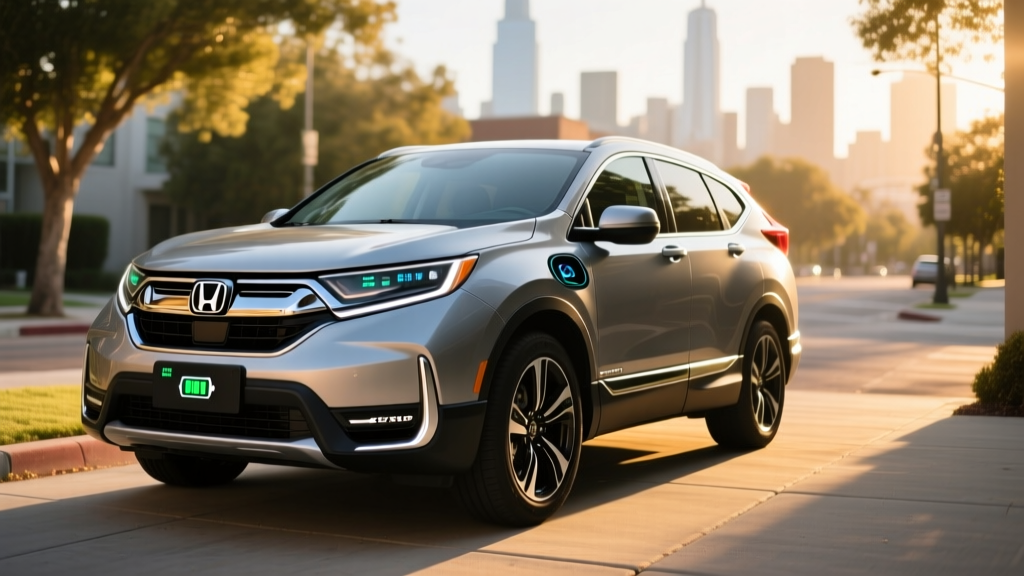
The Honda CR-V Hybrid Sport occupies a strategic middle ground in the compact crossover segment: it offers meaningful fuel savings over the gas-only CR-V without requiring any change to your daily routine. No plugging in, no range anxiety, no charging-curve math. For 2026, the Hybrid Sport trim pairs a 2.0-liter Atkinson-cycle engine with a two-motor hybrid system for 204 combined horsepower and an EPA-estimated 40 MPG combined. That's a real number you'll see in mixed driving—and in city traffic, you'll often beat it.
This guide covers the exact specs, real-world fuel economy expectations, ownership economics, and battery longevity data you need before signing a purchase agreement. We'll also clarify where the CR-V Hybrid fits against plug-in hybrids and full EVs so you can choose the right powertrain for your situation.
2026 Honda CR-V Hybrid Sport: Core Specifications
| Specification | 2026 CR-V Hybrid Sport (AWD) |
|---|---|
| Powertrain | 2.0L Atkinson-cycle 4-cyl + 2-motor hybrid system |
| Combined Horsepower | 204 hp |
| Combined Torque | 247 lb-ft (electric motor) |
| Drivetrain | Standard AWD (Real Time AWD) |
| Transmission | Electronically controlled CVT (eCVT) |
| EPA Fuel Economy (City / Hwy / Combined) | 40 / 34 / 37 MPG (AWD) |
| Fuel Tank Capacity | 15.3 gallons |
| Total Driving Range | ~566 miles (EPA est.) |
| 0–60 mph | ~7.8 seconds (est.) |
| Cargo Volume (rear seats up / folded) | 36.3 / 76.5 cu ft |
| Towing Capacity | 1,000 lbs |
| Base MSRP (Sport AWD) | $37,290 |
| Hybrid Battery Warranty | 8 years / 100,000 miles |
| Powertrain Warranty | 5 years / 60,000 miles |
Important note on EPA figures: The AWD Hybrid Sport is rated at 40 city / 34 highway / 37 combined MPG by the EPA. Front-wheel-drive variants earn slightly higher ratings (43/36/40). We focus on the AWD figures here since the Sport trim comes standard with all-wheel drive in 2026.
Real-World MPG: What You'll Actually See
EPA estimates are a starting point, not a guarantee. Honda's hybrid system excels in stop-and-go driving where the electric motors do the heavy lifting and regenerative braking recaptures energy. Here's what to expect across different scenarios:
| Driving Scenario | Expected MPG | Why |
|---|---|---|
| City / suburban (under 45 mph) | 40–45 MPG | Frequent regen, electric-only at low speeds, engine off at stops |
| Mixed commuting | 36–40 MPG | Blend of city efficiency and moderate highway cruising |
| Highway (70–80 mph sustained) | 30–34 MPG | Aerodynamic drag dominates; hybrid advantage diminishes at speed |
| Cold weather (below 30°F, short trips) | 32–36 MPG | Engine runs more for cabin heat; battery less efficient when cold |
| Mountain / hilly terrain | 28–35 MPG | Uphill energy demand offsets by downhill regen; net varies by route |
Real-World Fuel Economy Verdict: Expect 36–40 MPG in typical mixed driving with the AWD Sport. City-heavy commuters regularly report 42+ MPG on owner forums. Highway road-trippers should budget for 30–33 MPG at 75 mph. With the 15.3-gallon tank, that translates to 460–610 real-world miles between fill-ups depending on your driving mix.
Hybrid vs. Plug-In Hybrid vs. Full EV: Which Fits You?
The CR-V Hybrid is a conventional hybrid (HEV). It generates its own electricity through the engine and regenerative braking—you never plug it in. This is fundamentally different from a plug-in hybrid (PHEV) or a battery-electric vehicle (BEV). Here's how they compare:
| Factor | HEV (CR-V Hybrid) | PHEV (e.g., Toyota RAV4 Prime) | BEV (e.g., Tesla Model Y) |
|---|---|---|---|
| Plug-in required? | No | Yes (for EV range) | Yes |
| Electric-only range | None (EV assists at low speed) | 35–42 miles typical | 260–330 miles typical |
| Fuel/energy cost per mile | ~$0.10–0.12 | ~$0.04 (EV mode) / $0.10 (gas mode) | ~$0.03–0.05 |
| Home charging needed? | No | Recommended (Level 2 ideal) | Essential |
| Tax credit eligible? | No (federal §30D) | Up to $7,500 (if eligible) | Up to $7,500 (if eligible) |
| Upfront price premium | +$1,000–$1,500 vs gas | +$5,000–$8,000 vs gas | +$5,000–$15,000 vs gas |
| Best for | No home charging access, want simplicity | Short commutes + home charging | Daily charging access, lower running costs |
The CR-V Hybrid Sport makes the most sense if you can't install a home charger, rent your home, take frequent long road trips, or simply want a lower-cost entry point into electrified driving without lifestyle changes. If you have a garage with a 240V outlet and a commute under 40 miles, a PHEV like the RAV4 Prime will save more fuel on a daily basis—but costs significantly more upfront.
Powertrain Deep Dive: How the Hybrid System Works
Honda's two-motor hybrid system is one of the more elegant designs in the segment. The 2.0-liter Atkinson-cycle inline-four produces 146 hp on its own, but the combined system output is 204 hp because the electric motors (not the engine) drive the wheels most of the time.
Here's the operating logic:
- EV Drive: At low speeds and light loads, the electric motor propels the car using energy from the lithium-ion battery. The engine stays off.
- Hybrid Drive: During acceleration or higher loads, the engine spins a generator motor that feeds electricity to the drive motor. The engine doesn't mechanically connect to the wheels in most conditions.
- Engine Drive: At steady highway cruising, a lock-up clutch connects the engine directly to the wheels for maximum efficiency at constant speed.
- Regenerative Braking: Lift off the accelerator or brake, and the drive motor reverses into a generator, recapturing kinetic energy into the battery.
The result is smooth, electric-like acceleration from a stop (the electric motor delivers its 247 lb-ft instantly) with the range security of a gas engine. The eCVT isn't a traditional belt-and-pulley CVT—it's a direct-drive system with a fixed gear ratio, which eliminates the "rubber band" feel some drivers dislike in conventional CVTs.
Pricing, Trims, and Tax Credit Eligibility
The 2026 Honda CR-V Hybrid is available in four trims. The Sport sits in the middle of the lineup:
| Trim | MSRP (AWD) | Key Additions Over Base Hybrid |
|---|---|---|
| Hybrid Sport | $37,290 | Blacked-out exterior accents, 19" wheels, sport pedal covers |
| Hybrid Sport-L | $39,850 | Leather-trimmed seats, heated front seats, power tailgate |
| Hybrid Sport Touring | $42,350 | Bose audio, wireless CarPlay/Android Auto, heated rear seats, hands-free tailgate |
All prices include destination. Add roughly $1,200–$1,800 for popular dealer-installed accessories (roof rails, cargo cover, all-season mats).
Federal Tax Credit Status: The Honda CR-V Hybrid (conventional HEV) does not qualify for the federal §30D Clean Vehicle Credit. That credit applies only to plug-in vehicles (PHEVs and BEVs) with battery capacity of at least 7 kWh. The CR-V Hybrid's battery is approximately 1.1 kWh—far below the threshold.
However, some states and localities offer rebates or reduced registration fees for hybrid vehicles. Check your state's energy office or AFDC state incentive database for current programs.
Battery Longevity, Warranty, and Replacement Costs
Hybrid battery anxiety is the top concern we hear from first-time hybrid buyers. Here's what the data shows:
Honda Hybrid Battery Warranty: 8 years or 100,000 miles (whichever comes first) in most states. In California and states that follow CARB emissions standards (including NY, MA, NJ, CT, and others), the warranty extends to 10 years or 150,000 miles.
What's covered: Battery capacity loss below a defined threshold (typically 60–70% of original capacity), cell failures, and hybrid system component defects.
Honda's lithium-ion hybrid battery is designed to last the life of the vehicle. Real-world data from Honda's earlier hybrid systems (Insight, Accord Hybrid) shows most batteries retain 85–90%+ capacity at 150,000 miles. Unlike full EV batteries, hybrid batteries are small and operate in a narrow state-of-charge window (roughly 40–80%), which dramatically reduces degradation stress.
If replacement is needed out of warranty: A new OEM hybrid battery for the CR-V Hybrid runs approximately $2,000–$3,500 including installation at a Honda dealer. Independent hybrid specialists often offer refurbished units for $1,200–$2,000. Given the battery's track record, most owners will never face this cost.
Who Should Buy the CR-V Hybrid Sport?
Choose the CR-V Hybrid Sport if:
- You want better fuel economy without plugging in or changing habits
- You rent or lack access to Level 2 home charging
- You take regular road trips exceeding 300 miles
- You live in a cold climate where EV range loss is a concern
- You want AWD capability for snow or light off-road use
- Your budget is $37,000–$43,000 and you want proven reliability
Look at a PHEV or BEV instead if:
- You have home charging and a daily commute under 35 miles (a PHEV covers most trips on electricity)
- You want the lowest possible per-mile energy cost (BEV at $0.03–0.05/mile vs. hybrid at $0.10–0.12)
- You qualify for the $7,500 federal tax credit on a PHEV/BEV and want to offset a higher purchase price
- You want one-pedal driving and instant full-torque acceleration (BEV experience)
Pros
- 40 MPG city is outstanding for an AWD crossover
- No plug-in required—zero lifestyle change
- Smooth electric-motor torque from a stop
- Strong cargo space (36.3 cu ft) with no battery intrusion
- Honda's reliability reputation and 8–10 year battery warranty
- Competitively priced vs. RAV4 Hybrid and Tucson Hybrid
Cons
- Highway MPG drops to 30–33 at 75+ mph (aerodynamic limitations)
- No federal tax credit (HEV limitation)
- 1,000-lb towing capacity is low for the segment
- Engine drone under hard acceleration (eCVT characteristic)
- Sport trim lacks premium features (leather, Bose) found in Sport-L and Touring
Frequently Asked Questions
How many MPG does the Honda CR-V Hybrid Sport actually get?
The EPA rates the AWD Hybrid Sport at 40 city / 34 highway / 37 combined. In real-world mixed driving, expect 36–40 MPG. City-heavy drivers often see 42–45 MPG thanks to frequent regenerative braking and electric-only operation at low speeds. Highway-only driving at 75 mph drops to roughly 30–33 MPG.
Does the CR-V Hybrid need to be plugged in?
No. The CR-V Hybrid is a conventional hybrid (HEV). It charges its own small battery through the gas engine and regenerative braking. You fuel it like any other car—just fill up with regular unleaded gasoline.
How far can the CR-V Hybrid go on a full tank?
With a 15.3-gallon tank and 37 MPG combined EPA rating, the theoretical range is about 566 miles. Real-world range typically falls between 460 and 550 miles depending on driving conditions, speed, and temperature.
Is the hybrid battery reliable? What does replacement cost?
Honda's hybrid batteries have an excellent longevity record. The warranty covers 8 years/100,000 miles (10 years/150,000 miles in CARB states). Most batteries retain 85%+ capacity at 150,000 miles. If replacement is ever needed out of warranty, expect $2,000–$3,500 for a new OEM battery or $1,200–$2,000 for a refurbished unit.
Does the CR-V Hybrid qualify for a federal tax credit?
No. The federal §30D Clean Vehicle Credit applies only to plug-in vehicles (PHEVs and BEVs) with battery capacity of 7 kWh or more. The CR-V Hybrid's battery is approximately 1.1 kWh. Some states may offer separate hybrid incentives—check the AFDC database for your area.
How does the CR-V Hybrid compare to the Toyota RAV4 Hybrid?
The RAV4 Hybrid (219 hp, 41 MPG combined AWD) is slightly more powerful and marginally more efficient on paper. The CR-V Hybrid counters with more cargo space (36.3 vs 37.5 cu ft is comparable), a more refined interior in upper trims, and Honda's driving dynamics. Both are excellent choices—test-drive both to see which cockpit and ride quality you prefer.
Is AWD standard on the Hybrid Sport?
Yes. For 2026, all CR-V Hybrid trims come standard with Honda Real Time AWD. The system operates primarily in front-wheel drive for efficiency and sends torque to the rear wheels when slip is detected or under hard acceleration.
What's the difference between the Sport, Sport-L, and Sport Touring trims?
The Sport ($37,290) is the value entry with cloth seats and 19" black alloy wheels. The Sport-L ($39,850) adds leather, heated front seats, and a power tailgate. The Sport Touring ($42,350) is the fully loaded variant with Bose premium audio, wireless phone integration, heated rear seats, and a hands-free tailgate. All three share the identical 204 hp hybrid powertrain and AWD system.