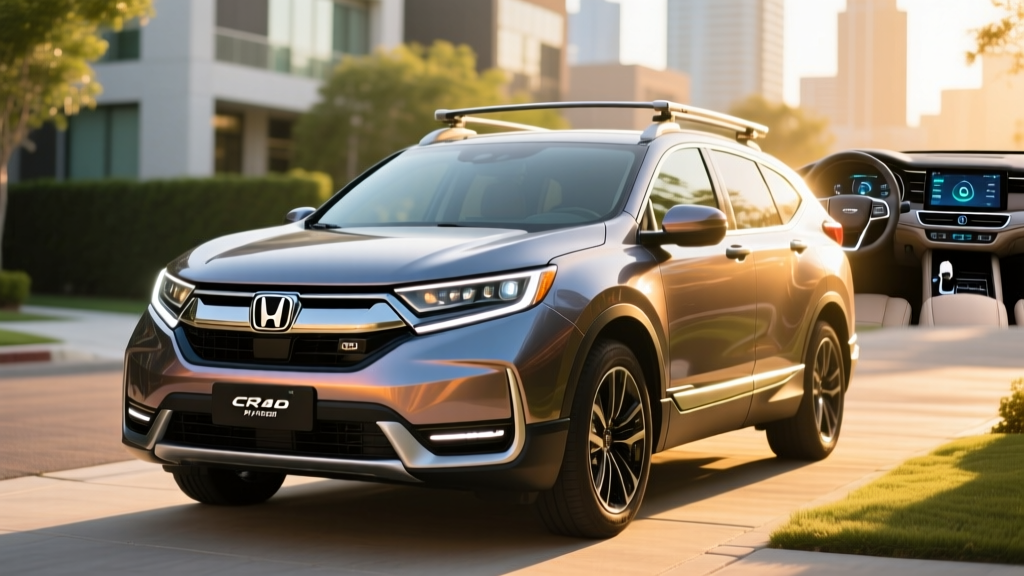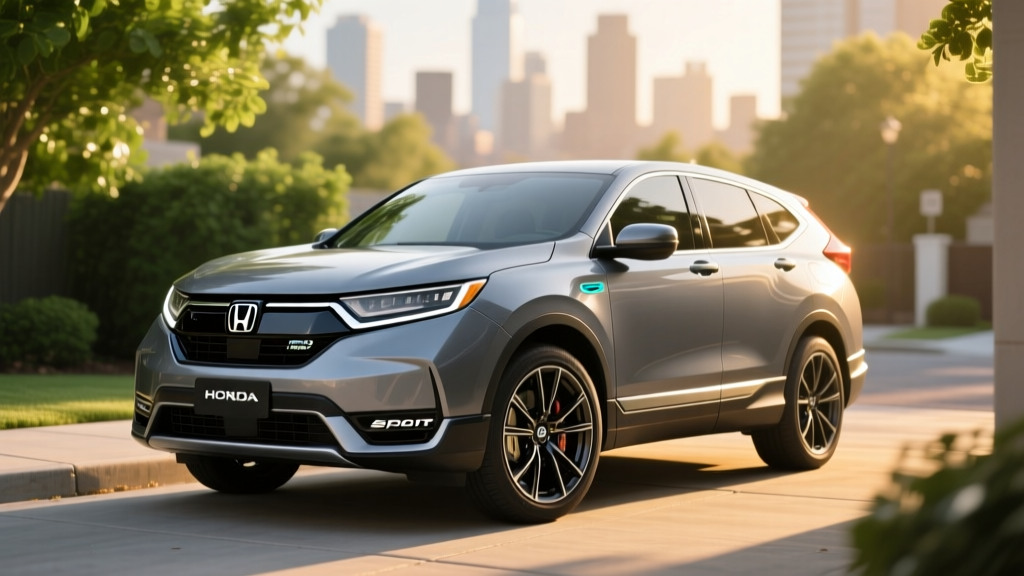
Honda CR-V Hybrid Sport: The Practical Compact SUV for Mileage-Minded Buyers
The Honda CR-V has been America's best-selling compact SUV for years, and the Hybrid Sport trim sits at a compelling intersection: sport-tuned styling, standard all-wheel drive, and a two-motor hybrid system that delivers EPA-rated 40 MPG combined without ever needing a plug. For 2026, the CR-V Hybrid Sport continues with the proven sixth-generation powertrain, updated infotainment, and Honda Sensing safety tech — making it one of the most data-backed choices in a crowded hybrid crossover segment.
This guide breaks down every number that matters: real-world fuel economy versus the EPA sticker, the hybrid battery warranty and replacement economics, how the CR-V Hybrid Sport stacks against plug-in hybrids and full EVs, and whether any federal tax credits apply. If you're cross-shopping the Toyota RAV4 Hybrid, Hyundai Tucson Hybrid, or considering whether a PHEV makes more financial sense, the figures below will help you decide.
EPA Fuel Economy vs. Real-World MPG: What to Actually Expect
The 2026 Honda CR-V Hybrid Sport with standard all-wheel drive carries EPA ratings of 40 MPG city, 34 MPG highway, and 37 MPG combined, according to fueleconomy.gov. Front-wheel-drive variants (where available) edge slightly higher at 43/36/40 MPG city/highway/combined.
| Drivetrain | City MPG | Highway MPG | Combined MPG |
|---|---|---|---|
| AWD (Sport, Sport Touring) | 40 | 34 | 37 |
| FWD (Sport, where available) | 43 | 36 | 40 |
These numbers deserve context. Honda's two-motor hybrid system operates primarily in electric-drive mode at low and moderate speeds, with the 2.0-liter Atkinson-cycle engine acting as a generator. This means city driving — where regenerative braking recaptures energy and the engine runs less — often yields real-world results that meet or exceed the EPA city figure. Many owners report 41–44 MPG in suburban and urban commuting.
Highway driving tells a different story. At sustained 70–80 mph speeds, the engine must directly drive the wheels via a lock-up clutch, and aerodynamic drag works against the CR-V's crossover profile. Expect 31–34 MPG on flat interstate runs, and potentially 28–30 MPG in mountainous terrain or when towing (maximum tow rating: 1,000 lbs). Cold weather (below 32°F) typically reduces fuel economy by 5–10% as the engine runs more frequently for cabin heat and battery conditioning.
Powertrain Specs: 204 Horsepower from Honda's Two-Motor System
The CR-V Hybrid Sport uses Honda's fourth-generation two-motor hybrid system, pairing a 2.0-liter DOHC Atkinson-cycle four-cylinder engine with two electric motors and a lithium-ion battery pack. The result is 204 combined system horsepower and 247 lb-ft of torque from the drive motor — figures that put it squarely in competition with the Toyota RAV4 Hybrid (219 hp) and ahead of the Hyundai Tucson Hybrid (226 hp combined, though with a traditional automatic rather than an e-CVT).
| Specification | Value |
|---|---|
| Engine | 2.0L DOHC Atkinson-cycle I-4 |
| Engine Power | 145 hp @ 6,100 rpm |
| Drive Motor Power | 181 hp (135 kW) |
| Combined System Output | 204 hp |
| Drive Motor Torque | 247 lb-ft (335 Nm) |
| Transmission | e-CVT (direct drive with lock-up clutch) |
| Hybrid Battery | Lithium-ion, ~1.1 kWh (HEV) |
| Drivetrain | Real Time AWD (standard on Sport) |
| 0–60 mph | ~7.6 seconds (est.) |
| Towing Capacity | 1,000 lbs |
This is a conventional hybrid (HEV), not a plug-in hybrid (PHEV). The battery recharges through regenerative braking and engine-generated electricity. You never plug it in. The relatively small ~1.1 kWh battery pack is sufficient for low-speed electric-only motoring (typically under 1–2 miles at parking-lot speeds) but is designed for assist-and-regenerate duty, not sustained electric driving.
HEV (Conventional Hybrid): Small battery (~1–2 kWh), charges via regen and engine, no plug needed, improves MPG 30–50% over gas-only. The CR-V Hybrid Sport is an HEV.
PHEV (Plug-In Hybrid): Larger battery (12–20+ kWh), plugs into a wall outlet or Level 2 charger, delivers 25–45 miles of electric-only range before the engine engages. Examples: Toyota RAV4 Prime (42 mi EV range), Hyundai Tucson PHEV (33 mi). PHEVs qualify for federal tax credits; conventional HEVs do not.
Pricing, Trims, and Tax Credit Eligibility
The 2026 Honda CR-V Hybrid Sport starts at an MSRP of approximately $36,395, including destination. The range-topping Hybrid Sport Touring, which adds leather seats, a Bose premium audio system, wireless Apple CarPlay/Android Auto, and a hands-free power tailgate, starts around $41,795.
| Trim | Drivetrain | MSRP (incl. destination) |
|---|---|---|
| Sport Hybrid | AWD | ~$36,395 |
| Sport Touring Hybrid | AWD | ~$41,795 |
Federal tax credit: The CR-V Hybrid Sport is a conventional hybrid (HEV), which means it does not qualify for the IRS §30D Clean Vehicle Credit. That credit — up to $7,500 — applies only to battery electric vehicles (BEVs) and plug-in hybrids (PHEVs) meeting battery-sourcing, critical-mineral, MSRP, and buyer-income requirements. Conventional hybrids receive no federal purchase incentive as of 2026.
Some states and local utilities offer rebates for hybrid purchases, but these vary widely by jurisdiction. Check your state energy office or utility provider for current programs. Honda occasionally offers manufacturer incentives (low-APR financing or cash-back), which can reduce the effective price at the dealership level.
Hybrid Battery Warranty, Lifespan, and Replacement Cost
Battery longevity is consistently the top concern among first-time hybrid buyers, and Honda addresses it with robust warranty coverage. The CR-V Hybrid's lithium-ion battery pack is covered under Honda's hybrid-system warranty:
• 8 years / 100,000 miles in most states
• 10 years / 150,000 miles in CARB states (California, New York, Massachusetts, and others adopting California emissions standards)
• Covers battery capacity loss below functional thresholds and all hybrid-system components (power control unit, drive motor, e-CVT)
In practice, Honda's hybrid batteries have demonstrated strong longevity. Data from fleet operators and long-term owner surveys suggest that the CR-V Hybrid battery typically retains 85–90% of its original capacity after 100,000 miles. Because the HEV battery is small and never deeply cycled (the system maintains a charge buffer, typically using only 40–60% of total capacity), degradation is gradual. Many CR-V Hybrids from the 2020–2023 model years are still operating on their original battery packs well past 120,000 miles.
If replacement is needed outside warranty, a new OEM hybrid battery for the CR-V Hybrid currently costs between $2,000 and $3,500 installed at a Honda dealership, depending on labor rates. Third-party refurbishment shops offer reconditioned packs for $1,200–$2,000. For context, this is dramatically less expensive than a full EV battery replacement ($8,000–$20,000+) because the CR-V Hybrid's pack is roughly 1/60th the size of a typical BEV battery.
CR-V Hybrid Sport vs. RAV4 Hybrid vs. Tucson Hybrid
The compact hybrid SUV segment is fiercely competitive. Here's how the CR-V Hybrid Sport stacks up on the numbers that matter most:
| Specification | Honda CR-V Hybrid Sport | Toyota RAV4 Hybrid XSE | Hyundai Tucson Hybrid SEL |
|---|---|---|---|
| Combined MPG (AWD) | 37 | 39 | 38 |
| City / Highway MPG | 40 / 34 | 41 / 38 | 38 / 38 |
| Combined Horsepower | 204 hp | 219 hp | 226 hp |
| 0–60 mph (est.) | ~7.6 sec | ~7.4 sec | ~7.1 sec |
| Cargo Volume (rear seats up) | 36.3 cu ft | 37.6 cu ft | 38.7 cu ft |
| Starting MSRP (AWD Hybrid) | ~$36,395 | ~$37,425 | ~$37,750 |
| Battery Warranty | 8 yr/100k mi | 10 yr/150k mi | 10 yr/100k mi |
| Federal Tax Credit | No | No | No |
The RAV4 Hybrid edges out the CR-V on fuel economy by 2 MPG combined, largely due to Toyota's more aggressive engine shut-off strategy and slightly lower curb weight. The Tucson Hybrid offers the most cargo space and the quickest acceleration. The CR-V Hybrid Sport's advantage lies in its interior refinement, Honda Sensing suite (standard adaptive cruise control, lane-keeping assist, and automatic emergency braking), and historically strong resale value — IIHS has consistently rated the CR-V as a Top Safety Pick+.
Who Should Choose the CR-V Hybrid Sport — And Who Shouldn't
- You drive 12,000–18,000 miles/year and want to cut fuel costs without changing your refueling habits
- You lack access to home or workplace charging (apartment, street parking) — no plug required
- You want AWD for snow/rain with minimal fuel-economy penalty
- You plan to keep the vehicle 8–12 years and value long-term reliability data
- You prefer Honda's driving dynamics and Honda Sensing safety tech
- You have a short commute and home charging — a PHEV (RAV4 Prime, Tucson PHEV) delivers 30–42 miles electric-only and qualifies for up to $7,500 in federal credits
- You want maximum cargo space — the Tucson Hybrid offers 2.4 cu ft more
- You tow regularly — the CR-V's 1,000-lb limit trails some competitors
- You want pure electric driving with zero tailpipe emissions — consider a BEV like the Hyundai Ioniq 5 or Tesla Model Y
- Prioritizing the absolute best MPG above all — the RAV4 Hybrid returns 39 MPG combined
For buyers with reliable home charging and a commute under 40 miles round-trip, a PHEV often makes stronger financial sense despite a higher MSRP, because the federal §30D credit (up to $7,500, subject to IRS income and sourcing rules) can offset the price premium. The RAV4 Prime, for example, starts around $44,000 but drops to roughly $36,500 after the full credit — comparable to the CR-V Hybrid Sport's sticker price while delivering 42 miles of electric-only range and 94 MPGe when charged.
But if plugging in simply isn't feasible — you park on the street, live in an apartment without charging access, or travel frequently to areas without charging infrastructure — the CR-V Hybrid Sport is one of the most rational choices available. It delivers meaningful fuel savings (roughly $500–$700/year versus a gas-only CR-V at 15,000 miles and $3.50/gallon), requires zero behavioral change, and carries the reliability pedigree Honda has built across two decades of hybrid production.
Ownership Costs: 5-Year Fuel Savings vs. Gas-Only CR-V
| Metric | CR-V Hybrid Sport (AWD) | CR-V EX Gas (AWD, 28 MPG comb.) |
|---|---|---|
| EPA Combined MPG | 37 | 28 |
| Annual Miles | 15,000 | 15,000 |
| Fuel Cost/Gallon | $3.50 | $3.50 |
| Annual Fuel Cost | ~$1,419 | ~$1,875 |
| 5-Year Fuel Cost | ~$7,095 | ~$9,375 |
| 5-Year Fuel Savings | ~$2,280 | |
The Hybrid Sport's roughly $1,800 MSRP premium over a comparably equipped gas CR-V is typically recouped through fuel savings within 4–5 years at current gas prices, and sooner if fuel prices rise or if your driving skews heavily toward city commuting where the hybrid advantage is greatest. Factor in the CR-V Hybrid's stronger resale value — hybrid variants typically retain 3–5% more of their purchase price at the 5-year mark, according to industry depreciation data — and the total cost of ownership tilts further in the hybrid's favor.
Frequently Asked Questions
How many MPG does the 2026 CR-V Hybrid Sport get?
The EPA rates the AWD CR-V Hybrid Sport at 40 MPG city, 34 MPG highway, and 37 MPG combined. Real-world mixed driving typically yields 37–42 MPG, with city-heavy routes often exceeding the EPA city estimate. Highway-only driving at 75+ mph drops to 31–34 MPG.
Does the CR-V Hybrid Sport need to be plugged in?
No. The CR-V Hybrid Sport is a conventional hybrid (HEV), not a plug-in hybrid. Its battery recharges automatically through regenerative braking and the gasoline engine. You fuel it exactly like a standard gas car — at any gas station.
Does the CR-V Hybrid qualify for any federal tax credit?
No. Under current IRS §30D rules, only battery electric vehicles (BEVs) and plug-in hybrids (PHEVs) qualify for the federal Clean Vehicle Credit (up to $7,500). Conventional hybrids like the CR-V Hybrid Sport are not eligible. Some state or utility rebates may apply — check local programs.
How long will the CR-V Hybrid battery last, and what does replacement cost?
Honda covers the hybrid battery for 8 years/100,000 miles (10 years/150,000 miles in CARB states). Real-world data shows most CR-V Hybrid batteries retain 85–90% capacity at 100,000 miles and last well beyond 150,000 miles. Out-of-warranty replacement costs $2,000–$3,500 for a new OEM pack, or $1,200–$2,000 for a refurbished unit.
Hybrid vs. PHEV vs. EV — which is right for me?
Choose the HEV (CR-V Hybrid Sport) if you lack home/workplace charging access or don't want to change refueling habits. Choose a PHEV if you can charge at home, commute under 40 miles, and want electric-only daily driving with gas-engine backup for road trips — plus potential federal tax credits. Choose a full EV if you have reliable charging, want zero tailpipe emissions, the lowest per-mile energy cost, and minimal maintenance.
Is the CR-V Hybrid Sport reliable?
Honda's two-motor hybrid system is in its fourth generation and has accumulated millions of real-world miles across the CR-V, Accord, and Civic Hybrid lineups. The e-CVT has no traditional gears or belts to wear, and the brake system benefits from regenerative braking (which reduces pad wear). The CR-V consistently earns top reliability marks from major consumer survey organizations, and Honda Sensing safety features come standard on every Hybrid Sport trim.