Quick Verdict: The CR-V Hybrid Sport-L in 2026
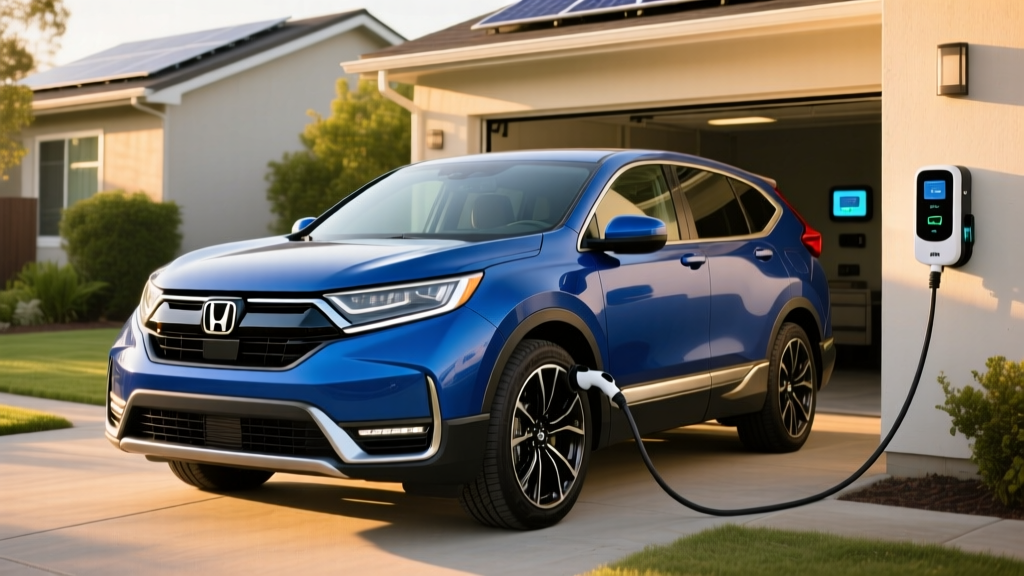
The 2026 Honda CR-V Hybrid Sport-L occupies a practical sweet spot for buyers who want electric-motor efficiency without plugging in. As a conventional hybrid (HEV), it requires zero lifestyle change — no home charger, no range planning — while delivering an EPA-estimated 40 MPG combined. The Sport-L trim adds leather seating, a power liftgate, and wireless Apple CarPlay/Android Auto on top of the hybrid powertrain, making it one of the most equipped non-touring CR-V Hybrid models Honda offers.
This guide covers the exact numbers that matter: fuel economy across city and highway driving, the two-motor hybrid system's output, real-world MPG expectations, battery longevity, and whether any federal tax incentives apply to this trim in 2026.
| Spec | Value |
|---|---|
| Powertrain | 2.0L Atkinson-cycle 4-cyl + two-motor hybrid system |
| Combined Horsepower | 204 hp |
| Combined Torque | 247 lb-ft (electric motor) |
| Drivetrain | AWD (standard on Sport-L) |
| EPA MPG (City / Hwy / Combined) | 40 / 34 / 37 |
| Fuel Tank | 14.0 gallons |
| EPA Total Range | ~518 miles |
| 0–60 mph | ~7.6 seconds (est.) |
| Cargo Volume (behind rear seats) | 36.3 cu ft |
| Towing Capacity | 1,000 lbs |
| Hybrid Battery Warranty | 8 years / 100,000 miles |
| MSRP (Sport-L AWD) | ~$38,950 (est.) |
HEV vs. PHEV: What the CR-V Hybrid Actually Is
A common point of confusion in the CR-V lineup is the difference between the standard CR-V Hybrid and a plug-in hybrid. Here's the distinction:
| Feature | CR-V Hybrid (HEV) | Plug-In Hybrid (PHEV) — General |
|---|---|---|
| Plugs into a charger? | No — refuels with gas only | Yes — has a charge port |
| Electric-only range | None (EV mode at low speeds only, ~1–2 mi) | Typically 25–45 miles |
| Battery size | ~1.1 kWh (small buffer) | 12–20 kWh |
| DC fast charging | N/A | Some models, not all |
| Federal tax credit (§30D) | Not eligible | Up to $7,500 if eligible |
| Best for | No home charging access; simple ownership | Home chargers; short commutes on electric |
The 2026 CR-V Hybrid Sport-L is a conventional hybrid (HEV). It recovers energy through regenerative braking and uses its electric motors to assist the gasoline engine — but it has no plug, no electric-only commuting range, and no external charging capability. Honda does not currently offer a PHEV variant of the CR-V in the U.S. market.
Fuel Economy: EPA Ratings and Real-World MPG
| Driving Cycle | EPA Estimate |
|---|---|
| City | 40 MPG |
| Highway | 34 MPG |
| Combined | 37 MPG |
The city-highway split tells an important story. Like most Honda hybrids using the two-motor system, the CR-V Hybrid excels in stop-and-go traffic where regenerative braking recaptures energy and the electric motor handles low-speed propulsion. The 40 MPG city figure is where this powertrain shines.
Real-World MPG: What Owners Actually See
EPA estimates are measured on controlled dynamometer cycles. In practice, your results depend heavily on driving style, climate, and route mix:
- City-dominant commuting: Many owners report 38–43 MPG in warm-weather city driving. The hybrid system's ability to run the engine only at its most efficient RPM, combined with frequent regen braking, can actually exceed the EPA city number.
- Highway cruising at 70–80 mph: Expect 30–34 MPG. At sustained highway speeds, the gasoline engine does most of the work directly, and aerodynamic drag dominates. This is where the hybrid advantage narrows.
- Cold weather (below 35°F): MPG typically drops 10–15%. The engine runs more often to provide cabin heat (no heat pump on the HEV), and battery efficiency decreases in low temperatures. Expect 32–35 MPG combined in winter conditions.
- Mixed driving (50/50 city-highway): Most owners land between 35–39 MPG combined over a full tank, closely tracking the EPA combined estimate of 37 MPG.
According to fueleconomy.gov, the CR-V Hybrid AWD achieves its 37 MPG combined rating with regular unleaded (87 octane), keeping fuel costs low compared to turbocharged competitors requiring premium.
Powertrain Deep Dive: Honda's Two-Motor Hybrid System
The 2026 CR-V Hybrid uses Honda's fourth-generation two-motor hybrid system, which operates differently from a traditional parallel hybrid like Toyota's planetary-gear setup:
- 2.0L Atkinson-cycle engine: Produces approximately 145 hp on its own. The Atkinson cycle sacrifices peak power for thermal efficiency — ideal for a hybrid where the electric motors fill in torque gaps.
- Drive motor: The primary propulsion motor delivers up to 181 hp and 247 lb-ft of torque. At low and moderate speeds, this motor does nearly all the driving.
- Generator motor: The second motor acts as a generator, converting engine output to electricity that feeds the drive motor or charges the small battery buffer.
- Combined output: 204 hp. This is system net output, not a simple sum — the engine and motors don't peak at the same RPM.
In normal driving, the CR-V Hybrid operates primarily as a series hybrid (engine generates electricity → motor drives wheels). At highway speeds, a lock-up clutch engages to connect the engine directly to the wheels, bypassing the electric conversion for better efficiency. This is why highway MPG is lower than city — the engine is doing direct mechanical work without the hybrid system's torque-multiplication benefit.
Pricing, Trim Positioning, and Tax Credit Eligibility
The 2026 CR-V Hybrid Sport-L AWD carries an estimated MSRP of approximately $38,950 (including destination). This positions it between the Sport (~$36,500) and the Sport Touring (~$42,000) in the CR-V Hybrid lineup.
Federal Tax Credit: Does the CR-V Hybrid Qualify?
No. Under IRS §30D rules, the federal Clean Vehicle Credit applies only to plug-in electric vehicles (BEVs and PHEVs) with a minimum battery capacity of 7 kWh and external charging capability. The CR-V Hybrid is a conventional HEV with a ~1.1 kWh battery and no charge port. It does not qualify for the federal §30D credit of up to $7,500.
Per IRS guidance on clean vehicle credits, conventional hybrids are excluded regardless of fuel efficiency. Some states may offer minor incentives for high-efficiency vehicles, but these vary by jurisdiction — check your state's energy or DMV website for specifics.
Total Fuel Cost Perspective
Even without a tax credit, the CR-V Hybrid's fuel savings are meaningful. At 37 MPG combined versus a comparable gas-only compact SUV at 28 MPG combined, driving 15,000 miles per year at $3.50/gallon:
- CR-V Hybrid: ~405 gallons/year = ~$1,419
- Gas-only competitor: ~536 gallons/year = ~$1,875
- Annual savings: ~$456/year, or ~$2,280 over five years
Reliability, Battery Lifespan, and Replacement Cost
Hybrid Battery Warranty
Honda covers the CR-V Hybrid's high-voltage battery for 8 years or 100,000 miles (whichever comes first) under the federal emissions warranty. In California Air Resources Board (CARB) states, this extends to 10 years or 150,000 miles. The warranty covers capacity loss below a defined threshold and any manufacturing defects.
How Long Will the Hybrid Battery Last?
Honda's hybrid battery is a lithium-ion pack sized at approximately 1.1 kWh usable. Because the system never fully charges or fully depletes the battery — maintaining a state-of-charge window of roughly 40–80% — the cells experience minimal cycle stress. Real-world data from Honda's hybrid fleet (Insight, Accord Hybrid, CR-V Hybrid) shows:
- Typical lifespan: Most Honda hybrid batteries last 150,000–200,000+ miles before significant degradation.
- Degradation pattern: Capacity loss is gradual. Owners may notice slightly reduced EV-mode assist at very low speeds after 100,000+ miles, but MPG impact is usually negligible (1–2 MPG at most).
- Failure rate: Catastrophic battery failure is rare. Most warranty claims involve individual cell balancing issues rather than full-pack replacement.
Battery Replacement Cost
If replacement is needed outside warranty, a refurbished CR-V Hybrid battery pack typically costs $2,000–$3,500 installed at an independent hybrid specialist. A new OEM pack from Honda runs approximately $3,500–$5,000 including labor at a dealership. Given the battery's track record of outlasting 150,000 miles, most original owners will never face this cost.
According to Consumer Reports hybrid reliability surveys, Honda's hybrid system ranks among the most dependable in the compact SUV segment, with fewer reported powertrain issues than turbocharged gas-only competitors.
CR-V Hybrid Sport-L vs. Alternatives: Which Should You Choose?
Pros — CR-V Hybrid Sport-L
- 40 MPG city without plugging in — zero lifestyle change
- Standard AWD with no MPG penalty vs. FWD hybrid competitors
- Smooth, responsive electric-motor torque at low speeds
- Sport-L adds leather, wireless CarPlay, power liftgate
- Proven Honda hybrid reliability; 8yr/100k-mi battery warranty
- 36.3 cu ft cargo — among the best in the segment
Cons — CR-V Hybrid Sport-L
- No federal tax credit (HEV, not PHEV/BEV)
- Highway MPG (34) trails city (40) noticeably
- Towing limited to 1,000 lbs (vs. 1,500 for some gas models)
- No PHEV option if you want electric-only commuting
- CVT-like drone under hard acceleration
- Sport-L pricing approaches Sport Touring territory with options
Decision Framework: Hybrid, PHEV, or Full EV?
- Choose the CR-V Hybrid (HEV) if: You lack reliable home or workplace charging, drive a mix of city and highway, and want maximum efficiency with zero plug-in hassle. Ideal for apartment dwellers and road-trippers alike.
- Choose a PHEV (like the Toyota RAV4 Prime or Hyundai Tucson PHEV) if: You can install a Level 2 home charger, your daily commute is under 35 miles round-trip, and you want electric-only driving most days with gas backup for longer trips. PHEVs may qualify for the §30D federal tax credit.
- Choose a full BEV (like the Hyundai Ioniq 5 or Tesla Model Y) if: You have home charging, rarely drive more than 250 miles in a single day, and want the lowest per-mile energy cost plus federal tax credit eligibility. BEVs eliminate oil changes and have fewer moving parts.
Honda Sensing and Safety
Every 2026 CR-V Hybrid Sport-L comes standard with the Honda Sensing suite, which includes:
- Adaptive Cruise Control (ACC) with Low-Speed Follow
- Collision Mitigation Braking System (CMBS)
- Lane Keeping Assist System (LKAS) and Road Departure Mitigation
- Traffic Sign Recognition
- Blind Spot Information with Rear Cross Traffic Monitor
This is an SAE Level 2 driver-assistance system — it can manage steering and speed simultaneously under supervision, but the driver must remain fully engaged with hands on the wheel and eyes on the road. It is not autonomous driving. The CR-V earned top marks from the IIHS in prior model years, and the 2026 model carries forward the same structural safety platform.
Frequently Asked Questions
How many MPG does the 2026 Honda CR-V Hybrid Sport-L get?
The EPA rates it at 40 MPG city, 34 MPG highway, and 37 MPG combined with AWD. Real-world results typically range from 35–43 MPG depending on driving conditions, with city-dominant routes yielding the best numbers.
Does the CR-V Hybrid need to be plugged in?
No. The CR-V Hybrid is a conventional hybrid (HEV). It charges its small battery through regenerative braking and the gasoline engine. You refuel it at a gas station like any other car.
Does the 2026 CR-V Hybrid qualify for a federal tax credit?
No. The IRS §30D Clean Vehicle Credit applies only to plug-in vehicles (BEVs and PHEVs). Conventional hybrids like the CR-V Hybrid are not eligible regardless of fuel efficiency.
How long will the CR-V Hybrid battery last?
Honda's hybrid batteries typically last 150,000–200,000+ miles. The system keeps the battery in a narrow state-of-charge window (roughly 40–80%), which dramatically reduces degradation. Honda covers the battery for 8 years/100,000 miles (10 years/150,000 miles in CARB states).
What does it cost to replace the hybrid battery?
Out-of-warranty replacement runs approximately $2,000–$3,500 for a refurbished pack or $3,500–$5,000 for a new OEM pack with labor. Most owners never need a replacement during typical ownership.
Is the CR-V Hybrid Sport-L better than the gas-only CR-V?
For most buyers, yes. The hybrid delivers 37 MPG combined versus approximately 30 MPG for the gas-only AWD CR-V — a ~23% fuel savings — while providing stronger low-speed torque from the electric motor. The trade-off is a slightly higher purchase price (~$1,500 more) and a 500-lb lower towing capacity.
Can I get a PHEV version of the CR-V?
Honda does not offer a plug-in hybrid CR-V in the U.S. market as of the 2026 model year. If PHEV capability is a priority, consider the Toyota RAV4 Prime (42 miles electric-only) or the Hyundai Tucson PHEV (33 miles electric-only).