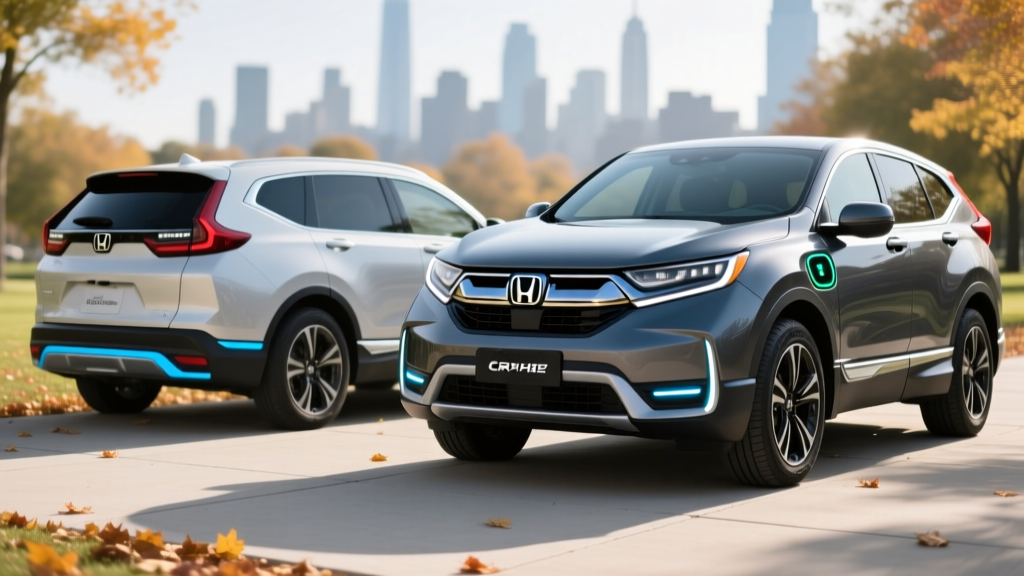
If you want to cut fuel costs without worrying about charging infrastructure, Honda's 2026 hybrid SUV lineup narrows the choice to two distinct paths: the self-charging CR-V Hybrid and the plug-in CR-V e:PHEV (branded in some markets as the CR-V Sport Plug-In Hybrid). Both use Honda's fourth-generation two-motor hybrid system, but they serve very different daily driving patterns. This guide breaks down every number that matters — MPG, electric-only range, battery size, pricing, and tax credit eligibility — so you can pick the right one.
HEV vs PHEV: What's the Actual Difference?
Before comparing trims, it's critical to understand that Honda sells two fundamentally different powertrain types in the CR-V for 2026:
- Conventional Hybrid (HEV): The CR-V Hybrid pairs a 2.0L Atkinson-cycle engine with two electric motors and a small 1.06 kWh lithium-ion battery. It never plugs in. The battery recharges through regenerative braking and the gas engine. You drive it exactly like a regular car — just with better fuel economy.
- Plug-In Hybrid (PHEV): The CR-V e:PHEV uses a larger 17.7 kWh battery and more powerful electric motors. You can plug it in to get up to 34 miles of pure electric driving before the gas engine kicks in. It also operates as a conventional hybrid once the battery depletes.
The HEV is simpler and cheaper; the PHEV rewards owners who can charge at home and have shorter commutes.
Fuel Economy: EPA MPG Breakdown
Here's where the numbers separate the two models. Data sourced from fueleconomy.gov and Honda's official specifications:
| Model | City MPG | Highway MPG | Combined MPG | MPGe (PHEV EV Mode) |
|---|---|---|---|---|
| 2026 CR-V Hybrid (FWD) | 43 | 36 | 40 | N/A |
| 2026 CR-V Hybrid (AWD) | 40 | 34 | 37 | N/A |
| 2026 CR-V e:PHEV (FWD, hybrid mode) | 40 | 35 | 38 | 92 MPGe |
Real-world MPG note: Honda's two-motor hybrid system excels in city driving, where the electric motors do most of the work at low speeds. Owners consistently report exceeding EPA city estimates by 2–4 MPG in stop-and-go traffic. Highway driving is where hybrids lose their advantage — expect the AWD CR-V Hybrid to deliver 31–33 MPG at sustained 75 mph on the interstate, below its 34 MPG sticker.
Total Range Reality
The CR-V Hybrid's 14.0-gallon tank yields a real-world range of approximately 500–520 miles in mixed driving. The CR-V e:PHEV adds 34 electric-only miles on top of roughly 430 miles in hybrid mode after depletion, for a combined total of around 460–470 miles before needing fuel or a plug.
CR-V e:PHEV: Electric-Only Range and Charging
The plug-in model's headline feature is 34 miles of EPA-rated electric-only range — enough to cover most daily commutes and school runs without burning a drop of gas. Here's the full charging picture:
| Spec | CR-V e:PHEV |
|---|---|
| Battery Capacity (usable) | 17.7 kWh lithium-ion |
| EPA Electric-Only Range | 34 miles |
| Level 1 Charging (120V, 1.4 kW) | ~12 hours (0–100%) |
| Level 2 Charging (240V, 7.2 kW) | ~2.5 hours (0–100%) |
| DC Fast Charging | Not supported |
| Charge Port | J1772 (Level 2) |
The lack of DC fast charging is a deliberate trade-off — Honda prioritized interior packaging and cost over rapid charging capability. For a PHEV with a 17.7 kWh battery, this is less of a limitation than it sounds. A full charge overnight on Level 2 is all most owners need, and the 2.5-hour Level 2 time means you can top up during a workday if you have access to a workplace charger.
Powertrain and Performance
Both models use Honda's e:HEV two-motor hybrid architecture, but with different output levels:
| Spec | CR-V Hybrid | CR-V e:PHEV |
|---|---|---|
| Engine | 2.0L Atkinson 4-cyl | 2.0L Atkinson 4-cyl |
| Combined System Horsepower | 204 hp | 207 hp |
| Combined Torque | 247 lb-ft | 247 lb-ft |
| 0–60 mph (est.) | 7.6 sec | 7.4 sec |
| Drivetrain Options | FWD or AWD | FWD only |
| Transmission | e-CVT | e-CVT |
The AWD Hybrid uses a rear-mounted electric motor (not a mechanical driveshaft) to power the rear wheels, providing traction in rain and light snow without a meaningful fuel-economy penalty. The e:PHEV is front-wheel drive only — a limitation worth noting if you live in a region with harsh winters.
Pricing and Tax Credit Eligibility
Here's what you'll actually pay at the dealership for 2026 models:
| Trim | MSRP |
|---|---|
| CR-V Hybrid Sport (FWD) | $36,395 |
| CR-V Hybrid Sport (AWD) | $37,895 |
| CR-V Hybrid Sport-L (AWD) | $40,695 |
| CR-V Hybrid Sport Touring (AWD) | $43,395 |
| CR-V e:PHEV Sport (FWD) | $42,995 |
Federal Tax Credit: PHEV Eligibility
The CR-V e:PHEV may qualify for up to $7,500 under the IRS §30D Clean Vehicle Credit, but eligibility depends on three conditions that change frequently:
- MSRP cap: SUVs must be under $80,000 (both models clear this easily)
- Buyer income cap: AGI must not exceed $150,000 (single) / $300,000 (joint)
- Battery sourcing: Critical minerals and battery components must meet phased-in domestic-content thresholds per IRS guidelines
The conventional CR-V Hybrid does not qualify for the federal §30D credit — it applies only to plug-in vehicles with at least 7 kWh of battery capacity. However, some states offer separate rebates for conventional hybrids; check your local energy office. The PHEV credit can now be transferred to the dealer at point of sale, effectively reducing your purchase price at the register.
Battery Longevity, Warranty, and Replacement Cost
Hybrid battery anxiety is the top concern we hear from buyers. Here's what the data shows:
| Coverage | CR-V Hybrid | CR-V e:PHEV |
|---|---|---|
| Hybrid Battery Warranty | 8 years / 100,000 miles | 8 years / 100,000 miles |
| Powertrain Warranty | 5 years / 60,000 miles | 5 years / 60,000 miles |
| Battery Chemistry | Lithium-ion (NMC) | Lithium-ion (NMC) |
| Replacement Cost (est.) | $2,500–$4,000 | $6,000–$9,000 |
Honda's 8-year/100,000-mile hybrid battery warranty covers capacity loss below 70% of original capacity. In practice, Honda's hybrid batteries have proven highly durable — the brand's hybrid system has been in production since the early 2000s (starting with the Insight), and widespread battery failure reports are rare. The smaller 1.06 kWh battery in the conventional hybrid undergoes shallow charge cycles, which dramatically extends its lifespan. The larger PHEV battery sees deeper cycles but benefits from robust thermal management.
If replacement is needed out of warranty, the conventional hybrid's small battery is relatively affordable ($2,500–$4,000 including labor), while the e:PHEV's 17.7 kWh pack is more expensive ($6,000–$9,000). Third-party refurbishment options are becoming available and can reduce costs by 30–40%.
Who Should Buy Which? A Decision Framework
Choose the CR-V Hybrid (HEV) if:
- You don't have access to home or workplace charging
- Your daily driving exceeds 40 miles and you don't want to think about plugging in
- You want AWD for snow or rain
- Budget is a priority — you save $5,000–$6,500 vs. the PHEV
- You want proven, low-complexity hybrid tech with no plug-in learning curve
Choose the CR-V e:PHEV if:
- You can install a Level 2 charger at home (240V outlet or hardwired unit)
- Your daily commute is under 30 miles round-trip (you'll rarely use gas)
- You qualify for the full $7,500 federal tax credit (effectively bringing price near the Hybrid Sport Touring)
- You want to drive on electricity without full-EV range anxiety on road trips
- You live in a mild climate where FWD is sufficient
Consider a full BEV instead if:
- Your daily driving is under 250 miles and you have reliable home charging
- You want to eliminate oil changes and engine maintenance entirely
- You're ready for models like the Hyundai Ioniq 5 (310 mi range) or Tesla Model Y (320 mi range) at comparable pricing after credits
Pros and Cons at a Glance
CR-V Hybrid (HEV) — Pros
- 40 MPG combined (FWD) exceeds most competitors
- No charging required — zero lifestyle adjustment
- AWD available across all trims
- Lower purchase price and proven reliability
- Exceeds EPA city MPG in real-world stop-and-go driving
CR-V Hybrid (HEV) — Cons
- No federal tax credit eligibility
- Highway MPG drops to 31–33 in real-world 75 mph driving
- No electric-only driving mode for zero-emission zones
- Still burns gas on every trip
CR-V e:PHEV — Pros
- 34 miles electric-only covers most commutes gas-free
- Potential $7,500 federal tax credit (point-of-sale transfer)
- 92 MPGe in EV mode — extremely low per-mile cost
- No range anxiety on road trips — gas engine takes over seamlessly
- 2.5-hour Level 2 charge is practical for workplace top-ups
CR-V e:PHEV — Cons
- FWD only — no AWD option
- No DC fast charging capability
- Higher MSRP ($42,995 base)
- Electric range drops significantly in cold weather (expect ~25 miles below freezing)
- Larger battery means higher replacement cost out of warranty
Frequently Asked Questions
How many MPG does the 2026 Honda CR-V Hybrid get in real-world driving?
The EPA rates the FWD CR-V Hybrid at 43 city / 36 highway / 40 combined. In real-world testing, city drivers often see 42–46 MPG thanks to the electric motor's dominance at low speeds. Highway fuel economy at sustained 70–75 mph typically falls to 31–33 MPG. Combined real-world driving lands most owners between 36–40 MPG, closely matching the EPA sticker.
How far can the CR-V e:PHEV go on electric power alone?
The EPA rates it at 34 miles of electric-only range. In mild weather (60–80°F) with moderate acceleration, expect 32–36 miles. In cold weather (below 35°F), battery efficiency drops and cabin heating draws additional power — expect 22–28 miles of electric range. Once the battery depletes, the gas engine engages automatically and the vehicle operates as a conventional hybrid at approximately 38 MPG combined.
Does the conventional CR-V Hybrid need to be plugged in?
No. The CR-V Hybrid (HEV) charges its 1.06 kWh battery entirely through regenerative braking and the gas engine. You fuel it like any conventional car. There is no plug and no electric-only range to manage.
Does either Honda hybrid SUV qualify for a federal tax credit?
Only the CR-V e:PHEV (plug-in) may qualify for the federal §30D Clean Vehicle Credit of up to $7,500, subject to buyer income limits ($150K single / $300K joint), MSRP caps ($80K for SUVs), and battery sourcing requirements. The conventional CR-V Hybrid does not qualify for any federal credit. Check current eligibility on irs.gov before purchasing, as sourcing rules update periodically.
How long will the Honda hybrid battery last and what does replacement cost?
Honda covers the hybrid battery for 8 years or 100,000 miles against capacity loss below 70%. Real-world data from Honda's long-running hybrid platforms suggests these batteries routinely last 150,000–200,000+ miles before significant degradation. If replacement is needed out of warranty, the CR-V Hybrid's small battery costs approximately $2,500–$4,000, while the e:PHEV's larger pack runs $6,000–$9,000 including labor.
Should I get the CR-V Hybrid, the e:PHEV, or a full electric SUV?
If you lack home charging or regularly drive over 300 miles between stops, the conventional Hybrid is the lowest-friction choice. If you can charge at home and commute under 30 miles daily, the e:PHEV lets you drive on electricity most days while keeping gas for road trips — and the tax credit can bring its effective price close to the Hybrid. If your daily driving is predictable, under 250 miles, and you have reliable Level 2 home charging, a full BEV like the Hyundai Ioniq 5 or Tesla Model Y eliminates engine maintenance and offers lower per-mile fueling costs.
Can the CR-V e:PHEV use DC fast chargers on road trips?
No. The CR-V e:PHEV only supports Level 1 (120V) and Level 2 (240V) AC charging via a J1772 connector. This is typical for most PHEVs — the battery is small enough that overnight Level 2 charging is sufficient. On road trips, the vehicle operates as a conventional hybrid and doesn't need to stop to charge.
Sources: EPA Fuel Economy, IRS §30D Clean Vehicle Credit, Honda Automobiles official specifications.