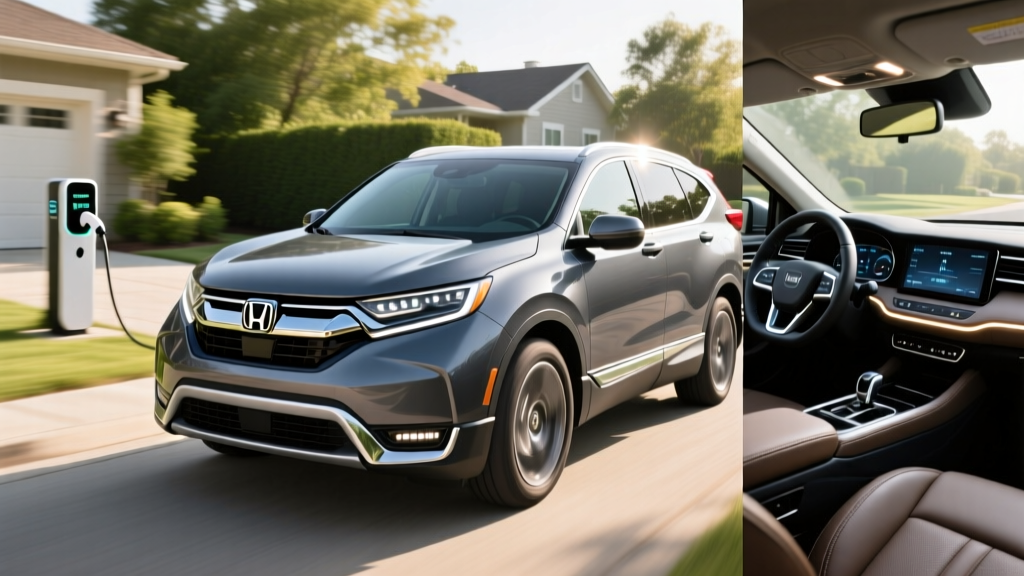
The Honda CR-V Hybrid has become one of the best-selling electrified compact SUVs in the U.S., and for good reason. It delivers the cargo space and ride comfort buyers expect from the CR-V nameplate while cutting fuel consumption by roughly 30% compared to the gasoline-only model. For 2026, the CR-V Hybrid continues with its proven two-motor powertrain, standard all-wheel drive, and a starting price that undercuts many rivals. This guide breaks down every number that matters — EPA fuel economy, real-world MPG, powertrain output, battery warranty, and whether any tax credits apply.
HEV vs PHEV: What the CR-V Hybrid Actually Is
Before digging into specs, it is critical to understand that the Honda CR-V Hybrid is a conventional hybrid electric vehicle (HEV), not a plug-in hybrid (PHEV). Here is what that distinction means for ownership:
- HEV (CR-V Hybrid): Charges its small battery internally via regenerative braking and the gasoline engine. You never plug it in. It cannot drive on electric power alone for meaningful distances. The battery is small (~1.1 kWh) and exists to assist the engine, not replace it.
- PHEV (e.g., Toyota RAV4 Prime): Has a larger battery (~18 kWh), can be plugged into a wall outlet or Level 2 charger, and offers 30–42 miles of electric-only range before the gas engine engages. Typically qualifies for federal tax credits.
- BEV (e.g., Tesla Model Y): Runs entirely on electricity with 250+ miles of range and no gasoline engine at all.
Honda does not currently offer a plug-in hybrid version of the CR-V in the United States. If you need electric-only commuting capability, you will need to look at competitors like the Toyota RAV4 Prime or consider a full battery-electric SUV.
Fuel Economy: EPA Ratings and Real-World MPG
Fuel economy is the primary reason buyers choose the CR-V Hybrid over the gas model. Here is how the EPA rates the 2026 CR-V Hybrid with standard all-wheel drive, per fueleconomy.gov:
| Driving Cycle | MPG |
|---|---|
| City | 40 MPG |
| Highway | 34 MPG |
| Combined | 37 MPG |
For comparison, the 2026 gas-only CR-V AWD is rated at 27 city / 32 highway / 29 combined. The hybrid delivers a meaningful 8 MPG advantage in combined driving — roughly a 28% improvement — and a dramatic 13 MPG gain in city traffic where the electric motors do the most work.
Real-World MPG: What Owners Actually See
EPA estimates are a useful baseline, but real-world results depend heavily on driving style, climate, and route mix. Based on owner-reported data and third-party testing:
- City-dominant driving: Many owners report 38–43 MPG in stop-and-go urban traffic. The hybrid system thrives here — regenerative braking recovers energy, and the engine shuts off frequently at low speeds.
- Highway-dominant driving (70–80 mph): Expect 31–35 MPG. At sustained high speeds, the gasoline engine does most of the work, and the hybrid advantage narrows.
- Cold weather (below 32°F): Fuel economy typically drops 10–15%, landing around 31–33 MPG combined. The engine runs more often to provide cabin heat and maintain battery temperature.
- Mixed commuting (50/50 city/highway): Most owners land between 35–39 MPG combined year-round.
The bottom line: if your daily driving involves significant city or suburban stop-and-go, the CR-V Hybrid will likely meet or slightly exceed its EPA rating. Highway-heavy commuters will see numbers closer to the gas model's advantage window.
Powertrain Specs: Horsepower, Engine, and Motors
| Specification | Value |
|---|---|
| Engine | 2.0L DOHC Atkinson-cycle 4-cylinder |
| Engine Output | 145 hp @ 6,100 rpm / 138 lb-ft torque |
| Electric Motors | Dual-motor system (one drive, one generator) |
| Drive Motor Output | 181 hp / 247 lb-ft torque |
| Combined System Output | 204 hp / 247 lb-ft torque |
| Transmission | e-CVT (no traditional gears) |
| Drivetrain | Standard Real-Time AWD |
| 0–60 mph | ~7.6 seconds (est.) |
| Hybrid Battery | ~1.1 kWh lithium-ion (sealed, self-charging) |
| Towing Capacity | 1,000 lbs |
Honda's two-motor hybrid system operates differently than a Toyota-style planetary gearset. In most low-speed driving, the gasoline engine acts solely as a generator to feed the electric drive motor — the wheels are driven entirely by electricity. At highway cruising speeds, a lock-up clutch connects the engine directly to the wheels for efficiency. The result is smooth, linear acceleration that feels more like an EV than a traditional hybrid around town.
The 204 combined horsepower is competitive within the segment. The Toyota RAV4 Hybrid produces 219 hp, while the Hyundai Tucson Hybrid delivers 226 hp. The CR-V Hybrid prioritizes fuel efficiency over outright power, and the 0–60 time reflects that calibration. It is adequate for merging and passing, but not quick.
Pricing, Trims, and Tax Credit Eligibility
The 2026 Honda CR-V Hybrid is available across four trims. Here is the MSRP breakdown:
- Sport (base): ~$35,750 (including destination)
- Sport-L: ~$38,350
- Sport Touring: ~$41,850
These prices place the CR-V Hybrid roughly $1,500–$2,000 above the equivalent gas-powered CR-V trims. At 37 MPG combined versus 29 MPG for the gas model, the hybrid premium pays for itself in fuel savings within approximately 2–3 years for an average driver covering 12,000 miles annually at $3.50/gallon.
Does the CR-V Hybrid Qualify for a Federal Tax Credit?
No. Under current IRS §30D rules, the Honda CR-V Hybrid does not qualify for the federal clean vehicle tax credit. The credit is reserved for plug-in electric vehicles (PHEVs and BEVs) with a battery capacity of at least 7 kWh that can be recharged from an external power source. As a conventional hybrid with a ~1.1 kWh self-charging battery, the CR-V Hybrid does not meet this threshold. For the latest eligibility rules, consult IRS.gov §30D guidance.
Some states offer separate incentives for hybrid vehicles — check your state's energy or environmental agency for details. However, these are typically modest ($250–$500 rebates) compared to the $7,500 federal credit available for qualifying PHEVs and EVs.
Battery Longevity, Warranty, and Replacement Cost
Honda Hybrid Battery Warranty:
- Duration: 8 years / 100,000 miles (10 years / 150,000 miles in CARB states including California, New York, Massachusetts, and others adopting California emissions standards)
- Coverage: Defects in materials and workmanship; capacity loss below a defined threshold
- Replacement cost (out of warranty): Estimated $2,000–$3,500 for the hybrid battery pack, plus labor
Hybrid battery anxiety is common among first-time hybrid buyers, but the data is reassuring. Honda's two-motor system uses a relatively small lithium-ion pack that operates within a narrow state-of-charge window — typically between 40% and 80%. This shallow cycling dramatically reduces degradation compared to a full EV battery that routinely cycles from 10% to 90%. Most Honda hybrid owners report no meaningful battery degradation over 150,000+ miles.
If a failure does occur outside the warranty window, replacement costs are significantly lower than EV battery replacements. The CR-V Hybrid's small battery pack typically costs $2,000–$3,500 to replace, compared to $10,000–$20,000+ for a full EV traction battery. Independent hybrid specialists can often perform the replacement at lower cost than a dealership.
For additional reliability data, IIHS crash-test ratings and Consumer Reports predicted reliability scores can inform your purchase decision.
CR-V Hybrid vs RAV4 Hybrid vs Tucson Hybrid
| Attribute | Honda CR-V Hybrid | Toyota RAV4 Hybrid | Hyundai Tucson Hybrid |
|---|---|---|---|
| Combined MPG (EPA) | 37 | 39 | 37 |
| City MPG | 40 | 41 | 37 |
| Highway MPG | 34 | 38 | 36 |
| Combined HP | 204 | 219 | 226 |
| 0–60 mph | ~7.6 sec | ~7.4 sec | ~7.1 sec |
| Cargo (rear seats up) | 36.3 cu ft | 37.6 cu ft | 38.7 cu ft |
| Starting MSRP (AWD) | ~$35,750 | ~$34,500 | ~$36,000 |
| Battery Warranty | 8 yr / 100k mi | 10 yr / 150k mi | 10 yr / 100k mi |
The RAV4 Hybrid edges ahead on fuel economy and cargo space, while the Tucson Hybrid offers the most power. The CR-V Hybrid's advantage lies in ride refinement, interior build quality, and Honda's strong resale value. None of these conventional hybrids qualify for the federal tax credit. If tax incentives are a priority, you would need to step up to a PHEV like the RAV4 Prime or a BEV like the Hyundai Ioniq 5.
Who Should Buy the CR-V Hybrid — and Who Shouldn't
Choose the CR-V Hybrid If:
- You want significantly better fuel economy without changing your driving habits or installing a home charger
- Your commute involves heavy city or suburban traffic where regenerative braking shines
- You need AWD for snow or rain but don't want the fuel penalty of a gas AWD SUV
- You plan to own the vehicle 5–10 years and value Honda's reliability reputation and resale value
- You want a hybrid at a moderate price premium (~$1,500–$2,000 over gas) that pays for itself in fuel savings
Look Elsewhere If:
- You want electric-only commuting — you need a PHEV (RAV4 Prime) or a BEV
- You want to qualify for the $7,500 federal tax credit — only PHEVs and BEVs are eligible under §30D
- You tow more than 1,000 lbs — the CR-V Hybrid's towing capacity is limited
- You do almost exclusively highway driving — the hybrid advantage narrows significantly at sustained 70–80 mph
- You want maximum cargo volume — the RAV4 Hybrid or Tucson Hybrid offer slightly more space
Hybrid vs PHEV vs EV — Quick Decision Framework:
- HEV (CR-V Hybrid): Best if you have no home charging access, drive a mix of city/highway, and want zero lifestyle change. You fuel up at gas stations normally.
- PHEV (RAV4 Prime, etc.): Best if you have home charging and a short commute (under 35 miles) but also take road trips. You get EV-like daily driving with a gas backup.
- BEV (Model Y, Ioniq 5, etc.): Best if you have reliable home charging, drive under 250 miles daily, and want the lowest operating cost and zero tailpipe emissions.
Frequently Asked Questions
How many MPG does the Honda CR-V Hybrid get?
The 2026 Honda CR-V Hybrid AWD is EPA-rated at 40 MPG city, 34 MPG highway, and 37 MPG combined. Real-world results vary: city-dominant drivers often see 38–43 MPG, while highway-heavy drivers at 75+ mph may see 31–34 MPG. Cold weather typically reduces combined economy by 10–15%.
Does the Honda CR-V Hybrid need to be plugged in?
No. The CR-V Hybrid is a conventional hybrid (HEV). Its small battery charges automatically through regenerative braking and the gasoline engine. There is no plug, no charging cable, and no need for a home charging setup. You simply fill up at a gas station as you would with any other vehicle.
Does the CR-V Hybrid qualify for any tax credit?
No. Under current IRS §30D rules, only plug-in electric vehicles (PHEVs and BEVs) with batteries of 7 kWh or larger qualify for the federal clean vehicle tax credit. The CR-V Hybrid's ~1.1 kWh battery does not meet this requirement. Some states may offer small hybrid rebates — check your state energy office for details.
How long will the CR-V Hybrid battery last, and what does replacement cost?
Honda covers the hybrid battery with an 8-year/100,000-mile warranty (10 years/150,000 miles in CARB states). In practice, Honda hybrid batteries routinely last 150,000–200,000+ miles without significant degradation because the system keeps the battery in a shallow charge window. Out-of-warranty replacement costs approximately $2,000–$3,500 including labor — far less than an EV battery replacement.
Is the Honda CR-V Hybrid reliable?
Honda's two-motor hybrid system has been in production since 2014 (Accord Hybrid) and has a strong reliability track record. The system has fewer moving parts than a conventional automatic transmission — there are no gear shifts, no torque converter, and no traditional CVT belt. Combined with Honda's overall build quality, the CR-V Hybrid is considered one of the more dependable choices in the compact hybrid SUV segment.
How does the CR-V Hybrid compare to a full EV like the Tesla Model Y?
These serve different use cases. The CR-V Hybrid costs less upfront (~$35,750 vs $45,000+), has no charging requirements, and can refuel anywhere in five minutes. The Model Y offers far lower per-mile energy costs (~$0.04/mile on electricity vs ~$0.10/mile on gas for the CR-V Hybrid), zero tailpipe emissions, and qualifies for the $7,500 federal credit. If you have home charging and drive under 300 miles daily, the EV saves more long-term. If you lack charging access or frequently drive long distances in rural areas, the hybrid is the more practical choice.