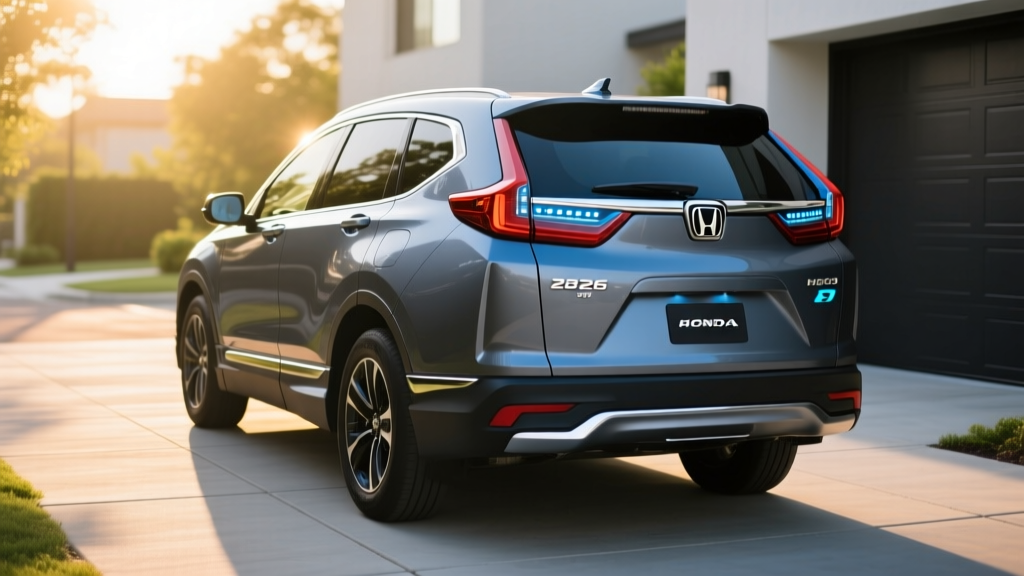
The Honda CR-V Hybrid has become one of the best-selling electrified compact SUVs in the U.S., and for good reason: it pairs the practicality buyers expect from the CR-V nameplate with a hybrid powertrain that squeezes serious efficiency out of every gallon. But when shoppers search for CR-V hybrid mileage, the numbers they find often raise more questions than they answer. Is the EPA rating achievable in daily driving? How does the hybrid compare to the gas-only CR-V or a full EV? And what happens when the hybrid battery ages?
This guide breaks down the 2026 Honda CR-V Hybrid's fuel economy with the precision real buyers need — EPA estimates, real-world expectations, powertrain details, battery longevity, tax-credit eligibility, and a clear framework for whether this hybrid, a PHEV, or a full BEV is the right call for your garage.
2026 Honda CR-V Hybrid MPG: EPA Estimates and Real-World Numbers
The 2026 Honda CR-V Hybrid uses a two-motor hybrid system paired with a 2.0-liter Atkinson-cycle four-cylinder engine. Front-wheel drive (FWD) and all-wheel drive (AWD) trims carry slightly different EPA ratings, and understanding the city/highway split is key to predicting your own experience.
| Drivetrain | City MPG | Highway MPG | Combined MPG | Annual Fuel Cost* |
|---|---|---|---|---|
| FWD (Sport, Sport Touring) | 43 | 36 | 40 | ~$1,350 |
| AWD (Sport, Sport Touring) | 40 | 34 | 37 | ~$1,460 |
*Based on 15,000 miles/year and $3.40/gallon regular unleaded. Source: fueleconomy.gov
The city-biased rating isn't a typo — it's how Honda's hybrid system works. At low speeds and in stop-and-go traffic, the CR-V Hybrid runs primarily on its electric motors, with the gasoline engine acting as a generator rather than directly driving the wheels. This means many owners actually exceed the EPA city rating on urban commutes, particularly in warm weather. Highway driving flips the script: the engine takes a more direct role, and aerodynamic drag at 70+ mph erodes efficiency.
Based on aggregated owner reports and independent testing, expect the AWD CR-V Hybrid to deliver:
- City / suburban commuting: 38–44 MPG (often beating EPA)
- Highway (65–70 mph): 32–35 MPG
- Highway (75+ mph): 29–32 MPG
- Cold weather (below 30°F, mixed driving): 33–36 MPG
- Overall observed average: 35–39 MPG
The gap between EPA combined (37–40 MPG) and real-world overall (35–39 MPG) is relatively narrow for the CR-V Hybrid — much tighter than what most full EVs experience between EPA range and highway/cold-weather range. Hybrids don't suffer the same cold-weather penalty that battery-electric vehicles do because waste engine heat warms the cabin without drawing from a traction battery.
CR-V Hybrid vs. Gas CR-V: The Mileage Gap in Dollars
To put the CR-V Hybrid's efficiency in context, compare it against the conventional gas-only 2026 CR-V equipped with the 1.5L turbocharged engine:
| Metric | CR-V Hybrid AWD | CR-V Gas AWD (1.5T) | Advantage |
|---|---|---|---|
| EPA Combined MPG | 37 | 28 | Hybrid +9 MPG |
| City MPG | 40 | 27 | Hybrid +13 MPG |
| Highway MPG | 34 | 32 | Hybrid +2 MPG |
| Gallons per 15,000 mi | ~405 | ~536 | Hybrid saves ~131 gal/yr |
| Annual fuel cost | ~$1,460 | ~$1,930 | Hybrid saves ~$470/yr |
At current fuel prices, the hybrid's mileage advantage translates to roughly $470 in annual fuel savings over the gas model. Over a typical six-year ownership period, that's approximately $2,820 in fuel savings — enough to offset most or all of the hybrid trim's price premium over equivalent gas trims, depending on the model year and dealer pricing.
Powertrain Specs: What's Under the Hood
The 2026 CR-V Hybrid uses Honda's fourth-generation two-motor hybrid system. Here's the complete powertrain breakdown:
| Specification | Detail |
|---|---|
| Engine | 2.0L DOHC Atkinson-cycle inline-4 |
| Engine horsepower | 145 hp @ 6,100 rpm |
| Engine torque | 134 lb-ft @ 4,500 rpm |
| Electric motors | Dual-motor system (propulsion + generator) |
| Propulsion motor output | 184 hp / 247 lb-ft |
| Combined system horsepower | 204 hp |
| Combined system torque | 247 lb-ft |
| Transmission | Direct-drive (no traditional CVT or gears) |
| 0–60 mph | ~7.6 seconds (AWD) |
| Fuel tank capacity | 14.0 gallons |
| Total driving range | ~518 miles (AWD, EPA combined) |
| Towing capacity | 1,000 lbs |
A few things worth noting for buyers cross-shopping this powertrain:
- No plug required. The CR-V Hybrid is a conventional hybrid (HEV), not a plug-in hybrid (PHEV). It generates all its electricity from the gasoline engine and regenerative braking. You never plug it in.
- Electric-only driving is limited. The hybrid battery is small (approximately 1.06 kWh), so the CR-V Hybrid can only travel roughly 0.5–1 mile on electric power alone at very low speeds. The electric motor's role is to assist the engine and optimize efficiency, not to serve as a primary propulsion source.
- Smooth, not sporty. The 204 combined horsepower provides confident merging and passing, but the direct-drive system prioritizes smoothness and efficiency over acceleration thrills. The 7.6-second 0–60 time is adequate for daily driving but trails some turbocharged competitors.
HEV vs. PHEV vs. EV: Which Powertrain Fits Your Life?
The CR-V Hybrid occupies a specific niche in the electrification spectrum. Understanding where it sits helps you decide if it's the right choice — or if you should look at a PHEV like the Toyota RAV4 Prime or a full BEV like the Hyundai Ioniq 5.
Conventional Hybrid (HEV)
Example: Honda CR-V Hybrid
- No plug-in charging
- 37–40 MPG combined
- ~518 mi total range
- No EV-only commuting
- Lowest upfront cost
- No home charging needed
Plug-In Hybrid (PHEV)
Example: Toyota RAV4 Prime
- Plug in for 25–42 mi EV range
- ~38 MPG combined after EV range
- ~600+ mi total range
- EV-only daily commuting possible
- Higher upfront cost
- Needs Level 2 for best experience
Battery Electric (BEV)
Example: Hyundai Ioniq 5
- Full electric, no gasoline
- 250–320 mi EPA range
- 100–130 MPGe combined
- Zero tailpipe emissions
- Highest upfront cost, lowest fuel cost
- Requires reliable charging access
- Choose the CR-V Hybrid (HEV) if: You want maximum MPG without changing your fueling habits, don't have access to home charging, drive a mix of city and highway, and want the lowest purchase price among electrified options.
- Choose a PHEV if: You have home charging (Level 1 or 2), your daily commute is under 35 miles round-trip, and you want EV-like daily driving with gas-engine flexibility for road trips.
- Choose a full EV if: You have reliable home Level 2 charging, rarely drive more than 250 miles in a single day, want to eliminate gasoline entirely, and are willing to plan around DC fast charging on road trips.
Pricing, Trims, and Tax Credit Eligibility
The 2026 Honda CR-V Hybrid is available in two main trims, both offered with FWD or AWD:
| Trim | Drivetrain | MSRP |
|---|---|---|
| Sport Hybrid | FWD | ~$35,700 |
| Sport Hybrid | AWD | ~$37,200 |
| Sport Touring Hybrid | AWD (standard) | ~$41,200 |
Prices are approximate MSRP including destination. Actual dealer prices may vary.
Federal Tax Credit Status
Here's where many buyers get confused: the Honda CR-V Hybrid does NOT qualify for the federal §30D Clean Vehicle Credit. Under current IRS rules, the §30D credit (up to $7,500) is available only for plug-in electric vehicles — battery-electric vehicles (BEVs) and plug-in hybrids (PHEVs) with a minimum battery capacity of 7 kWh. The CR-V Hybrid's ~1.06 kWh battery falls well short of this threshold.
- ❌ Minimum 7 kWh battery capacity — CR-V Hybrid has ~1.06 kWh
- ❌ Plug-in charging capability — CR-V Hybrid is a conventional HEV
- ✅ MSRP under $80,000 (SUV cap) — passes, but irrelevant
- ✅ Buyer income under threshold — passes, but irrelevant
- Result: Not eligible for federal §30D credit
Some states offer their own hybrid incentives or rebates. Check your state's energy office or department of revenue for current programs.
Battery Longevity, Warranty, and Replacement Cost
Hybrid battery reliability is consistently one of the top concerns for buyers considering their first hybrid. The CR-V Hybrid uses a lithium-ion hybrid battery pack that is fundamentally different from the large traction batteries in full EVs — it's smaller, operates in a narrower state-of-charge window, and is managed to avoid deep cycling, all of which promote longevity.
- Coverage: 8 years / 100,000 miles (10 years / 150,000 miles in CARB states including CA, NY, MA, and others)
- What's covered: Defects in materials/workmanship and capacity loss below a functional threshold
- Replacement cost (out of warranty): Approximately $2,000–$3,500 for the hybrid battery pack, plus labor
Honda's hybrid battery track record is strong. The company has been refining its hybrid systems since the early 2000s Insight, and real-world data shows that modern Honda hybrid batteries routinely exceed 150,000 miles with minimal degradation. Unlike full EV batteries, which may lose 10–15% capacity over a decade, hybrid batteries operate in a tightly managed 40–80% state-of-charge window that dramatically reduces stress on the cells.
If a hybrid battery does fail outside of warranty, the replacement cost is a fraction of what a full EV battery replacement would run ($8,000–$20,000+). Independent hybrid specialists also offer refurbished battery packs for roughly $1,200–$2,000, providing an even more affordable out-of-warranty option.
Reliability and Ownership Costs
The CR-V Hybrid benefits from one of the most reliable platforms in the compact SUV segment. The two-motor hybrid system has fewer moving parts than a conventional automatic transmission (no torque converter, no multi-speed gear sets), and regenerative braking reduces wear on the friction brake pads — many hybrid owners report original brake pads lasting 70,000+ miles.
According to IIHS, the 2026 CR-V continues to earn top safety ratings, and Honda Sensing (the brand's Level 2 driver-assistance suite) comes standard on all trims. This includes adaptive cruise control, lane-keeping assist, collision mitigation braking, and traffic sign recognition.
| Cost Category | CR-V Hybrid AWD | CR-V Gas AWD |
|---|---|---|
| Purchase price (Sport AWD) | ~$37,200 | ~$34,900 |
| Fuel (15,000 mi/yr × 5 yr) | ~$7,300 | ~$9,650 |
| Maintenance (est.) | ~$2,200 | ~$2,600 |
| Insurance (est. avg) | ~$7,500 | ~$7,200 |
| 5-year total (before resale) | ~$54,200 | ~$54,350 |
The hybrid's higher purchase price is nearly offset by fuel and maintenance savings within five years. Beyond year five, the hybrid pulls ahead — particularly if gas prices rise. Hybrids also tend to hold strong resale values as fuel prices fluctuate and buyer demand for efficient vehicles remains high.
Pros and Cons: The Honest Assessment
✓ Pros
- 40/37 MPG (FWD/AWD) EPA combined — among the best in the segment
- City MPG often exceeded in real-world driving
- No plug-in charging needed — zero lifestyle change
- 518+ mile total range eliminates range anxiety entirely
- Strong hybrid battery warranty (8–10 years)
- Lower brake wear from regenerative braking
- Spacious cargo area (36.3 cu ft behind rear seats)
- Honda Sensing ADAS standard on all trims
✗ Cons
- No federal tax credit eligibility
- No meaningful electric-only driving range
- AWD highway MPG drops to 34 (still good, but less impressive)
- ~$2,300 price premium over equivalent gas trims
- 1,000-lb towing capacity (lower than some turbo competitors)
- Hybrid trims limited to Sport and Sport Touring
- Engine drone under hard acceleration (direct-drive characteristic)
Frequently Asked Questions
How many MPG does the 2026 Honda CR-V Hybrid actually get?
The EPA rates the FWD CR-V Hybrid at 43 city / 36 highway / 40 combined MPG, and the AWD version at 40 city / 34 highway / 37 combined MPG. In real-world driving, most owners see 35–39 MPG overall, with city driving often exceeding the EPA estimate and sustained highway driving at 75+ mph coming in slightly below.
Does the CR-V Hybrid need to be plugged in?
No. The CR-V Hybrid is a conventional hybrid (HEV), not a plug-in hybrid (PHEV). It charges its small battery through regenerative braking and the gasoline engine. You fuel it exactly like a regular gas car — no charging cables, no home charger installation, no public charging station visits.
How far can the CR-V Hybrid drive on electric power alone?
Less than one mile. The hybrid battery is approximately 1.06 kWh, and the electric-only mode is designed for low-speed maneuvering and brief assists, not sustained electric driving. If you want meaningful electric-only range for commuting, you need a PHEV (like the Toyota RAV4 Prime with 42 miles EV range) or a full BEV.
Is the CR-V Hybrid battery reliable, and what does replacement cost?
Honda's hybrid battery track record is excellent. The battery is covered by an 8-year/100,000-mile warranty (10 years/150,000 miles in CARB states). Real-world data shows these batteries commonly lasting 150,000+ miles. Out-of-warranty replacement runs approximately $2,000–$3,500, with refurbished options available for $1,200–$2,000.
Does the Honda CR-V Hybrid qualify for any tax credit?
The CR-V Hybrid does not qualify for the federal §30D Clean Vehicle Credit because it is a conventional hybrid, not a plug-in vehicle. The federal credit requires a minimum 7 kWh battery and plug-in charging capability. Check your state's energy office for any state-level hybrid incentives, which vary by jurisdiction.
CR-V Hybrid vs. RAV4 Hybrid — which gets better mileage?
The Toyota RAV4 Hybrid AWD is EPA-rated at 41 city / 38 highway / 40 combined MPG. The Honda CR-V Hybrid AWD comes in at 40 city / 34 highway / 37 combined. The RAV4 Hybrid holds a slight edge in highway and combined ratings, while the CR-V Hybrid competes closely in city driving. Both are among the most efficient AWD compact SUVs available.
Sources: EPA Fuel Economy, IRS Clean Vehicle Credits, Honda CR-V Hybrid Official Page