The Honda CR-V Hybrid has quietly become one of the best-selling electrified vehicles in the United States, and for good reason: it pairs a roomy, well-built cabin with a fuel-sipping powertrain that requires zero lifestyle change. If you've been searching for a deep look at the Honda CR-V Hybrid interior alongside the hard numbers on MPG, powertrain behavior, and long-term battery costs, this guide covers every spec a practical buyer needs for the 2026 model year.
Unlike a plug-in hybrid (PHEV) or a full battery-electric vehicle (BEV), the CR-V Hybrid is a conventional self-charging hybrid (HEV). That means no plug, no charging cable, and no range anxiety. You fuel it like any other gasoline car, and the hybrid system recovers energy through regenerative braking and the engine itself to squeeze dramatically more miles out of every gallon — especially in city driving where hybrids thrive.
HEV vs PHEV vs EV: Where Does the CR-V Hybrid Fit?
Before we get into the cabin and powertrain details, it's worth clarifying exactly what the CR-V Hybrid is — and what it isn't. Honda does not currently offer a plug-in hybrid version of the CR-V in the U.S. market. If you see references to a "CR-V e:PHEV" online, that model is sold in Europe and China but is not part of Honda's American lineup as of the 2026 model year.
| Feature | Honda CR-V Hybrid (HEV) | Typical PHEV (e.g., Toyota RAV4 Prime) | Full EV (e.g., Tesla Model Y) |
|---|---|---|---|
| Plug-in charging required? | No | Yes (Level 1/2) | Yes (Level 1/2/DC) |
| Electric-only range | ~1 mile at low speed | 35-42 miles | 280-330 miles (EPA) |
| Combined MPG / MPGe | 40 MPG (EPA) | 38 MPG + 94 MPGe | 122 MPGe |
| Tailpipe emissions while driving | Low (hybrid mode) | Zero (EV mode), Low (hybrid) | Zero |
| Federal tax credit (§30D) | Not eligible | Up to $7,500 (if eligible) | Up to $7,500 (if eligible) |
| Home charging install needed | No | Recommended (240V) | Essential (240V) |
The CR-V Hybrid is the right choice if you want meaningful fuel savings without any change to your fueling routine. It's the wrong choice if you want electric-only commuting or federal tax credit eligibility — for those, you'd need to look at a PHEV or BEV.
Honda CR-V Hybrid Interior: Space, Materials, and Technology
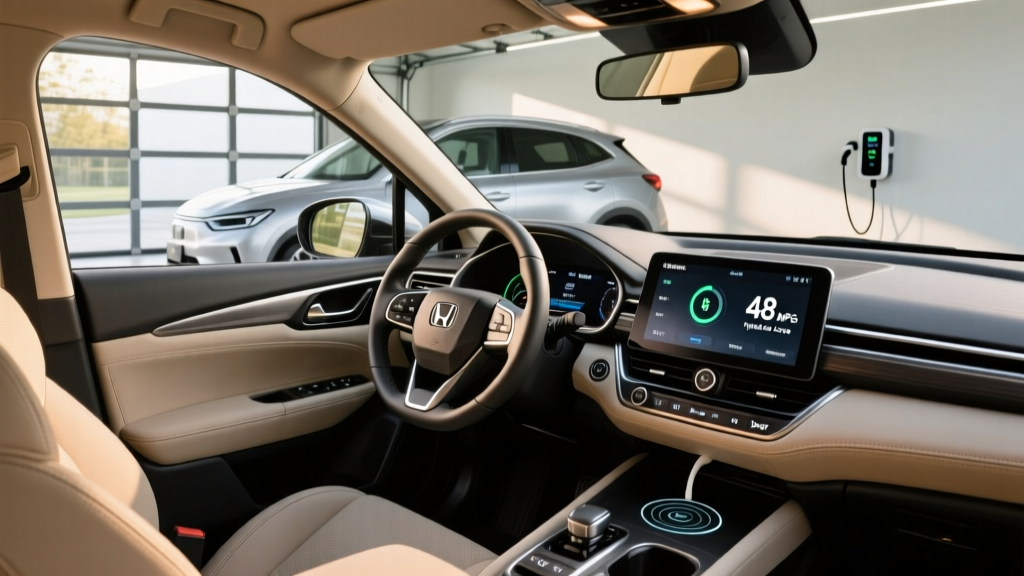
The reason so many shoppers specifically search for the Honda CR-V Hybrid interior is that Honda made a significant leap in cabin quality with the current sixth-generation CR-V platform. The 2026 model carries forward the same architecture introduced for the 2023 redesign, with minor trim and tech updates.
Seating and Cargo Dimensions
The CR-V Hybrid seats five passengers across two rows. The rear seat offers 41.0 inches of legroom, which is competitive with the largest crossovers in the segment and noticeably more generous than the Toyota RAV4 Hybrid's 37.8 inches. Behind the second row, you get 36.3 cubic feet of cargo space — identical to the gas-only CR-V, since Honda packages the hybrid battery beneath the cargo floor without intruding on volume. Fold the rear seats flat and total cargo capacity reaches 76.5 cubic feet.
One detail hybrid buyers should note: the CR-V Hybrid does not offer a spare tire. Honda provides a tire repair kit instead, partly to offset the weight of the hybrid system. If a full-size spare is a priority, you'll need to look at aftermarket solutions or accept the kit.
Infotainment and Displays
The 2026 CR-V Hybrid comes standard with a 7-inch touchscreen on the Sport trim and a 9-inch touchscreen on Sport-L and Sport Touring trims. The larger screen supports wireless Apple CarPlay and Android Auto; the 7-inch system requires a USB cable. A 10.2-inch digital driver display is standard across all hybrid trims, showing hybrid-specific readouts including energy flow, battery state of charge, and real-time regeneration levels.
The Sport Touring trim — the top of the hybrid lineup — adds a 12-speaker Bose premium audio system, wireless phone charging, a head-up display, and Honda's built-in Google-based infotainment with native Google Maps and Google Assistant integration.
Materials and Build Quality
Lower trims use a durable cloth upholstery with a honeycomb-patterned dashboard insert that adds visual texture without feeling cheap. Sport-L steps up to leather-trimmed seats and a leather-wrapped steering wheel. Sport Touring adds heated and ventilated front seats, heated rear outboard seats, and a heated steering wheel. Fit and finish across the lineup is tight — panel gaps are consistent, and materials hold up well in long-term ownership based on the track record of the current generation since 2023.
Powertrain Specs: How the Two-Motor Hybrid System Works
The CR-V Hybrid uses Honda's fourth-generation two-motor hybrid system. Here's the hardware:
| Specification | 2026 Honda CR-V Hybrid |
|---|---|
| Engine | 2.0L DOHC Atkinson-cycle 4-cylinder |
| Engine output | 145 hp / 134 lb-ft torque |
| Electric motors | Two (one drive motor, one generator) |
| Drive motor output | 181 hp / 247 lb-ft torque |
| Combined system output | 204 hp / 247 lb-ft torque |
| Drivetrain (standard) | FWD (Sport trim) |
| Drivetrain (available) | Real Time AWD (Sport, Sport-L, Sport Touring) |
| Transmission | Direct-drive (no traditional gearbox) |
| 0-60 mph | ~7.5 seconds (AWD) |
| Towing capacity | 1,000 lbs |
The system operates primarily as a series hybrid at low and moderate speeds: the gasoline engine spins the generator motor, which produces electricity to feed the drive motor that actually turns the wheels. At highway cruising speeds, a lock-up clutch connects the engine directly to the wheels for efficiency. This architecture means the drive motor provides the instant torque feel typical of electric vehicles around town, while the engine handles steady-state highway driving where it's most efficient.
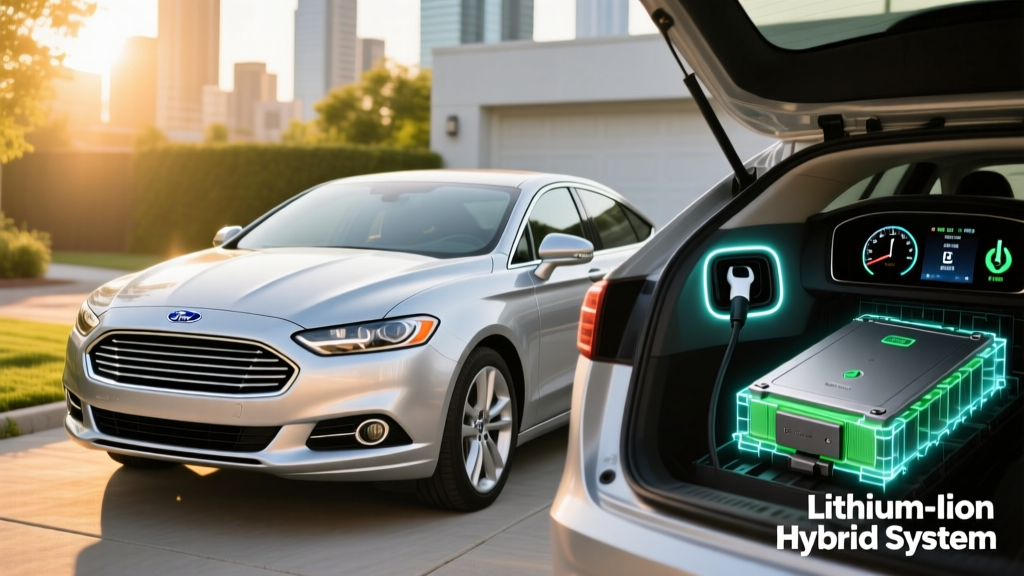
The hybrid battery is a lithium-ion pack mounted under the cargo floor. Honda does not publish the exact kWh capacity in U.S. specifications, but it is a small pack (estimated 1.1-1.3 kWh total, with roughly 0.8 kWh usable) — typical for a conventional hybrid. It is not designed for plug-in charging and exists solely to buffer energy recovered from braking and the engine.
Fuel Economy: EPA Ratings and Real-World MPG
Fuel economy is where the CR-V Hybrid makes its strongest case over the gas-only CR-V, which returns a combined 30 MPG. Here's the official EPA breakdown:
| Trim / Drivetrain | City MPG | Highway MPG | Combined MPG |
|---|---|---|---|
| Sport (FWD) | 43 | 36 | 40 |
| Sport (AWD) | 40 | 34 | 37 |
| Sport-L (AWD) | 40 | 34 | 37 |
| Sport Touring (AWD) | 40 | 34 | 37 |
Source: EPA Fuel Economy
Hybrids tend to exceed their EPA city estimates in gentle, stop-and-go driving because regenerative braking recovers more energy at lower speeds. In our experience and consistent owner reports, the FWD CR-V Hybrid can return 44-46 MPG in suburban and city driving during mild weather. Highway driving at 70-75 mph is where the hybrid advantage narrows — expect 31-34 MPG, which is below the EPA sticker. In cold weather (below 30°F), overall fuel economy typically drops 10-15% due to increased engine runtime for cabin heat and reduced battery efficiency. Annual fuel cost at 15,000 miles/year and $3.40/gallon averages roughly $1,275 for the FWD model, compared to about $1,700 for the gas CR-V.
Pricing, Trims, and Tax Credit Eligibility
The 2026 Honda CR-V Hybrid is offered in three trims. Pricing below reflects MSRP including destination charge:
| Trim | Drivetrain | MSRP |
|---|---|---|
| Sport | FWD or AWD | $36,395 (FWD) / $37,895 (AWD) |
| Sport-L | AWD | $40,695 |
| Sport Touring | AWD | $43,295 |
Federal Tax Credit: Not Eligible
Because the CR-V Hybrid is a conventional hybrid (HEV) — not a plug-in hybrid or electric vehicle — it does not qualify for the IRS §30D Clean Vehicle Credit, which offers up to $7,500 for new PHEVs and BEVs that meet battery sourcing, MSRP, and buyer income requirements. The now-expired §30C alternative fuel vehicle credit and the former hybrid-specific credits that existed before 2010 are also no longer available.
Some states offer their own incentives for hybrid purchases, though these are increasingly focused on plug-in vehicles. Check your state's energy or environmental agency for current programs. Source: IRS Clean Vehicle Credits.
Battery Warranty, Reliability, and Replacement Cost
This is the question every hybrid buyer eventually asks: what happens when the hybrid battery fails?
Honda Hybrid Battery Warranty
- Hybrid battery: 8 years / 100,000 miles (10 years / 150,000 miles in CARB states including California, New York, Massachusetts, and others that follow California emissions standards)
- Hybrid system components: 8 years / 100,000 miles
- Powertrain (engine, transmission): 5 years / 60,000 miles
- Bumper-to-bumper: 3 years / 36,000 miles
Honda's hybrid battery warranty covers capacity loss below a defined threshold (typically 60-70% of original capacity, though Honda's specific threshold is outlined in the warranty booklet) and outright failure. In practice, Honda's lithium-ion hybrid batteries in the CR-V, Accord Hybrid, and Civic Hybrid have demonstrated strong longevity. The current-generation system has been on the market since 2023, and earlier Honda hybrid systems in the Accord and Insight routinely reached 150,000-200,000 miles without battery replacement.
If replacement is needed out of warranty, a new Honda CR-V hybrid battery currently costs between $2,000 and $4,000 installed at a dealership. Third-party refurbished battery options are emerging for older Honda hybrids at $1,200-$2,000. This is dramatically less than a full EV battery replacement, which can exceed $10,000-$20,000.
For reliability data, the CR-V as a nameplate earns strong marks. The current generation has received favorable ratings from both IIHS (Top Safety Pick when equipped with specific headlights) and positive owner satisfaction surveys. The hybrid powertrain adds complexity but removes the traditional transmission — a common failure point in conventional vehicles — which partially offsets maintenance risk.
Who Should Choose the CR-V Hybrid (and Who Shouldn't)
Choose the CR-V Hybrid If:
- You want 37-40 MPG without plugging in or changing your fueling routine
- City and suburban driving make up most of your mileage (where the hybrid advantage is largest)
- You need a spacious cargo area and generous rear legroom for family use
- You plan to own the vehicle 8+ years and value Honda's long-term reliability reputation
- You don't have access to home charging and aren't ready for a PHEV or EV
- You want AWD availability with minimal fuel-economy penalty
Look Elsewhere If:
- You want electric-only commuting — consider a PHEV like the RAV4 Prime or a BEV
- Federal tax credit eligibility is a dealbreaker (the CR-V Hybrid doesn't qualify)
- You do mostly highway miles at 75+ mph (the hybrid advantage shrinks; a diesel or efficient gas car may match it)
- You need more than 1,000 lbs of towing capacity
- You want three-row seating (Honda offers the Pilot Hybrid for that, but not the CR-V)
CR-V Hybrid vs. Full EV: If you have reliable home Level 2 charging and your daily commute is under 250 miles, a BEV like the Hyundai Ioniq 5 or Tesla Model Y will deliver lower per-mile energy costs and zero tailpipe emissions — but at a higher purchase price. If you lack home charging or regularly take long road trips through areas with sparse DC fast-charging infrastructure, the CR-V Hybrid is the lower-risk, lower-cost choice.
CR-V Hybrid vs. Gas CR-V: The hybrid carries a roughly $2,500-$3,000 premium over the equivalent gas trim. At 40 MPG combined vs. 30 MPG combined and $3.40/gallon fuel, the hybrid saves roughly $425/year at 15,000 miles driven. Payback takes approximately 6 years — right around average ownership length. If you plan to keep the vehicle longer, the hybrid is the clear financial winner. If you trade every 3 years, the gas model may cost less overall.
Frequently Asked Questions
How many MPG does the Honda CR-V Hybrid actually get?
The EPA rates the FWD CR-V Hybrid at 43 city / 36 highway / 40 combined MPG. AWD trims are rated at 40 city / 34 highway / 37 combined. In real-world city driving, many owners report 42-46 MPG. Highway driving at 75 mph typically returns 31-34 MPG. Cold weather reduces these figures by 10-15%.
Does the Honda CR-V Hybrid need to be plugged in?
No. The CR-V Hybrid is a conventional hybrid (HEV), not a plug-in hybrid. It charges its small battery internally through regenerative braking and the gasoline engine. You never plug it in — you simply fill it with gasoline like any other car.
Is there a plug-in hybrid (PHEV) version of the Honda CR-V?
Not in the United States. Honda sells a CR-V e:PHEV in Europe and China, but it is not part of the U.S. lineup as of the 2026 model year. If you want a compact SUV PHEV, the closest competitors are the Toyota RAV4 Prime (42 miles EV range) and the Hyundai Tucson PHEV (33 miles EV range).
Does the CR-V Hybrid qualify for any federal tax credit?
No. The IRS §30D Clean Vehicle Credit applies only to plug-in electric vehicles (BEVs and PHEVs) that meet battery sourcing, MSRP cap, and buyer income requirements. Conventional hybrids like the CR-V Hybrid are not eligible. Check your state's energy agency for any local hybrid incentives.
How long will the CR-V Hybrid battery last, and what does replacement cost?
Honda covers the hybrid battery for 8 years/100,000 miles (10 years/150,000 miles in CARB states). Based on Honda's track record with hybrid systems in the Accord and Insight, these batteries routinely last 150,000-200,000 miles. Out-of-warranty replacement currently costs $2,000-$4,000 at a dealer.
Is the CR-V Hybrid slower than the gas version?
No — it's actually quicker. The hybrid's combined 204 hp and 247 lb-ft of electric torque gives it a 0-60 mph time of roughly 7.5 seconds with AWD, compared to about 8.2 seconds for the 190-hp turbocharged gas CR-V. The electric motor's instant torque makes the hybrid feel particularly responsive in city acceleration.
Does the hybrid battery eat into cargo space?
No. Honda mounts the hybrid battery pack beneath the cargo floor, and cargo volume remains 36.3 cubic feet behind the rear seats — identical to the gas-only CR-V. There is no frunk (front trunk), as the engine bay is fully occupied by the hybrid powertrain.