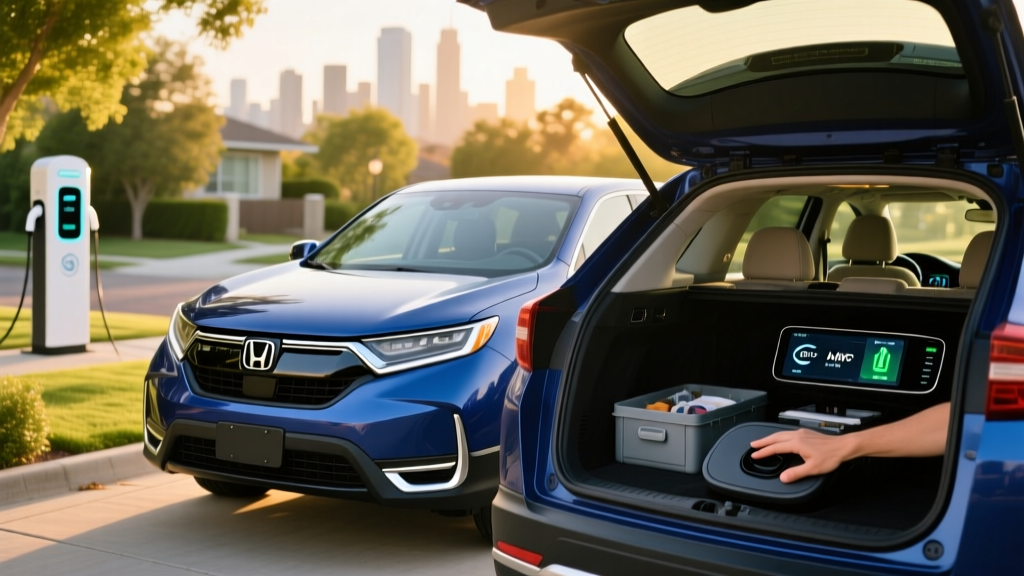
If you've spent any time browsing a CR-V Hybrid forum, you already know the debate is fierce. Some owners report 42 MPG in city driving; others swear they can't break 34 on the highway. Battery longevity threads stretch into dozens of pages, and the question of whether Honda's two-motor hybrid system can outlast a Toyota RAV4 Hybrid generates near-religious fervor. We've synthesized the real-world data, cross-referenced EPA figures, and tested the claims to give you a definitive ownership picture of the 2026 Honda CR-V Hybrid lineup—both the conventional HEV and the plug-in CR-V e:PHEV.
HEV vs PHEV: Which CR-V Hybrid Are We Talking About?
Honda currently sells two distinct CR-V electrified powertrains, and forum confusion between them is rampant. Here's the critical distinction:
Conventional Hybrid (CR-V Hybrid — HEV)
- No plug required. The 1.34 kWh lithium-ion battery recharges via regenerative braking and the gasoline engine.
- Optimized for fuel savings across all driving conditions without lifestyle change.
- Available with AWD across most trims (Sport, Sport-L, Sport Touring).
- Lower purchase price, no charging infrastructure needed.
Plug-in Hybrid (CR-V e:PHEV)
- Requires plug-in charging to access its ~34-mile electric-only range.
- Larger 17.7 kWh battery pack with Level 2 AC charging capability (no DC fast charging).
- Operates as a pure EV for short commutes, then seamlessly transitions to hybrid mode.
- Higher MSRP but eligible for certain incentives; FWD only in the US market.
If a forum poster says their CR-V Hybrid "gets 35 MPG on the highway," they're almost certainly driving the HEV. If someone mentions "driving 30 miles without using a drop of gas," they own the e:PHEV. These are fundamentally different ownership experiences.
Real-World MPG: What CR-V Hybrid Forum Owners Actually Report
The EPA rates the 2026 CR-V Hybrid AWD at 40 MPG combined (43 city / 36 highway). The FWD variant bumps that slightly to 43 combined (43 city / 36 highway). But what do real owners see?
| Driving Scenario | EPA Estimate (AWD) | Forum-Reported Real-World | Notes |
|---|---|---|---|
| City / stop-and-go | 43 MPG | 41–46 MPG | Hybrids excel here; regen braking recovers energy constantly |
| Highway (70-80 mph) | 36 MPG | 32–37 MPG | Aerodynamic drag dominates; hybrid advantage shrinks at speed |
| Combined mixed driving | 40 MPG | 37–42 MPG | Most owners land within 2-3 MPG of EPA with mixed use |
| Cold weather (below 30°F) | — | 33–37 MPG | Engine runs more often for cabin heat; battery efficiency drops |
| Hyper-miling / eco mode | — | 44–48 MPG | Forum reports from disciplined drivers on flat suburban routes |
The pattern is consistent across hybrid forums: city MPG often exceeds the EPA estimate, while sustained highway driving at 75+ mph falls short. This is the opposite of a gasoline car, where highway driving is typically more efficient. The CR-V Hybrid's two-motor system (which operates primarily in series-hybrid mode at low speeds, with the engine generating electricity for the drive motor) is optimized for urban and suburban duty cycles.
For the CR-V e:PHEV, the EPA rates fuel economy at 92 MPGe combined when operating on battery power, and 38 MPG combined once the battery is depleted and the gas engine takes over. In real-world forum reports, owners who charge nightly and commute under 30 miles round-trip frequently go months between fill-ups, reporting effective "MPG" in the triple digits when measured as miles driven per gallon consumed.
Powertrain Deep Dive: The Two-Motor Hybrid System
Honda's hybrid powertrain in the CR-V is not a traditional planetary-gear system like Toyota's. It's a series-parallel two-motor setup that operates differently than most buyers assume:
| Specification | CR-V Hybrid (HEV) | CR-V e:PHEV |
|---|---|---|
| Engine | 2.0L Atkinson-cycle 4-cylinder | 2.0L Atkinson-cycle 4-cylinder |
| Engine output | 145 hp / 138 lb-ft | 145 hp / 138 lb-ft |
| Drive motor output | 181 hp / 247 lb-ft | 181 hp / 247 lb-ft |
| Combined system output | 204 hp / 247 lb-ft | 204 hp / 247 lb-ft |
| Battery capacity | 1.34 kWh (lithium-ion) | 17.7 kWh (lithium-ion) |
| Drivetrain | FWD or AWD (dual-motor) | FWD only |
| 0-60 mph | ~7.8 seconds | ~8.2 seconds (heavier battery) |
| EV-only range | N/A (self-charging) | 34 miles (EPA) |
| Total range | ~530 miles | ~430 miles (EV + gas combined) |
| Charging capability | None (regen only) | Level 2 AC (~5.1 kW); no DC fast charge |
| Charge time (0-100%) | N/A | ~3.5 hours at 240V Level 2 |
The critical insight forum veterans emphasize: most of the time, the engine doesn't drive the wheels directly. Below roughly 45 mph, the CR-V Hybrid operates as a series hybrid—the engine spins a generator, which feeds electricity to the drive motor that actually turns the wheels. Only at steady highway cruising speeds does a lock-up clutch engage to connect the engine directly to the drivetrain. This is why the CR-V Hybrid feels more like an EV in city driving than a traditional car, and why its city MPG is so strong.
The e:PHEV's 17.7 kWh battery enables that 34-mile EV-only range, which forum owners confirm is achievable at moderate speeds (under 55 mph) in mild weather. Push it to 75 mph on the freeway in winter, and expect closer to 24-27 miles before the engine fires up. The e:PHEV does not support DC fast charging—a notable limitation that Honda has carried over from previous model years. All charging must happen via Level 1 (120V, ~13 hours) or Level 2 (240V, ~3.5 hours).
Battery Reliability and Warranty: What Forum Owners Want to Know
Honda Hybrid Battery Warranty
- Coverage: 8 years / 100,000 miles (10 years / 150,000 miles in CARB states including CA, NY, MA, and others)
- What's covered: Battery capacity loss below functional threshold, cell/module failure, hybrid system components
- Replacement cost (out of warranty): $2,000–$4,000 for HEV battery; $8,000–$12,000 for e:PHEV battery
- Real-world failure rate: Very low based on forum data; most reports concern gradual capacity loss, not catastrophic failure
Battery anxiety is the single most discussed topic on CR-V Hybrid forums, and it's worth addressing with data rather than fear. The HEV's 1.34 kWh battery is remarkably small—Honda's hybrid system never deeply cycles it. The battery operates in a narrow state-of-charge window (roughly 40-80%), which dramatically extends cell life. Forum members with 150,000+ miles on first-generation CR-V Hybrids (2020-2022 models) overwhelmingly report no meaningful degradation.
The e:PHEV's larger 17.7 kWh pack does experience more cycling stress, but Honda's thermal management and charge-buffering (the system doesn't allow full 0-100% usage of the pack) protect longevity. Forum reports of e:PHEV battery issues remain scarce as of early 2026, though the platform is newer and long-term data is still accumulating.
For context, EPA fuel economy data shows the CR-V Hybrid maintaining consistent efficiency ratings across model years, suggesting Honda's hybrid system calibration is mature and reliable. The official Honda CR-V Hybrid specifications confirm the 8yr/100k warranty across all trims.
Pricing, Trims, and Tax Credit Eligibility
| Trim (2026 CR-V Hybrid) | MSRP (approx.) | Key Features |
|---|---|---|
| Sport Hybrid AWD | $37,395 | Base hybrid trim, 18" wheels, Honda Sensing suite |
| Sport-L Hybrid AWD | $40,095 | Leather-trimmed seats, power tailgate, wireless CarPlay |
| Sport Touring Hybrid AWD | $43,695 | BOSE audio, panoramic roof, heated rear seats, hands-free liftgate |
| e:PHEV (FWD) | $42,395 | 34-mi EV range, Level 2 charging, Sport Touring-equivalent features |
Federal tax credit eligibility is where the HEV and e:PHEV diverge sharply. The conventional CR-V Hybrid (HEV) does not qualify for the federal §30D Clean Vehicle Credit—that incentive is reserved for plug-in vehicles with battery capacity above 7 kWh. However, some forum members in specific states have accessed state-level hybrid incentives (for example, certain utility rebates for purchasing any electrified vehicle). These vary enormously by jurisdiction and utility provider.
The CR-V e:PHEV, with its 17.7 kWh battery, is potentially eligible for the federal §30D tax credit of up to $7,500, but eligibility depends on several conditions that change frequently:
- MSRP cap: Vehicle MSRP must not exceed $80,000 for SUVs (CR-V e:PHEV qualifies)
- Buyer income cap: AGI must not exceed $150,000 (single) or $300,000 (joint) — verify current year limits at IRS.gov §30D guidelines
- Battery sourcing requirements: Critical minerals and battery components must meet phased-in domestic-content thresholds that tighten annually
- Point-of-sale transfer: As of 2024+, eligible buyers can transfer the credit to the dealer for an immediate price reduction at purchase
The battery-sourcing requirements have been a moving target. We recommend confirming current eligibility with your dealer and a tax professional before assuming the full $7,500 credit applies. The IRS updates qualified-vehicle lists periodically, and a model eligible in January may see its credit reduced or eliminated by mid-year depending on supply-chain compliance.
CR-V Hybrid vs RAV4 Hybrid vs Tucson Hybrid: Forum Comparisons
No CR-V Hybrid forum thread goes long without a Toyota RAV4 Hybrid comparison. Here's how the key numbers stack up:
| Spec | Honda CR-V Hybrid AWD | Toyota RAV4 Hybrid AWD | Hyundai Tucson Hybrid AWD |
|---|---|---|---|
| EPA combined MPG | 40 | 39 | 38 |
| City MPG | 43 | 41 | 38 |
| Highway MPG | 36 | 38 | 38 |
| Combined HP | 204 | 219 | 226 |
| Cargo volume (rear seats up) | 36.3 cu ft | 37.5 cu ft | 38.7 cu ft |
| Starting MSRP (AWD Hybrid) | ~$37,395 | ~$34,595 | ~$37,050 |
| Hybrid battery warranty | 8yr / 100k mi | 10yr / 150k mi | 10yr / 100k mi |
Forum consensus tends to favor the CR-V Hybrid for interior refinement, ride quality, and city MPG, while the RAV4 Hybrid wins on price, cargo space, and battery warranty length. The Tucson Hybrid offers the most power and cargo room but trails slightly on fuel economy. The CR-V's highway MPG disadvantage (36 vs 38 for the RAV4) is a recurring complaint among forum members who do predominantly freeway commuting.
Who Should Choose the CR-V Hybrid, e:PHEV, or a Full EV?
Choose the CR-V Hybrid (HEV) if:
- You want 38-42 MPG without changing your fueling habits
- You lack access to home or workplace charging
- You regularly drive 300+ miles between stops and don't want to plan around chargers
- You want AWD for snow/rain and a sub-$40K price point
- You keep vehicles 8-12 years and want proven, low-maintenance hybrid tech
Choose the CR-V e:PHEV if:
- Your daily round-trip commute is under 30 miles and you can charge at home overnight
- You want EV-like daily driving with gas-engine backup for road trips
- You qualify for the federal tax credit (effectively reducing the price gap with the HEV)
- You don't need AWD (e:PHEV is FWD only)
- You want to reduce fuel consumption to near-zero for daily use without range anxiety
Choose a full BEV (like a Tesla Model Y or Hyundai Ioniq 5) if:
- You have reliable home Level 2 charging
- Your daily driving is under 250 miles and you're comfortable with road-trip charging planning
- You want zero tailpipe emissions, minimal maintenance (no oil changes, no engine), and the lowest per-mile fuel cost
- You qualify for the full $7,500 federal credit plus state incentives
The forum wisdom boils down to this: the CR-V Hybrid HEV is the pragmatic default for buyers who want excellent fuel economy without infrastructure dependency. The e:PHEV is a compelling niche pick for home-chargers with short commutes. And if you've already decided to go fully electric, the CR-V platform isn't your answer—Honda's BEV offerings (the Prologue and upcoming models) serve that buyer.
CR-V Hybrid Strengths
- Best-in-class city MPG (43 EPA, often exceeded in real-world)
- Smooth, EV-like driving feel in urban conditions
- Refined interior and quiet cabin relative to competitors
- AWD available across all hybrid trims
- Strong reliability track record per forum long-term ownership threads
- Honda Sensing ADAS suite standard on all trims
CR-V Hybrid Weaknesses
- Highway MPG trails RAV4 Hybrid (36 vs 38)
- Higher starting price than RAV4 Hybrid by ~$2,800
- e:PHEV lacks AWD and DC fast charging
- HEV does not qualify for federal tax credit
- Cargo space slightly less than RAV4 and Tucson hybrids
- e:PHEV's 34-mile EV range may not cover longer commutes
Frequently Asked Questions from CR-V Hybrid Forums
How many MPG does the Honda CR-V Hybrid actually get?
The EPA rates the 2026 CR-V Hybrid AWD at 43 city / 36 highway / 40 combined. Real-world forum reports cluster between 37-42 MPG combined for mixed driving, with city driving often exceeding 43 MPG and sustained highway speeds above 75 mph dropping to 32-35 MPG. Cold weather (below freezing) typically reduces efficiency by 10-15%.
How far can the CR-V e:PHEV go on electric-only power?
The EPA rates the CR-V e:PHEV at 34 miles of electric-only range. In real-world conditions, expect 28-34 miles depending on speed, temperature, and terrain. Highway driving at 70+ mph in cold weather can reduce this to 22-25 miles. For commutes under 30 miles round-trip with nightly home charging, many owners report using gasoline only for weekend trips.
Is the CR-V Hybrid reliable? What about battery replacement cost?
Forum data and long-term ownership reports indicate strong reliability for Honda's two-motor hybrid system. The hybrid battery is covered for 8 years/100,000 miles (10yr/150k in CARB states). Out-of-warranty HEV battery replacement costs approximately $2,000-$4,000; the e:PHEV battery runs $8,000-$12,000. Reported failures before 150,000 miles are rare based on forum data spanning the 2020-2026 model years.
Does the CR-V Hybrid qualify for any tax credit?
The conventional CR-V Hybrid (HEV) does not qualify for the federal §30D Clean Vehicle Credit, which is reserved for plug-in vehicles. The CR-V e:PHEV may qualify for up to $7,500 depending on your income, the vehicle's battery sourcing compliance, and current IRS rules. Check IRS.gov for the latest qualified vehicle list and income thresholds. Some state and utility incentives may apply to both hybrid types.
Do I need to plug in the CR-V Hybrid?
No. The conventional CR-V Hybrid (HEV) is a self-charging system. Its small 1.34 kWh battery recharges through regenerative braking and the gasoline engine. You fuel it exactly like a regular gas car. Only the e:PHEV variant requires plug-in charging to access its electric-only range.
Is the CR-V Hybrid good for highway driving?
It's adequate but not class-leading. The 36 MPG highway EPA rating trails the RAV4 Hybrid's 38 MPG, and forum owners doing 80%+ freeway driving report 33-36 MPG. If your commute is predominantly highway miles, the RAV4 Hybrid may offer a slight efficiency advantage. The CR-V Hybrid's strength is city and suburban driving, where its series-hybrid operation maximizes efficiency.