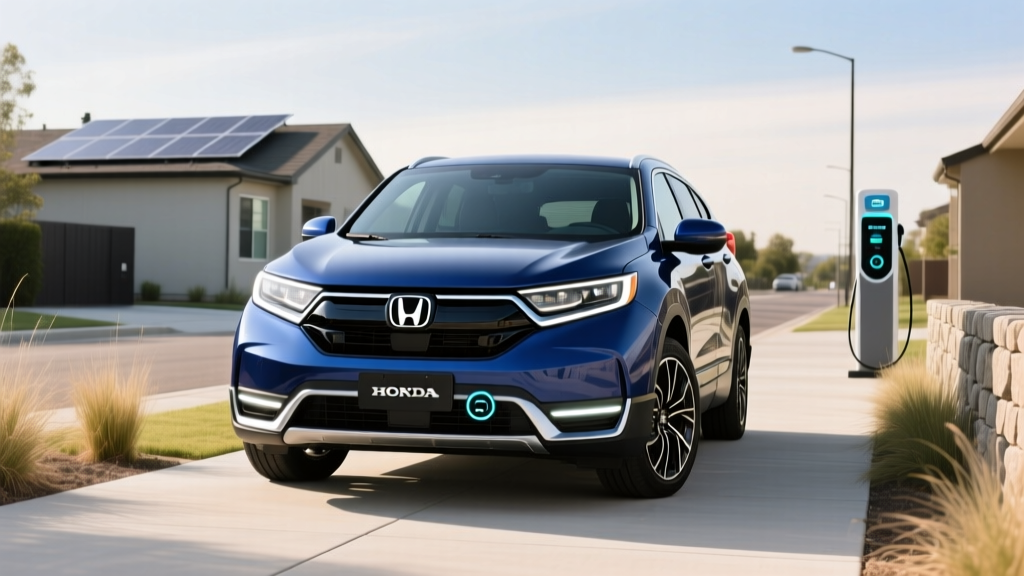
The compact SUV hybrid segment is crowded, but the 2026 Honda CR-V Sport Hybrid continues to anchor itself as a practical, efficiency-focused choice for buyers who want electrified fuel savings without plugging in. As a conventional hybrid (HEV), the CR-V Sport Hybrid requires zero lifestyle change — no charging cables, no range planning — yet delivers fuel economy that cuts gas bills nearly in half compared to its turbocharged gas-only sibling.
This guide breaks down every number that matters: EPA and real-world MPG, the two-motor hybrid powertrain, pricing by trim, battery warranty details, and how the CR-V Sport Hybrid stacks up against plug-in hybrid and full-electric alternatives. If you're cross-shopping the Toyota RAV4 Hybrid, Hyundai Tucson Hybrid, or Ford Escape Hybrid, the data below will clarify where Honda's offering lands.
HEV vs. PHEV: Where the CR-V Sport Hybrid Fits
Before examining specs, it's essential to clarify what the CR-V Sport Hybrid is — and what it isn't. Honda sells the CR-V in two electrified flavors for 2026:
Conventional Hybrid (HEV) — CR-V Sport Hybrid
- No plug required. The battery recharges via regenerative braking and the gasoline engine.
- Self-sufficient operation. You fuel it like any gas car; the electric motors assist seamlessly.
- Small battery (~1.1 kWh). Enables short electric-only bursts at low speed but not sustained EV driving.
- No federal tax credit under current IRS §30D rules (plug-in capability required).
Plug-In Hybrid (PHEV) — Not Offered for CR-V in the US
- Honda does not currently sell a CR-V PHEV in the United States for the 2026 model year.
- PHEVs offer 25–40 miles of electric-only range and qualify for up to $7,500 in federal tax credits (subject to MSRP, income, and battery-sourcing requirements).
- If plug-in capability is a priority, consider the Toyota RAV4 Prime (PHEV, 42 mi EV range) or the Hyundai Tucson PHEV (33 mi EV range).
Bottom line: The 2026 CR-V Sport Hybrid is a traditional HEV. You never plug it in. It simply uses less fuel.
Fuel Economy: EPA Ratings and Real-World MPG
Fuel efficiency is the CR-V Sport Hybrid's headline feature. Honda's two-motor hybrid system pairs a 2.0-liter Atkinson-cycle inline-4 with dual electric motors, prioritizing electric propulsion at low and moderate speeds while the engine kicks in for highway cruising and hard acceleration.
| Metric | EPA Estimate | Real-World Expectation |
|---|---|---|
| City MPG | 43 MPG | 42–46 MPG (hybrids often exceed EPA in stop-and-go) |
| Highway MPG | 36 MPG | 33–37 MPG (aerodynamic drag at 75+ mph reduces gains) |
| Combined MPG | 40 MPG | 38–42 MPG depending on driving mix |
| Total Range (14.0 gal tank) | ~560 miles | ~510–580 miles |
According to fueleconomy.gov, the FWD CR-V Sport Hybrid achieves 43 city / 36 highway / 40 combined. The AWD variant drops slightly to 40 city / 34 highway / 37 combined due to the added drivetrain weight and friction.
Real-world context: In mixed suburban-and-highway driving, most owners report landing within 1–2 MPG of the EPA combined figure. Hybrids shine in city traffic — the electric motor handles launches and low-speed crawling, so the gas engine runs less frequently. If your commute is 70% city, expect to beat the combined rating. On long road trips at sustained 80 mph, plan for the lower end of the highway estimate.
Cold weather reduces fuel economy by roughly 5–10% in winter months, primarily because the engine must run more often to generate cabin heat and because battery chemistry is less efficient below freezing. This is modest compared to the 20–30% range loss a full EV experiences in cold conditions.
Powertrain and Performance Specs
| Specification | 2026 CR-V Sport Hybrid |
|---|---|
| Engine | 2.0L Atkinson-cycle DOHC inline-4 |
| Engine Output | 145 hp @ 6,100 rpm / 134 lb-ft torque |
| Electric Motors | Dual-motor hybrid system (propulsion + generator) |
| Combined System Output | 204 hp / 247 lb-ft torque |
| Transmission | Electronic continuously variable (e-CVT) |
| Drivetrain | FWD standard; Real Time AWD available |
| 0–60 mph | ~7.6 seconds (FWD, manufacturer estimate) |
| Towing Capacity | 1,000 lbs |
| Battery Type | Lithium-ion, ~1.1 kWh (self-charging, non-plug-in) |
The 204 combined horsepower is a meaningful step up from the gas-only CR-V's 190 hp turbocharged 1.5L engine. More importantly, the 247 lb-ft of electric torque arrives instantly, giving the Sport Hybrid noticeably stronger off-the-line acceleration than its turbo sibling, which suffers from slight turbo lag. The e-CVT operates without the rubber-band feeling of older CVTs; Honda's system uses fixed-gear lockup at highway speeds for more natural engine behavior.
The AWD variant uses a mechanically driven rear axle (not a dedicated rear electric motor), which is why it doesn't match the seamless torque-vectoring AWD of some competitors. It's adequate for snow and rain traction but not designed for off-road use.
Pricing, Trims, and Tax Credit Eligibility
The 2026 Honda CR-V Sport Hybrid is available in multiple trim levels. Pricing below reflects MSRP including destination charge:
- Sport Hybrid (FWD): ~$36,350
- Sport Hybrid (AWD): ~$37,850
- Sport-L Hybrid (AWD): ~$40,850
- Sport Touring Hybrid (AWD): ~$44,150
Does the CR-V Sport Hybrid Qualify for a Federal Tax Credit?
No. Under current IRS §30D rules, the federal clean vehicle credit requires a vehicle to have plug-in capability and a minimum battery capacity of 7 kWh. The CR-V Sport Hybrid is a conventional HEV with a ~1.1 kWh battery and no plug-in port, making it ineligible for the federal credit.
Some states offer separate incentives for hybrids, but these are increasingly rare as programs shift toward BEVs and PHEVs. Check your state's energy office or Alternative Fuels Data Center for local availability. Do not count on a state incentive when budgeting.
The absence of a tax credit is worth factoring into your purchase math. A comparably equipped RAV4 Hybrid starts around $34,000, giving Toyota a modest price advantage. However, the CR-V Sport Hybrid's higher combined output, larger cargo area (36.3 cu ft behind rear seats vs. the RAV4 Hybrid's 37.6 cu ft — a near wash), and more refined interior materials justify the premium for many buyers.
Battery Longevity, Warranty, and Replacement Cost
Battery anxiety is the top concern for hybrid-curious buyers who haven't owned one before. Here's what the data shows:
Honda Hybrid Battery Warranty
- Hybrid battery warranty: 8 years / 100,000 miles (10 years / 150,000 miles in CARB states including CA, NY, MA, and others adopting California emissions standards)
- Capacity retention threshold: Honda covers the hybrid battery if it fails or drops below functional capacity during the warranty period
- Powertrain warranty: 5 years / 60,000 miles
Real-world longevity: Honda's hybrid system has been in production since the early 2000s (Insight, Accord Hybrid). Field data and owner surveys from Consumer Reports and iSeeCars consistently rank Honda hybrids among the most reliable in the segment. The lithium-ion hybrid battery in the CR-V is small (~1.1 kWh) and operates in a narrow state-of-charge window (roughly 40–80%), which dramatically reduces degradation compared to a full EV battery that cycles between 10–90%.
Replacement cost if out of warranty: A hybrid battery replacement for the CR-V Sport Hybrid runs approximately $2,500–$4,000 including labor at a Honda dealership. Independent hybrid specialists often perform the same job for $1,800–$2,800. This is a fraction of EV battery replacement costs ($10,000–$20,000+) because the hybrid battery is much smaller.
Most CR-V Hybrid batteries last well beyond 150,000 miles without significant degradation. The battery management system's conservative charge window is the key reason.
Hybrid vs. PHEV vs. Full EV: Which Should You Choose?
The CR-V Sport Hybrid sits in a specific lane. Here's a decision framework to determine if it's the right electrified vehicle for your situation:
Choose the CR-V Sport Hybrid (HEV) if:
- You don't have reliable access to home or workplace charging (apartment dwellers, street parkers)
- You want lower fuel costs with zero behavioral change — no apps, no charging stops, no route planning
- Your annual mileage is 12,000–18,000 miles and you want a $500–$800/year fuel savings over a gas-only CR-V
- You plan to keep the vehicle 8–10+ years (hybrid reliability data is strong long-term)
Choose a PHEV (e.g., Toyota RAV4 Prime) if:
- You can install a Level 2 charger at home and your daily commute is under 40 miles
- You want to drive mostly on electricity for daily errands but need gas flexibility for road trips
- You qualify for the federal §30D tax credit (up to $7,500) and can absorb a higher MSRP (~$44,500 for RAV4 Prime)
Choose a Full EV (e.g., Tesla Model Y, Hyundai Ioniq 5) if:
- You have home Level 2 charging and your daily driving is under 250 miles
- You want to eliminate gasoline entirely and reduce per-mile fuel cost to $0.04–$0.08/mile (vs. $0.14–$0.18/mile for the CR-V Hybrid)
- You're comfortable with public DC fast charging on road trips and potential cold-weather range reduction
The math is straightforward: a hybrid saves you money at the pump with no infrastructure investment. A PHEV saves more if you charge daily but costs more upfront. A full EV saves the most per mile but requires charging access and a higher purchase price.
Pros and Cons at a Glance
Pros
- 40 MPG combined EPA — genuine fuel savings without plugging in
- 204 hp combined output — quicker than the gas CR-V
- Strong city MPG (43) benefits stop-and-go commuters
- Proven hybrid system with conservative battery management
- Spacious interior: 36.3 cu ft cargo behind rear seats
- Standard Honda Sensing ADAS suite (adaptive cruise, lane-keep, collision mitigation)
- No charging infrastructure needed
Cons
- No federal tax credit eligibility
- AWD system is mechanical, not electric — less refined than e-AWD competitors
- Highway MPG (36) trails some expectations for a hybrid
- ~$36,350 starting price is above the gas-only CR-V EX (~$33,000)
- Towing limited to 1,000 lbs (gas CR-V can tow 1,500 lbs)
- No PHEV variant available in the US market
Ownership Costs: CR-V Sport Hybrid vs. Gas CR-V
Let's run the numbers on a 5-year, 75,000-mile ownership horizon to see if the hybrid premium pays for itself:
| Cost Factor | CR-V Sport Hybrid (FWD) | CR-V EX (Gas, FWD) |
|---|---|---|
| MSRP (approx.) | $36,350 | $33,000 |
| Fuel cost (75,000 mi @ $3.40/gal) | $6,375 (40 MPG) | $8,947 (28 MPG combined) |
| Fuel savings over 5 years | $2,572 saved with hybrid | |
| Estimated insurance (5 yr) | ~$7,500 | ~$7,000 |
| Maintenance (5 yr) | ~$2,800 | ~$3,200 |
| Net premium after fuel savings | Hybrid costs ~$878 more over 5 years at current gas prices | |
The hybrid's $3,350 MSRP premium is partially offset by $2,572 in fuel savings and slightly lower maintenance costs (regenerative braking reduces brake pad wear). At $3.40/gallon, the payback period is roughly 6–7 years. If gas prices rise to $4.00/gallon, payback shortens to about 5 years. The hybrid also holds a slight resale-value advantage based on historical Honda Hybrid depreciation data from Kelley Blue Book.
Note: These figures don't include potential state hybrid incentives, which vary by jurisdiction. Always check current local programs.
Frequently Asked Questions
How many MPG does the 2026 Honda CR-V Sport Hybrid get?
The FWD CR-V Sport Hybrid is EPA-rated at 43 city / 36 highway / 40 combined. The AWD version drops to 40 city / 34 highway / 37 combined. Real-world results typically land within 1–2 MPG of these figures, with city driving often exceeding the EPA estimate thanks to the electric motor handling low-speed propulsion.
Does the CR-V Sport Hybrid need to be plugged in?
No. The CR-V Sport Hybrid is a conventional hybrid (HEV). Its ~1.1 kWh lithium-ion battery recharges automatically through regenerative braking and the gasoline engine. You fuel it at a gas station like any other car. There is no plug, no charging cable, and no electric-only range to manage.
How far can the CR-V Sport Hybrid drive on electric only?
Not far — typically under 1 mile at very low speeds (under 25 mph) in stop-and-go traffic. This is not a PHEV. The small hybrid battery exists to assist the gas engine and capture braking energy, not to provide meaningful electric-only driving. If you want 25–40 miles of electric-only range, you need a plug-in hybrid like the Toyota RAV4 Prime.
Is the CR-V Sport Hybrid reliable, and what does battery replacement cost?
Honda's hybrid system has a strong reliability track record spanning two decades. The hybrid battery is covered for 8 years / 100,000 miles (10 years / 150,000 miles in CARB states). Out-of-warranty replacement costs approximately $2,500–$4,000 at a dealership. Most hybrid batteries last well beyond 150,000 miles due to the conservative charge window the battery management system maintains.
Does the 2026 CR-V Sport Hybrid qualify for any tax credit?
Not the federal §30D clean vehicle credit, which requires plug-in capability and at least 7 kWh of battery capacity. The CR-V Sport Hybrid meets neither requirement. Some states may offer small hybrid incentives, but these are uncommon and change frequently. Consult the IRS clean vehicle credit page and your state energy office for current eligibility.
CR-V Sport Hybrid vs. RAV4 Hybrid: which is better?
The Toyota RAV4 Hybrid (LE AWD starts ~$34,000, EPA 41 combined MPG) offers slightly better fuel economy and AWD standard on all trims, at a lower starting price. The Honda CR-V Sport Hybrid counters with more horsepower (204 vs. 219 combined for Toyota — comparable), a more refined interior, and Honda Sensing standard. If budget is the top priority, the RAV4 Hybrid wins. If interior quality and driving refinement matter more, the CR-V Sport Hybrid earns the edge. Both are excellent, proven choices.
What is the difference between the CR-V Sport Hybrid and the Sport Touring Hybrid?
The powertrain is identical — 204 hp combined, same 2.0L engine and dual-motor system. The difference is equipment. The Sport Touring Hybrid adds a hands-free power tailgate, Bose premium audio, wireless phone charging, heated rear seats, a heated steering wheel, and upgraded interior trim. It also comes exclusively with AWD at ~$44,150. The base Sport Hybrid starts at ~$36,350 with FWD. The hybrid fuel economy is the same regardless of trim.
The 2026 Honda CR-V Sport Hybrid is a calculated, no-compromise hybrid for buyers who want measurable fuel savings without altering their driving routine. It won't qualify for federal tax credits, and it won't drive 40 miles on electricity alone. What it will do is deliver 40 MPG combined, 204 hp, Honda's proven reliability, and a total ownership experience that requires nothing more than filling up at the gas station — just less often.