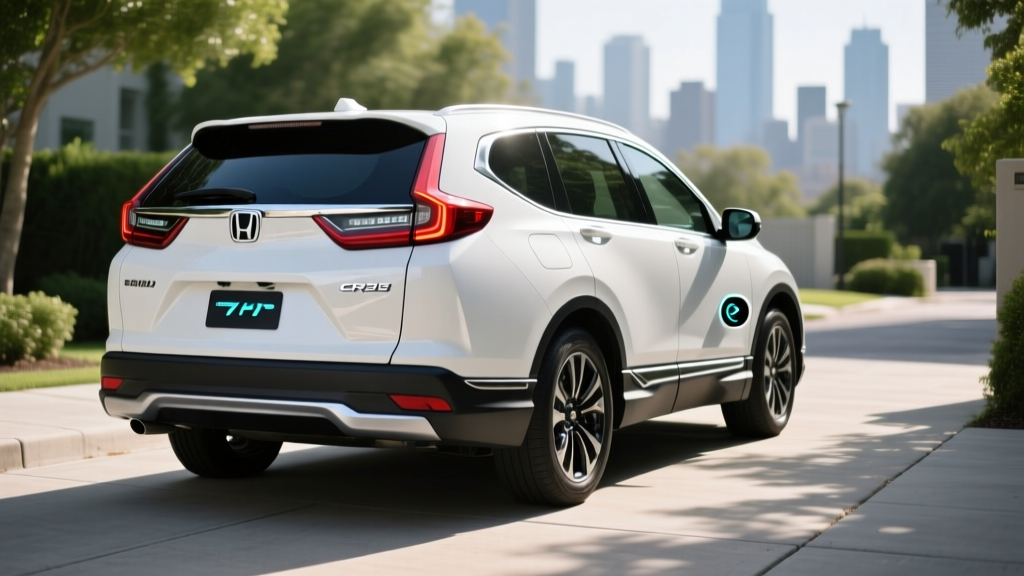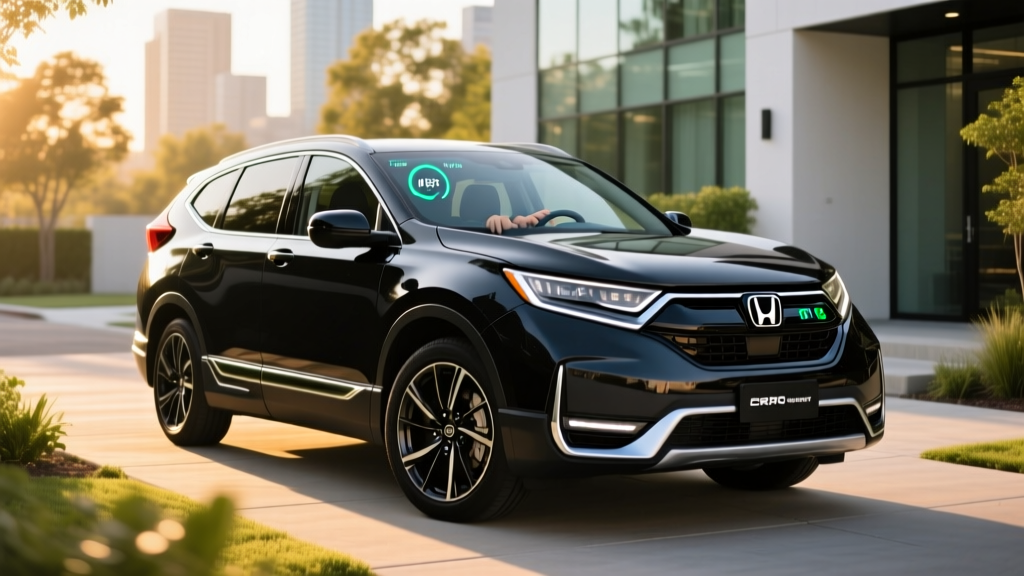
Quick Verdict: The 2026 Honda CR-V Hybrid Sport Touring
The 2026 Honda CR-V Hybrid Sport Touring sits at the top of Honda's hybrid compact SUV lineup, pairing a 204-horsepower two-motor hybrid system with standard all-wheel drive and a premium feature set. With an EPA-estimated 40 MPG combined and no plug required, it targets buyers who want EV-like city efficiency without changing their fueling habits. At an MSRP of $41,845 (including destination), it undercuts many plug-in hybrid and full-electric rivals while delivering proven Honda reliability and a spacious cabin.
This is a conventional hybrid (HEV) — not a plug-in. You never plug it in. The system captures energy through regenerative braking and the gasoline engine to keep its small battery charged. If you want electric-only driving, you'd need to look at a PHEV like the Toyota RAV4 Prime or a full BEV. But for drivers who want seamless, high-MPG operation with zero behavior change, the CR-V Hybrid Sport Touring is one of the strongest options in the segment.
The CR-V Hybrid is a conventional hybrid (HEV). It has a small battery (~1.1 kWh) that charges via the engine and regenerative braking. You never plug it in. A plug-in hybrid (PHEV) has a larger battery (typically 15-20 kWh), can be plugged in, and offers 25-45 miles of electric-only range before the gas engine kicks in. Honda does not currently offer a CR-V PHEV in the US market. If you want plug-in capability from Honda, you're currently out of luck in the compact SUV segment.
Fuel Economy: EPA Ratings and Real-World MPG
The 2026 CR-V Hybrid uses Honda's fourth-generation two-motor hybrid system, which is optimized for low-end electric torque and efficient highway cruising. The EPA rates the Sport Touring trim — which comes exclusively with all-wheel drive and 19-inch wheels — as follows:
| Metric | MPG |
|---|---|
| City | 43 |
| Highway | 36 |
| Combined | 40 |
| Fuel Tank | 14.0 gal |
| Total Range | ~560 miles |
Source: fueleconomy.gov
Honda's hybrid system excels in city driving, where the electric motor handles low-speed propulsion and regenerative braking recaptures energy at every stop. In real-world city and suburban driving, owners frequently report 42-47 MPG — exceeding the EPA city estimate. Highway driving tells a different story: at sustained 75-80 MPH, expect 33-36 MPG, consistent with the EPA highway figure. Cold weather (below 35°F) can reduce combined efficiency by 5-10% due to increased engine operation for cabin heating and reduced battery efficiency. If your commute is mostly stop-and-go city driving, this hybrid will likely beat its sticker. If you're a highway-dominant driver, the gap narrows.
Powertrain: 204 HP Two-Motor Hybrid System
The CR-V Hybrid Sport Touring uses Honda's twin-motor hybrid architecture, which is fundamentally different from the single-motor assist systems found in older hybrids. Here's the breakdown:
| Component | Specification |
|---|---|
| Engine | 2.0L DOHC Atkinson-cycle 4-cylinder |
| Engine Output | 145 hp / 134 lb-ft torque |
| Drive Motor | 184 hp / 247 lb-ft torque |
| Combined System Output | 204 hp / 247 lb-ft torque |
| Hybrid Battery | ~1.1 kWh lithium-ion (not plug-in) |
| Transmission | e-CVT (direct drive, no traditional gears) |
| Drivetrain | Standard AWD (rear motor-driven) |
| 0-60 MPH | ~7.7 seconds |
The twin-motor setup means the CR-V Hybrid drives like an EV at low to moderate speeds — the propulsion motor handles most acceleration duties, while the engine primarily acts as a generator. At highway speeds or under heavy acceleration, the engine mechanically couples to the wheels through a lock-up clutch for direct-drive efficiency. The result is smooth, linear acceleration that feels more responsive than the 204-hp figure alone suggests, thanks to the electric motor's instant 247 lb-ft of torque from zero RPM.
The AWD system is worth noting: unlike mechanical AWD with a driveshaft, the CR-V Hybrid uses a dedicated rear-mounted electric motor to power the rear axle. This means no mechanical connection between front and rear, reducing parasitic losses and improving efficiency versus traditional AWD systems.
Pricing, Trims, and Tax Credit Eligibility
The 2026 Honda CR-V Hybrid Sport Touring is the top-of-the-line hybrid trim. Here's how it's priced:
| CR-V Hybrid Trim | MSRP (incl. destination) |
|---|---|
| Sport | $36,395 |
| Sport-L | $38,695 |
| Sport Touring (AWD) | $41,845 |
No. The 2026 Honda CR-V Hybrid is a conventional hybrid (HEV), not a plug-in vehicle. The IRS §30D Clean Vehicle Credit — worth up to $7,500 — applies only to battery electric vehicles (BEVs) and plug-in hybrids (PHEVs) with a minimum battery capacity of 7 kWh and external charging capability. The CR-V Hybrid's ~1.1 kWh battery and lack of a charge port disqualify it entirely.
There is no federal tax credit for conventional hybrids as of 2026. Some states may offer minor incentives (HOV lane access, registration discounts), but these vary widely. Check your state's energy office or AFDC's state law database for local programs.
The Sport Touring trim justifies its premium with a long list of standard equipment: a 9-inch touchscreen with wireless Apple CarPlay and Android Auto, Bose 12-speaker premium audio, wireless phone charging, heated rear seats, a heated steering wheel, a hands-free power tailgate, rain-sensing wipers, and Honda's full Honda Sensing suite (adaptive cruise, lane-keeping, automatic emergency braking, blind-spot monitoring, rear cross-traffic). It also includes low-speed braking control and a traffic sign recognition system.
Reliability and Hybrid Battery Warranty
Hybrid battery longevity remains the top concern for buyers considering their first hybrid. Here's what you need to know about the CR-V Hybrid specifically:
- Hybrid battery: 8 years / 100,000 miles (10 years / 150,000 miles in CARB states including CA, CT, ME, MA, NJ, NY, OR, RI, VT, WA)
- Hybrid system components: 8 years / 100,000 miles
- Powertrain warranty: 5 years / 60,000 miles
- Limited vehicle warranty: 3 years / 36,000 miles
The warranty covers battery capacity loss below a defined threshold (typically 60-70% of original capacity, per Honda's warranty documentation). Honda does not publish an exact percentage — ask your dealer for the specific warranty terms at purchase.
Real-world reliability data: Honda's two-motor hybrid system has been in production since 2014 (Accord Hybrid) and has proven durable. Unlike early hybrid systems from the 2000s that experienced notable battery failures, modern lithium-ion hybrid batteries from Honda and Toyota routinely last 150,000-200,000+ miles before significant degradation. The CR-V Hybrid's small ~1.1 kWh battery operates in a narrow state-of-charge window (roughly 40-80%), which dramatically reduces stress on the cells and extends lifespan.
Battery replacement cost: If the hybrid battery does eventually need replacement outside of warranty, expect to pay $2,000-$4,000 for a replacement pack plus labor at a Honda dealer. Independent hybrid specialists may offer refurbished packs for $1,500-$2,500. This is significantly cheaper than full EV battery replacements, which can exceed $10,000-$20,000, because the hybrid battery is small and the system is less complex.
CR-V Hybrid vs. PHEV vs. Full EV: Which Is Right for You?
The CR-V Hybrid Sport Touring competes in a crowded space. Here's how it stacks up against the plug-in hybrid and full-electric alternatives in practical terms:
| Vehicle | Type | EPA MPG / MPGe | EV Range | Price (approx.) | Tax Credit |
|---|---|---|---|---|---|
| Honda CR-V Hybrid Sport Touring | HEV | 40 MPG | N/A | $41,845 | None |
| Toyota RAV4 Prime SE | PHEV | 94 MPGe / 38 MPG | 42 mi | ~$44,500 | Up to $7,500* |
| Hyundai Tucson PHEV Limited | PHEV | 80 MPGe / 35 MPG | 33 mi | ~$46,000 | Up to $7,500* |
| Tesla Model Y Long Range | BEV | 117 MPGe | 310 mi | ~$44,990 | Up to $7,500* |
*Tax credit eligibility depends on buyer income, vehicle MSRP caps, battery sourcing, and critical mineral requirements per IRS §30D. Verify current eligibility at irs.gov before purchasing.
Choose the CR-V Hybrid (HEV) if:
- You cannot charge at home (apartment, street parking, no garage)
- You want maximum simplicity — no plug, no apps, no charging planning
- Your budget is under $42,000 and you want a fully loaded compact SUV
- You drive 10,000-15,000 miles/year in mixed city/highway conditions
- You value Honda's reliability track record and dealer network
Choose a PHEV (RAV4 Prime, Tucson PHEV) if:
- You can install a Level 2 charger at home and have a short commute (<40 miles)
- You want electric-only daily driving but gas flexibility for road trips
- You qualify for the $7,500 federal credit, effectively lowering the purchase price
Choose a full EV (Model Y, Ioniq 5) if:
- You have reliable home charging and want the lowest per-mile fuel cost
- You want zero tailpipe emissions and minimal maintenance (no oil, no engine)
- You qualify for the full $7,500 credit and your state offers additional EV incentives
- You're comfortable with public DC fast charging for road trips
5-Year Cost of Ownership Estimate
Fuel savings are the primary financial argument for the CR-V Hybrid. Here's a conservative 5-year / 75,000-mile ownership comparison against the gas-only CR-V EX-L AWD (EPA 29 MPG combined):
| Cost Factor | CR-V Hybrid Sport Touring | CR-V EX-L AWD (Gas) |
|---|---|---|
| MSRP | $41,845 | $38,250 |
| Fuel (75k mi @ $3.40/gal avg) | $6,375 | $8,793 |
| Maintenance (est. 5 yr) | $2,800 | $3,400 |
| Federal Tax Credit | $0 | $0 |
| Total (MSRP + Fuel + Maint.) | $51,020 | $50,443 |
At these assumptions, the Hybrid Sport Touring costs about $577 more over five years — but you're getting a significantly higher trim level (Bose audio, heated rear seats, premium interior) versus the EX-L. If you compare the Hybrid Sport trim ($36,395) against the gas Sport ($34,395), the hybrid breaks even on fuel within about 3 years and saves money thereafter. The hybrid also typically commands $2,000-$3,500 more in resale value at the 5-year mark, which often tips the total cost of ownership in the hybrid's favor.
Pros and Cons
- 43 MPG city — exceeds EPA in real-world stop-and-go driving
- Smooth EV-like acceleration from the 247 lb-ft electric motor
- No plug-in required — zero behavior change from a gas car
- Standard AWD with no fuel-economy penalty vs FWD hybrid
- Comprehensive Honda Sensing safety suite standard
- Spacious cabin: 36.3 cu ft cargo behind rear seats, 76.5 cu ft folded
- Strong resale value; hybrid demand continues to grow
- No federal tax credit — HEVs don't qualify for §30D
- Highway MPG (36) is only average; PHEVs and some diesels do better
- Sport Touring MSRP ($41,845) pushes into luxury-adjacent territory
- No plug-in or EV-only option in the CR-V lineup
- CVT drone under hard acceleration (common to all e-CVT hybrids)
- 9-inch infotainment screen is smaller than some competitors
Frequently Asked Questions
How many MPG does the 2026 Honda CR-V Hybrid Sport Touring get?
The EPA rates it at 43 MPG city, 36 MPG highway, and 40 MPG combined. In real-world city driving, many owners report 42-47 MPG thanks to the hybrid system's efficiency at low speeds and in stop-and-go traffic. Highway efficiency settles around 33-36 MPG at 75+ MPH.
Does the CR-V Hybrid need to be plugged in?
No. The CR-V Hybrid is a conventional hybrid (HEV). Its small lithium-ion battery charges automatically through regenerative braking and the gasoline engine. There is no charge port. You fuel it like any other gas car — just less often.
Is the CR-V Hybrid reliable, and what does battery replacement cost?
Honda's two-motor hybrid system has been in production since 2014 and has a strong reliability record. The hybrid battery is warrantied for 8 years/100,000 miles (10 years/150,000 miles in CARB states). Modern hybrid batteries routinely last 150,000-200,000+ miles. Out-of-warranty replacement costs approximately $2,000-$4,000 at a dealer.
Does the 2026 CR-V Hybrid qualify for any tax credit?
No federal tax credit applies to conventional hybrids. The IRS §30D Clean Vehicle Credit (up to $7,500) is available only for plug-in vehicles (BEVs and PHEVs). Some states may offer minor hybrid incentives — check your state's energy office for details.
How does the CR-V Hybrid compare to a PHEV or full EV?
The CR-V Hybrid is ideal if you can't charge at home and want simplicity. A PHEV like the RAV4 Prime offers 42 miles of electric-only range if you can plug in nightly, and may qualify for a $7,500 federal credit. A full EV like the Tesla Model Y eliminates fuel costs entirely but requires home charging access and comfort with road-trip charging stops. See our decision framework above for a detailed breakdown.
What's the difference between the CR-V Hybrid Sport and Sport Touring?
The Sport Touring adds approximately $3,150 over the Sport-L trim and includes Bose 12-speaker audio, heated rear seats, a heated steering wheel, rain-sensing wipers, low-speed braking control, and a hands-free power tailgate. All hybrid trims share the same 204-hp powertrain and AWD system. If you don't need the premium audio and heated rear seats, the Sport trim at $36,395 offers the same fuel economy at a lower price.