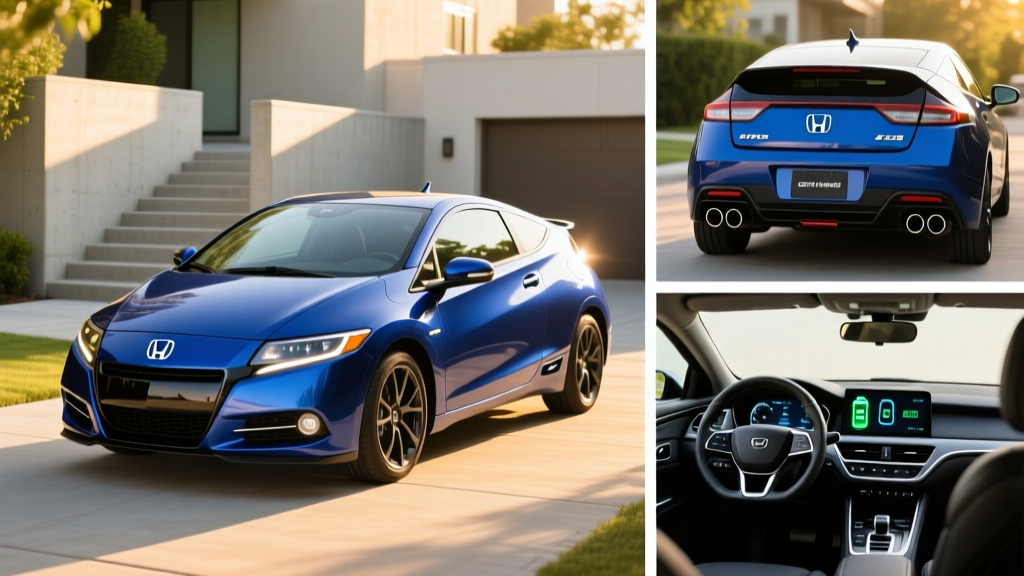
The Honda CR-Z hybrid occupies a curious space in automotive history: a two-seat sport compact that tried to prove fuel efficiency and driving engagement weren't mutually exclusive. Produced from 2011 through 2016, the CR-Z used Honda's Integrated Motor Assist (IMA) system — a mild-hybrid architecture fundamentally different from today's full hybrids and plug-in hybrids. If you're researching the Honda CR-Z hybrid as a potential used purchase in 2026, this guide covers everything from real-world MPG to IMA battery replacement costs and how it stacks up against modern electrified alternatives.
2011–2016 Honda CR-Z Hybrid: Quick Specs
| Specification | Honda CR-Z (All Years) |
|---|---|
| Powertrain | 1.5L i-VTEC 4-cyl + IMA electric motor |
| Combined Horsepower | 130 hp @ 6,000 rpm |
| Combined Torque | 140 lb-ft (CVT) / 127 lb-ft (6MT) |
| Battery | 0.67 kWh NiMH (nickel-metal hydride) |
| Transmission | 6-speed manual or CVT |
| EPA MPG (CVT) | 35 city / 38 highway / 36 combined |
| EPA MPG (6MT) | 31 city / 37 highway / 34 combined |
| 0–60 mph | ~9.7 seconds |
| Plug-in capable? | No — conventional HEV only |
| Production years | 2011–2016 (discontinued) |
How Many MPG Does the Honda CR-Z Hybrid Get?
The EPA fuel economy figures for the Honda CR-Z hybrid vary by transmission choice, which is unusual for a hybrid and reflects its sport-oriented positioning:
| Transmission | City MPG | Highway MPG | Combined MPG |
|---|---|---|---|
| CVT (automatic) | 35 | 38 | 36 |
| 6-speed manual | 31 | 37 | 34 |
Source: fueleconomy.gov
Real-World MPG vs. EPA Estimates
Owner-reported data from Fuelly and Honda forums consistently shows the CR-Z CVT averaging between 37 and 42 MPG combined in real-world mixed driving — often exceeding EPA estimates. This is typical of Honda's IMA system, which recovers more energy during frequent braking in city and suburban conditions. Highway-only driving at sustained 75+ mph tends to return 34–36 MPG, closer to or slightly below the EPA highway figure.
The manual transmission variant typically sees real-world averages of 33–37 MPG combined, with enthusiastic driving dropping that to the high 20s. The 3-pedal sport mode, which sharpens throttle response and increases electric motor assist, reduces economy by roughly 2–4 MPG depending on usage.
Honda IMA Hybrid System: How It Works
Understanding the CR-Z requires understanding Honda's Integrated Motor Assist (IMA), which differs fundamentally from the full-hybrid systems used in the Toyota Prius or modern Honda Accord Hybrid.
Conventional Hybrid (HEV) — Small battery (under 2 kWh), no plug, motor assists the engine but cannot drive the car alone at meaningful speeds. The CR-Z uses this architecture.
Plug-in Hybrid (PHEV) — Larger battery (8–25 kWh), plug-in capable, 20–50 miles of electric-only range before the gas engine engages. Examples: Toyota RAV4 Prime, Chrysler Pacifica Hybrid.
Battery Electric (BEV) — No gasoline engine, 200–400+ miles of all-electric range, requires plug-in charging. Examples: Tesla Model 3, Hyundai Ioniq 5.
The CR-Z's 0.67 kWh NiMH battery is far too small for electric-only propulsion. The IMA motor provides up to 14 hp and 58 lb-ft of torque assist to the 1.5L engine, smoothing acceleration and enabling idle stop-start, but the gasoline engine is always doing the primary work.
The IMA system's key functions in the CR-Z include:
- Motor assist: The 10-kW electric motor adds torque during acceleration, reducing the load on the gasoline engine
- Regenerative braking: Captures kinetic energy during deceleration to recharge the NiMH battery
- Idle stop: Shuts off the engine at stops (when conditions allow), restarting seamlessly when the brake is released
- Cylinder deactivation: The 1.5L engine can shut down all four cylinders during deceleration to reduce pumping losses
IMA Battery Lifespan, Warranty, and Replacement Cost
The IMA battery is the single biggest concern for anyone considering a used Honda CR-Z hybrid in 2026. These vehicles are now 10–15 years old, and NiMH batteries degrade with age and heat cycles regardless of mileage.
Honda covered the IMA battery for 8 years / 80,000 miles in most states, and 10 years / 150,000 miles in California Air Resources Board (CARB) states (CA, CT, MA, ME, NJ, NY, OR, RI, VT, WA). As of 2026, all CR-Z vehicles have exceeded their original factory hybrid battery warranty.
Replacement cost: A refurbished IMA battery pack costs approximately $1,500–$2,500 installed at an independent hybrid specialist. A new OEM Honda IMA battery (if available) runs $2,500–$3,800 installed at a dealership. Third-party rebuilt packs from suppliers like Bumble Bee Batteries or Dorman offer a cost-effective middle ground at $1,200–$1,800 for the part alone.
Signs of IMA Battery Degradation
When evaluating a used CR-Z, watch for these indicators of a weakening IMA battery:
- IMA warning light on the dashboard — indicates the system has detected a fault
- Reduced assist: The car feels noticeably slower off the line, as the electric motor contributes less
- Frequent recalibration: The battery gauge drops and the engine runs at high RPM to recharge — this "forced charge" cycle signals the battery can no longer hold adequate charge
- Idle stop failure: The auto stop-start system disables itself when battery state of charge is low
- Reduced MPG: A degraded IMA battery typically drops real-world economy by 3–6 MPG as the engine compensates
A healthy CR-Z IMA battery should show 8–10 bars of charge on the dash gauge during normal driving and sustain assist without triggering frequent recalibration cycles. Many owners report the original battery lasting 120,000–160,000 miles before significant degradation, though age alone can cause failure in lower-mileage examples stored in hot climates.
Who Should Buy the Honda CR-Z Hybrid in 2026?
The CR-Z is a niche vehicle, and its appeal depends heavily on what you prioritize. Here's a practical decision framework:
- You want a lightweight, engaging two-seat coupe with 35+ MPG
- You prefer a manual transmission — the CR-Z is one of the last hybrids ever offered with a stick shift
- You're comfortable with a used vehicle and potential $1,500–$2,500 IMA battery replacement
- You want Honda reliability with widely available parts and simple mechanicals
- Your budget is $6,000–$14,000 for a well-maintained example
- You need more than two seats or meaningful cargo space (the CR-Z has 22.5 cu ft behind the seats with the parcel shelf removed)
- You want electric-only driving or plug-in capability — consider a used Chevrolet Volt, Toyota Prius Prime, or Ford Fusion Energi instead
- You want modern safety tech — the CR-Z lacks automatic emergency braking, lane-keeping assist, and adaptive cruise control
- You want a full hybrid system with more substantial electric assist — the Toyota Prius or Honda Insight offer more advanced hybrid architectures
CR-Z vs. Modern Hybrids: A 2026 Reality Check
Hybrid technology has advanced considerably since the CR-Z ended production. Here's how it compares to current alternatives a buyer might cross-shop:
| Vehicle | Type | Combined MPG / MPGe | Seats | Approx. Used Price (2026) |
|---|---|---|---|---|
| Honda CR-Z (2011–2016) | HEV (mild) | 34–36 MPG | 2 | $6,000–$14,000 |
| Toyota Prius (2016–2022) | HEV (full) | 52–56 MPG | 5 | $16,000–$26,000 |
| Honda Insight (2019–2022) | HEV (full) | 48–52 MPG | 5 | $18,000–$27,000 |
| Toyota Prius Prime (2017–2022) | PHEV | 25 mi EV + 54 MPG | 5 | $20,000–$30,000 |
The efficiency gap is substantial. Modern full hybrids like the fourth-generation Prius achieve over 50 MPG combined while seating five passengers — a feat the CR-Z's mild-hybrid system was never designed to match. The CR-Z's advantage was always driving dynamics, not maximum efficiency.
Does the Honda CR-Z Qualify for Any Tax Credit?
No. The Honda CR-Z hybrid does not qualify for the federal §30D Clean Vehicle tax credit in 2026. There are two reasons:
- The §30D credit applies only to new plug-in electric vehicles (BEVs and PHEVs) with a minimum battery capacity of 7 kWh. The CR-Z's 0.67 kWh NiMH battery falls far short, and it's a conventional hybrid, not a plug-in.
- The used EV tax credit (up to $4,000 or 30% of sale price, per IRS guidelines) applies only to used BEVs and PHEVs — not conventional hybrids.
Some states may offer minimal incentives for used hybrid purchases, but these are uncommon and typically small. Check your state's energy office or department of environmental quality for any local programs. For current federal credit rules, consult the IRS Clean Vehicle Tax Credits page.
Reliability and Long-Term Ownership Costs
Honda's 1.5L i-VTEC engine is well-regarded for longevity, with many examples exceeding 200,000 miles with basic maintenance. The IMA system adds modest complexity compared to a conventional gas car, but it's far simpler than a full hybrid or plug-in hybrid powertrain. Key ownership considerations:
- IMA battery: The primary expense risk. Budget $1,500–$2,500 for a replacement if the original is still in the car and showing age-related degradation.
- 12V battery: Like all hybrids, the CR-Z has a standard 12V auxiliary battery. A dead 12V battery can prevent the car from starting even if the IMA battery is healthy — a common point of confusion for new hybrid owners.
- CVT maintenance: Honda's CVT in the CR-Z requires periodic fluid changes (every 30,000–60,000 miles). Neglected CVTs can develop shudder or slipping. The 6-speed manual is more robust and preferred by enthusiasts.
- Brakes: Regenerative braking reduces wear on the friction brakes. Many CR-Z owners report original brake pads lasting 80,000+ miles.
- Insurance: Typically $80–$130/month depending on profile — modest for a sport compact, as the CR-Z's 130 hp output keeps it in a low-risk bracket.
Frequently Asked Questions
Can the Honda CR-Z drive on electric power alone?
No. The CR-Z's IMA system is a mild hybrid — the electric motor assists the gasoline engine but cannot propel the car independently. The engine is always running when the vehicle is moving (except during idle stop at a standstill). If electric-only driving is a priority, look at a PHEV like the Toyota Prius Prime (25–44 miles EV range depending on year) or a full BEV.
Is the Honda CR-Z a good first hybrid to own?
It can be, with caveats. The CR-Z is mechanically straightforward, parts are widely available, and any Honda dealer or competent independent shop can service it. However, you're buying a 10–15-year-old vehicle with an aging hybrid battery. If you're not prepared for a potential $1,500–$2,500 IMA battery replacement within the first year or two of ownership, consider a newer used hybrid with more battery life remaining.
How does the CR-Z compare to the second-generation Honda Insight?
The 2019–2022 Honda Insight is a fundamentally different vehicle: a five-passenger sedan with Honda's two-motor i-MMD full-hybrid system, achieving 48–52 MPG combined. It's more efficient, more practical, and more modern — but also significantly more expensive on the used market ($18,000–$27,000 vs. $6,000–$14,000 for a CR-Z). The CR-Z wins on driving engagement and price; the Insight wins on efficiency, space, and technology.
What should I check before buying a used Honda CR-Z?
Prioritize these items during a pre-purchase inspection: (1) IMA battery health — ask for a scan tool reading of battery module voltages and internal resistance; (2) IMA system warning history — check for stored codes related to the battery or motor; (3) CVT fluid condition and service records; (4) timing chain tensioner (a known wear item on the 1.5L engine at high mileage); and (5) air conditioning compressor operation, as the CR-Z uses an electric A/C compressor that's more expensive to replace than a belt-driven unit.
Does the CR-Z hybrid need to be plugged in?
No. The Honda CR-Z is a conventional hybrid (HEV) and has no plug or charging port. The small NiMH battery charges entirely through regenerative braking and engine-driven generation. You simply fuel it with gasoline like any other car — the hybrid system operates transparently in the background.