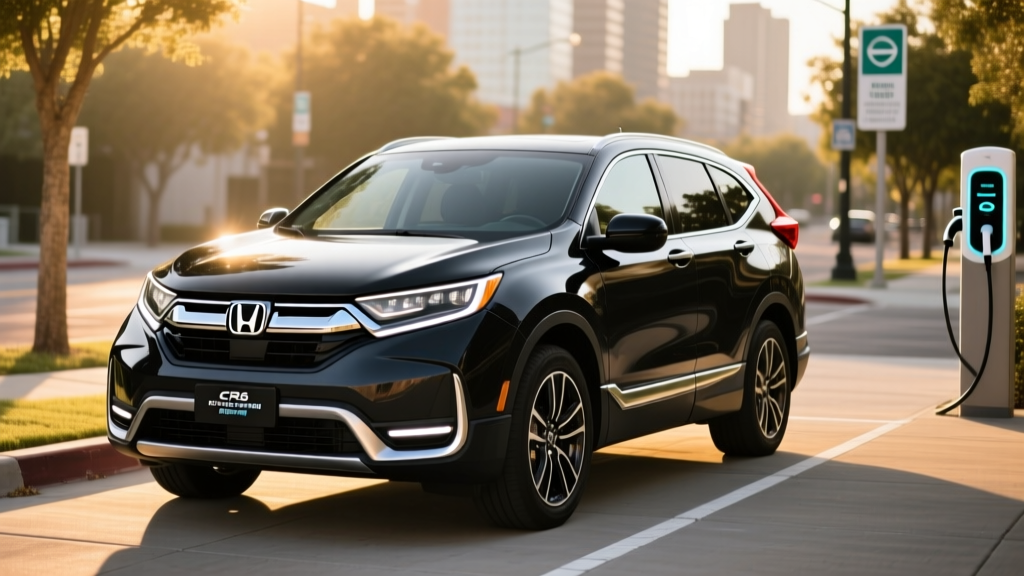
Quick Verdict: The Honda CR-V Touring Hybrid at a Glance
The Honda CR-V Touring Hybrid is the top-trim, conventional hybrid (HEV) version of Honda's best-selling compact SUV. It pairs a 2.0-liter Atkinson-cycle four-cylinder engine with a two-motor hybrid system for a combined 204 horsepower, delivering an EPA-estimated 40 MPG combined — with real-world city driving frequently exceeding that figure. For 2026, the Touring Hybrid remains the most equipped CR-V variant, bundling all-wheel drive, a panoramic moonroof, Bose premium audio, and Honda's full Honda Sensing suite into a package starting at $42,350 MSRP (including destination).
This is not a plug-in hybrid (PHEV) and not a battery electric vehicle (BEV). It never needs to be plugged in. If you're looking for electric-only driving or federal tax credits, the CR-V Hybrid won't qualify — but its proven reliability, strong city MPG, and zero lifestyle compromise make it a compelling bridge for buyers not yet ready for full electrification.
| Spec | Value |
|---|---|
| Powertrain | 2.0L Atkinson-cycle I-4 + two-motor hybrid system (HEV) |
| Combined Horsepower | 204 hp |
| Combined Torque | 247 lb-ft (electric motor peak) |
| Drivetrain | Real Time AWD (standard on Touring Hybrid) |
| EPA Fuel Economy (City/Hwy/Combined) | 40 / 34 / 37 MPG (AWD) |
| Fuel Tank Capacity | 15.3 gallons |
| Total Driving Range | ~566 miles (EPA combined) |
| 0–60 mph | ~7.9 seconds |
| Cargo Volume (rear seats up / down) | 36.3 / 76.5 cu ft |
| Towing Capacity | 1,000 lbs |
| Hybrid Battery Warranty | 8 years / 100,000 miles |
| Base MSRP (Touring Hybrid AWD) | $42,350 (incl. destination) |
| Federal EV Tax Credit (§30D) | Not eligible (HEV, not PHEV or BEV) |
How Many MPG Does the Honda CR-V Touring Hybrid Actually Get?
The EPA rates the 2026 CR-V Hybrid AWD at 40 MPG city, 34 MPG highway, and 37 MPG combined, according to fueleconomy.gov. These numbers apply to all AWD CR-V Hybrid trims, including the Touring.
| Driving Cycle | EPA Rating | Real-World Expectation |
|---|---|---|
| City | 40 MPG | 38–44 MPG (hybrids excel in stop-and-go) |
| Highway | 34 MPG | 30–34 MPG (less regen benefit at steady speed) |
| Combined | 37 MPG | 34–39 MPG (varies with driving mix) |
Real-world note: Honda's two-motor hybrid system operates primarily as a series hybrid at low and moderate speeds, meaning the electric motor drives the wheels while the gas engine acts as a generator. This is why city MPG is higher than highway — the opposite of a conventional gas car. In warm-weather city driving with moderate traffic, owners routinely report 42–45 MPG on the trip computer. Highway cruising at 75+ MPH, where the engine clutches directly to the wheels via a single fixed gear ratio, yields lower efficiency. Cold weather (below 30°F) can reduce city MPG by 3–5 MPG due to increased engine-on time for cabin heat and reduced battery efficiency.
Compared to the gas-only CR-V AWD (27/32/29 MPG EPA), the hybrid saves roughly 130 gallons of fuel per year at 15,000 miles — approximately $450–$550 annually at $3.50/gallon, depending on your driving mix.
Hybrid (HEV) vs. Plug-In Hybrid (PHEV) vs. Full EV: Which Is Right for You?
Critical distinction: The CR-V Touring Hybrid is a conventional hybrid (HEV). It has a small lithium-ion battery (approximately 1.1 kWh) that is charged exclusively by the gas engine and regenerative braking. You never plug it in. It cannot drive on electric power alone for any meaningful distance — only at very low speeds for brief stretches in EV mode.
Honda does not currently offer a CR-V PHEV in the U.S. market. If you want electric-only commuting with a gas backup, you'd need to look at competitors like the Toyota RAV4 Prime (42 miles electric-only, EPA-rated) or the Hyundai Tucson PHEV (33 miles). These qualify for partial or full federal tax credits under IRS §30D rules, subject to MSRP caps ($80,000 for SUVs), buyer income limits, and battery component/critical mineral sourcing requirements.
Choose the CR-V Touring Hybrid (HEV) if:
- You don't have access to home or workplace charging
- You want maximum fuel savings with zero behavior change
- You regularly take long road trips and don't want to plan around charging
- You prioritize proven reliability and low maintenance
Choose a PHEV (like RAV4 Prime) if:
- You can charge at home and commute under 40 miles round-trip
- You want to drive mostly electric on weekdays with gas flexibility on weekends
- You want to capture a federal tax credit (eligibility varies — consult a tax professional)
Choose a full BEV (like Tesla Model Y or Hyundai Ioniq 5) if:
- You have reliable Level 2 home charging
- Your daily driving is under 250 miles and you can plan road-trip charging
- You want to eliminate gasoline entirely and capture the full $7,500 federal credit (if eligible)
Powertrain Deep Dive: How Honda's Two-Motor Hybrid System Works
The CR-V Hybrid uses Honda's fourth-generation two-motor hybrid system, which operates differently from Toyota's planetary-gear Hybrid Synergy Drive. Here's how it functions across driving conditions:
- EV Drive (low speed, light load): The propulsion motor drives the wheels using battery energy. The engine is off. Range: less than 1 mile at very low speeds.
- Hybrid Drive (most city/suburban driving): The engine spins the generator motor, which produces electricity to power the propulsion motor. Excess energy charges the battery. The engine is mechanically disconnected from the wheels.
- Engine Drive (highway cruising): A lock-up clutch connects the engine directly to the front wheels through a single fixed gear ratio (~equivalent to a tall overdrive gear). This is more efficient at steady highway speeds than converting mechanical energy to electrical and back.
The propulsion motor produces 181 hp and 247 lb-ft of torque, which is what you feel accelerating from a stop. The 2.0L Atkinson-cycle engine contributes 145 hp on its own, but combined system output is rated at 204 hp because the engine and motor power curves don't peak simultaneously. The result is smooth, linear acceleration with a 0–60 time of approximately 7.9 seconds — adequate for merging and passing, though not sporty.
The Real Time AWD system adds a rear-mounted electric motor that engages the rear axle when slip is detected or during hard acceleration. Unlike mechanical AWD systems, there's no driveshaft — the rear motor is powered electrically, which reduces parasitic loss and improves fuel economy.
Touring Trim: What You Get for the Premium Price
The Touring Hybrid sits at the top of the CR-V Hybrid lineup for 2026, and its $42,350 MSRP reflects a comprehensive feature list. Key Touring-exclusive or Touring-standard equipment includes:
- 19-inch alloy wheels
- Panoramic moonroof
- Bose 12-speaker premium audio system
- Wireless Apple CarPlay and Android Auto on a 9-inch touchscreen
- Wireless phone charging pad
- Heated and ventilated front seats, heated rear outboard seats
- Heated steering wheel
- Hands-free power tailgate with kick sensor
- Low Speed Braking Control and Traffic Jam Assist (part of Honda Sensing)
- Front and rear parking sensors
- Low Speed Follow (adaptive cruise with stop-and-go)
For comparison, the CR-V Hybrid Sport-L starts at $37,295 and the Sport Touring Hybrid at $40,695. The Touring Hybrid adds the panoramic roof, Bose audio, ventilated seats, and rear heated seats over the Sport Touring — a $1,655 step-up that most buyers will find worthwhile if planning to keep the vehicle long-term.
Hybrid Battery Warranty, Reliability, and Replacement Cost
Honda Hybrid Battery Warranty: 8 years or 100,000 miles (whichever comes first), covering defects and capacity loss below functional thresholds. In states that follow California Air Resources Board (CARB) emissions rules — including California, New York, Massachusetts, Oregon, Washington, and others — the hybrid battery warranty extends to 10 years or 150,000 miles.
Expected Battery Lifespan: Honda's lithium-ion hybrid battery pack is designed to last the life of the vehicle. Real-world data from earlier-generation CR-V Hybrids (2020–2023) and Honda Accord Hybrids shows minimal degradation — typically under 10% capacity loss over 100,000 miles. The battery is small (~1.1 kWh), so it undergoes shallow charge/discharge cycles, which is ideal for lithium-ion longevity.
Replacement Cost (out of warranty): If the hybrid battery fails outside the warranty window, replacement runs approximately $2,000–$4,000 for the battery pack itself, plus $500–$800 in labor. Honda dealerships quote on the higher end; independent hybrid specialists can often source refurbished or aftermarket packs for less. For context, this is significantly cheaper than a BEV battery replacement ($5,000–$20,000+) because the pack is far smaller.
The broader powertrain — engine, transmission (e-CVT), and electric motors — is covered under Honda's 5-year/60,000-mile powertrain warranty. Honda's hybrid systems have earned strong reliability marks from Consumer Reports and J.D. Power over multiple model years, with the e-CVT design proving more durable than conventional belt-and-pulley CVTs because it has no belts, pulleys, or friction materials to wear.
Safety Ratings and Driver Assistance
The 2026 CR-V Hybrid carries top safety marks. The IIHS named the CR-V a Top Safety Pick+ (the highest designation) when equipped with specific headlights, and NHTSA awarded it a 5-Star Overall Safety Rating.
The Honda Sensing suite, standard on all trims including the Touring Hybrid, includes:
- Collision Mitigation Braking System (CMBS)
- Road Departure Mitigation (RDM)
- Adaptive Cruise Control with Low-Speed Follow
- Lane Keeping Assist System (LKAS)
- Traffic Sign Recognition
- Traffic Jam Assist (steering support at low speeds)
Important: Honda Sensing is an SAE Level 2 driver-assistance system. It provides combined steering and acceleration/braking support, but the driver must remain fully engaged, hands on or near the wheel, and eyes on the road at all times. It is not a self-driving system and cannot navigate autonomously. Think of it as enhanced cruise control with lane-centering, not hands-free autonomy.
Tax Credits, Incentives, and Total Cost of Ownership
The CR-V Touring Hybrid does not qualify for the federal §30D Clean Vehicle Credit. That credit is reserved for plug-in electric vehicles (PHEVs and BEVs) meeting battery sourcing and critical mineral requirements. Because the CR-V Hybrid is a conventional HEV that never plugs in, it is ineligible regardless of buyer income or MSRP.
However, several states and localities offer their own incentives for hybrid vehicles, though these are increasingly rare as state programs shift toward PHEVs and BEVs. Some utility companies offer rebates for any electrified vehicle purchase. Check your state energy office and local utility for current programs.
| Cost Factor | CR-V Touring Hybrid AWD ($42,350) | CR-V EX-L Gas AWD ($37,295) |
|---|---|---|
| Purchase Price (MSRP) | $42,350 | $37,295 |
| Federal Tax Credit | $0 | $0 |
| Fuel Cost (5 yr / 75,000 mi at $3.50/gal) | ~$7,095 (37 MPG combined) | ~$9,032 (29 MPG combined) |
| Estimated Insurance (5 yr) | ~$8,500 | ~$8,000 |
| Maintenance (5 yr) | ~$2,500 | ~$2,800 |
| Estimated Depreciation (5 yr) | ~$17,000 | ~$15,500 |
| Approximate 5-Year Total | ~$77,445 | ~$72,627 |
The hybrid saves roughly $1,937 in fuel over five years but costs $5,055 more upfront. The break-even point on fuel savings alone is roughly 11–12 years at 15,000 miles/year. However, the Touring trim includes significant premium features (panoramic roof, Bose audio, ventilated seats) that would not be available on the gas EX-L, so the comparison isn't purely apples-to-apples. Compared to a gas CR-V Sport Touring ($40,295), the hybrid premium narrows to $2,055 and the fuel savings close the gap in about 4–5 years.
Pros, Cons, and Final Assessment
Pros
- 40 MPG city EPA — real-world city driving often exceeds this
- No plug-in required; zero lifestyle change from a gas car
- 204 hp with smooth, linear electric-motor torque delivery
- Top-tier safety ratings (IIHS TSP+, NHTSA 5-Star)
- 8-year/100,000-mile hybrid battery warranty (10 yr/150k in CARB states)
- Comprehensive Touring trim with premium features standard
- Strong resale value and Honda reliability track record
- 36.3 cu ft cargo with seats up — competitive for the class
Cons
- Highway MPG drops to 34 — less impressive on long road trips
- No federal tax credit eligibility (HEV, not PHEV/BEV)
- Touring trim starts at $42,350 — steep for a compact SUV
- Towing limited to 1,000 lbs (many competitors offer 1,500–3,500 lbs)
- No spare tire — tire repair kit only
- Rear-seat entertainment and premium navigation require phone integration
- Engine can drone under hard acceleration (typical of Atkinson-cycle + e-CVT)
Frequently Asked Questions
Does the Honda CR-V Touring Hybrid need to be plugged in?
No. The CR-V Touring Hybrid is a conventional hybrid (HEV). Its small lithium-ion battery is recharged by the gas engine and regenerative braking. You fuel it like any other car — there is no plug, no charging cable, and no electric-only driving range to manage.
How far can the CR-V Hybrid drive on electric power alone?
Less than one mile, and only at very low speeds (under 25 mph) with a fully charged hybrid battery. The EV mode button allows you to force electric-only operation in limited situations (e.g., creeping through a parking garage), but the 1.1 kWh battery depletes almost immediately. This is not a PHEV — it has no meaningful electric-only range.
Is the Honda CR-V Hybrid reliable?
Yes. Honda's two-motor hybrid system has been in production since 2014 (Accord Hybrid) and has demonstrated strong long-term reliability. The e-CVT has no belts or friction materials to wear, and the hybrid battery undergoes shallow cycles that minimize degradation. Consumer Reports has given recent CR-V Hybrid model years above-average predicted reliability ratings.
What does it cost to replace the CR-V Hybrid battery?
Out of warranty, expect $2,500–$4,500 total (parts and labor) at a Honda dealer. Independent hybrid shops may offer refurbished packs for less. However, real-world data suggests hybrid battery replacement is rarely needed before 150,000+ miles, and most vehicles will be covered by the 8-year/100,000-mile warranty (10 years/150,000 miles in CARB states).
Does the CR-V Hybrid qualify for any tax credit?
Not the federal §30D Clean Vehicle Credit, which requires a plug-in vehicle (PHEV or BEV). Some states or utilities may offer small rebates for hybrid purchases, but these are becoming less common. Always check IRS guidelines and your state energy office for current incentive programs.
CR-V Hybrid vs. Toyota RAV4 Hybrid — which is better?
Both are excellent. The RAV4 Hybrid (39 MPG combined EPA, 219 hp, ~$38,000 starting) offers slightly more horsepower and a lower entry price. The CR-V Hybrid (37 MPG combined EPA, 204 hp) edges ahead in cargo volume (36.3 vs 37.5 cu ft is roughly comparable) and interior refinement, especially in the Touring trim. The RAV4 Prime PHEV variant is the choice if you want electric-only commuting and potential tax credit eligibility. Test-drive both to compare ride quality, infotainment preference, and seat comfort.
How does cold weather affect the CR-V Hybrid's fuel economy?
Expect a 5–10% MPG reduction in sustained cold weather (below 30°F). The engine runs more frequently to provide cabin heat and maintain battery temperature, reducing the time spent in electric-only or series-hybrid mode. Short trips in cold weather see the largest penalty — the engine may run continuously for the first 5–10 minutes just to warm the cabin. Pre-conditioning isn't applicable here since there's no plug-in capability, but using seat heaters instead of cranking the cabin heat can marginally improve efficiency.