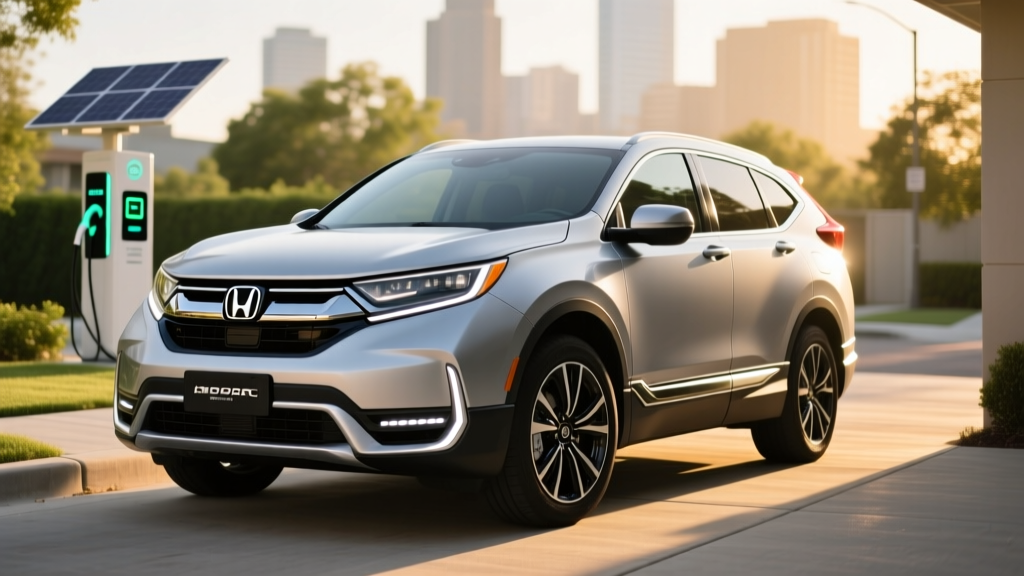
The Honda CR-V Sport Touring Hybrid sits at the top of Honda's compact-SUV lineup, pairing a turbocharged four-cylinder with a two-motor hybrid system for 204 combined horsepower and an EPA-estimated 40 MPG combined with front-wheel drive. It's a conventional hybrid (HEV), meaning it never needs to be plugged in — the gasoline engine and regenerative braking handle all battery charging. For buyers weighing a premium-trim compact SUV against full EVs and plug-in hybrids, the Sport Touring Hybrid occupies a specific niche: near-luxury features, strong real-world city efficiency, and zero charging infrastructure requirements.
This guide covers everything a spec-driven buyer needs — EPA fuel economy breakdowns, real-world MPG expectations, powertrain details, battery warranty terms, pricing, tax-credit eligibility, and a decision framework for choosing this HEV over a PHEV or BEV.
HEV vs PHEV: What the CR-V Sport Touring Hybrid Actually Is
Conventional Hybrid (HEV) — This Vehicle: The CR-V Sport Touring Hybrid uses a small traction battery (~1.06 kWh) charged entirely by the gasoline engine and regenerative braking. You fuel it like any gas car. There is no plug, no electric-only driving range to manage, and no home charger requirement. Efficiency gains come from the electric motor assisting the engine at low speeds and recapturing energy during deceleration.
Plug-In Hybrid (PHEV): A PHEV carries a much larger battery (typically 15–20 kWh), can be plugged in to a Level 1 or Level 2 charger, and offers 25–50 miles of electric-only driving before the gas engine takes over. Honda does not currently offer a PHEV variant of the CR-V in the US market. Competitors like the Toyota RAV4 Prime provide 42 miles of electric-only range with a plug-in architecture.
This distinction matters because the CR-V Sport Touring Hybrid will not qualify for the federal §30D clean vehicle tax credit (which requires plug-in capability and minimum battery capacity), and it will not provide any electric-only commuting. What it does deliver is consistently strong fuel economy without any behavioral change from a conventional gas vehicle.
Fuel Economy: EPA Ratings and Real-World MPG
| Drivetrain | City MPG | Highway MPG | Combined MPG |
|---|---|---|---|
| FWD | 43 | 36 | 40 |
| AWD | 40 | 34 | 37 |
Source: EPA / fueleconomy.gov
The front-wheel-drive CR-V Sport Touring Hybrid achieves 43 city / 36 highway / 40 combined MPG. The all-wheel-drive variant drops slightly to 40/34/37. These figures place it among the most efficient compact crossovers available, though the AWD penalty of roughly 3 MPG combined is worth noting if you live in a region where AWD is essential.
Real-World MPG: What to Actually Expect
Conventional hybrids typically exceed their EPA city ratings in stop-and-go traffic because regenerative braking recovers more energy in urban driving. On the highway, where the gasoline engine does most of the work alone, real-world figures tend to land at or slightly below the EPA sticker.
- City driving (suburban commuting, traffic): Expect 41–46 MPG FWD; 38–43 MPG AWD. Many owners report beating the EPA city number by 2–4 MPG in warm weather with moderate acceleration.
- Highway cruising (70–80 mph): Expect 33–37 MPG FWD; 31–35 MPG AWD. Aerodynamic drag at higher speeds reduces hybrid advantage.
- Cold weather penalty: In sub-40°F conditions, expect a 5–10% reduction across the board. The engine runs more frequently to provide cabin heat and warm the catalytic converter, reducing time spent in EV mode.
- Mountainous terrain: Steep climbs will drop instantaneous MPG into the low 20s, but regenerative braking on descents partially recovers the deficit. Net trip MPG in hilly terrain typically lands 2–4 MPG below combined ratings.
On a 14.8-gallon fuel tank (FWD), the CR-V Sport Touring Hybrid delivers a theoretical maximum range of roughly 592 miles at its combined EPA rating — or closer to 650+ miles in city-heavy driving where it exceeds its sticker. AWD models with a 14.0-gallon tank yield approximately 518 miles combined.
Powertrain and Performance Specifications
| Specification | Detail |
|---|---|
| Engine | 2.0L DOHC 16-valve Atkinson-cycle 4-cylinder |
| Hybrid System | Two-motor hybrid (drive motor + generator motor) |
| Combined System Output | 204 hp / 247 lb-ft torque |
| Traction Battery | ~1.06 kWh lithium-ion (HEV, not plug-in) |
| Transmission | Electronic Continuously Variable (e-CVT) |
| 0–60 mph | ~7.6 seconds (AWD) |
| Drivetrain | FWD standard; Real Time AWD available |
| Fuel Tank | 14.8 gal (FWD) / 14.0 gal (AWD) |
| Towing Capacity | 1,000 lbs |
| Cargo Volume | 36.3 cu ft (rear seats up) / 76.5 cu ft (rear seats folded) |
The two-motor hybrid system operates in three modes: EV Drive (electric motor only, at low speeds and light loads), Hybrid Drive (engine powers the generator, which feeds the drive motor), and Engine Drive (a lock-up clutch connects the engine directly to the wheels at steady highway speeds). This architecture, which Honda calls its fourth-generation two-motor system, eliminates a traditional geared transmission entirely — the e-CVT is a power-split device, not a belt-driven CVT, and it avoids the rubber-band sensation associated with older CVT designs.
The 204 combined horsepower is competitive with the Toyota RAV4 Hybrid (219 hp) and Hyundai Tucson Hybrid (226 hp), though the CR-V prioritizes smoothness and low-RPM torque over peak acceleration. The 0–60 time of approximately 7.6 seconds (AWD) is adequate for highway merging but won't feel sporty. Where the Honda excels is low-speed responsiveness — the electric drive motor delivers 247 lb-ft of torque from near-zero RPM, making the CR-V feel quicker around town than its 0–60 number suggests.
Pricing, Trims, and Tax Credit Eligibility
The 2026 Honda CR-V Sport Touring Hybrid carries an MSRP starting at approximately $40,850 (including destination charge). This positions it as the most expensive CR-V variant, reflecting its standard AWD, leather-trimmed seats, Bose premium audio, wireless Apple CarPlay/Android Auto, heated front and rear seats, panoramic moonroof, hands-free power tailgate, and the full Honda Sensing suite of driver-assistance features.
Federal Tax Credit: Does It Qualify?
No federal §30D tax credit. The CR-V Sport Touring Hybrid is a conventional hybrid (HEV), not a plug-in vehicle. Under IRS rules, the §30D Clean Vehicle Credit applies only to plug-in electric vehicles (BEVs and PHEVs) meeting minimum battery capacity, critical-mineral sourcing, MSRP caps, and buyer income thresholds. The CR-V HEV does not meet the fundamental plug-in requirement.
Some states offer separate incentives for conventional hybrids, though these are increasingly rare as programs shift focus to plug-in vehicles. Check your state's energy or environmental agency for current programs. Honda also periodically offers manufacturer incentives (lease cash, loyalty bonuses) that can reduce out-of-pocket cost — check Honda's current offers page for active promotions.
Battery Warranty, Reliability, and Replacement Cost
Hybrid battery longevity remains one of the top concerns for HEV buyers, and Honda addresses this with robust warranty coverage:
| Coverage | Term |
|---|---|
| Hybrid Battery Warranty | 8 years / 100,000 miles (10 yr/150,000 mi in CARB states) |
| Powertrain Warranty | 5 years / 60,000 miles |
| Limited Vehicle Warranty | 3 years / 36,000 miles |
| Rust Perforation | 5 years / unlimited miles |
In CARB-adopting states (California, Colorado, Connecticut, Maine, Maryland, Massachusetts, Minnesota, Nevada, New Jersey, New Mexico, New York, Oregon, Rhode Island, Vermont, Virginia, Washington), the hybrid battery warranty extends to 10 years / 150,000 miles.
How Long Will the Hybrid Battery Last?
Honda's hybrid batteries are designed to last the life of the vehicle. The ~1.06 kWh battery is small and operates within a narrow state-of-charge window (roughly 40–80%), which dramatically reduces degradation compared to a full EV battery that cycles through wider charge ranges. Real-world data from Honda's earlier hybrid systems (Insight, Accord Hybrid) shows battery packs routinely lasting 150,000–200,000+ miles with minimal capacity loss.
If replacement is needed out of warranty, a Honda CR-V Hybrid battery pack currently costs approximately $2,500–$4,500 including labor at a dealership — significantly less than a full EV battery replacement ($10,000–$20,000+). Third-party hybrid battery rebuild services can reduce this to $1,500–$2,500. However, given Honda's track record and the battery's conservative charge management, out-of-warranty replacement is uncommon.
Overall Reliability
Honda's fourth-generation two-motor hybrid system has been in production since the 2023 CR-V redesign, building on architecture proven in the Accord Hybrid and CR-V Hybrid since 2020. The e-CVT design has fewer moving parts than a traditional automatic transmission (no planetary gearsets, no clutch packs to wear), and Honda's hybrid components have earned strong reliability marks from Consumer Reports and J.D. Power across multiple model years.
Sport Touring Trim: What You Get for the Premium
The Sport Touring Hybrid is the flagship CR-V trim. Key standard equipment includes:
- Real Time AWD with intelligent torque distribution
- Leather-trimmed seats with heated front and rear outboard seats
- Heated steering wheel
- Panoramic moonroof
- Bose 12-speaker premium audio system
- 9-inch touchscreen with wireless Apple CarPlay and Android Auto
- Wireless phone charging pad
- Hands-free power tailgate with walk-away close
- Honda Sensing suite: Adaptive Cruise Control, Lane Keeping Assist, Collision Mitigation Braking, Road Departure Mitigation, Traffic Sign Recognition
- Low-Speed Follow (stop-and-go adaptive cruise)
- Blind Spot Information with Cross Traffic Monitor
- LED headlights with auto high-beam
- 19-inch Berlina Black alloy wheels
- Dual-zone automatic climate control with rear vents
Notably, the Honda Sensing suite is SAE Level 2 driver assistance — it provides steering and acceleration/braking support but requires the driver to remain fully engaged and hands on the wheel at all times. This is not autonomous driving.
CR-V Sport Touring Hybrid vs. Alternatives: Which Fits You?
Pros
- 40 MPG combined (FWD) — class-leading efficiency
- No charging infrastructure needed — fuel and go
- Premium Sport Touring trim with leather, Bose audio, panoramic roof
- Strong low-speed electric torque for responsive city driving
- Proven hybrid reliability with 8–10 year battery warranty
- Competitive cargo space (36.3 cu ft rear seats up)
Cons
- No federal tax credit eligibility (HEV, not PHEV)
- AWD drops combined MPG to 37
- Modest 0–60 time (~7.6 sec AWD) — not sporty despite "Sport" badge
- 1,000-lb towing capacity limits utility vs. truck-based SUVs
- Higher MSRP than non-hybrid CR-V trims (~$5,000 premium)
- No electric-only driving capability
Decision Framework: Hybrid vs PHEV vs EV
Choose the CR-V Sport Touring Hybrid (HEV) if:
- You cannot install a home charger (apartment, street parking, no garage)
- You want maximum efficiency without changing fueling habits
- You take frequent long road trips where charging infrastructure is sparse
- You want premium features without a $50,000+ EV price tag
- You drive 10,000–15,000 miles/year and want low fuel cost without range planning
Choose a PHEV (e.g., Toyota RAV4 Prime) if:
- You can charge at home and want 25–42 miles of electric-only commuting
- Your daily commute is under 40 miles round-trip
- You want a federal tax credit (if the model qualifies under §30D sourcing rules)
- You want EV-like daily driving with gas-engine backup for road trips
Choose a full EV (e.g., Hyundai Ioniq 5, Tesla Model Y) if:
- You have reliable home Level 2 charging
- Your daily driving is under 250 miles and you can plan road-trip charging
- You want the lowest per-mile fuel cost and minimal maintenance
- You want to take advantage of the §30D federal tax credit (up to $7,500, subject to eligibility)
- You want zero tailpipe emissions and a quieter driving experience
5-Year Cost of Ownership Snapshot
Assuming 15,000 miles/year, $3.50/gallon regular unleaded, and the CR-V Sport Touring Hybrid AWD at 37 MPG combined:
- Annual fuel cost: ~$1,426 (15,000 mi ÷ 37 MPG × $3.50)
- 5-year fuel cost: ~$7,130
- Compared to a 28-MPG gas compact SUV: The hybrid saves approximately $2,473 in fuel over 5 years ($9,375 gas cost – $7,130 hybrid cost)
- Maintenance savings: Hybrids typically have lower brake wear (regenerative braking reduces pad usage) and no transmission fluid changes. Expect $500–$1,000 in maintenance savings over 5 years vs. a conventional automatic.
The ~$5,000 price premium for the hybrid powertrain over a comparably equipped gas CR-V is largely offset by fuel savings within 5–7 years of average driving, after which the hybrid continues to deliver savings.
Frequently Asked Questions
How many MPG does the Honda CR-V Sport Touring Hybrid get?
The FWD model achieves an EPA-estimated 43 city / 36 highway / 40 combined MPG. The AWD model (standard on the Sport Touring trim) achieves 40 city / 34 highway / 37 combined MPG. Real-world city driving often exceeds these figures by 2–4 MPG, while sustained highway driving at 75+ mph may fall 2–3 MPG below the highway rating.
Does the CR-V Sport Touring Hybrid need to be plugged in?
No. It is a conventional hybrid (HEV), not a plug-in hybrid. The battery charges through regenerative braking and the gasoline engine. You fuel it exactly like a standard gas car — there is no charging port, no plug, and no electric-only range to manage.
How far can it go on electric only?
Not far enough to matter for commuting. The CR-V HEV can operate in EV mode for very short distances (roughly 0.5–1 mile) at low speeds (under 25 mph) when the battery has sufficient charge. This is for creeping through parking lots or residential streets — not a substitute for a PHEV's 25–42 mile electric range or a full EV's 250+ mile range.
Is the CR-V Hybrid reliable, and what does battery replacement cost?
Honda's hybrid system has a strong reliability record across multiple model years. The hybrid battery is warrantied for 8 years/100,000 miles (10 years/150,000 miles in CARB states), and real-world data shows these batteries routinely lasting 150,000–200,000+ miles. If replacement is needed out of warranty, expect $2,500–$4,500 at a dealership, or $1,500–$2,500 through a third-party hybrid battery specialist.
Does the Honda CR-V Hybrid qualify for any tax credit?
No federal tax credit. The IRS §30D Clean Vehicle Credit applies only to plug-in electric vehicles. The CR-V HEV does not qualify. Some states may offer minor hybrid incentives — check your state energy office. Manufacturer incentives (lease deals, loyalty bonuses) may be available directly from Honda.
How does the CR-V Sport Touring Hybrid compare to the Toyota RAV4 Hybrid?
The RAV4 Hybrid (219 hp, 41 MPG combined AWD) offers slightly more horsepower and 4 MPG better combined efficiency with standard AWD, starting around $3,000 less than the CR-V Sport Touring Hybrid. However, the CR-V Sport Touring offers a more premium interior (leather, Bose audio, panoramic roof) at its trim level, more rear legroom (41.3 vs 37.8 inches), and a smoother e-CVT calibration. The RAV4 Prime PHEV (42 miles electric-only, ~$44,000) is the better comparison if you want plug-in capability.
Is the Sport Touring trim worth the price premium?
If you want leather, premium audio, a panoramic roof, and the full Honda Sensing suite in a CR-V, the Sport Touring Hybrid is the only trim that bundles all of these with the hybrid powertrain. The step up from the Sport-L Hybrid (~$37,500) adds approximately $3,350 for the panoramic roof, Bose audio, heated rear seats, and hands-free tailgate. Whether that's worthwhile depends on how much you value those premium features — mechanically, all CR-V Hybrid trims share the same 204-hp powertrain and EPA ratings.