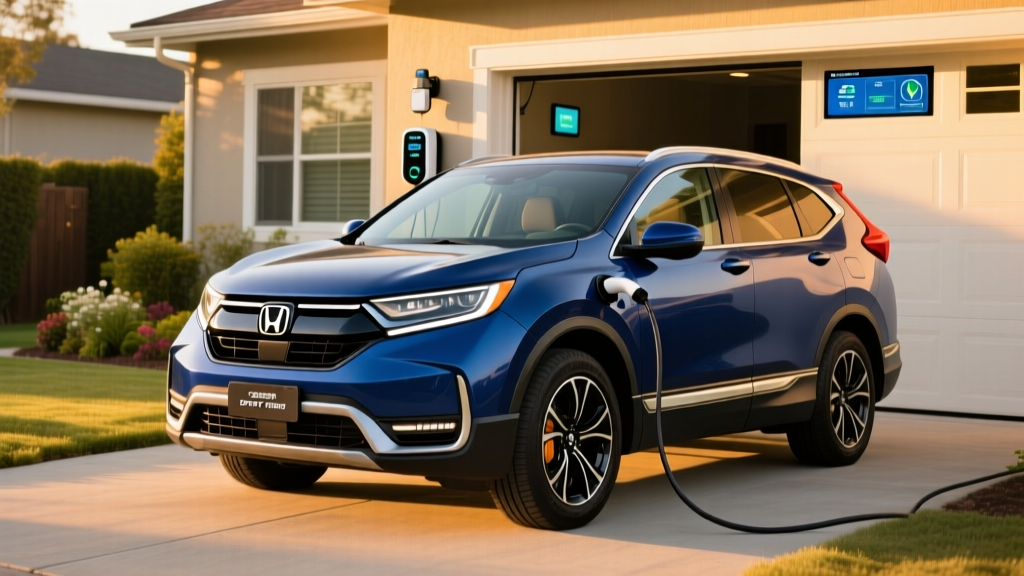
The Honda CR-V has long been the default compact SUV for pragmatic buyers, and the Sport L Hybrid sits in the sweet spot of the lineup — offering all-wheel drive, a premium interior, and the fuel-sipping two-motor hybrid system without the price jump to the top Sport Touring trim. For 2026, the CR-V Sport L Hybrid carries forward Honda's proven fourth-generation two-motor hybrid powertrain with minor refinements. If you're cross-shopping this against a full EV or a gas-only CR-V, this guide breaks down the exact numbers you need to decide.
2026 Honda CR-V Sport L Hybrid: Quick Specs at a Glance
| Spec | Value |
|---|---|
| Powertrain | 2.0L DOHC 4-cyl + 2-motor hybrid system (AWD) |
| Combined Horsepower | 204 hp |
| Combined Torque | 247 lb-ft (electric motor) |
| EPA MPG (City / Hwy / Combined) | 40 / 34 / 37 |
| Fuel Tank | 14.0 gallons |
| Total Range | ~518 miles |
| Drivetrain | Real Time AWD (standard on Sport L Hybrid) |
| 0–60 mph | ~7.6 seconds (est.) |
| Cargo Volume | 36.3 cu ft (rear seats up) / 76.5 cu ft (folded) |
| Towing Capacity | 1,000 lbs |
| Hybrid Battery Warranty | 8 years / 100,000 miles |
| MSRP (Sport L Hybrid AWD) | ~$39,845 (incl. destination) |
Fuel Economy: EPA Ratings vs. Real-World MPG
The EPA rates the 2026 CR-V Hybrid AWD at 40 mpg city, 34 mpg highway, and 37 mpg combined per fueleconomy.gov. Those numbers apply across all CR-V Hybrid trims including the Sport L, since they share the same powertrain and weight class.
| Driving Scenario | EPA Rating | Real-World Expectation |
|---|---|---|
| City | 40 mpg | 42–45 mpg (warm), 36–38 mpg (cold) |
| Highway | 34 mpg | 30–32 mpg (75 mph), 33–35 mpg (65 mph) |
| Combined | 37 mpg | 35–40 mpg depending on mix |
How the Hybrid Powertrain Works
The CR-V Sport L Hybrid uses Honda's fourth-generation two-motor hybrid system. Here's the mechanical breakdown:
- Engine: 2.0-liter Atkinson-cycle DOHC inline-4 producing 146 hp and 134 lb-ft on its own
- Propulsion Motor: 181 hp / 247 lb-ft electric motor that drives the front wheels directly
- Generator Motor: Second electric motor that starts the engine, generates electricity, and manages energy flow
- Combined System Output: 204 hp (limited by engine-generator output, not the sum of individual components)
- AWD System: Honda's Real Time AWD adds a rear driveshaft and rear-mounted electric motor for torque distribution to the rear axle when needed
In normal driving, the CR-V Hybrid operates primarily as a series hybrid at low speeds — the engine generates electricity that feeds the propulsion motor, which actually turns the wheels. At highway cruising speeds, a lock-up clutch engages to connect the engine directly to the wheels for better efficiency. This is why city MPG exceeds highway MPG: the electric motor handles the inefficient stop-start work while the engine stays in its optimal RPM range.
This is a conventional hybrid (HEV), not a plug-in hybrid. There is no charging port, no electric-only range to manage, and no need to alter your routine. The small lithium-ion battery pack (approximately 1.06 kWh) charges itself through regenerative braking and the gasoline engine.
HEV vs. PHEV vs. Full EV: Which Powertrain Fits You?
The CR-V Sport L Hybrid is a self-charging HEV. Honda does not currently offer a CR-V plug-in hybrid in the US market (the CR-V e:PHEV is sold in China and Europe but not stateside). Here's how the three electrified options compare for a compact SUV buyer:
| Factor | HEV (CR-V Hybrid) | PHEV (e.g., Toyota RAV4 Prime) | Full EV (e.g., Hyundai Ioniq 5) |
|---|---|---|---|
| Plug-in Required? | No | Yes (for EV range benefit) | Yes (mandatory) |
| Electric-Only Range | None (EV assist only) | ~42 miles | 250–310 miles |
| Home Charging Needed? | No | Recommended (120V or 240V) | Yes (240V Level 2 ideal) |
| Fuel Cost per 15k mi/yr | ~$1,420 | ~$700–$1,100 (depends on EV%) | ~$540–$750 (electricity) |
| Federal Tax Credit (§30D) | No | Up to $7,500 (if eligible) | Up to $7,500 (if eligible) |
| Upfront Price Premium | +$1,500 vs gas | +$5,000–$8,000 vs gas | +$5,000–$15,000 vs gas |
| Best For | No home charging access; wants simplicity | Home charging + short commute + road trips | Home charging + daily driving + lower running costs |
- Choose the CR-V Sport L Hybrid if: You want better fuel economy without changing your habits — no plug, no range planning, no charging apps. Ideal for apartment dwellers, street parkers, or anyone who drives 200+ miles between fill-ups regularly.
- Choose a PHEV if: You have home charging (even a 120V outlet works), your daily commute is under 40 miles, and you still want gasoline backup for road trips.
- Choose a full EV if: You have reliable Level 2 home charging, want the lowest per-mile energy cost, and your typical trips fit within 200–250 miles or you're willing to plan DC fast-charging stops.
Pricing, Trims, and Tax Credit Eligibility
The 2026 Honda CR-V Sport L Hybrid carries an MSRP of approximately $39,845 including destination charges. This positions it between the Sport Hybrid (~$36,695) and the fully loaded Sport Touring Hybrid (~$42,495).
The Sport L adds over the base Sport trim:
- Leather-trimmed seats and leather-wrapped steering wheel
- Wireless phone charger
- Power tailgate with walk-away close
- Heated front seats
- 9-inch touchscreen with wireless Apple CarPlay and Android Auto
Federal Tax Credit Status
The CR-V Sport L Hybrid does not qualify for the federal §30D clean vehicle tax credit. Under current IRS rules, only plug-in electric vehicles (BEVs and PHEVs with at least 7 kWh of battery capacity) are eligible. Conventional hybrids like the CR-V Hybrid are excluded regardless of price or income.
Some states offer their own incentives for hybrid vehicles, though these are increasingly rare as programs shift focus to plug-in vehicles. Check your state's energy or DMV website for current programs — amounts and eligibility vary significantly by jurisdiction.
Battery Warranty, Reliability, and Replacement Cost
Long-Term Reliability
Honda's two-motor hybrid system is now in its fourth generation and has a strong reliability track record. The Accord Hybrid, which uses the same architecture, has demonstrated battery longevity well beyond 150,000 miles in fleet and owner data. Unlike early hybrid systems, the current setup has no conventional transmission — the direct-drive clutch and electric motors eliminate the most common mechanical failure points.
The CR-V as a platform earned a TOP SAFETY PICK+ rating from the IIHS and a 5-star overall rating from NHTSA, which carries forward to the 2026 model year with no structural changes.
Battery Replacement Cost
If the hybrid battery fails outside of warranty, replacement costs typically range from $2,000 to $4,000 including labor at a Honda dealer. Independent hybrid specialists may offer refurbished battery packs for $1,500–$2,500. However, out-of-warranty hybrid battery failures on Honda's fourth-gen system remain rare based on current longevity data. The battery is a relatively small 1.06 kWh pack — far less expensive to replace than the 60–80+ kWh packs in full EVs.
Daily Ownership: What Living With the CR-V Sport L Hybrid Is Actually Like
The two-motor hybrid system delivers smooth, electric-like acceleration from stops — the propulsion motor's 247 lb-ft of torque is available instantly, making the CR-V Hybrid feel quicker than its 7.6-second 0–60 time suggests in city driving. The transition between electric-only, series-hybrid, and direct-engine drive modes is nearly imperceptible.
Regenerative braking is managed through steering wheel paddles that let you select from four levels of regen intensity. At the highest setting, you get meaningful deceleration when lifting off the throttle — not true one-pedal driving (the car won't come to a complete stop on regen alone), but enough to reduce brake wear significantly in stop-and-go traffic.
The AWD system adds a rear-mounted electric motor that engages when front wheels slip or during hard acceleration. It's not designed for off-road use, but handles rain, snow, and gravel confidently. The trade-off is a slight fuel economy penalty versus the FWD-only hybrid variant sold in some markets (the US gets AWD standard on all Hybrid trims).
- 40 mpg city — real-world often higher in traffic
- No charging or plug-in required
- Smooth electric-like low-speed acceleration
- AWD standard on all US hybrid trims
- Proven hybrid reliability (4th-gen system)
- 36.3 cu ft cargo with rear seats up
- Top safety ratings (IIHS TSP+, NHTSA 5-star)
- Highway MPG drops to ~30–32 at 75+ mph
- No federal tax credit (HEV excluded from §30D)
- 1,000-lb towing limit (gas CR-V tows 1,500 lbs)
- Engine drone under hard acceleration (CVT-like behavior)
- ~$3,150 premium over gas Sport AWD
- No plug-in hybrid option in US market
Frequently Asked Questions
How many MPG does the CR-V Sport L Hybrid get?
The EPA rates it at 40 mpg city, 34 mpg highway, and 37 mpg combined. In real-world city driving, many owners report 42–45 mpg. Highway driving at 75+ mph typically yields 30–32 mpg. Your results depend heavily on driving mix, speed, and temperature.
Does the CR-V Sport L Hybrid need to be plugged in?
No. This is a conventional hybrid (HEV), not a plug-in hybrid. The battery charges through regenerative braking and the gasoline engine. There is no charging port. You fuel it like any other gas car.
Is the CR-V Hybrid reliable, and what does battery replacement cost?
Honda's fourth-generation two-motor hybrid system has a strong reliability record with battery longevity commonly exceeding 150,000 miles. The battery is warranted for 8 years/100,000 miles (10 years/150,000 in CARB states). Out-of-warranty replacement runs $2,000–$4,000 at a dealer, though failures remain uncommon.
Does the CR-V Hybrid qualify for any tax credit?
No. The federal §30D clean vehicle credit applies only to plug-in vehicles (BEVs and qualifying PHEVs). Conventional hybrids are excluded. Some states may offer separate hybrid incentives — check your state energy office for current programs.
Hybrid vs. PHEV vs. EV — which should I choose?
If you lack home charging access or regularly drive long distances without planning stops, the CR-V Hybrid (HEV) is the right choice. If you can charge at home and commute under 40 miles, a PHEV like the RAV4 Prime offers the best of both worlds. If you have Level 2 home charging and want the lowest running costs, a full EV like the Ioniq 5 or Tesla Model Y will save more over time — but requires charging infrastructure.
How does the Sport L trim differ from the Sport Touring Hybrid?
The Sport Touring adds a Bose 12-speaker audio system, heated rear seats, heated steering wheel, wireless CarPlay on a larger 9-inch display, navigation, and a hands-free power tailgate. The powertrain, MPG, and AWD system are identical. The ~$2,650 price gap comes down to whether those comfort features justify the cost.
What is the CR-V Hybrid's towing capacity?
The CR-V Hybrid is rated for 1,000 pounds — adequate for a small utility trailer or a couple of dirt bikes, but not enough for most campers or boat trailers. The gas-only CR-V AWD is rated for 1,500 pounds. If towing is a priority, neither is ideal; consider a midsize SUV.