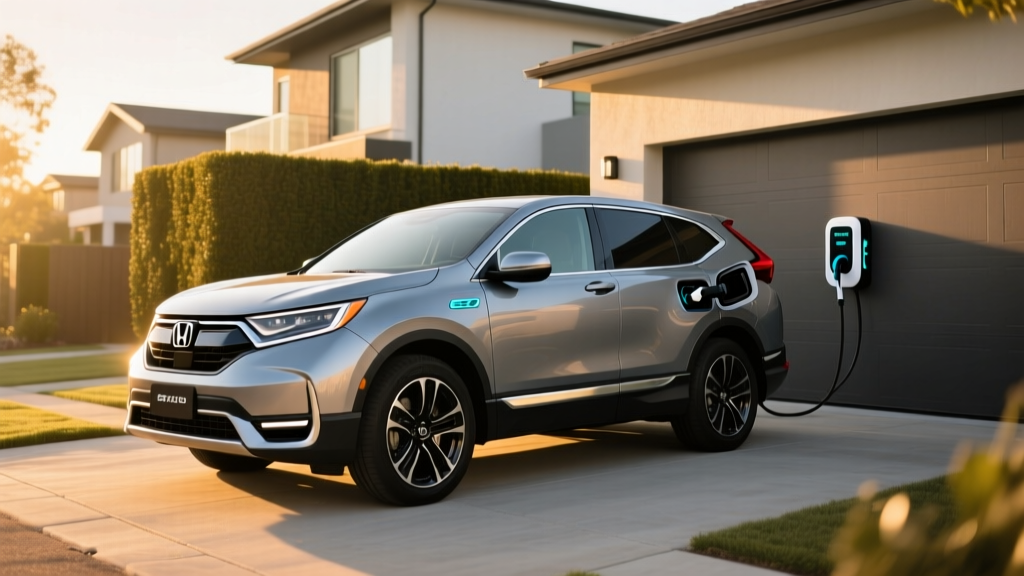
For buyers who want electric commuting without the full-EV commitment, the Honda CR-V plug-in hybrid occupies a compelling middle ground. Known in some markets as the CR-V e:PHEV, this compact crossover pairs a turbocharged gasoline engine with a sizable traction battery and electric motor to deliver short electric-only trips and long combined range. But how does it stack up against the standard CR-V Hybrid (HEV), a full battery-electric SUV, or even a gas-only competitor? This guide breaks down the exact numbers, tax-credit realities, and ownership economics you need before signing a purchase order.
HEV vs PHEV: What's the Actual Difference?
Honda sells two electrified CR-V variants in the 2026 model year, and confusing them is one of the most common buyer mistakes. Here is the core distinction:
| Attribute | CR-V Hybrid (HEV) | CR-V Plug-In Hybrid (PHEV) |
|---|---|---|
| Plug-in charging | No — charges via engine and regenerative braking only | Yes — AC Level 1/2 plug-in capable |
| Electric-only range | Less than 1 mile at low speed | EPA est. ~34 miles |
| Battery capacity | ~1.1 kWh (small buffer) | ~17.7 kWh usable (lithium-ion) |
| Combined system output | 204 hp | ~204–207 hp |
| EPA combined fuel economy | ~40 MPG combined | ~37 MPG (hybrid mode after battery depleted) |
| MSRP starting | ~$36,000 | ~$41,500 |
| Federal tax credit (§30D) | Not eligible | Eligibility varies — see tax credit section |
The conventional HEV is self-charging: you never plug it in. It recovers energy through regenerative braking and the gasoline engine, and it uses its small battery to assist acceleration and enable brief electric-only creep. The PHEV carries a much larger battery that you charge from a wall outlet or public charger, giving you a meaningful electric-only commuting envelope before the gasoline engine takes over as a series-parallel hybrid.
Electric-Only Range and Total Driving Range
The headline figure for any plug-in hybrid is how far it goes on electricity alone. The 2026 Honda CR-V plug-in hybrid delivers an EPA-estimated 34 miles of electric-only range on a full charge. That is enough to cover the average American one-way commute (roughly 16 miles each way per the U.S. Census Bureau) entirely on electrons, with a small buffer remaining.
Once the battery is depleted, the CR-V PHEV operates as a conventional hybrid, delivering an estimated 370+ miles of total combined range (electric + gasoline) from its 12.2-gallon fuel tank and remaining battery buffer. That eliminates any range anxiety for road trips — you simply fill up at any gas station.
Fuel Economy: EPA Numbers and Real-World MPG
Understanding PHEV fuel economy requires looking at two figures: MPGe (miles per gallon equivalent, which counts electric driving) and MPG after the battery is depleted (charge-sustaining mode).
| Driving Mode | City | Highway | Combined |
|---|---|---|---|
| Electric + Gas (MPGe) | ~85 MPGe combined (first 34 miles) | ||
| Hybrid Mode (MPG, battery depleted) | ~38 MPG | ~35 MPG | ~37 MPG |
| CR-V HEV (conventional hybrid, for comparison) | ~43 MPG | ~36 MPG | ~40 MPG |
Real-world note: Hybrid-mode MPG in the PHEV often runs slightly below the conventional HEV because the PHEV carries roughly 300 additional pounds of battery mass. However, if you charge nightly and your daily driving stays under 34 miles, your effective fuel consumption can drop to near zero for weekday commuting, with the engine only running on longer weekend trips. Owners who plug in regularly report using fewer than 10 gallons per month in mixed driving.
Powertrain, Battery, and Charging Specs
| Specification | 2026 CR-V Plug-In Hybrid |
|---|---|
| Engine | 2.0L Atkinson-cycle inline-4 turbo |
| Electric motor | Two-motor hybrid system (drive + generator) |
| Combined system output | ~204 hp / 247 lb-ft torque |
| 0–60 mph | ~7.8 seconds (est.) |
| Battery chemistry | Lithium-ion (NMC) |
| Usable battery capacity | ~17.7 kWh |
| Onboard charger (AC) | ~6.6 kW (Level 2 capable) |
| DC fast charging | Not available — AC only |
| Level 1 charge time (120V, 12A) | ~12–14 hours (0–100%) |
| Level 2 charge time (240V, 32A) | ~2.5–3 hours (0–100%) |
| Drivetrain | FWD standard; AWD available |
| Towing capacity | ~1,000 lbs |
A critical detail: the CR-V PHEV does not support DC fast charging. This is typical for plug-in hybrids — the battery is small enough that a 6.6 kW Level 2 home charger replenishes it fully in under three hours, making DC infrastructure unnecessary for daily use. If you rely exclusively on public charging, however, this means longer top-up sessions at AC destination chargers rather than quick 20-minute DC stops.
kW vs kWh refresher: kW (kilowatts) measures the rate of charging — how fast energy flows into the battery. kWh (kilowatt-hours) measures the battery's total energy capacity. The CR-V PHEV's 17.7 kWh battery charged at 6.6 kW fills in roughly 2.7 hours (17.7 ÷ 6.6 ≈ 2.7).
Pricing, Trims, and Tax Credit Eligibility
The 2026 Honda CR-V plug-in hybrid is expected to start around $41,500 (base MSRP, FWD), with AWD and higher trims pushing toward $47,000. The conventional CR-V Hybrid starts roughly $5,000–$6,000 lower.
Federal Tax Credit (§30D) — Does the CR-V PHEV Qualify?
This is where PHEV buyers must be precise. Under current IRS §30D rules, the federal clean vehicle credit of up to $7,500 requires that a vehicle meet all of the following:
- Battery capacity: At least 7 kWh — the CR-V PHEV's ~17.7 kWh qualifies.
- MSRP cap: SUVs/vans/pickups must be under $80,000 — the CR-V PHEV clears this easily.
- Buyer income cap: AGI must not exceed $150,000 (single), $225,000 (head of household), or $300,000 (joint).
- Final assembly: Must occur in North America — verify the specific VIN via the DOE/Fueleconomy.gov eligibility tool.
- Battery component sourcing: A percentage of battery components must be manufactured or assembled in North America, and critical minerals must be sourced from the U.S. or FTA partners. These thresholds increase annually and have eliminated several PHEVs from eligibility.
Battery Longevity, Warranty, and Replacement Cost
Is the Honda CR-V plug-in hybrid reliable? Honda's two-motor hybrid system has been in production since the early 2010s (Accord Hybrid, Clarity PHEV) and has proven robust. The PHEV battery uses proven NMC lithium-ion cells with active thermal management. Based on historical Honda hybrid data and industry-wide PHEV degradation studies, expect roughly 8–12% capacity loss over the first 8 years of typical use — well within the warranty threshold.
Battery replacement cost: Out of warranty, a full CR-V PHEV battery replacement is estimated at $6,000–$9,000 including parts and labor, based on comparable Honda hybrid battery pricing. However, most PHEV batteries outlast the vehicle's economic life; individual module replacement (if supported) can reduce costs to $1,500–$3,000.
Who Should Choose the CR-V PHEV vs a Full EV or Gas Car?
- You can charge at home (Level 1 or 2) and your daily round-trip commute is under 35 miles.
- You take road trips frequently and don't want to plan around DC charging infrastructure.
- You live in an apartment or area with unreliable public charging, but can install a home outlet.
- You want to reduce fuel consumption dramatically without committing to a full BEV.
- You have reliable home Level 2 charging and your daily driving is under 250 miles.
- You want zero tailpipe emissions and the lowest per-mile fuel cost.
- You want to maximize federal tax credits (BEVs generally have clearer §30D eligibility).
- You cannot charge at home and have no plans to install a charger.
- You want the lowest purchase price and don't need electric-only commuting.
- Your driving is mostly long highway trips where PHEV electric range adds little benefit.
Pros and Cons at a Glance
- 34 miles electric-only covers most commutes
- No range anxiety — 370+ mi total range
- Smooth, quiet electric driving in daily use
- Honda Sensing safety suite standard
- Strong reliability track record for Honda hybrids
- 8 yr / 100k mi battery warranty (longer in CARB states)
- No DC fast charging — AC only
- ~$5,500 premium over conventional CR-V Hybrid
- Hybrid-mode MPG slightly lower than HEV variant
- Tax credit eligibility uncertain due to sourcing rules
- Reduced cargo space vs HEV (battery packaging)
- 1,000-lb towing limit (lower than some competitors)
Frequently Asked Questions
How many MPG does the Honda CR-V plug-in hybrid get?
After the battery is depleted, the CR-V PHEV returns an EPA-estimated 37 MPG combined (38 city / 35 highway). During the first 34 miles on a full charge, it achieves approximately 85 MPGe. The conventional CR-V Hybrid achieves 40 MPG combined for comparison.
How far can the CR-V PHEV go on electric only?
The EPA estimates 34 miles of electric-only range. Real-world results typically fall between 28 and 32 miles in moderate weather, dropping to 22–26 miles in cold conditions or sustained highway driving above 65 mph.
Does the Honda CR-V plug-in hybrid qualify for a tax credit?
It may qualify for up to $7,500 under IRS §30D, but eligibility depends on battery-component sourcing, critical-mineral requirements, buyer income, and North American final assembly. Verify your specific VIN on fueleconomy.gov and consult a tax professional before relying on the credit.
Is the CR-V PHEV battery reliable, and what does replacement cost?
Honda's hybrid battery systems have a strong reliability record. The battery is warranted for 8 years/100,000 miles (10 years/150,000 miles in CARB states) against more than 30% capacity loss. Out-of-warranty replacement is estimated at $6,000–$9,000, though most PHEV batteries last the vehicle's lifetime.
Do I need to plug in the CR-V PHEV every night?
You don't have to — the car operates as a normal hybrid without plugging in. But to capture the fuel savings and electric-only driving benefit, nightly charging on a standard 120V outlet (Level 1) or a 240V home charger (Level 2) is recommended. A Level 2 charger fills the battery in about 2.5–3 hours.
How does the CR-V PHEV compare to a full EV like the Hyundai Ioniq 5 or Tesla Model Y?
A full BEV offers 250–320 miles of electric range, lower per-mile fuel costs, and typically stronger tax credit eligibility. The trade-off is dependence on charging infrastructure for road trips. The CR-V PHEV sacrifices long electric range for unlimited gasoline range, making it ideal for one-car households that commute short distances but road-trip regularly.
Can the CR-V PHEV charge at public DC fast chargers?
No. The CR-V plug-in hybrid supports only AC charging (Level 1 at 120V and Level 2 at 240V, up to 6.6 kW). DC fast charging (CCS, NACS, CHAdeMO) is not available on this model, which is standard for most PHEVs with smaller battery packs.
Sources: fueleconomy.gov (EPA estimates), IRS §30D Clean Vehicle Credits, Honda Newsroom specifications. All figures are EPA estimates or manufacturer-published data; real-world results vary by driving conditions, climate, and vehicle configuration. Tax credit eligibility is subject to change — verify before purchase.