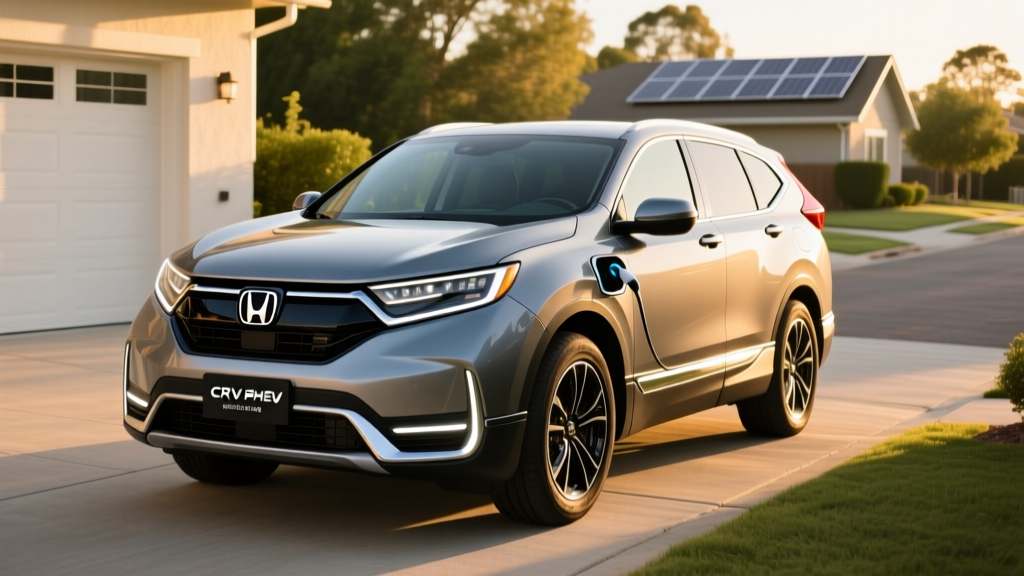
The Honda CR-V has long been a benchmark compact SUV, but the electrified lineup can confuse even seasoned shoppers. Between the standard CR-V Hybrid (HEV) and the plug-in variant sold in select global markets under the e:PHEV or e:HEV badge, buyers need precise numbers — not marketing gloss. This guide dissects the Honda CR-V PHEV powertrain, real-world efficiency, battery longevity, and whether it beats a full EV or conventional hybrid for your daily routine.
Honda CR-V PHEV vs. CR-V Hybrid: What's the Actual Difference?
Conventional Hybrid (HEV): The US-market CR-V Hybrid uses a 2.0L Atkinson-cycle engine paired with a two-motor system. It never plugs in. The small ~1.1 kWh battery recharges through regenerative braking and the engine. You simply fuel up and drive.
Plug-in Hybrid (PHEV): The CR-V e:PHEV (available in China, Europe, and select Asian markets — not currently sold in the US as of the 2026 model year) carries a much larger 17.7 kWh lithium-ion battery. You plug it in overnight to unlock 30–34 miles of pure electric driving before the gasoline engine seamlessly engages as a generator or direct-drive source.
This distinction matters enormously. If you see "CR-V Hybrid" at your local US Honda dealer, you are looking at the HEV. The PHEV variant exists globally but Honda has not brought the e:PHEV to North American showrooms, opting instead to push the standard hybrid and the upcoming Prologue BEV for the US market. International buyers in supported regions, however, get a compelling middle-ground vehicle.
EPA and WLTP Efficiency: MPG, MPGe, and Electric-Only Range
Because the CR-V e:PHEV is not sold in the United States, it does not carry an EPA rating. Instead, we rely on WLTP (Worldwide Harmonised Light Vehicle Test Procedure) figures, which tend to run 10–15% more optimistic than EPA estimates. Here is what Honda publishes for the 2026 model-year e:PHEV:
| Metric | WLTP Figure | Estimated US EPA Equivalent |
|---|---|---|
| Electric-only range | 54 km (~34 mi) | ~28–30 mi |
| Combined MPGe (charge-sustaining + electric) | ~166 MPGe | ~140 MPGe |
| Gas-only (charge-sustaining) consumption | 5.2 L/100 km | ~43 MPG combined |
| Total combined range | ~660 km (~410 mi) | ~380 mi |
Real-world expectation: In mixed driving at moderate temperatures (60–75°F), expect 26–30 miles of electric range before the engine fires. Highway driving at 70+ mph or cold-weather operation (below 32°F) can cut electric range to 20–24 miles due to cabin heating demands and higher aerodynamic drag. Once the battery is depleted, the 2.0L engine delivers a genuine 38–43 MPG combined — competitive with the standard CR-V Hybrid's EPA-rated 40/35/37 MPG city/highway/combined (fueleconomy.gov).
For US buyers comparing the CR-V Hybrid HEV: the EPA rates it at 43 city / 36 highway / 40 combined MPG for FWD trims. Real-world city driving often exceeds the EPA city figure because regenerative braking recovers more energy in stop-and-go traffic. Highway-only trips tend to fall 2–4 MPG below the sticker.
Powertrain Specs: Horsepower, Battery, and Charging
| Specification | CR-V e:PHEV (Global) | CR-V Hybrid HEV (US) |
|---|---|---|
| Engine | 2.0L Atkinson 4-cyl | 2.0L Atkinson 4-cyl |
| Combined system output | 204 hp / 247 lb-ft | 204 hp / 247 lb-ft |
| Battery capacity (usable) | 17.7 kWh (NMC lithium-ion) | ~1.1 kWh |
| Electric-only range | ~30–34 mi (WLTP) | N/A (not plug-in) |
| Level 1 charging (120V) | ~10 hours (0–100%) | N/A |
| Level 2 charging (240V, 6.6 kW) | ~2.5 hours (0–100%) | N/A |
| DC fast charging | Not available | N/A |
| 0–60 mph | ~8.5 sec (est.) | ~8.0 sec |
| Drivetrain | FWD (e-motor front) | FWD or AWD |
The PHEV uses Honda's fourth-generation two-motor hybrid system. Under 30 miles of electric-only operation, the traction motor (181 hp on its own) handles all propulsion. Once the battery depletes, the engine either acts as a series generator (feeding electricity to the motor) or, at steady highway speeds, clutches directly to the front wheels for maximum efficiency. There is no traditional transmission — the direct-drive clutch eliminates the need for one.
Charging reality: The 6.6 kW onboard charger means a full Level 2 replenishment takes roughly 2.5 hours. Plug in at home on a standard 240V outlet (NEMA 14-50 or hardwired wallbox), and you wake up to a full battery every morning. The absence of DC fast charging is typical for compact PHEVs — the battery is simply too small to justify the added cost and weight of a DC inlet.
Battery Longevity, Warranty, and Replacement Cost
Honda Hybrid Battery Warranty (Global PHEV & US HEV):
- Standard coverage: 8 years / 100,000 miles (whichever comes first)
- CARB states (US HEV): 10 years / 150,000 miles
- Capacity retention threshold: Warranty triggers if battery falls below ~60–70% of original capacity
- Chemistry: NMC (nickel manganese cobalt) for the PHEV; similar lithium-ion for the HEV
Honda's hybrid battery track record is strong. The earlier Insight and Accord Hybrid batteries have demonstrated 150,000–200,000+ mile lifespans with moderate degradation (typically 10–15% loss over 10 years). The PHEV's larger 17.7 kWh pack benefits from conservative buffer management — Honda locks away roughly 10–15% of gross capacity at the top and bottom to prevent deep cycling stress.
Replacement cost: If the battery fails outside warranty, expect $4,000–$6,500 for the PHEV pack (parts + labor) based on current global pricing. The US-market HEV's smaller battery is cheaper to replace, typically $2,000–$3,500. In practice, complete battery failure before 150,000 miles is rare; individual cell-module replacement is sometimes possible at lower cost.
Pricing and Tax Credit Eligibility
Because Honda does not sell the CR-V e:PHEV in the United States for 2026, the federal §30D clean vehicle credit does not apply — there is simply no VIN to register at a US dealership. International pricing provides context:
- Europe (e:PHEV): Starting ~€48,000–€52,000 depending on market and trim
- China (e:PHEV): Starting ~¥270,000 (~$37,000 USD equivalent)
- US CR-V Hybrid HEV: $36,395–$42,895 MSRP (Sport Hybrid to Sport Touring Hybrid, 2026 model year)
For US buyers, the CR-V Hybrid HEV does not qualify for the federal §30D credit because it is a conventional hybrid, not a plug-in vehicle with ≥7 kWh of battery capacity. Some states offer rebates for hybrids, but these vary by jurisdiction — check your state energy office or AFDC state incentives database for current programs.
Who Should Choose the CR-V PHEV, HEV, or a Full EV?
CR-V PHEV Is Right If:
- You live outside the US (Europe, Asia) where it's sold
- Your daily commute is under 30 miles round-trip and you can charge at home
- You want electric commuting but need gas-engine flexibility for road trips
- You lack reliable public DC fast charging infrastructure nearby
Consider the HEV or a BEV Instead If:
- You are a US buyer — the PHEV isn't available stateside
- You can't install a Level 2 charger at home (PHEV value drops without daily plugging)
- Your commute is mostly highway (PHEV electric range depletes quickly at 70+ mph)
- You want zero tailpipe emissions — consider a full BEV like the Honda Prologue
Choose the CR-V Hybrid HEV (US) if: You want a simple, no-plug compact SUV with 40+ MPG, AWD availability, and strong reliability — without worrying about charging access or battery-plug habits.
Choose the CR-V e:PHEV (global markets) if: You have home charging, a short commute, and want to drive electrically most weekdays while keeping a gas tank for longer trips.
Choose a full BEV if: You have reliable home and/or workplace charging, your trips rarely exceed 250 miles, and you want the lowest per-mile fuel cost and zero tailpipe emissions.
Real-World Ownership: What the Specs Don't Tell You
Three practical nuances matter once you live with either CR-V electrified variant:
1. Cold-weather range loss. The PHEV's electric range drops 20–30% below freezing because the cabin heater draws heavily from the 17.7 kWh battery. The HEV is less affected because waste engine heat warms the cabin once the engine runs — which it does more often in winter anyway.
2. Highway efficiency crossover. Above roughly 50 mph, the PHEV's electric advantage narrows. Aerodynamic drag dominates, and the heavier PHEV (by ~250 lbs over the HEV) consumes slightly more energy. On long highway trips, the HEV and PHEV deliver nearly identical MPG once the PHEV's battery is depleted.
3. Charging discipline. A PHEV that never gets plugged in is just a heavier, more expensive hybrid. If your household cannot commit to nightly plugging, the HEV delivers equivalent or better real-world fuel economy at a lower purchase price. The PHEV's value proposition only works when you actually use the plug.
Frequently Asked Questions
How many MPG does the Honda CR-V Hybrid get?
The US-market 2026 CR-V Hybrid (HEV) is EPA-rated at 43 city / 36 highway / 40 combined MPG for front-wheel-drive trims, and 40/34/37 MPG for AWD. Real-world city driving often exceeds the EPA city figure thanks to regenerative braking, while sustained highway driving may fall 2–4 MPG below sticker.
How far can the Honda CR-V PHEV go on electric only?
The global-market CR-V e:PHEV achieves 30–34 miles (WLTP) on electric power alone. In real-world conditions — with climate control, hills, and highway speeds — expect 24–30 miles. Cold weather (below 32°F) can reduce this to 20–24 miles.
Does the Honda CR-V Hybrid or PHEV qualify for a tax credit?
The US-market CR-V Hybrid (HEV) does not qualify for the federal §30D clean vehicle credit, which requires plug-in capability and ≥7 kWh of battery capacity. The CR-V e:PHEV is not sold in the US, so it is also ineligible. State-level hybrid rebates may apply depending on your jurisdiction.
Is the Honda CR-V Hybrid battery reliable, and what does replacement cost?
Honda's hybrid batteries carry an 8-year/100,000-mile warranty (10 years/150,000 miles in CARB states). Real-world data from earlier Honda hybrids shows batteries lasting 150,000–200,000+ miles with moderate degradation. Out-of-warranty replacement costs $2,000–$3,500 for the HEV and $4,000–$6,500 for the PHEV.
Should I buy the CR-V Hybrid or wait for a PHEV or full EV?
If you're a US buyer, the CR-V Hybrid HEV is the best electrified CR-V you can buy today — it needs no plug, delivers 40 MPG, and has AWD availability. If you want electric-only commuting and can charge at home, consider a dedicated PHEV like the Toyota RAV4 Prime or a full EV like the Hyundai Ioniq 5. Honda's US PHEV plans remain unannounced for the CR-V nameplate.