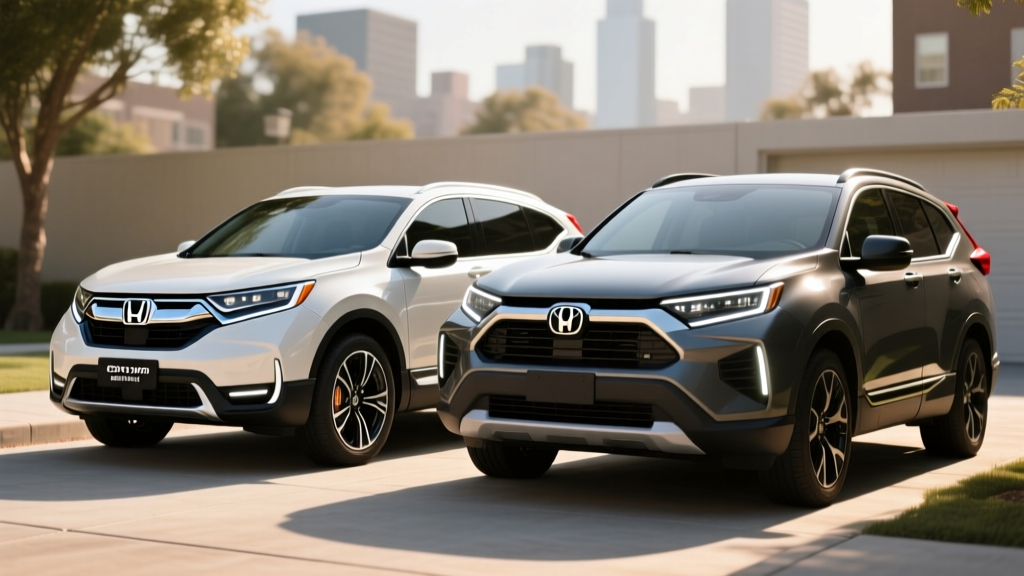
The compact hybrid SUV segment is a two-horse race, and it has been for years. The Honda CR-V Hybrid vs Toyota RAV4 Hybrid debate shows up in nearly every buyer search because both vehicles deliver real-world efficiency, strong reliability records, and practical cargo space without the upfront cost premium of a plug-in hybrid or full electric vehicle. For 2026, both SUVs have been refreshed with updated tech and refined powertrains, making the choice harder — and more important — than ever.
This guide breaks down every number that matters: EPA MPG, real-world fuel economy expectations, powertrain output, battery warranty, pricing, and tax credit eligibility. We'll also clarify where these conventional hybrids fit compared to their PHEV siblings and full EVs, so you can make the right call for your driving pattern.
Quick Verdict: Which Hybrid SUV Wins?
There is no universal winner — the right choice depends on what you prioritize. The Toyota RAV4 Hybrid edges ahead on raw city fuel economy and available AWD configurations, while the Honda CR-V Hybrid delivers a more refined driving experience, slightly more cargo volume, and a more intuitive infotainment system. Both are excellent. Here's the fast breakdown:
EPA Fuel Economy & Real-World MPG
Fuel economy is the headline number for any hybrid buyer. Both SUVs use conventional hybrid (HEV) powertrains — meaning they recharge their small batteries through regenerative braking and the gasoline engine. You never plug them in. This is a critical distinction from plug-in hybrids (PHEVs), which we'll cover below.
| Metric | 2026 Honda CR-V Hybrid (AWD) | 2026 Toyota RAV4 Hybrid (AWD) |
|---|---|---|
| EPA City MPG | 40 | 41 |
| EPA Highway MPG | 34 | 38 |
| EPA Combined MPG | 37 | 39 |
| Fuel Tank Capacity | 14.0 gal | 14.5 gal |
| Total Driving Range | ~518 miles | ~565 miles |
| Real-World Combined (owner-reported) | 35–39 MPG | 37–42 MPG |
Source: fueleconomy.gov — EPA estimates. Real-world figures compiled from owner forums and long-term test data.
HEV vs PHEV: Understanding the Difference
Both the CR-V and RAV4 are available as conventional hybrids (HEVs) and as plug-in hybrids (PHEVs). The distinction fundamentally changes how you use the vehicle.
| Feature | Conventional Hybrid (HEV) | Plug-In Hybrid (PHEV) |
|---|---|---|
| Plug in to charge? | No — self-charging via regen + engine | Yes — plug in for electric-only range |
| Battery size | ~1.0–1.6 kWh (small) | ~18–19 kWh (much larger) |
| Electric-only range | Less than 1 mile at low speed | 35–42 miles (EPA) |
| DC fast charging? | No | No (Level 2 AC only, ~2.5 hrs) |
| Federal tax credit? | No | Up to $7,500 (subject to eligibility) |
| Price premium over HEV | — | +$7,000–$10,000 MSRP |
RAV4 Prime & CR-V e:PHEV — The PHEV Options
The Toyota RAV4 Prime (PHEV) offers an EPA-estimated 42 miles of electric-only range with an 18.1 kWh battery. It charges via Level 2 AC in approximately 2.5 hours and does not support DC fast charging. Combined with its gas engine, total range exceeds 600 miles. The RAV4 Prime produces 302 combined horsepower — dramatically more than the standard hybrid's 219 hp — and starts around $44,900 MSRP.
The Honda CR-V e:PHEV (sold in select markets; US availability varies by model year) uses a 17.7 kWh battery with an EPA-estimated 37 miles of electric-only range. Like the RAV4 Prime, it charges on Level 2 only and lacks DC fast-charge capability.
Key PHEV question — how far on electric only? The RAV4 Prime delivers 42 miles EPA electric-only, enough to cover most daily commutes without using gasoline. Once the battery depletes, it operates as a conventional hybrid at approximately 38 MPG combined.
Powertrain Specs: Horsepower, Engines & Motors
| Specification | 2026 Honda CR-V Hybrid | 2026 Toyota RAV4 Hybrid |
|---|---|---|
| Engine | 2.0L 4-cyl Atkinson-cycle | 2.5L 4-cyl Dynamic Force |
| Electric Motors | Two-motor hybrid system | Two-motor hybrid system (three-motor with eAWD) |
| Combined Horsepower | 204 hp | 219 hp |
| Combined Torque | 247 lb-ft (motor) | 163 lb-ft (engine) + motor torque |
| Transmission | e-CVT | e-CVT |
| Drivetrain | AWD (standard on hybrid trims) | AWD (standard on all hybrid trims) |
| 0–60 mph | ~7.6 sec | ~7.4 sec |
| Towing Capacity | 1,000 lbs | 1,750 lbs |
| Battery (traction) | ~1.06 kWh lithium-ion | ~1.6 kWh nickel-metal hydride |
The RAV4 Hybrid's 219 hp gives it a slight edge in acceleration and highway passing confidence. Its electronic on-demand AWD uses a dedicated rear motor, engaging only when slippage is detected — this is more efficient than a mechanical AWD system. The CR-V Hybrid uses a similar e-CVT architecture but Honda's tuning prioritizes smoothness and low-speed electric-motor assist, which contributes to its strong city MPG.
Pricing, Trims & Tax Credit Eligibility
Here's where the math matters. Both vehicles are priced competitively, but tax credit eligibility changes the equation significantly for the PHEV variants.
2026 Honda CR-V Hybrid Pricing
- Sport (base hybrid): $35,395 MSRP
- Sport Touring (top hybrid): $41,895 MSRP
2026 Toyota RAV4 Hybrid Pricing
- LE (base hybrid): $33,425 MSRP
- XLE: $35,325 MSRP
- XSE: $37,075 MSRP
- Limited (top hybrid): $40,275 MSRP
- RAV4 Prime SE (PHEV): $44,900 MSRP
- RAV4 Prime XSE (PHEV): $48,800 MSRP
- The conventional CR-V Hybrid and RAV4 Hybrid (HEVs) are not eligible for the federal §30D clean vehicle credit. Only plug-in vehicles with ≥7 kWh battery capacity qualify.
- The RAV4 Prime (PHEV) may qualify for up to $7,500, subject to: buyer income caps ($150K single / $300K joint AGI), MSRP cap ($80,000 for SUVs), and critical mineral + battery component sourcing requirements per IRS §30D rules.
- Point-of-sale transfer is available — the dealer applies the credit at purchase, reducing your out-of-pocket cost immediately.
- Battery sourcing requirements change annually. Verify current-year eligibility on fueleconomy.gov before purchasing.
- Consult a tax professional — this is not tax advice.
Bottom line on price: The RAV4 Hybrid LE undercuts the CR-V Hybrid Sport by nearly $2,000 at base. If you want PHEV capability and qualify for the full $7,500 credit, the RAV4 Prime's effective price drops to roughly $37,400 — making it competitive with loaded HEV trims while adding 42 miles of electric commuting.
Battery Warranty, Reliability & Replacement Cost
Hybrid battery longevity is the single most common concern among first-time hybrid buyers. Both Honda and Toyota have decades of hybrid production experience, and their track records are strong.
- Honda: 8 years / 100,000 miles (10 years / 150,000 miles in CARB states including CA, NY, MA, and others)
- Toyota: 10 years / 150,000 miles (all states, from 2020 model year onward)
- Warranty covers battery capacity below a specified threshold (typically ~60–70% of original capacity)
- Hybrid system components (inverter, motor, control unit) are covered under the same warranty
Is This Hybrid Reliable?
Toyota's hybrid system is among the most proven in the automotive industry — the RAV4 Hybrid uses a derivation of the powertrain architecture introduced with the Prius in 1997. According to IIHS data and long-term owner surveys, hybrid powertrain failure rates are lower than conventional automatic transmissions. Honda's two-motor hybrid system, introduced with the Accord Hybrid and refined for the CR-V, has also proven durable with no widespread failure patterns.
Battery Replacement Cost
If the hybrid battery fails outside warranty, replacement costs are:
- Toyota RAV4 Hybrid: $2,500–$4,000 (refurbished) or $4,000–$6,000 (new OEM). Toyota's NiMH packs are widely available from third-party refurbishers.
- Honda CR-V Hybrid: $2,000–$3,500 (refurbished) or $4,000–$5,500 (new OEM). Honda's smaller lithium-ion pack is slightly less expensive to replace.
For context, most hybrid batteries last 150,000–200,000+ miles before significant degradation. Many original Prius batteries are still in service at 200,000+ miles. The risk is real but statistically low.
Who Should Choose the HEV, PHEV, or Full EV?
- You don't have reliable home charging access (apartment, street parking)
- You want maximum simplicity — no plugs, no charging apps, no range planning
- Your budget is under $40,000 and you don't qualify for EV/PHEV tax credits
- You drive 30+ miles of highway daily where PHEV electric range provides limited benefit
- You can charge at home (Level 2 or even Level 1 overnight)
- Your daily commute is under 40 miles round-trip (you'll rarely use gas)
- You qualify for the §30D federal tax credit, reducing the price premium
- You want EV-like commuting with gas-engine flexibility for road trips
- You have reliable home Level 2 charging
- Your daily driving is under 250 miles and you road-trip infrequently
- You want the lowest per-mile fuel cost ($0.04–$0.06/mile on home electricity vs. $0.12–$0.16/mile for hybrids at 38 MPG)
- You want zero tailpipe emissions and minimal maintenance (no oil changes, no engine wear)
Pros and Cons: Side by Side
2026 Honda CR-V Hybrid
Pros:- Smoother, quieter ride quality
- More intuitive infotainment (12.3" available)
- Excellent Honda Sensing ADAS suite
- Strong city MPG with seamless regen
- Spacious rear seat and cargo area
- Higher base price than RAV4 Hybrid
- Lower towing capacity (1,000 lbs)
- Slightly lower combined MPG (37 vs 39)
- No PHEV variant widely available in the US
2026 Toyota RAV4 Hybrid
Pros:- Best-in-class combined MPG (39 EPA)
- Available RAV4 Prime PHEV with 42-mi EV range
- Higher towing capacity (1,750 lbs)
- 10yr/150K-mile hybrid warranty nationwide
- Proven, long-standing hybrid reliability
Frequently Asked Questions
How many MPG does the Honda CR-V Hybrid get?
The 2026 Honda CR-V Hybrid AWD is EPA-rated at 40 city / 34 highway / 37 combined MPG. Real-world owners typically report 35–39 MPG combined, with city driving sometimes exceeding the EPA estimate thanks to frequent regenerative braking.
How many MPG does the Toyota RAV4 Hybrid get?
The 2026 Toyota RAV4 Hybrid AWD is EPA-rated at 41 city / 38 highway / 39 combined MPG. Owner-reported real-world figures range from 37–42 MPG combined, making it one of the most fuel-efficient compact SUVs available without a plug.
For the PHEV: how far can the RAV4 Prime go on electric only?
The Toyota RAV4 Prime delivers an EPA-estimated 42 miles of electric-only range on a full charge. This covers most daily commutes without engaging the gasoline engine. After the battery depletes, it operates as a conventional hybrid at approximately 38 MPG combined.
Do conventional hybrids need to be plugged in?
No. The Honda CR-V Hybrid and Toyota RAV4 Hybrid (HEV versions) never need to be plugged in. Their small traction batteries recharge through regenerative braking and the gasoline engine. You fuel them like any conventional car — the hybrid system simply makes them more efficient.
Is the hybrid reliable and what is battery replacement cost?
Both Toyota and Honda hybrid systems have excellent reliability records spanning decades. Toyota covers the hybrid battery for 10 years / 150,000 miles; Honda covers it for 8 years / 100,000 miles (10/150K in CARB states). Out-of-warranty replacement costs $2,500–$6,000 depending on new vs. refurbished. Most hybrid batteries last 150,000–200,000+ miles.
Does the CR-V Hybrid or RAV4 Hybrid qualify for any tax credit?
No. Conventional hybrids (HEVs) do not qualify for the federal §30D clean vehicle credit — only plug-in vehicles with ≥7 kWh battery capacity are eligible. The RAV4 Prime (PHEV) may qualify for up to $7,500 depending on buyer income, MSRP caps, and battery sourcing requirements. Check current eligibility at fueleconomy.gov and consult a tax professional.
Hybrid vs PHEV vs EV — which fits me?
Choose a conventional hybrid (HEV) if you lack home charging or want maximum simplicity. Choose a PHEV if you can charge at home and your daily commute is under 40 miles — you'll drive mostly electric with gas-engine backup. Choose a full EV if you have reliable home charging, drive under 250 miles daily, and want the lowest per-mile operating cost with zero tailpipe emissions.