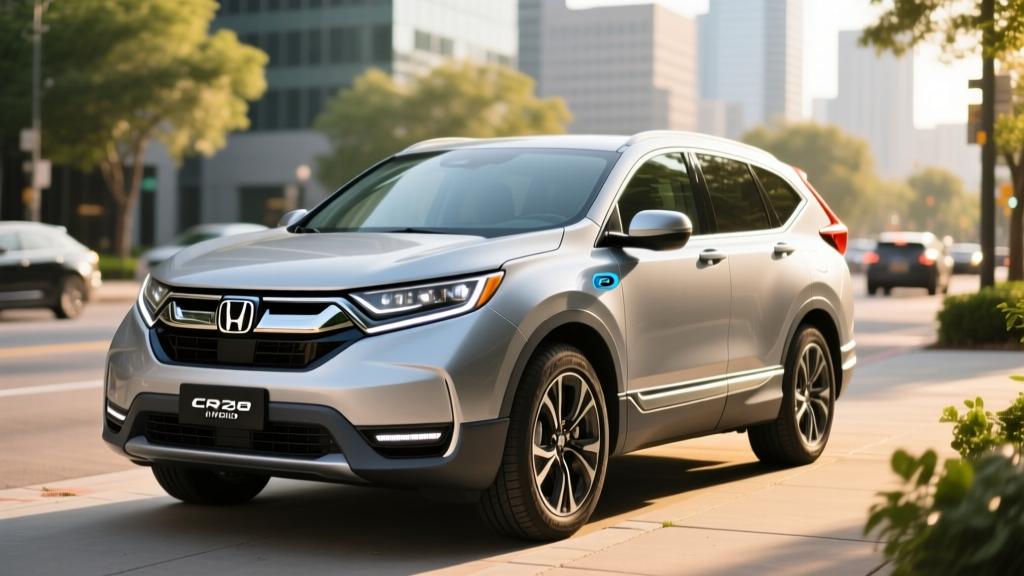
The Honda CR-V Hybrid remains one of the best-selling electrified compact SUVs in America, and for good reason: it pairs a proven two-motor hybrid system with the practicality buyers expect from the CR-V nameplate. For 2026, Honda continues to offer the CR-V Hybrid across multiple trim levels, each with distinct pricing, feature sets, and the same efficient powertrain. If you're researching Honda CR-V Hybrid trim levels to find the right fit, this guide breaks down every tier with exact EPA fuel economy figures, real-world MPG expectations, battery warranty coverage, and a clear verdict on who should buy hybrid versus stepping up to a PHEV or full EV.
2026 Honda CR-V Hybrid Trim Levels at a Glance
Honda offers the CR-V Hybrid in four primary trims for 2026: Sport, Sport-L, Sport Touring, and the newly expanded Sport-L AWD as a standalone configuration. All trims share the same two-motor hybrid powertrain, so fuel economy differences between trims are negligible (typically 1 MPG or less based on wheel size and weight). Here's how they stack up on price and key equipment:
| Trim | Drivetrain | MSRP (2026) | EPA Combined MPG | Key Features |
|---|---|---|---|---|
| Sport | FWD or AWD | $36,395 (FWD) / $37,895 (AWD) | 40 / 37 | 18" wheels, 7" display, Honda Sensing suite |
| Sport-L | FWD or AWD | $38,695 (FWD) / $40,195 (AWD) | 40 / 37 | Leather-trimmed seats, power tailgate, heated front seats |
| Sport Touring | AWD standard | $42,895 | 37 | 19" wheels, Bose 12-speaker audio, wireless CarPlay/Android Auto, heated steering wheel, navigation |
Pricing includes destination charge. Source: Honda Official Site.
How Many MPG Does the Honda CR-V Hybrid Get?
The EPA rates the 2026 Honda CR-V Hybrid FWD trims (Sport, Sport-L) at 43 MPG city / 36 MPG highway / 40 MPG combined. AWD-equipped trims drop slightly to 40 MPG city / 34 MPG highway / 37 MPG combined, while the Sport Touring with its larger 19-inch wheels rates at 37 MPG combined (fueleconomy.gov).
| Trim / Drivetrain | City MPG | Highway MPG | Combined MPG |
|---|---|---|---|
| Sport FWD | 43 | 36 | 40 |
| Sport AWD | 40 | 34 | 37 |
| Sport-L FWD | 43 | 36 | 40 |
| Sport-L AWD | 40 | 34 | 37 |
| Sport Touring AWD | 40 | 34 | 37 |
Powertrain: What's Under the Hood?
Every 2026 CR-V Hybrid trim shares Honda's fourth-generation two-motor hybrid system. This is a conventional hybrid (HEV) — it does not plug in and charges its small battery through regenerative braking and the gasoline engine.
| Specification | Detail |
|---|---|
| Engine | 2.0L Atkinson-cycle inline-4 |
| Electric Motors | Dual-motor system (one drive, one generator) |
| Combined System Output | 204 hp / 247 lb-ft torque |
| Transmission | Direct-drive (no traditional CVT or gears) |
| Hybrid Battery | ~1.06 kWh lithium-ion (traction) |
| 0–60 MPH | ~7.6 seconds |
| Towing Capacity | 1,000 lbs (hybrid trims) |
The system operates primarily in EV mode at low speeds, seamlessly engaging the gasoline engine for highway cruising or hard acceleration. The direct-drive transmission eliminates the rubber-band feel of older CVTs, and the 247 lb-ft of electric torque gives the CR-V Hybrid a responsive, punchy feel around town.
HEV vs. PHEV vs. Full EV: Which Is Right for You?
The CR-V Hybrid is a conventional hybrid (HEV). Honda does not currently offer a CR-V plug-in hybrid (PHEV) in the U.S. market for 2026. Understanding the difference is critical before you shop:
| Factor | HEV (CR-V Hybrid) | PHEV (e.g., Toyota RAV4 Prime) | Full EV (e.g., Hyundai Ioniq 5) |
|---|---|---|---|
| Plugs In? | No | Yes (Level 1/2) | Yes (Level 1/2/DC) |
| Electric-Only Range | ~1 mile at low speed | 35–42 miles | 250–320 miles |
| Total Range | ~500+ miles | ~550+ miles | 250–320 miles |
| Home Charging Needed? | No | Recommended (Level 2) | Essential (Level 2) |
| Federal Tax Credit | None | Up to $7,500 (§30D) | Up to $7,500 (§30D) |
| Best For | No home charger, long trips | Home charger + short commute | Home charger + daily driving |
- You don't have access to home or workplace charging
- You frequently take road trips over 300 miles
- You want better fuel economy without changing your refueling habits
- You want a lower purchase price than a PHEV or EV
- You have Level 2 home charging and a commute under 40 miles (PHEV covers most trips on electricity)
- You want to minimize gasoline use and qualify for the federal tax credit
- You're ready to commit to electric-only driving with a BEV
Battery Warranty, Reliability, and Replacement Cost
Hybrid battery longevity is the number-one concern for buyers considering a used or new CR-V Hybrid. Here's what you need to know:
- Hybrid battery: 8 years / 100,000 miles (10 years / 150,000 miles in CARB states including CA, NY, MA, and others)
- Hybrid system components: 8 years / 100,000 miles
- Standard powertrain warranty: 5 years / 60,000 miles
Honda's hybrid system has proven highly reliable. The CR-V Hybrid's lithium-ion traction battery is small (~1.06 kWh) and operates within a narrow state-of-charge window, which significantly reduces degradation stress compared to a full EV battery. Real-world data from third-generation CR-V Hybrids (2020–2022) shows minimal capacity loss at 100,000+ miles.
Battery replacement cost: If the hybrid battery fails outside warranty, expect a replacement cost of $2,000–$4,000 including parts and labor at a Honda dealer. Independent hybrid specialists may offer refurbished units for $1,200–$2,000. However, out-of-warranty hybrid battery failures remain rare on Honda's system — far less common than transmission or engine issues on conventional gas vehicles at similar mileage.
Does the Honda CR-V Hybrid Qualify for a Tax Credit?
No. The 2026 Honda CR-V Hybrid is a conventional hybrid (HEV), not a plug-in hybrid or battery electric vehicle. Under current IRS §30D rules, the federal clean vehicle credit of up to $7,500 applies only to new plug-in electric vehicles (PHEVs and BEVs) that meet battery sourcing, critical mineral, MSRP, and buyer income requirements (IRS.gov).
The CR-V Hybrid does not qualify for the federal EV tax credit. Some states offer their own incentives for hybrid vehicles, but these are uncommon and typically small ($250–$500 rebates where available). Check your state's energy office or department of environmental quality for current programs.
| Federal §30D Credit | Not eligible — HEV only |
| State Hybrid Rebates | Varies; most states offer none for HEVs |
| HOV Lane Access | Not eligible in most states (CA Clean Air decal program discontinued for HEVs) |
| Local Utility Rebates | Not applicable (no plug-in charging) |
Pros and Cons: The Honest Verdict
Pros
- Strong real-world city MPG (38–44 combined achievable)
- No plug-in charging required — works with your existing routine
- 204 hp provides confident merging and passing power
- Excellent reliability record on Honda's hybrid system
- 8-year/100,000-mile hybrid battery warranty (10/150k in CARB states)
- Competitive cargo space: 36.3 cu ft behind rear seats, 76.5 cu ft folded
- Honda Sensing ADAS suite standard on all trims
Cons
- No federal tax credit eligibility (HEV, not PHEV)
- Highway MPG drops noticeably above 70 MPH (30–33 real-world)
- AWD trims lose 3 MPG combined vs FWD
- Sport Touring's 19" wheels cost 3 MPG vs 18" wheel trims
- No PHEV option available in U.S. market
- 1,000-lb towing capacity limits utility for trailers
- Hybrid premium of ~$1,500 over equivalent gas-only CR-V trims
Frequently Asked Questions
How many MPG does the 2026 Honda CR-V Hybrid get in real-world driving?
The EPA rates FWD trims at 40 MPG combined and AWD trims at 37 MPG combined. In real-world mixed driving, most owners report 38–44 MPG. City driving favors the hybrid system, while sustained highway speeds above 70 MPH reduce efficiency to 30–33 MPG. Cold weather typically reduces fuel economy by 3–5 MPG.
Does the Honda CR-V Hybrid need to be plugged in?
No. The CR-V Hybrid is a conventional hybrid (HEV). It charges its small traction battery through regenerative braking and the gasoline engine. You simply fill up at a gas station as you would with any other vehicle.
How long will the CR-V Hybrid battery last?
Honda covers the hybrid battery for 8 years/100,000 miles (10 years/150,000 miles in CARB states). In practice, Honda's hybrid batteries regularly exceed 150,000 miles with minimal degradation due to the small battery size and conservative charge management. Out-of-warranty replacement costs $2,000–$4,000 if needed.
Is there a Honda CR-V plug-in hybrid (PHEV)?
Not in the U.S. market. Honda offers the CR-V e:PHEV in China and Europe, but as of 2026, U.S. buyers can only get the conventional hybrid. If you want a compact SUV PHEV, consider the Toyota RAV4 Prime (42 miles electric-only), Hyundai Tucson PHEV (33 miles), or Mitsubishi Outlander PHEV (38 miles).
Which CR-V Hybrid trim offers the best value?
The Sport AWD at $37,895 offers the best balance of efficiency, features, and price. You get AWD capability, Honda Sensing safety tech, and 37 MPG combined without paying the premium for leather or the Bose audio system. If you want leather and heated seats, the Sport-L AWD at $40,195 is a strong upgrade. The Sport Touring at $42,895 adds luxury features but costs you 0 MPG and $5,000 over the base Sport AWD.
Does the CR-V Hybrid qualify for any tax credit?
No. Because it's a conventional hybrid (not a plug-in), the CR-V Hybrid does not qualify for the federal §30D clean vehicle credit. It also generally doesn't qualify for state EV rebates or HOV lane stickers. The fuel savings from 37–40 MPG are the primary financial benefit.
How does the CR-V Hybrid compare to the gas-only CR-V?
The gas-only 2026 CR-V (1.5L turbo) rates at 30 MPG combined (FWD) or 28 MPG combined (AWD). The hybrid delivers 37–40 MPG combined — a 25–35% improvement. The hybrid also produces more torque (247 lb-ft vs 179 lb-ft) and provides smoother acceleration. The trade-off is a ~$1,500 price premium and 500 lbs less towing capacity (1,000 lbs vs 1,500 lbs for the turbo).