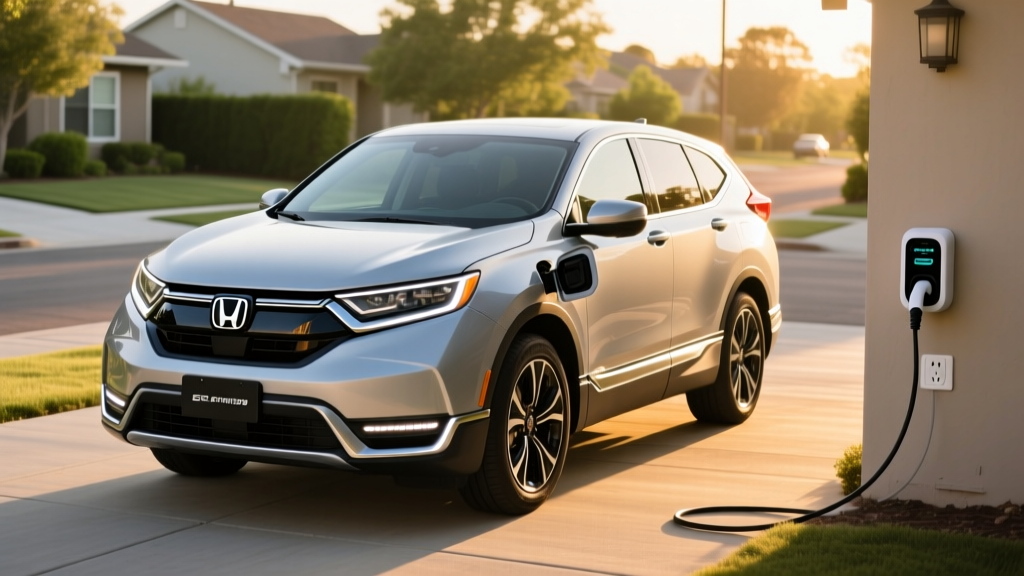
The Honda CR-V Hybrid has quietly become the default choice for compact-SUV buyers who want electric-motor efficiency without plugging in. The 2025 Honda CR-V Hybrid Touring sits at the top of that lineup — loaded with every feature Honda offers in the CR-V, paired with a two-motor hybrid system that delivers strong city fuel economy and standard all-wheel drive. If you're cross-shopping this against a plug-in hybrid or a full battery-electric SUV, the decision hinges on your daily mileage, charging access, and budget. This guide breaks down every number that matters.
HEV vs PHEV: Where the CR-V Hybrid Fits
Before we get into the Touring trim specifics, it's critical to understand what the CR-V Hybrid is — and isn't. Honda's CR-V Hybrid is a conventional hybrid (HEV). It uses a small battery recharged entirely by the gasoline engine and regenerative braking. You never plug it in. There is currently no plug-in hybrid (PHEV) version of the sixth-generation CR-V sold in the United States.
HEV vs PHEV vs EV — Quick Decision Framework
| Factor | HEV (CR-V Hybrid) | PHEV (e.g., Toyota RAV4 Prime) | BEV (e.g., Tesla Model Y) |
|---|---|---|---|
| Plug in required? | No | Yes (optional but recommended) | Yes (mandatory) |
| Electric-only range | ~1 mi at low speed | 25–42 mi typical | 250–330 mi |
| Home charging needed? | No | Level 2 strongly advised | Level 2 essential |
| Federal tax credit (§30D) | Not eligible | Up to $7,500 (varies) | Up to $7,500 (varies) |
| Upfront price premium vs gas | ~$1,500–$2,500 | ~$5,000–$9,000 | ~$8,000–$15,000+ |
The conventional hybrid approach means zero lifestyle change: you fill up at any gas station, the hybrid system handles the rest, and you get a meaningful fuel-economy bump — especially in stop-and-go city driving where the electric motors do the heavy lifting.
Fuel Economy: EPA Ratings and Real-World MPG
The 2025 CR-V Hybrid comes exclusively with all-wheel drive (AWD). Honda pairs the 2.0-liter Atkinson-cycle four-cylinder engine with two electric motors integrated into the e-CVT transmission. The EPA rates the AWD CR-V Hybrid as follows:
| Cycle | EPA Rating |
|---|---|
| City | 40 MPG |
| Highway | 34 MPG |
| Combined | 37 MPG |
Source: fueleconomy.gov
For context, the non-hybrid 2025 CR-V AWD with the 1.5L turbo is rated at 29 MPG combined. The hybrid's 8 MPG combined advantage translates to roughly 100 fewer gallons per year at 12,000 miles — a savings of $300–$450 annually depending on local fuel prices.
Powertrain: How the Two-Motor Hybrid System Works
The CR-V Hybrid uses Honda's fourth-generation two-motor hybrid system. Here's what's under the hood:
| Specification | 2025 CR-V Hybrid (AWD) |
|---|---|
| Engine | 2.0L Atkinson-cycle DOHC 4-cyl |
| Engine power | 145 hp @ 6,100 rpm |
| Electric motor power | 181 hp / 247 lb-ft torque |
| Combined system output | 204 hp / 247 lb-ft |
| Transmission | e-CVT (direct-drive w/ lock-up clutch) |
| Drivetrain | AWD (rear motor-driven) |
| 0–60 mph | ~7.6 seconds (est.) |
| Hybrid battery | ~1.06 kWh lithium-ion |
| Fuel tank | 14.0 gallons |
| Total driving range | ~518 miles (EPA est.) |
| Towing capacity | 1,000 lbs |
Unlike a traditional CVT with belts and pulleys, Honda's e-CVT uses the two electric motors as the primary drive mechanism at low and medium speeds. The gasoline engine mostly acts as a generator, producing electricity for the drive motor. At highway speeds (roughly above 50 mph under steady load), a lock-up clutch mechanically connects the engine to the front wheels for better efficiency. The rear axle gets its own dedicated electric motor, providing AWD traction without a mechanical driveshaft — a setup that's lighter and more responsive than a conventional AWD system.
The ~1.06 kWh hybrid battery is small by EV standards, but it doesn't need to store much energy. It buffers power between the engine-generator and the drive motors, capturing energy from regenerative braking and releasing it during acceleration. This is why you never plug in a conventional hybrid — the system is self-sustaining.
2025 CR-V Hybrid Touring: Pricing and Trim Features
The Touring is the top-tier CR-V Hybrid trim. For the 2025 model year, pricing breaks down as follows:
| Item | Price |
|---|---|
| 2025 CR-V Hybrid Touring AWD MSRP | $40,850 |
| Destination & delivery | $1,350 |
| Total MSRP | $42,200 |
Source: Honda Automobiles
Touring-exclusive features over lower trims (Sport, Sport-L, Sport Touring) include a Bose 12-speaker premium audio system, a hands-free power tailgate, heated rear seats, a wireless phone charger, rain-sensing wipers, and Honda's full Honda Sensing suite with low-speed braking control and traffic sign recognition. The 9-inch touchscreen supports wireless Apple CarPlay and Android Auto.
Federal and State Tax Credits
Because the CR-V Hybrid is a conventional HEV — not a plug-in vehicle — it does not qualify for the federal §30D Clean Vehicle Credit (up to $7,500). That credit requires a minimum 7 kWh battery and plug-in charging capability, per IRS guidelines. The CR-V Hybrid's ~1 kWh battery falls well below that threshold.
Some states offer separate incentives for conventional hybrids, though these have become less common as state programs shift focus to PHEVs and BEVs. Check your state's energy or environmental agency for current programs. A few states historically offered $500–$1,000 rebates for HEVs, but availability varies by jurisdiction and funding cycle.
Battery Warranty, Reliability, and Replacement Cost
Hybrid Battery Warranty
Honda covers the CR-V Hybrid's lithium-ion hybrid battery under its 8-year / 100,000-mile powertrain warranty nationwide. In states that follow California Air Resources Board (CARB) emissions standards — including California, New York, Massachusetts, and several others — hybrid battery coverage extends to 10 years / 150,000 miles.
The warranty covers battery capacity loss below a defined threshold (typically 60–70% of original capacity) and any defects in the hybrid system components, including the electric motors, inverter, and e-CVT.
Long-Term Reliability Outlook
Honda's hybrid system has proven durable in real-world use. The previous-generation CR-V Hybrid (2020–2022) and the Accord Hybrid have demonstrated minimal battery degradation over 100,000+ miles. Unlike EV batteries, which cycle deeply every drive, the CR-V Hybrid's small battery operates in a narrow state-of-charge window (roughly 40–60% SoC), which dramatically reduces cell stress and extends cycle life.
If the hybrid battery does need replacement out of warranty, expect a cost of $2,000–$4,000 for a refurbished or new OEM battery pack, including labor. Third-party hybrid battery rebuilders offer cells for $1,000–$1,500 plus installation. This is significantly less than EV battery replacements, which can exceed $10,000–$15,000 for larger packs.
The gasoline engine in the hybrid is a naturally aspirated 2.0L — no turbocharger to maintain — which simplifies long-term mechanical reliability compared to the 1.5L turbo found in the non-hybrid CR-V.
Who Should Buy the CR-V Hybrid Touring (and Who Shouldn't)
Pros
- 40 MPG city — best-in-class for AWD compact SUVs
- Standard AWD with responsive rear electric motor
- No plug-in required; zero lifestyle change from gas
- Touring trim fully loaded at ~$42K — competitive pricing
- Smooth, quiet hybrid powertrain with 204 hp
- Strong reliability track record; simple NA engine
Cons
- No PHEV option — can't drive on electric-only for commutes
- No federal tax credit eligibility
- Highway MPG (34) lags city significantly
- Towing limited to 1,000 lbs
- Touring trim pushes $42K+ with destination
- 1.06 kWh battery means no meaningful EV-only range
Choose the CR-V Hybrid Touring if:
- You don't have access to home or workplace charging (apartment, street parking)
- Your driving is mostly city and suburban — where hybrid efficiency shines
- You want a premium, fully loaded compact SUV under $45K without EV range concerns
- You plan to keep the vehicle 8+ years and value Honda's reliability reputation
Look at a PHEV or BEV instead if:
- You have Level 2 home charging and a short commute (PHEV handles 25–42 mi electric-only)
- You want to claim the $7,500 federal tax credit (requires a qualifying PHEV or BEV)
- You drive predominantly highway miles where the hybrid advantage narrows
- You want to eliminate gasoline use entirely for environmental or cost reasons
CR-V Hybrid vs. Competitors: Where It Stands
| Model | Type | Combined MPG | System HP | AWD? | Starting MSRP |
|---|---|---|---|---|---|
| Honda CR-V Hybrid Touring | HEV | 37 | 204 | Standard | $40,850 |
| Toyota RAV4 Hybrid Limited | HEV | 39 | 219 | Standard | $40,355 |
| Toyota RAV4 Prime XSE | PHEV | 94 MPGe / 38 gas | 302 | Standard | $47,575 |
| Hyundai Tucson Hybrid Limited | HEV | 37 | 226 | Standard | $39,630 |
| Ford Escape PHEV | PHEV | 105 MPGe / 39 gas | 210 | FWD only | $39,500 |
The Toyota RAV4 Hybrid edges the CR-V Hybrid by 2 MPG combined and offers a PHEV variant (the RAV4 Prime) with 42 miles of electric-only range — but at a $7,000+ premium. The CR-V Hybrid Touring counters with a more refined interior, a quieter ride, and Honda's well-regarded Honda Sensing ADAS suite. If you want plug-in capability with Honda branding, you'd need to look at the Clarity PHEV's discontinuation and wait for Honda's upcoming PHEV offerings, which remain limited in the U.S. market as of 2025.
Frequently Asked Questions
How many MPG does the 2025 Honda CR-V Hybrid get?
The EPA rates the 2025 CR-V Hybrid AWD at 40 MPG city, 34 MPG highway, and 37 MPG combined. Real-world testing shows most owners achieve 35–40 MPG in mixed driving, with city-heavy commutes often exceeding the EPA city rating thanks to regenerative braking.
Does the CR-V Hybrid need to be plugged in?
No. The CR-V Hybrid is a conventional hybrid (HEV). Its small lithium-ion battery recharges through the gasoline engine and regenerative braking during deceleration. You fuel it at any gas station — no charging infrastructure required.
How far can the CR-V Hybrid drive on electric power alone?
Only about 1 mile at very low speeds (under 25 mph) in EV mode. The ~1.06 kWh battery isn't designed for sustained electric-only driving. If you need 25+ miles of electric-only range, you'll want a plug-in hybrid like the Toyota RAV4 Prime or a full BEV.
Is the CR-V Hybrid reliable, and what does a battery replacement cost?
Honda's hybrid system has a strong reliability record. The hybrid battery is warranted for 8 years/100,000 miles (10 years/150,000 miles in CARB states). Out-of-warranty replacement costs $2,000–$4,000 for an OEM pack, or $1,000–$1,500 for a third-party rebuild. The naturally aspirated 2.0L engine is simpler than the turbo 1.5L in the gas model, reducing long-term mechanical risk.
Does the 2025 CR-V Hybrid qualify for any tax credits?
The CR-V Hybrid does not qualify for the federal §30D Clean Vehicle Credit, which requires plug-in capability and a minimum 7 kWh battery. Some states may offer small hybrid incentives, but these vary widely. Check your state energy office or the fueleconomy.gov tax incentives page for current programs.
How does the CR-V Hybrid compare to a full EV like the Tesla Model Y?
The CR-V Hybrid costs roughly $8,000–$12,000 less upfront than a comparable Model Y Long Range, doesn't require home charging infrastructure, and eliminates range anxiety on long road trips. However, the Model Y costs about $500–$800 less per year in fuel (electricity vs. gasoline at 12,000 miles/year), qualifies for up to $7,500 in federal tax credits, and produces zero tailpipe emissions. Over 5 years, total cost of ownership can be similar depending on your local electricity rates, charging access, and annual mileage.
What's the difference between the CR-V Hybrid Sport Touring and the Touring?
For the 2025 model year, Honda consolidated naming. The "Sport Touring Hybrid" is the top trim — it includes the hybrid powertrain, all Touring features (Bose audio, heated rear seats, hands-free tailgate), and sport-styling cues like black exterior accents and 19-inch Berlina Black alloy wheels. Verify the exact trim name with your local dealer, as Honda's naming conventions have shifted across model years.
Safety ratings: The 2025 CR-V earned a 5-Star Overall Safety Rating from NHTSA and a Top Safety Pick designation from IIHS when equipped with specific headlights. Always verify ratings for your specific trim and build date.