Quick Verdict: The CR-V Hybrid Sport Touring at a Glance
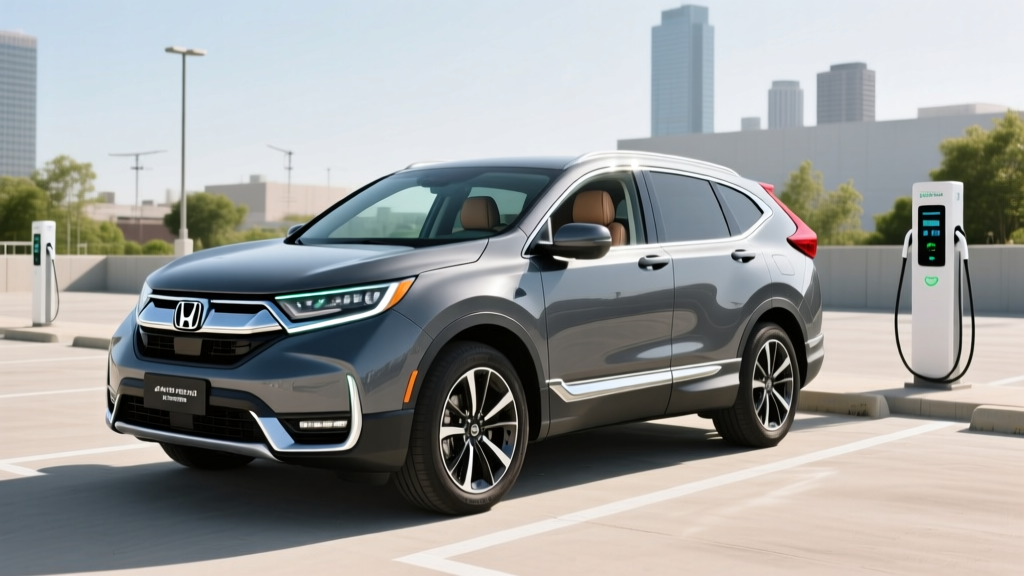
The 2026 Honda CR-V Hybrid Sport Touring sits at the top of Honda's hybrid SUV lineup, pairing a 2.0-liter Atkinson-cycle four-cylinder with a two-motor hybrid system for a combined 204 horsepower and an EPA-estimated 43 MPG city. It's a conventional hybrid (HEV) — meaning no plug, no range anxiety, and no dependence on charging infrastructure. For buyers who want premium features, all-wheel drive, and sub-30 MPG combined fuel economy from a compact SUV without changing their refueling habits, the Sport Touring trim makes a compelling case at roughly $41,000 before destination.
This guide breaks down the exact numbers you need — EPA and real-world MPG, powertrain specs, battery warranty, tax credit eligibility, and how the CR-V Hybrid compares to plug-in hybrid and full electric alternatives.
EPA Fuel Economy and Real-World MPG
| Metric | EPA Estimate | Real-World Expectation |
|---|---|---|
| City MPG | 43 MPG | 40–46 MPG (hybrids often exceed EPA in stop-and-go) |
| Highway MPG | 36 MPG | 32–36 MPG (sustained 75+ mph reduces hybrid advantage) |
| Combined MPG | 40 MPG | 37–42 MPG depending on driving mix |
| Fuel Tank Capacity | 14.0 gallons | — |
| Total Range (est.) | ~560 miles | ~500–580 miles |
Source: EPA fueleconomy.gov
Hybrid Powertrain: How It Works
The CR-V Hybrid uses Honda's two-motor hybrid system, which operates differently from a traditional parallel hybrid like Toyota's setup:
- Engine: 2.0-liter Atkinson-cycle DOHC 4-cylinder, 146 hp / 134 lb-ft torque
- Drive Motor: Electric traction motor, 181 hp / 247 lb-ft torque
- Generator Motor: Second motor acts as a generator and engine starter
- Combined System Output: 204 hp / 247 lb-ft torque
- Transmission: No traditional transmission — uses an e-CVT with a lock-up clutch for direct engine drive at highway speeds
- Drivetrain: Real Time AWD (Sport Touring is AWD only)
At low speeds and in city driving, the CR-V Hybrid operates primarily as a series hybrid — the gas engine spins the generator motor, which produces electricity to power the drive motor. This means the engine runs at its most efficient RPM regardless of vehicle speed. At highway cruising speeds (roughly 55+ mph), a lock-up clutch engages to connect the engine directly to the front wheels for better efficiency.
| Specification | Value |
|---|---|
| Combined Horsepower | 204 hp |
| Combined Torque | 247 lb-ft |
| 0–60 mph (est.) | ~7.8 seconds |
| EPA Combined MPG | 40 MPG |
| EPA City / Highway | 43 / 36 MPG |
| Drivetrain | Real Time AWD |
| Towing Capacity | 1,000 lbs |
| Cargo Volume (behind 2nd row) | 36.3 cu ft |
| Cargo Volume (max, seats folded) | 76.5 cu ft |
| Hybrid Battery Type | Lithium-ion (IPU under cargo floor) |
| Base MSRP (Sport Touring Hybrid AWD) | ~$40,850 + $1,395 destination |
HEV vs PHEV vs EV: Which Powertrain Fits You?
A common question from CR-V shoppers is whether to choose the conventional hybrid, wait for a plug-in hybrid variant, or jump to a full electric SUV. The CR-V Hybrid is a conventional hybrid (HEV) — it does not plug in, has no electric-only driving range to speak of, and recharges its small lithium-ion battery entirely through regenerative braking and the gas engine.
| Factor | CR-V Hybrid (HEV) | Typical PHEV SUV (e.g., Tucson PHEV) | Full EV SUV (e.g., Ioniq 5) |
|---|---|---|---|
| Plug-in Required? | No | Yes (for EV range benefit) | Yes |
| Electric-Only Range | ~1 mile at low speed | 30–38 miles | 250–310 miles (EPA) |
| Total Range | ~560 miles | ~420–450 miles | 250–310 miles |
| Home Charging Needed? | No | Recommended (Level 2) | Essential (Level 2) |
| Federal Tax Credit (§30D) | Not eligible | Up to $7,500 (if eligible) | Up to $7,500 (if eligible) |
| Starting Price Range | ~$35,000–$42,000 | ~$38,000–$48,000 | ~$42,000–$58,000 |
| Best For | No home charging, long trips, simplicity | Short commutes + home charging + road trips | Home charging, daily commuting, lowest running cost |
- You don't have access to home or workplace charging
- You regularly drive 300+ miles without stopping
- You want lower fuel costs without changing any habits
- You live in an apartment or street-park with no outlet access
- Your daily commute is under 35 miles round-trip and you can install a Level 2 charger
- You want electric-only daily driving but gas backup for road trips
- You qualify for the §30D federal tax credit (offsetting the PHEV price premium)
- You have reliable home Level 2 charging
- Your daily driving is under 200 miles
- You want the lowest per-mile fuel cost and minimal maintenance
Sport Touring Trim: What You Get for the Money
The Sport Touring Hybrid is the top-tier trim in the CR-V Hybrid lineup. Here's what distinguishes it from the Sport Hybrid (the lower hybrid trim):
- Wheels: 19-inch Berlina Black alloy wheels
- Interior: Leather-trimmed seats, heated front seats, heated steering wheel
- Infotainment: 9-inch touchscreen with wireless Apple CarPlay and Android Auto
- Audio: Bose Premium 12-speaker audio system
- Charging: Wireless phone charger
- Navigation: Built-in Honda satellite-linked navigation
- Hands-Free: Hands-free power tailgate with walk-away close
- ADAS: Full Honda Sensing suite (adaptive cruise, lane-keeping, collision mitigation, traffic sign recognition, blind-spot monitoring with cross-traffic alert)
- Parking: Low-speed braking control and front/rear parking sensors
The Sport Touring Hybrid typically carries a ~$3,000–$3,500 premium over the Sport Hybrid. For buyers who value leather, the Bose system, and the larger 9-inch display, the upgrade is justified. If you're budget-focused and primarily want the hybrid fuel economy, the Sport Hybrid at roughly $37,000 delivers the same powertrain and MPG.
Battery Warranty, Reliability, and Replacement Cost
- Coverage: 8 years / 100,000 miles (10 years / 150,000 miles in CARB states including CA, CT, MA, ME, MD, NJ, NY, OR, RI, VT, WA, and others adopting California emissions standards)
- What's Covered: Hybrid battery pack (IPU), DC-DC converter, power drive unit, and related hybrid system components
- Capacity Threshold: Honda warrants against defects and abnormal degradation; there is no published minimum capacity retention percentage (unlike EV warranties which typically guarantee 70% SoH)
- Transferable: Yes, the hybrid system warranty transfers to subsequent owners
Honda's hybrid system has a strong reliability track record. The two-motor architecture has been in production since the 2014 Accord Hybrid, and the lithium-ion IPU (Intelligent Power Unit) is relatively small — typically around 1.0–1.5 kWh — meaning it experiences shallow charge/discharge cycles that are gentle on battery longevity. Unlike a full EV battery that cycles through deep charges daily, the CR-V Hybrid's battery acts more like a buffer, rarely dropping below 40% or exceeding 80% state of charge.
Battery Replacement Cost: If the hybrid battery fails outside of warranty, expect a replacement cost between $2,000 and $4,000 for the battery pack, plus labor. This is significantly less than an EV battery replacement ($8,000–$20,000+) because the CR-V's hybrid battery is small. Third-party and refurbished options may be available for less. In practice, widespread hybrid battery failures in Honda's two-motor system have been rare based on long-term owner data.
For broader reliability context, the CR-V as a nameplate consistently earns strong marks from Consumer Reports and has been an IIHS Top Safety Pick in recent model years. Honda Sensing is a Level 2 driver-assistance system — it requires the driver to remain fully engaged and is not a self-driving system.
Tax Credit and Incentive Eligibility
| Incentive | Eligible? | Details |
|---|---|---|
| §30D New Clean Vehicle Credit (up to $7,500) | No | Conventional hybrids (HEVs) do not qualify. Only PHEVs and BEVs with sufficient battery capacity (≥7 kWh) are eligible under IRS §30D rules. |
| §25D Used Clean Vehicle Credit (up to $4,000) | No | Used-EV credit also requires plug-in capability with ≥7 kWh battery. |
| State/Local Hybrid Incentives | Varies | A handful of states offer rebates for hybrids (e.g., some utility company programs). Check your state energy office or local utility for current programs. |
| HOV Lane Access | Generally No | Most states restrict HOV stickers to PHEVs and BEVs. Some states previously allowed hybrid HOV access but have phased it out. |
The lack of federal tax credit eligibility is the CR-V Hybrid's biggest financial disadvantage compared to PHEV and EV rivals. A qualifying buyer purchasing a Hyundai Tucson PHEV or Toyota RAV4 Prime could receive up to $7,500 at point of sale, effectively narrowing or eliminating the price gap. However, the CR-V Hybrid's lower base price and lack of required charging infrastructure can offset this for many buyers.
Ownership Costs: 5-Year Projection
Here's how the CR-V Hybrid Sport Touring stacks up on estimated 5-year running costs compared to the gas-only CR-V and a comparable EV:
| Cost Factor | CR-V Hybrid Sport Touring (AWD) | CR-V EX-L Gas (AWD) | Comparable EV SUV (e.g., Ioniq 5) |
|---|---|---|---|
| Purchase Price (MSRP) | ~$42,245 | ~$38,500 | ~$47,500 |
| Federal Tax Credit | $0 | $0 | Up to $7,500 (if eligible) |
| Fuel / Energy (75K mi) | ~$6,750 (at $3.60/gal, 40 MPG) | ~$9,375 (at $3.60/gal, 28 MPG) | ~$2,800 (at $0.14/kWh, 3.5 mi/kWh) |
| Maintenance (5 yr) | ~$2,500 | ~$3,200 | ~$1,500 |
| Insurance (est. avg) | ~$7,500 | ~$7,000 | ~$8,500 |
| Est. Depreciation (5 yr) | ~$18,000 | ~$17,000 | ~$22,000 |
| Approx. 5-Year Total | ~$77,000 | ~$75,000 | ~$70,300 |
Note: These are estimates for comparison purposes. Actual costs vary by location, driving habits, fuel/electricity prices, and insurance profile. Tax credit eligibility depends on income, MSRP caps, and battery sourcing requirements per IRS guidelines.
The CR-V Hybrid saves roughly $2,600 in fuel over five years compared to the gas model — enough to partially offset the hybrid trim premium. The EV comes out ahead on running costs if you qualify for the full tax credit and have affordable home charging, but the gap narrows considerably if you're ineligible for §30D or rely on expensive public DC fast charging.
Pros and Cons
Pros
- 43 MPG city is exceptional for a compact AWD SUV
- No plug-in required — zero lifestyle change from a gas car
- 204 hp provides confident highway merging and passing
- Smooth, quiet hybrid operation with minimal engine drone
- Full Honda Sensing ADAS suite standard
- Sport Touring trim includes premium features (Bose, leather, wireless CarPlay)
- Strong reliability track record for Honda's two-motor hybrid system
- 8-year/100K-mile hybrid warranty (10/150K in CARB states)
Cons
- No federal tax credit eligibility (HEV, not PHEV)
- Highway MPG (36) is less impressive than city (43)
- Only ~1,000-lb towing capacity
- AWD system is front-biased — not for serious off-road use
- Sport Touring price approaches $43K with options and destination
- No spare tire — tire repair kit only
- Infotainment still uses Honda's older interface (functional but not class-leading)
Frequently Asked Questions
How many MPG does the 2026 CR-V Hybrid Sport Touring get?
The EPA rates the CR-V Hybrid Sport Touring AWD at 43 MPG city, 36 MPG highway, and 40 MPG combined. In real-world driving, city MPG often exceeds the EPA estimate thanks to the electric motor handling low-speed propulsion. Highway fuel economy tends to align closely with or fall slightly below the EPA number at sustained speeds above 70 mph. Over a 75,000-mile ownership period, expect to spend roughly $6,500–$7,000 on fuel at current national averages.
Does the CR-V Hybrid need to be plugged in?
No. The CR-V Hybrid is a conventional hybrid (HEV). Its lithium-ion battery recharges entirely through regenerative braking and the onboard gas engine. You refuel it exactly like a regular gas car — at any gas station. There is no plug, no charging cable, and no electric-only range to manage.
Is there a CR-V Plug-In Hybrid (PHEV) available?
As of the 2026 model year, Honda does not offer a plug-in hybrid CR-V in the United States. The CR-V e:PHEV is available in some international markets (China, Europe) with roughly 50 miles of electric-only range, but it has not been confirmed for the U.S. market. If plug-in capability is a priority, consider the Toyota RAV4 Prime (42 miles EV range, eligible for partial §30D credit) or the Hyundai Tucson PHEV (33 miles EV range).
Is the CR-V Hybrid reliable, and what does battery replacement cost?
Honda's two-motor hybrid system has been in production since 2014 and has demonstrated strong long-term reliability. The hybrid battery is covered by an 8-year/100,000-mile warranty (10 years/150,000 miles in CARB states). Out-of-warranty replacement costs typically range from $2,000 to $4,000 including labor — substantially less than an EV battery replacement. The small battery (~1–1.5 kWh) undergoes shallow cycling, which is favorable for longevity.
Does the CR-V Hybrid qualify for any tax credit?
No. The federal §30D Clean Vehicle Credit requires a plug-in vehicle with a battery capacity of at least 7 kWh. The CR-V Hybrid's battery is approximately 1.0–1.5 kWh and the vehicle does not plug in, making it ineligible for both the new and used clean vehicle federal tax credits. Some state or utility programs may offer small incentives for hybrid purchases — check your local programs. The IRS maintains current eligibility rules at irs.gov.
How does the CR-V Hybrid compare to the RAV4 Hybrid?
The Toyota RAV4 Hybrid is the CR-V Hybrid's most direct competitor. The RAV4 Hybrid is rated at 41 MPG combined (AWD) versus the CR-V's 40 MPG combined — a negligible difference. The RAV4 Hybrid produces 219 hp versus the CR-V's 204 hp, and Toyota offers the RAV4 Prime PHEV variant if you want plug-in capability. Interior quality and infotainment are subjective, but the CR-V Sport Touring's Bose audio and leather interior tend to edge out the RAV4 Limited in perceived quality. Both are strong choices; test-driving both is recommended.
What is the Honda Sensing system, and is it self-driving?
Honda Sensing is a Level 2 driver-assistance system per SAE International's automation levels. It includes adaptive cruise control with low-speed follow, lane-keeping assist, road departure mitigation, and collision mitigation braking. It is not a self-driving system — the driver must remain attentive, keep hands on the wheel, and be prepared to take over at any time. It is comparable to Toyota Safety Sense, Subaru EyeSight, and Hyundai SmartSense in capability.