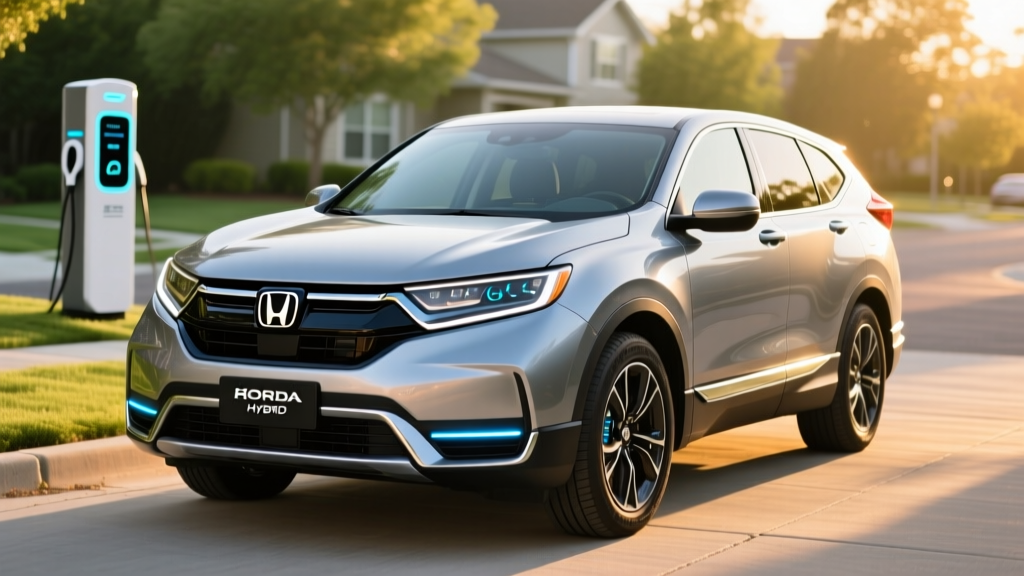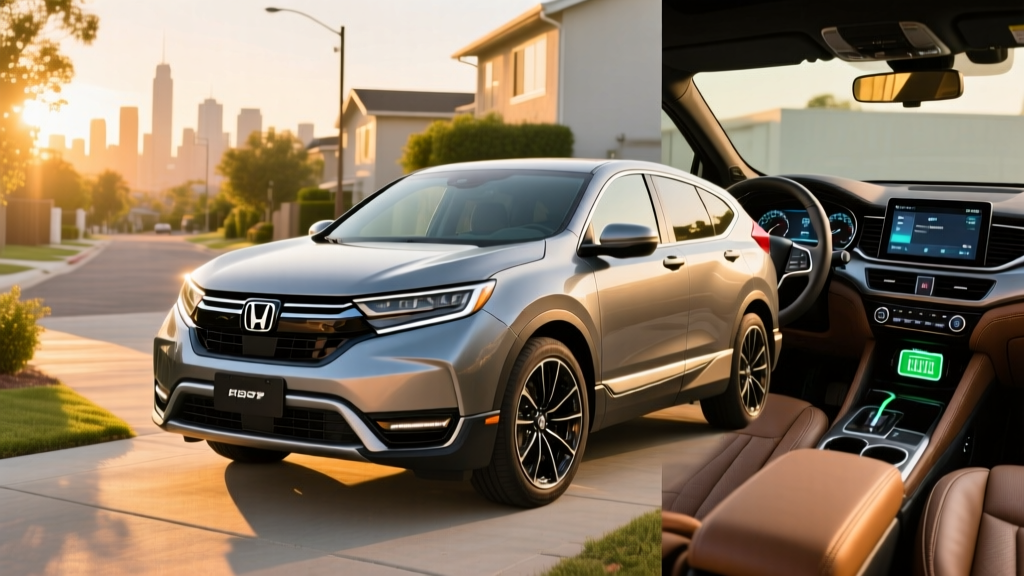
The Honda CR-V has long been the default compact SUV for pragmatic buyers, and the Hybrid Sport-L trim sits at a compelling intersection: upscale interior appointments paired with a fuel-sipping hybrid powertrain — no plug required. For 2026, the CR-V Hybrid Sport-L continues with Honda's proven two-motor hybrid system, delivering strong city efficiency and all-wheel-drive capability without the range anxiety or charging logistics of a full EV.
This guide breaks down everything a buyer needs to know: exact EPA MPG figures, how real-world fuel economy compares, the powertrain specs, battery longevity and warranty coverage, pricing with any applicable incentives, and a clear framework for deciding whether this hybrid, a PHEV, or a full BEV is the right call for your driving pattern.
HEV vs. PHEV: Where the CR-V Hybrid Sport-L Fits
Before diving into specs, it's critical to understand what the CR-V Hybrid Sport-L is — and what it isn't.
Conventional Hybrid (HEV) — This is the CR-V Hybrid Sport-L. It pairs a gasoline engine with electric motors and a small battery that recharges through regenerative braking and the engine. You never plug it in. You simply fuel up at any gas station. The hybrid system optimizes when the engine runs, when the motors drive the wheels, and when both work together, maximizing efficiency automatically.
Plug-in Hybrid (PHEV) — This is NOT the CR-V Hybrid Sport-L. A PHEV has a larger battery (typically 15–20 kWh) that you charge from an outlet or charger, giving 25–45 miles of electric-only driving before the gas engine kicks in. Honda does not currently offer a CR-V PHEV in the US market. If plug-in capability is a priority, you'd need to look at competitors like the Toyota RAV4 Prime or the Hyundai Tucson PHEV.
Battery Electric Vehicle (BEV) — No gas engine at all. Vehicles like the Hyundai Ioniq 5 or Tesla Model Y run entirely on electricity. They offer the lowest operating costs but require access to charging infrastructure and involve higher upfront prices.
The CR-V Hybrid Sport-L is an HEV. There is no plug, no electric-only range to manage, and no charging to schedule. It's a gas-electric hybrid designed to maximize MPG without changing your refueling habits.
Fuel Economy: EPA Ratings and Real-World MPG
Fuel economy is the primary reason buyers choose the CR-V Hybrid over the gas-only model. Here's what the EPA rates it at, per fueleconomy.gov:
| Driving Cycle | EPA Rating (MPG) | Real-World Expectation |
|---|---|---|
| City | 43 MPG | 42–46 MPG (hybrids often beat EPA city) |
| Highway | 36 MPG | 32–35 MPG (sustained 70+ mph reduces hybrid advantage) |
| Combined | 40 MPG | 37–42 MPG depending on driving mix |
Why the city number is higher: Honda's two-motor hybrid system allows the electric motor to drive the wheels at low speeds, with the 2.0L engine acting primarily as a generator. This means stop-and-go traffic — where gas-only vehicles are least efficient — is where the CR-V Hybrid shines brightest. In real-world city driving, many owners report matching or slightly exceeding the 43 MPG city rating, especially in moderate temperatures.
Why highway MPG drops: At sustained highway speeds, the engine connects directly to the wheels via a lock-up clutch. There's less opportunity for regenerative braking, and aerodynamic drag dominates. Expect 32–35 MPG on long interstate trips at 70–80 mph. Cold weather can reduce combined efficiency by 3–5 MPG due to reduced battery efficiency and increased engine runtime for cabin heat.
Compared to the gas-only CR-V: The non-hybrid 2026 CR-V with AWD is rated at 27 city / 32 highway / 29 combined. The hybrid delivers roughly a 38% improvement in combined MPG — a meaningful difference that translates to approximately 130 fewer gallons per year for a driver covering 15,000 miles annually.
Powertrain Specs: What Moves the CR-V Hybrid Sport-L
| Specification | 2026 CR-V Hybrid Sport-L AWD |
|---|---|
| Engine | 2.0L Atkinson-cycle 4-cylinder |
| Engine Output | 145 hp @ 6,100 rpm / 134 lb-ft torque |
| Electric Motors | Dual-motor system (propulsion + generator) |
| Combined System Output | 204 hp / 247 lb-ft torque |
| Drivetrain | Real-Time AWD (rear motor-driven) |
| Transmission | Single-speed direct drive (no traditional CVT or gears) |
| 0–60 mph | ~7.6 seconds (estimated) |
| Towing Capacity | 1,000 lbs |
| Hybrid Battery | ~1.06 kWh lithium-ion (not plug-in) |
The fourth-generation two-motor hybrid system is the same architecture used in the Accord Hybrid. The larger propulsion motor handles most low-to-mid-speed driving, while the 2.0L Atkinson-cycle engine operates at its most efficient RPM range as a generator. At highway speeds, a lock-up clutch connects the engine directly to the front wheels for efficiency.
The AWD system is worth noting: unlike mechanical AWD with a driveshaft, the CR-V Hybrid uses the rear electric motor to power the rear wheels when traction demands it. This means there's no mechanical parasitic loss when AWD isn't needed — contributing to the strong fuel economy despite all-wheel drive.
Sport-L Trim: What You Get for the Price
The Sport-L occupies the upper-middle tier of the CR-V Hybrid lineup, positioned above the Sport and below the Sport Touring. For 2026, the key specifications include:
| Feature | Sport-L AWD Details |
|---|---|
| MSRP (incl. destination) | ~$40,850 |
| Wheels | 19-inch Berlina Black alloy |
| Upholstery | Leather-trimmed seats |
| Infotainment | 9-inch touchscreen, wireless Apple CarPlay/Android Auto |
| Audio | 8-speaker system |
| Power Tailgate | Hands-free access with walk-away close |
| Wireless Charging | Qi-compatible wireless phone charger |
| Honda Sensing Suite | Adaptive cruise, lane-keeping, collision mitigation, traffic sign recognition |
| Heated Front Seats | Standard |
| Moonroof | One-touch power moonroof |
The Sport-L is essentially the Sport trim upgraded with leather, a power tailgate, and wireless phone charging — features that many buyers consider essential for daily use. The step up to the Sport Touring adds navigation, a premium Bose audio system, heated rear seats, and a heated steering wheel for roughly $3,000 more.
Battery Warranty, Reliability, and Replacement Costs
Hybrid battery longevity is consistently the top concern among prospective hybrid buyers. Here's what Honda provides and what real-world data shows:
Honda Hybrid Battery Warranty: 8 years / 100,000 miles (10 years / 150,000 miles in CARB states including California, New York, Massachusetts, and others adopting California emissions standards). The warranty covers the hybrid battery pack against defects and capacity loss below functional thresholds.
Hybrid System Warranty: The broader hybrid system components — including the electric motors, power control unit, and related electronics — are covered under the same 8-year/100,000-mile term (10/150k in CARB states).
Real-world battery lifespan: Honda's hybrid system has been in production since the early 2000s (starting with the Insight and Civic Hybrid). The current-generation two-motor system, introduced with the 2023 CR-V redesign, uses a smaller, more robust lithium-ion battery pack compared to older nickel-metal hydride designs. Because the battery is relatively small (~1.06 kWh) and the system manages charge/discharge cycles conservatively — never fully depleting or fully charging the pack — degradation is minimal. Based on historical Honda hybrid data and fleet reports, these packs routinely exceed 150,000 miles without significant capacity loss.
Replacement cost if out of warranty: Should a hybrid battery replacement be needed after the warranty period, current estimates range from $2,000 to $4,000 for the battery pack itself, plus $500–$1,000 in labor. This is notably less expensive than EV battery replacements (which can exceed $10,000) because the hybrid pack is far smaller. Third-party and refurbished options are increasingly available, which can reduce costs further.
General reliability: The CR-V Hybrid powertrain carries Honda's strong reliability reputation. Per IIHS, the 2026 CR-V earns top marks in crash testing. The hybrid system adds complexity but eliminates the traditional transmission — one of the most common failure points in conventional vehicles — which partially offsets the added component risk.
Tax Credits and Incentives: What Applies to the CR-V Hybrid
This is where hybrid buyers need clear expectations:
- Federal §30D Clean Vehicle Credit ($7,500): The CR-V Hybrid Sport-L does not qualify for the federal EV tax credit. Per IRS guidelines, the §30D credit applies only to plug-in electric vehicles (BEVs and PHEVs) meeting battery capacity, critical mineral sourcing, and MSRP caps. Conventional hybrids (HEVs) are excluded.
- Used Clean Vehicle Credit (§25E, up to $4,000): Also does not apply to HEVs — this credit is limited to used BEVs and PHEVs.
- State-level incentives: A small number of states offer modest rebates or tax incentives for conventional hybrids, but these are increasingly rare as state programs focus on plug-in vehicles. Check your state's energy or environmental agency website for current programs.
- Insurance and registration: Some insurers offer minor discounts for hybrid vehicles. A few states impose additional registration fees on EVs but not on hybrids, which can make the HEV slightly cheaper to register than a comparable BEV.
The bottom line: the CR-V Hybrid Sport-L's financial advantage comes from fuel savings, not tax credits. At 40 MPG combined versus 29 MPG for the gas model, a driver covering 15,000 miles per year at $3.50/gallon saves approximately $1,440 annually — recovering the hybrid premium in roughly 2–3 years depending on trim pricing.
CR-V Hybrid Sport-L vs. PHEV vs. BEV: Which Is Right for You?
Choose the CR-V Hybrid Sport-L (HEV) if:
- You lack access to home or workplace charging (apartment, street parking, no garage outlet)
- You want maximum simplicity — no plugs, no charging apps, no route planning around chargers
- Your driving is a mix of city and highway with no single dominant pattern
- You want AWD capability and strong cargo space (36.3 cu ft behind rear seats)
- Your budget is under $42,000 and you don't want to stretch for a BEV
Choose a PHEV (e.g., Toyota RAV4 Prime) if:
- You can install a Level 2 charger at home and have a short commute (under 40 miles round-trip)
- You want to drive mostly on electricity during the week but need gas flexibility for road trips
- You want to qualify for the $7,500 federal tax credit (subject to income and sourcing requirements)
- You're willing to pay a $5,000–$8,000 premium over a comparable HEV
Choose a full BEV (e.g., Hyundai Ioniq 5, Tesla Model Y) if:
- You have reliable home charging (Level 2, 240V)
- Your daily driving is under 250 miles and you're comfortable with public DC fast charging for road trips
- You want the lowest per-mile fuel cost (~$0.04–$0.06/mile vs. ~$0.09/mile for the hybrid)
- You want to eliminate oil changes, spark plugs, and transmission fluid entirely
- You qualify for the federal tax credit and can absorb a higher purchase price
Pros and Cons at a Glance
Pros
- 40 MPG combined EPA — among the best in the compact SUV class
- No plug-in required — zero change to refueling habits
- Strong city efficiency (43 MPG) where most driving occurs
- 204 hp combined provides confident merging and passing
- Standard AWD with no mechanical efficiency penalty
- 8-year/100,000-mile hybrid battery warranty (10/150k in CARB states)
- Honda Sensing ADAS suite standard on all trims
- Competitive cargo space: 36.3 cu ft (rear seats up), 76.5 cu ft (folded)
- Proven Honda reliability and strong resale value
Cons
- No federal tax credit eligibility (HEV exclusion)
- Highway MPG (36) trails city rating — long road trips see less benefit
- Towing limited to 1,000 lbs (gas CR-V AWD tows 1,500 lbs)
- No plug-in option in the CR-V lineup for electric-only commuting
- Sport-L pricing (~$40,850) approaches luxury compact SUV territory
- Engine drone under hard acceleration (common in Honda hybrids)
- Rear seats don't slide or recline (fixed configuration)
Frequently Asked Questions
How many MPG does the Honda CR-V Hybrid Sport-L get?
The EPA rates the 2026 CR-V Hybrid AWD at 43 city / 36 highway / 40 combined MPG. In real-world driving, expect 42–46 MPG in city conditions and 32–35 MPG on sustained highway trips. Cold weather and aggressive driving can reduce combined figures to the mid-30s.
Does the CR-V Hybrid need to be plugged in?
No. The CR-V Hybrid is a conventional hybrid (HEV), not a plug-in hybrid (PHEV). The battery recharges automatically through regenerative braking and the gasoline engine. You only ever need to fill up at a gas station.
How far can the CR-V Hybrid drive on electric only?
The CR-V Hybrid can operate in EV mode for very short distances at low speeds (typically under 1 mile at speeds below 25 mph), such as creeping through a parking lot. It is not designed for meaningful electric-only driving. If you want 30+ miles of electric-only range, you need a PHEV like the Toyota RAV4 Prime (42 miles EV range).
Does the Honda CR-V Hybrid qualify for any tax credit?
The CR-V Hybrid does not qualify for the federal §30D Clean Vehicle Credit ($7,500) because it is a conventional hybrid, not a plug-in vehicle. It also does not qualify for the used EV credit. Some states may offer minor hybrid incentives, but these are uncommon. The fuel savings — approximately $1,440/year versus the gas model — are the primary financial benefit.
Is the CR-V Hybrid reliable, and what does battery replacement cost?
Honda's hybrid system has a strong reliability track record spanning two decades. The hybrid battery is covered by an 8-year/100,000-mile warranty (10 years/150,000 miles in CARB states). Out-of-warranty replacement costs are estimated at $2,000–$4,000 for the battery pack plus labor — significantly less than EV battery replacements due to the smaller pack size. Real-world data suggests these batteries routinely last 150,000+ miles.
How does the CR-V Hybrid compare to the Toyota RAV4 Hybrid?
Both are strong choices. The RAV4 Hybrid is rated at 41 city / 38 highway / 40 combined MPG — nearly identical to the CR-V Hybrid. The RAV4 offers a slightly higher towing capacity (1,750 lbs vs. 1,000 lbs) and has a PHEV variant (RAV4 Prime) available. The CR-V Hybrid offers slightly more cargo volume and a more refined interior in the Sport-L trim. The choice often comes down to styling preference, dealer proximity, and specific trim features.
What's the total range on a full tank?
With a 15.3-gallon fuel tank and 40 MPG combined, the CR-V Hybrid Sport-L delivers approximately 612 miles of total range. In city-heavy driving at 43 MPG, range can exceed 650 miles. This is a significant advantage over most EVs for road trips, with no charging stops required.
The Verdict: A Smart Buy for the Charging-Optional Buyer
The 2026 Honda CR-V Hybrid Sport-L makes a compelling case for buyers who want dramatically better fuel economy without the infrastructure demands of a plug-in vehicle. At 40 MPG combined with AWD, a premium interior, Honda's safety suite, and a proven hybrid powertrain, it delivers on the practical priorities that define the compact SUV segment.
The Sport-L trim specifically hits a sweet spot: leather seats, wireless connectivity, and a hands-free tailgate without the $3,000 jump to the Touring. The absence of federal tax credits stings compared to PHEV and BEV alternatives, but the lower purchase price and zero charging logistics offset that gap for buyers without home charging access.
If you can charge at home and want to maximize electric driving, a PHEV or BEV will deliver lower operating costs and federal incentives. But if you want a set-it-and-forget-it efficiency upgrade that works with your existing gas-station routine, the CR-V Hybrid Sport-L is one of the strongest options in its class — and its hybrid battery warranty ensures peace of mind for the long haul.