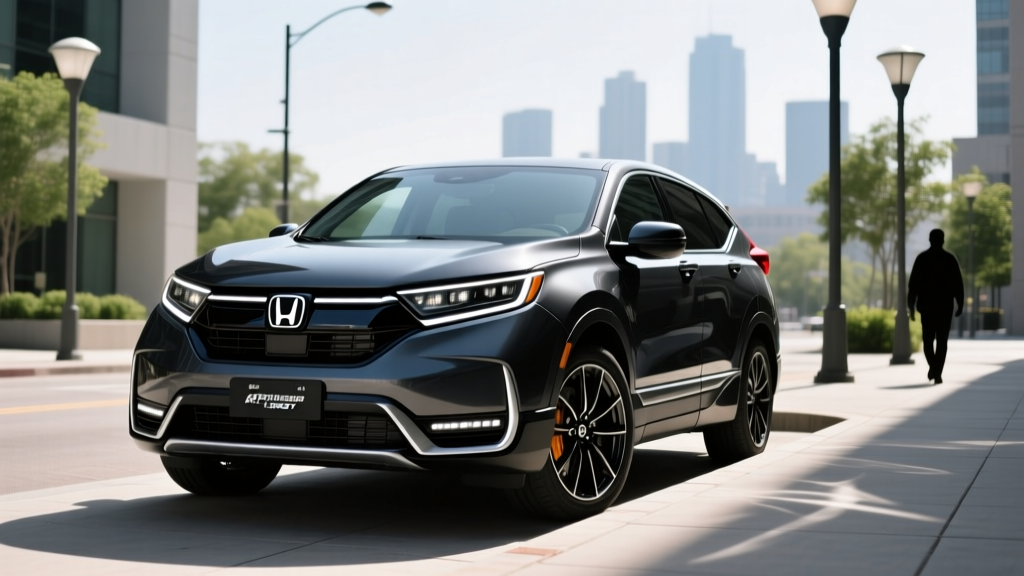
Quick Verdict: The 2026 Honda CR-V Hybrid Sport-L delivers 40 MPG combined with 204 hp from its two-motor hybrid system, all for a $38,395 MSRP. It's a conventional hybrid (HEV) — no plug required — making it the right call for buyers who want EV-like city efficiency without charging infrastructure.
2026 Honda CR-V Hybrid Sport-L: Full Specifications
| Specification | 2026 CR-V Hybrid Sport-L |
|---|---|
| Powertrain Type | Conventional Hybrid (HEV) |
| Engine | 2.0L Atkinson-cycle 4-cylinder |
| Combined Horsepower | 204 hp |
| Combined Torque | 247 lb-ft |
| Drivetrain | AWD (standard on Sport-L) |
| EPA MPG (City / Hwy / Combined) | 40 / 34 / 37 |
| Transmission | e-CVT (direct-drive) |
| 0-60 mph | ~7.8 seconds |
| Cargo Volume (rear seats up / down) | 36.3 / 76.5 cu ft |
| Towing Capacity | 1,000 lbs |
| MSRP (AWD) | $38,395 |
| Federal Tax Credit | Not eligible (HEV) |
| Hybrid Battery Warranty | 8 years / 100,000 miles |
Fuel Economy: EPA Ratings vs. Real-World MPG
The EPA rates the 2026 CR-V Hybrid Sport-L AWD at 40 city / 34 highway / 37 combined MPG (fueleconomy.gov). Those numbers come from Honda's fourth-generation two-motor hybrid system, which uses the gasoline engine primarily as a generator at lower speeds, letting the electric traction motor handle propulsion — essentially operating as a series hybrid in city driving.
| Driving Scenario | EPA Rating | Real-World Expectation |
|---|---|---|
| City | 40 MPG | 38–43 MPG (regenerative braking excels in stop-and-go) |
| Highway (70 mph) | 34 MPG | 30–33 MPG (engine directly drives wheels, less hybrid advantage) |
| Combined | 37 MPG | 34–38 MPG (depends on city/highway mix) |
| Cold Weather (below 32°F) | — | 28–32 MPG combined (engine runs more for cabin heat) |
Like most conventional hybrids, the CR-V Hybrid tends to beat its EPA city rating in real-world stop-and-go driving, where regenerative braking recaptures energy that a gas-only vehicle would waste as heat. Highway efficiency is the relative weak spot — at sustained speeds above 65 mph, the engine mechanically connects to the wheels via a lock-up clutch, and the hybrid system's electric-motor advantage diminishes. Expect a noticeable MPG drop in winter when the engine runs more frequently to provide cabin heating.
HEV vs. PHEV vs. EV: Which Powertrain Fits You?
The CR-V Hybrid is a conventional hybrid (HEV), not a plug-in hybrid (PHEV). Honda does not currently offer a PHEV version of the CR-V in the US market. Understanding the distinction matters for your purchase decision:
| Feature | HEV (CR-V Hybrid) | PHEV (e.g., Toyota RAV4 Prime) | BEV (e.g., Hyundai Ioniq 5) |
|---|---|---|---|
| Plug-in Charging Required? | No | Yes (for EV range) | Yes (always) |
| Electric-Only Range | ~1 mile at low speed | 35–42 miles | 250–320+ miles |
| Total Range | ~440 miles | ~520+ miles | 250–320+ miles |
| Battery Size | ~1.1 kWh (small buffer) | ~18.1 kWh | 58–84 kWh |
| Home Charging Needed? | No | Recommended (Level 2) | Essential |
| Federal Tax Credit (§30D) | Not eligible | Up to $7,500 (varies) | Up to $7,500 (varies) |
| Best For | No home charger access | Short commutes + road trips | Home charging + lower running costs |
Choose the CR-V Hybrid (HEV) if: You lack reliable home or workplace charging access, you want maximum simplicity with no plug-in routine, or you frequently take long road trips where charging stops would be inconvenient.
Consider a PHEV (RAV4 Prime, Tucson PHEV) if: You can install a Level 2 charger at home, your daily commute is under 40 miles (covering it on electric), and you still want gas-engine range for weekend trips.
Go full EV (Ioniq 5, Model Y) if: You have home charging, want the lowest per-mile fuel cost, and your typical drives fall within 200–250 miles.
Powertrain Deep Dive: How Honda's Hybrid System Works
The 2026 CR-V Hybrid uses Honda's fourth-generation two-motor hybrid system paired with a 2.0-liter Atkinson-cycle four-cylinder engine. The combined output is 204 horsepower and 247 lb-ft of torque, with torque available near-instantly from the electric traction motor.
Here's how the system operates across driving conditions:
- Low-speed / city driving: The gasoline engine acts as a generator, producing electricity that powers the traction motor. The engine speed is decoupled from vehicle speed, allowing it to run at its most efficient RPM. This is essentially series-hybrid operation.
- Acceleration: Both the engine (via generator) and the lithium-ion battery supply power to the traction motor for maximum thrust.
- Highway cruising: A lock-up clutch mechanically connects the engine to the front wheels, bypassing the electric drivetrain for efficiency at steady speeds.
- Deceleration / braking: The traction motor reverses function, acting as a generator to recapture kinetic energy and recharge the hybrid battery.
The hybrid battery pack is a ~1.1 kWh lithium-ion unit — small by EV standards, but appropriately sized for an HEV. It doesn't store enough energy for meaningful electric-only driving, but it buffers energy between the engine-generator and the traction motor, smoothing power delivery and enabling regenerative braking.
Standard AWD on the Sport-L trim adds a rear-mounted electric motor that provides torque to the rear axle when needed. This is not a mechanical driveshaft system — it's an electrically activated rear axle, which reduces parasitic loss compared to traditional AWD.
Battery Warranty, Lifespan, and Replacement Cost
Honda Hybrid Battery Warranty: 8 years or 100,000 miles (whichever comes first) in most states. In California Air Resources Board (CARB) states, the warranty extends to 10 years or 150,000 miles.
What's covered: Defects and capacity loss below a functional threshold. Honda does not publish a specific percentage degradation trigger, but the warranty covers battery modules that fail to hold sufficient charge for hybrid system operation.
Hybrid battery longevity is a top concern for buyers, and the data is reassuring. Honda's lithium-ion hybrid packs in the CR-V are far smaller and experience shallower charge-discharge cycles than EV batteries. Real-world failure data from earlier-generation CR-V Hybrids and similar Honda systems suggests most hybrid batteries last well beyond 150,000 miles without significant issues.
If replacement is needed out of warranty, expect to pay approximately $2,500–$4,000 for a new hybrid battery pack installed at a Honda dealer. Independent hybrid specialists may offer refurbished packs for $1,500–$2,500. Individual module replacement (only the degraded cells) can reduce cost further. This is dramatically less expensive than an EV traction battery replacement, which can exceed $10,000–$15,000.
The powertrain warranty (engine, transmission, hybrid system components) also covers 5 years / 60,000 miles, providing additional protection for the e-CVT and electric motors.
Pricing, Trims, and Tax Credit Eligibility
The 2026 Honda CR-V Hybrid is offered in three trims, all with standard AWD:
| Trim | MSRP | Key Additions |
|---|---|---|
| Sport | $35,895 | Base hybrid trim, 18" wheels, heated seats |
| Sport-L | $38,395 | Leather-trimmed seats, power liftgate, wireless CarPlay/Android Auto |
| Sport Touring | $41,895 | Bose audio, panoramic roof, heated steering wheel, navigation |
The Sport-L sits in the middle and is the volume trim for good reason — it adds leather upholstery and a power liftgate for $2,500 over the Sport, features most buyers expect in a compact SUV at this price point.
Federal Tax Credit (§30D) Status:
- ❌ Not eligible. The CR-V Hybrid is a conventional HEV, not a plug-in vehicle. The IRS §30D Clean Vehicle Credit applies only to battery electric vehicles (BEVs) and plug-in hybrids (PHEVs) with a battery capacity of at least 7 kWh.
- ❌ No used-EV credit either. The §25E used clean vehicle credit also requires a plug-in vehicle.
- ⚠️ State incentives may apply. Some states offer rebates for conventional hybrids, though these are increasingly rare as incentive programs shift toward plug-in vehicles. Check your state's energy or environmental agency for current programs.
For the full details on federal clean vehicle credit eligibility rules — including MSRP caps, buyer income limits, and battery sourcing requirements — consult IRS.gov §30D guidelines or speak with a tax professional.
Reliability, Safety Ratings, and Ownership Costs
Honda's hybrid powertrain has a strong reliability track record. The two-motor system has fewer moving parts than a traditional automatic transmission — there's no torque converter, no gear-shifting mechanism, and the e-CVT is fundamentally a pair of electric motors with a planetary gearset. The NHTSA and IIHS historically rate the CR-V well; the current generation earned an IIHS Top Safety Pick designation in prior model years.
Estimated annual ownership costs for the CR-V Hybrid Sport-L:
- Fuel: ~$1,350/year at 15,000 miles and $3.50/gallon (vs. ~$1,800 for a 28 MPG gas-only compact SUV)
- Maintenance: ~$400–$600/year (standard oil changes, no hybrid-specific maintenance required)
- Insurance: ~$1,400–$1,800/year (varies by state and driver profile; hybrids sometimes carry a slight premium over gas models)
- Depreciation: CR-V Hybrids hold value well — expect roughly 45–50% retention after 5 years, competitive with the segment
The fuel savings over a gas-only competitor averaging 28 MPG combined works out to approximately $450/year, or about $2,250 over five years. That nearly offsets the hybrid premium over a gas-only CR-V EX (roughly $2,500 more for the Hybrid Sport-L vs. a comparably equipped gas EX).
Pros and Cons: CR-V Hybrid Sport-L
Pros
- 40 MPG city — real-world city driving often exceeds EPA estimate
- No plug-in charging required; zero lifestyle change from a gas car
- 204 hp with instant electric torque feels responsive in daily driving
- Strong cargo capacity (36.3 cu ft) with no battery-pack intrusion
- AWD standard with electric rear axle — no fuel-economy penalty vs. FWD
- 8-year/100,000-mile hybrid battery warranty (10 years in CARB states)
- Excellent resale value; CR-V Hybrid demand remains high
Cons
- No federal tax credit eligibility (HEV, not PHEV or BEV)
- Highway MPG (34) is only average — less advantage over gas on long trips
- 1,000-lb towing capacity limits utility for trailer or boat owners
- No DC fast charging or meaningful electric-only range
- Cold-weather MPG drops noticeably (engine runs for cabin heat)
- ~$2,500 price premium over gas-only CR-V EX trim
Frequently Asked Questions
How many MPG does the 2026 Honda CR-V Hybrid Sport-L get?
The EPA rates it at 40 city / 34 highway / 37 combined MPG. In real-world city driving with frequent stops, owners commonly report 38–43 MPG. Highway driving at 70+ mph typically yields 30–33 MPG. Cold weather reduces combined efficiency to roughly 28–32 MPG due to increased engine operation for cabin heating.
Does the CR-V Hybrid need to be plugged in?
No. The CR-V Hybrid is a conventional hybrid (HEV). It charges its small battery pack entirely through regenerative braking and the onboard gasoline engine-generator. You fuel it like any other gas car — there is no plug, no charging cable, and no home charger needed.
How far can the CR-V Hybrid drive on electric only?
Effectively less than one mile at very low speeds (under 25 mph in light-load conditions). The ~1.1 kWh battery is not designed for electric-only driving. It serves as an energy buffer for the hybrid system, not as an EV range extender. If electric-only commuting is your goal, you need a PHEV or BEV.
Is the Honda CR-V Hybrid reliable, and what does battery replacement cost?
Honda's hybrid system has demonstrated strong long-term reliability, with most packs lasting well past 150,000 miles. The hybrid battery is warranted for 8 years/100,000 miles (10 years/150,000 miles in CARB states). Out-of-warranty replacement runs approximately $2,500–$4,000 at a dealer, or $1,500–$2,500 through independent hybrid specialists using refurbished packs.
Does the 2026 CR-V Hybrid qualify for any tax credit?
No. The federal §30D Clean Vehicle Credit applies only to plug-in vehicles (BEVs and PHEVs) with a battery of at least 7 kWh. The CR-V Hybrid's ~1.1 kWh pack does not qualify. Some states may offer hybrid-specific incentives, but these are uncommon. Check your state energy office for current programs.
How does the CR-V Hybrid compare to the Toyota RAV4 Hybrid?
The RAV4 Hybrid is the CR-V Hybrid's closest competitor. The RAV4 Hybrid AWD is rated at 41/38/39 MPG (city/highway/combined) with 219 hp and starts at approximately $34,000. The CR-V Hybrid offers slightly less highway MPG but provides a more refined interior and a more car-like driving feel. The RAV4 Prime PHEV variant (42 miles electric-only, up to $7,500 tax credit) is worth considering if you have home charging and a short commute.
Is the CR-V Hybrid Sport-L worth the premium over the Sport trim?
The $2,500 step up to Sport-L adds leather-trimmed seats, a power liftgate, wireless Apple CarPlay and Android Auto, and a leather-wrapped steering wheel. If you value these comfort and convenience features, the Sport-L is the sweet-spot trim. The Sport Touring adds another $3,500 for Bose audio and a panoramic roof — nice features, but they push the CR-V into pricing territory where PHEV competitors become viable.