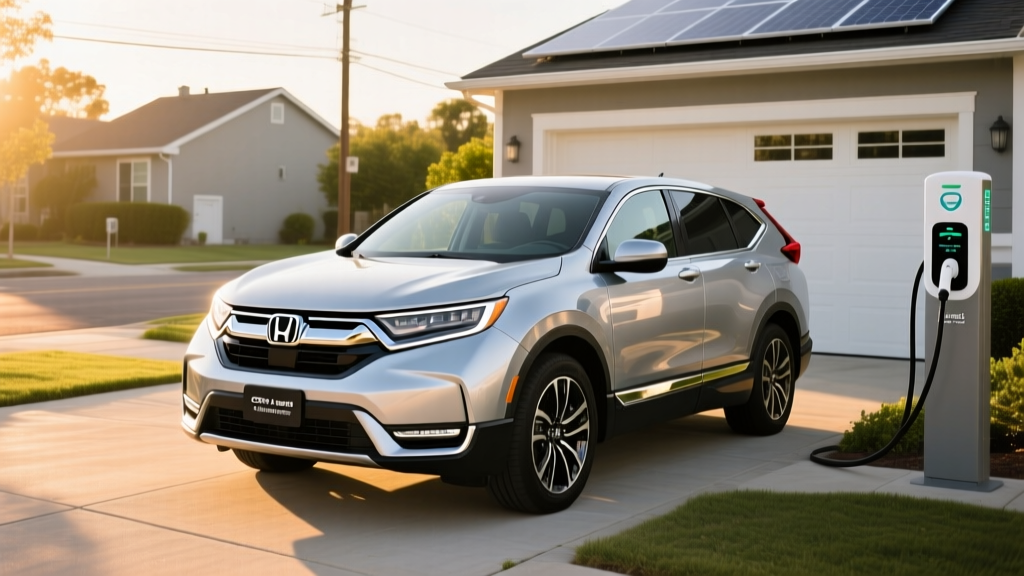
If you're researching Honda CR-V hybrid cars, you're likely weighing fuel savings against practicality. The 2026 Honda CR-V Hybrid is a conventional hybrid electric vehicle (HEV) — meaning it never needs to be plugged in — and it remains one of the best-selling compact hybrid SUVs in America. With standard all-wheel drive, a spacious cabin, and an EPA-estimated 40 MPG combined, it occupies a compelling middle ground between gas-only SUVs and full battery-electric vehicles.
This guide covers everything a buyer needs: exact EPA fuel economy figures, real-world MPG expectations, powertrain specs, trim pricing, battery warranty details, tax credit eligibility, and how the CR-V Hybrid stacks up against plug-in hybrid and full EV alternatives.
HEV vs. PHEV: Understanding the 2026 CR-V Hybrid
Before we get into numbers, it's critical to distinguish what the CR-V Hybrid is — and what it isn't. Honda currently sells the CR-V exclusively as a conventional hybrid (HEV) in the United States. There is no plug-in hybrid (PHEV) version of the CR-V for the U.S. market as of the 2026 model year.
Conventional Hybrid (HEV) vs. Plug-In Hybrid (PHEV)
| Feature | CR-V Hybrid (HEV) | Typical PHEV (e.g., Toyota RAV4 Prime) |
|---|---|---|
| Plugs in? | No — charges via regenerative braking and engine | Yes — has a larger battery charged externally |
| Electric-only range | ~1 mile at low speeds | 25–42 miles typical |
| Battery size | ~1.06 kWh (small, self-charging) | 13–18 kWh |
| Federal tax credit | Not eligible (§30D requires plug-in) | May qualify, subject to IRS §30D rules |
| Price premium over gas model | ~$1,500–$2,000 | ~$5,000–$8,000 |
The CR-V Hybrid's job is simple: reduce fuel consumption without changing your habits. You fill it at a gas station and drive normally. The hybrid system handles the rest.
Fuel Economy: EPA Ratings and Real-World MPG
The 2026 Honda CR-V Hybrid uses a two-motor hybrid system paired with a 2.0-liter Atkinson-cycle four-cylinder engine. All trims come with standard all-wheel drive (AWD), which slightly impacts fuel economy compared to a theoretical FWD setup.
| 2026 CR-V Hybrid AWD | City | Highway | Combined |
|---|---|---|---|
| EPA Estimate | 40 MPG | 34 MPG | 37 MPG |
| Real-World (mixed driving) | 38–43 MPG | 30–34 MPG | 35–39 MPG |
| Cold weather (below 35°F) | 34–38 MPG | 28–32 MPG | 31–35 MPG |
Source: EPA Fuel Economy
Key insight for CR-V Hybrid owners: Like most Toyota and Honda hybrids, the CR-V Hybrid tends to exceed its EPA city rating in stop-and-go traffic. Regenerative braking recaptures energy that a gas car wastes as heat, so city driving actually favors the hybrid system. Highway driving is where efficiency dips — aerodynamic drag dominates at 70+ mph, and the engine runs more frequently. Expect 38–43 MPG in city-heavy commutes and closer to 30–34 MPG on sustained interstate trips.
Cold weather impact: In sub-freezing temperatures, expect a 3–5 MPG drop. The engine runs more often to generate cabin heat and warm the catalytic converter. This is a smaller penalty than EVs face in winter (20–30% range loss), but it's real and worth budgeting for if you live in the northern U.S.
Powertrain and Performance Specs
| Specification | 2026 Honda CR-V Hybrid AWD |
|---|---|
| Powertrain | 2.0L Atkinson-cycle I-4 + two electric motors |
| Combined System Horsepower | 204 hp |
| Combined System Torque | 247 lb-ft (motor torque) |
| Transmission | e-CVT (electronic continuously variable) |
| Drivetrain | AWD standard (all trims) |
| 0–60 mph | ~7.6 seconds |
| Hybrid Battery Capacity | ~1.06 kWh (lithium-ion) |
| Towing Capacity | 1,000 lbs |
| Cargo Volume (behind rear seats) | 36.3 cu ft / 76.5 cu ft (rear seats folded) |
The CR-V Hybrid's two-motor system operates primarily as a series hybrid at low speeds — the engine generates electricity while the drive motor propels the wheels. At highway speeds, a lockup clutch connects the engine directly to the wheels for efficiency. The result is seamless operation with no traditional gear shifts. Acceleration is adequate for merging and passing, though the 7.6-second 0–60 time won't thrill enthusiasts. The instant torque from the electric motor makes the CR-V Hybrid feel punchier than the number suggests in around-town driving.
2026 CR-V Hybrid Trims and Pricing
The 2026 Honda CR-V Hybrid is available in four trims. All come with AWD and the same 204-hp hybrid powertrain — trim differences are in features, not performance.
| Trim | MSRP (incl. destination) | Key Features |
|---|---|---|
| Sport | ~$36,550 | 18" wheels, 7" touchscreen, wireless CarPlay/Android Auto, Honda Sensing suite |
| Sport-L | ~$38,950 | Leather-trimmed seats, power liftgate, heated front seats, 9" touchscreen |
| Sport Touring | ~$41,750 | Bose 12-speaker audio, wireless charging, heated steering wheel, navigation, panoramic roof |
| Sport-L (w/o roof rack, base fleet) | Varies by region | Limited availability; check dealer |
Note: Pricing reflects estimated 2026 MSRP including destination charges. Confirm with your local Honda dealer as prices may vary.
Tax Credits and Incentives: What You Need to Know
This is where many buyers get confused. The Honda CR-V Hybrid does NOT qualify for the federal §30D Clean Vehicle tax credit. That credit — worth up to $7,500 — is reserved for plug-in electric vehicles (BEVs and PHEVs) that meet specific battery capacity, critical mineral sourcing, MSRP cap, and buyer income requirements as defined by the IRS.
Since the CR-V Hybrid is a conventional HEV that cannot be plugged in, it falls outside the §30D program entirely. There is no federal purchase incentive for conventional hybrids as of 2026.
What about state incentives? A handful of states offer modest rebates or HOV lane access for hybrids, but these programs have largely shifted toward BEVs and PHEVs. Check your state's energy or environmental agency website for current programs. Some states offer reduced registration fees or emissions-testing exemptions for hybrids, which provide minor savings.
The economics still work without a tax credit because the price premium over the gas-only CR-V is modest (~$1,500) and the fuel savings add up. At 37 MPG combined vs. the gas CR-V's 29 MPG combined, and assuming $3.40/gallon and 12,000 miles/year, the hybrid saves approximately $350–$400 annually in fuel. The premium pays for itself in roughly 4 years at current prices.
Battery Warranty, Reliability, and Replacement Cost
Honda CR-V Hybrid Battery Warranty
- Hybrid battery warranty: 8 years / 100,000 miles (10 years / 150,000 miles in CARB states including CA, CT, ME, MA, NJ, NY, OR, VT, WA)
- Capacity threshold: Honda covers defects and significant capacity loss that impairs hybrid system function
- Powertrain warranty: 5 years / 60,000 miles
- Limited vehicle warranty: 3 years / 36,000 miles
How long do Honda hybrid batteries actually last? Honda's lithium-ion hybrid battery packs have an excellent track record. Real-world data from Honda and Toyota hybrid owners shows these small battery packs routinely lasting 150,000–200,000+ miles with minimal degradation. Unlike full EV batteries that cycle deeply (0–100%), the CR-V Hybrid's ~1.06 kWh pack operates in a narrow state-of-charge window (roughly 20–80%), which dramatically reduces wear. The battery is never fully depleted or fully charged — the system manages this buffer automatically.
Replacement cost: If a hybrid battery does fail outside warranty, replacement costs typically range from $2,000 to $4,000 including labor, depending on whether you use a new OEM pack, a refurbished unit, or an independent hybrid shop. This is far less than a full EV battery replacement ($8,000–$20,000+), because the CR-V Hybrid's battery is small and accessible.
Reliability ratings: The CR-V Hybrid benefits from Honda's decades of hybrid experience (the Insight debuted in 1999). Honda Sensing — the standard ADAS suite including adaptive cruise, lane-keeping, and automatic emergency braking — is a mature SAE Level 2 driver-assist system. It requires full driver attention at all times; it is not self-driving.
CR-V Hybrid vs. PHEV vs. Full EV: Which Fits You?
Choose the CR-V Hybrid (HEV) if:
- You lack access to home or workplace charging (apartment, street parking)
- You want lower fuel costs without any behavior change
- Your budget tops out around $38,000–$42,000
- You take frequent road trips and don't want to plan around charging stops
- You want AWD and strong cargo space in a compact SUV
Choose a PHEV (e.g., Toyota RAV4 Prime) if:
- You can charge at home (Level 1 or Level 2) and your commute is under 40 miles
- You want electric-only daily driving but gas flexibility for road trips
- You're willing to pay a $5,000–$8,000 premium (partially offset if a tax credit applies)
- You want 25–42 miles of electric range before the engine starts
Choose a full EV (e.g., Hyundai Ioniq 5, Tesla Model Y) if:
- You can install a Level 2 home charger (240V)
- Your daily driving is under 250 miles and you're comfortable with public DC fast charging for road trips
- You want zero tailpipe emissions and the lowest per-mile fuel cost (~$0.04–$0.06/mi on home electricity)
- You qualify for the federal §30D tax credit (up to $7,500), which narrows the price gap
The CR-V Hybrid is the lowest-friction entry point into electrified driving. No plugs, no range anxiety, no charging apps, no electrical upgrades. You just drive and save fuel.
✓ Pros
- 40 MPG city — excellent for a compact AWD SUV
- No plug-in required — zero lifestyle change
- Standard AWD across all trims
- Spacious cabin: 36.3 cu ft cargo, 76.5 cu ft max
- Proven Honda hybrid reliability and 8–10 yr battery warranty
- Modest price premium over gas CR-V (~$1,500)
✗ Cons
- No electric-only driving range (unlike a PHEV)
- Not eligible for the federal §30D tax credit
- 0–60 in ~7.6 sec — adequate, not quick
- 1,000-lb towing limit (lower than some gas competitors)
- Highway MPG drops to 34 — less efficient than city driving
- No DC fast charging capability (not applicable to HEV)
Ownership Costs: 5-Year Fuel Savings Breakdown
| 5-Year Cost Factor | CR-V Hybrid (37 MPG) | CR-V Gas AWD (29 MPG) |
|---|---|---|
| Fuel (60,000 mi @ $3.40/gal) | $5,514 | $7,034 |
| Fuel savings vs. gas | +$1,521 saved | — |
| Hybrid premium at purchase | ~$1,500 | $0 |
| Net 5-year position | ~Break-even to +$21 | Baseline |
| Maintenance (oil, brakes) | Slightly lower (regen saves brake pads) | Standard |
At 12,000 miles per year, the hybrid's fuel savings offset its purchase premium within 4–5 years. Beyond that, every mile driven is net savings. Owners who keep their CR-V for 8–10 years will see $2,500–$3,500 in total fuel savings. Regenerative braking also reduces brake pad wear, saving an additional $200–$400 over the vehicle's life.
Frequently Asked Questions
How many MPG does the Honda CR-V Hybrid get?
The 2026 Honda CR-V Hybrid AWD is EPA-rated at 40 MPG city, 34 MPG highway, and 37 MPG combined. In real-world city-heavy driving, many owners report 38–43 MPG. Highway-only driving at 70+ mph typically yields 30–34 MPG. Cold weather reduces efficiency by 3–5 MPG.
Does the Honda CR-V Hybrid need to be plugged in?
No. The CR-V Hybrid is a conventional hybrid (HEV). Its small lithium-ion battery recharges through regenerative braking and the gasoline engine. You never plug it in — you simply refuel at a gas station as normal.
Is there a plug-in hybrid (PHEV) version of the Honda CR-V?
Not in the United States as of the 2026 model year. Honda offers PHEV versions of the CR-V in some international markets (China, Europe), but the U.S. lineup is limited to the conventional HEV. If you need a plug-in compact SUV hybrid, consider the Toyota RAV4 Prime (42 miles electric range) or the Hyundai Tucson PHEV (33 miles electric range).
Does the CR-V Hybrid qualify for any federal tax credit?
No. The federal §30D Clean Vehicle Credit requires the vehicle to be a plug-in electric vehicle (BEV or PHEV) meeting battery capacity, critical mineral sourcing, MSRP, and buyer income requirements. The CR-V Hybrid is a conventional HEV and is not eligible. No federal hybrid-specific purchase incentive exists as of 2026. Some states may offer minor registration or inspection benefits — check your local DMV.
Is the Honda CR-V Hybrid reliable, and what does battery replacement cost?
Honda's hybrid system has an excellent reliability record spanning over two decades. The hybrid battery is warrantied for 8 years/100,000 miles (10 years/150,000 miles in CARB states). Real-world data suggests these batteries regularly last 150,000–200,000+ miles. If replacement is ever needed outside warranty, expect $2,000–$4,000 for a new or refurbished pack — far less than a full EV battery replacement.
How does the CR-V Hybrid compare to the gas-only CR-V?
The hybrid costs approximately $1,500 more upfront but delivers 37 MPG combined vs. the gas model's 29 MPG combined. At 12,000 miles/year and $3.40/gallon, the hybrid saves $350–$400 per year in fuel. The premium pays for itself in 4–5 years. The hybrid also comes with standard AWD on all trims and produces 204 hp vs. the gas model's 190 hp, with smoother low-speed acceleration from electric motor torque.
What's the difference between the CR-V Hybrid Sport, Sport-L, and Sport Touring?
All three trims share the identical 204-hp hybrid powertrain and AWD system. The Sport ($36,550) is the base hybrid trim with 18" wheels and a 7" screen. The Sport-L ($38,950) adds leather seats, a 9" screen, and a power liftgate. The Sport Touring ($41,750) tops the range with Bose audio, panoramic roof, heated steering wheel, and navigation. Fuel economy is identical across all trims.