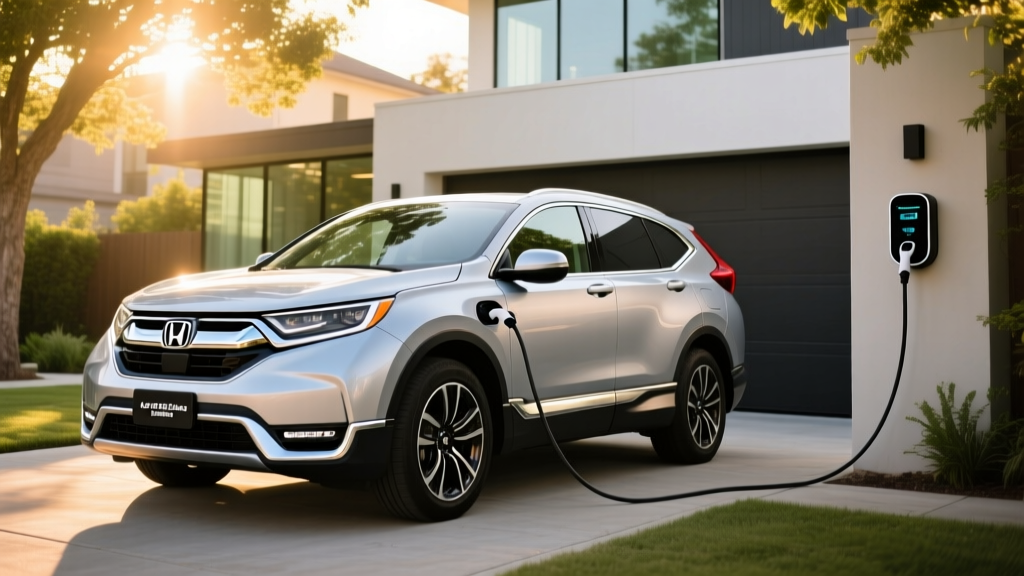
The Honda CR-V has long been the default compact SUV for pragmatic buyers, and the hybrid version has become the volume seller in the lineup. For 2026, the CR-V Hybrid continues with the two-motor powertrain introduced in the sixth generation, delivering strong city efficiency without requiring a plug. If you've been searching for a CR-V Hybrid and wondering whether the MPG numbers hold up in real driving, how the battery holds up long-term, or whether you'd be better served by a plug-in hybrid or full EV, this guide covers every spec and ownership variable that matters.
HEV vs PHEV vs EV: Where the CR-V Hybrid Fits
Before diving into specs, it's critical to understand what the CR-V Hybrid is — and what it isn't. Honda sells the CR-V exclusively as a conventional hybrid (HEV) in the United States. It does not plug in. There is no plug-in hybrid (PHEV) variant of the CR-V for the 2026 model year, despite persistent online speculation.
| Feature | CR-V Hybrid (HEV) | Typical PHEV SUV (e.g., RAV4 Prime) | Full EV (e.g., Tesla Model Y) |
|---|---|---|---|
| Plugs in? | No — self-charging | Yes — Level 1/2 AC | Yes — AC + DC fast charge |
| Electric-only range | ~1 mile at low speed | 35–42 miles | 280–330 miles (EPA) |
| Fuel/energy source | Gasoline (regen recaptures energy) | Gasoline + grid electricity | Grid electricity only |
| Home charging needed? | No | Yes, for EV-range benefit | Yes, strongly recommended |
| Federal tax credit (§30D) | Not eligible | Up to $7,500 (if sourcing/income rules met) | Up to $7,500 (if sourcing/income rules met) |
The CR-V Hybrid is engineered for buyers who want better fuel economy without altering their refueling habits. You fill up at a gas station exactly as you would with the non-hybrid CR-V. The hybrid system recovers kinetic energy during braking and deceleration, storing it in a small lithium-ion battery that assists the gasoline engine during acceleration and enables brief electric-only operation at low speeds.
Powertrain Specs: Two-Motor Hybrid System
The 2026 CR-V Hybrid uses Honda's fourth-generation two-motor hybrid system, which pairs a 2.0-liter Atkinson-cycle inline-4 engine with two electric motors. Here's the exact breakdown:
| Specification | Detail |
|---|---|
| Engine | 2.0L Atkinson-cycle DOHC i-VTEC inline-4 |
| Engine output | 145 hp / 138 lb-ft torque |
| Drive motors | Dual-motor hybrid system |
| Combined system output | 204 hp / 247 lb-ft torque |
| Transmission | e-CVT (no traditional gearbox — direct drive at highway speed) |
| Drivetrain | FWD standard; Real-Time AWD available (Sport Touring Hybrid standard) |
| 0–60 mph | ~7.6 seconds (FWD), ~7.9 seconds (AWD) |
| Hybrid battery | ~1.06 kWh lithium-ion (not user-accessible; assists engine, not plug-in) |
The two-motor design means the CR-V Hybrid operates primarily as a series hybrid in city driving — the engine generates electricity that feeds the drive motor, which turns the wheels. At sustained highway speeds, a lockup clutch connects the engine directly to the wheels for efficiency. This architecture is why the CR-V Hybrid feels responsive off the line: the electric drive motor delivers its 247 lb-ft of torque instantly, without waiting for engine RPM to build.
Fuel Economy: EPA Ratings and Real-World MPG
Fuel economy is the headline reason buyers choose the CR-V Hybrid over the turbocharged gas model. Here are the official EPA figures for the 2026 model year, per fueleconomy.gov:
| Trim / Drivetrain | City MPG | Highway MPG | Combined MPG |
|---|---|---|---|
| Sport Hybrid (FWD) | 43 | 36 | 40 |
| Sport Hybrid (AWD) | 40 | 34 | 37 |
| Sport-L Hybrid (FWD) | 43 | 36 | 40 |
| Sport-L Hybrid (AWD) | 40 | 34 | 37 |
| Sport Touring Hybrid (AWD std.) | 40 | 34 | 37 |
Real-world MPG reality check: Conventional hybrids like the CR-V tend to exceed their EPA city rating in stop-and-go traffic, because regenerative braking recovers more energy with frequent deceleration. In mixed suburban driving with moderate temperatures, owners regularly report 38–44 MPG combined. Highway-only driving at 75+ mph will pull the number down to 31–34 MPG, as the engine works harder without regenerative assist. In cold weather (below 30°F), expect a 5–10% drop as the engine runs more frequently to maintain cabin heat and battery temperature.
For comparison: The non-hybrid 2026 CR-V (1.5L turbo) is rated at 29 city / 34 highway / 31 combined (FWD). The hybrid's 37–40 combined MPG represents a 19–29% improvement, saving roughly $400–$550 per year in fuel at 15,000 miles driven and $3.40/gallon regular unleaded.
Pricing and Tax Credit Eligibility
The 2026 Honda CR-V Hybrid is available in three trims. Pricing below reflects MSRP before destination charges:
| Trim | Drivetrain | MSRP (approx.) |
|---|---|---|
| Sport Hybrid | FWD or AWD | $36,395 (FWD) / $37,895 (AWD) |
| Sport-L Hybrid | FWD or AWD | $38,895 (FWD) / $40,395 (AWD) |
| Sport Touring Hybrid | AWD (standard) | $43,195 |
Federal tax credit: The CR-V Hybrid is a conventional hybrid (HEV), not a plug-in vehicle. It does not qualify for the IRS §30D Clean Vehicle Credit, which is reserved for battery electric vehicles (BEVs) and plug-in hybrid electric vehicles (PHEVs) with a battery capacity of at least 7 kWh that meet critical-mineral and battery-component sourcing requirements. Per IRS guidelines, conventional hybrids are excluded from this credit entirely.
Some states offer their own incentives for hybrid vehicles, though these are less common than EV incentives. Check your state's energy or environmental agency website for current programs. A few states have offered registration-fee reductions or HOV-lane access for hybrids, but these programs have largely wound down in favor of EV-focused incentives.
Battery Longevity, Warranty, and Replacement Cost
The most common question from hybrid shoppers: how long will the battery last, and what does it cost to replace?
Honda covers the CR-V Hybrid's high-voltage battery with an 8-year/100,000-mile warranty (extended to 10 years/150,000 miles in California Air Resources Board (CARB) states, which include CA, CO, CT, ME, MA, NJ, NY, OR, RI, VT, and WA). This warranty covers battery capacity loss below a defined threshold — typically around 60–70% of original capacity — as well as defects.
Hybrid battery lifespan data: Honda's lithium-ion hybrid battery is small (~1.06 kWh) and operates within a narrow state-of-charge window (roughly 40–60%), which dramatically reduces degradation stress. Based on long-term data from Honda and Toyota hybrid systems, these batteries routinely last 150,000–200,000+ miles before requiring replacement. Many first-generation Honda Insight and Civic Hybrid batteries are still functioning beyond 200,000 miles.
Replacement cost: If the hybrid battery fails out of warranty, a replacement from Honda typically costs between $2,000 and $3,500 including parts and labor. Third-party refurbishment shops offer reconditioned batteries for $1,200–$2,000. This is substantially less than a full EV battery replacement ($8,000–$20,000+), because the CR-V Hybrid's battery is small and its chemistry is less complex than the large NMC or LFP packs in battery-electric vehicles.
The 12-volt auxiliary battery (which powers accessories and starts the hybrid system) is a separate component and typically needs replacement every 4–6 years at a cost of $150–$250, identical to a conventional vehicle.
Reliability and Ownership Track Record
Honda's hybrid powertrain has a strong reliability history. The two-motor system used in the CR-V Hybrid shares architecture with the Accord Hybrid and Civic Hybrid, both of which have accumulated millions of fleet miles. According to owner surveys and reliability databases, the CR-V Hybrid's powertrain has fewer reported issues than the turbocharged 1.5L gas engine in the non-hybrid CR-V, which has historically had oil-dilution complaints in cold climates.
The hybrid system eliminates the traditional automatic transmission entirely — there is no torque converter, no planetary gearset, and no transmission fluid to change. The e-CVT is a direct-drive unit with a single clutch, reducing mechanical complexity. Brake wear is also reduced, as regenerative braking handles much of the deceleration load; owners report original brake pads lasting 60,000–80,000 miles in mixed driving.
CR-V Hybrid vs RAV4 Hybrid vs Full EV: Decision Framework
Choose the CR-V Hybrid if:
- You drive 10,000–18,000 miles/year and want 37–40 MPG without plugging in
- You lack reliable access to home or workplace charging (apartment, street parking)
- You take frequent road trips and don't want to plan around DC fast-charging stops
- You want Honda's safety suite (Honda Sensing), strong resale value, and proven hybrid reliability
Choose the Toyota RAV4 Hybrid (or RAV4 Prime PHEV) if:
- You prefer Toyota's hybrid system (slightly higher combined MPG at 41 for the RAV4 Hybrid LE AWD)
- You want a PHEV option: the RAV4 Prime offers 42 miles of electric-only range and qualifies for up to $7,500 in federal tax credits (subject to IRS §30D sourcing rules)
- You value Toyota's 10-year/150,000-mile hybrid battery warranty nationwide (vs. Honda's 8/100k outside CARB states)
Choose a full EV (Tesla Model Y, Hyundai Ioniq 5, Ford Mustang Mach-E) if:
- You can install a Level 2 home charger (240V, ~$500–$1,500 installation)
- Your daily commute is under 60 miles round-trip, and you road-trip fewer than 4–5 times per year
- You want to eliminate gasoline costs entirely and qualify for the §30D federal tax credit
- You prioritize instant torque, minimal maintenance, and zero tailpipe emissions
Pros and Cons at a Glance
Pros
- 40 MPG combined (FWD) — best-in-class among compact hybrid SUVs
- 204 hp / 247 lb-ft torque — responsive acceleration, no turbo lag
- No plug-in charging required — zero lifestyle change from a gas car
- Strong reliability record; e-CVT eliminates traditional transmission
- Reduced brake wear from regenerative braking
- Spacious cargo area (36.3 cu ft behind rear seats, 76.5 cu ft folded)
- Honda Sensing safety suite standard on all trims
Cons
- Not eligible for federal §30D tax credit (HEV, not PHEV/BEV)
- AWD reduces combined MPG from 40 to 37
- Hybrid premium over gas CR-V: ~$3,000–$4,000 more at equivalent trim
- Highway MPG (34 AWD) is less impressive than city; EVs beat it on highway efficiency
- No DC fast charging or meaningful electric-only range
- Sport Touring Hybrid tops $43,000 — approaching luxury-compact territory
Frequently Asked Questions
How many MPG does the 2026 CR-V Hybrid actually get?
The EPA rates the FWD CR-V Hybrid at 43 city / 36 highway / 40 combined. AWD trims are rated at 40 city / 34 highway / 37 combined. In real-world suburban driving with moderate temperatures, most owners see 38–44 MPG combined. Highway-only driving at 75+ mph typically yields 31–34 MPG, and cold weather (below 30°F) reduces efficiency by 5–10%.
Does the CR-V Hybrid come as a plug-in hybrid (PHEV)?
No. Honda does not offer a plug-in hybrid CR-V in the United States for the 2026 model year. The CR-V Hybrid is a conventional (self-charging) hybrid. If you want a plug-in hybrid compact SUV, the Toyota RAV4 Prime (42 miles electric-only range), Hyundai Tucson PHEV (33 miles), or Ford Escape PHEV (37 miles) are the primary alternatives.
Is the CR-V Hybrid battery reliable, and what does replacement cost?
Honda's hybrid battery has an excellent longevity record. The small lithium-ion pack operates within a narrow charge window, minimizing degradation. Most hybrid batteries last 150,000–200,000+ miles. Honda covers the battery for 8 years/100,000 miles (10 years/150,000 miles in CARB states). Out-of-warranty replacement costs $2,000–$3,500 from Honda, or $1,200–$2,000 from third-party refurbishers.
Does the CR-V Hybrid qualify for any tax credit?
No. The federal §30D Clean Vehicle Credit applies only to plug-in vehicles (BEVs and PHEVs) with battery packs of at least 7 kWh. The CR-V Hybrid's ~1.06 kWh battery disqualifies it entirely. Some states may offer minor incentives for hybrids, but these are uncommon and vary by jurisdiction — check your state's energy agency for current programs.
Hybrid vs PHEV vs EV — which should I choose?
Choose the CR-V Hybrid (HEV) if you can't charge at home and want better MPG without any lifestyle change. Choose a PHEV (like the RAV4 Prime) if you can charge at home and want 35–42 miles of electric commuting with a gas engine for road trips. Choose a full EV (like the Model Y or Ioniq 5) if you have home charging, drive under 250 miles daily, and want the lowest operating cost and zero tailpipe emissions.
How does the CR-V Hybrid compare to the gas CR-V on fuel cost?
At 15,000 miles/year and $3.40/gallon, the gas CR-V (31 combined MPG) costs roughly $1,645 per year in fuel. The CR-V Hybrid AWD (37 combined) costs about $1,378 — saving approximately $267/year. The FWD hybrid (40 combined) saves roughly $369/year. Over a 5-year ownership period, the FWD hybrid saves about $1,845 in fuel, partially offsetting its higher purchase price.
The 2026 Honda CR-V Hybrid remains one of the most practical compact SUVs on the market for drivers who want meaningful fuel savings without adopting plug-in charging. Its 40 MPG combined rating, 204-hp two-motor powertrain, and proven reliability make it the default choice for hybrid SUV shoppers who don't need electric-only range. If your situation supports home charging and you want to eliminate gasoline from your daily commute entirely, a PHEV or full EV may serve you better — but for pure simplicity and efficiency, the CR-V Hybrid sets a high bar.