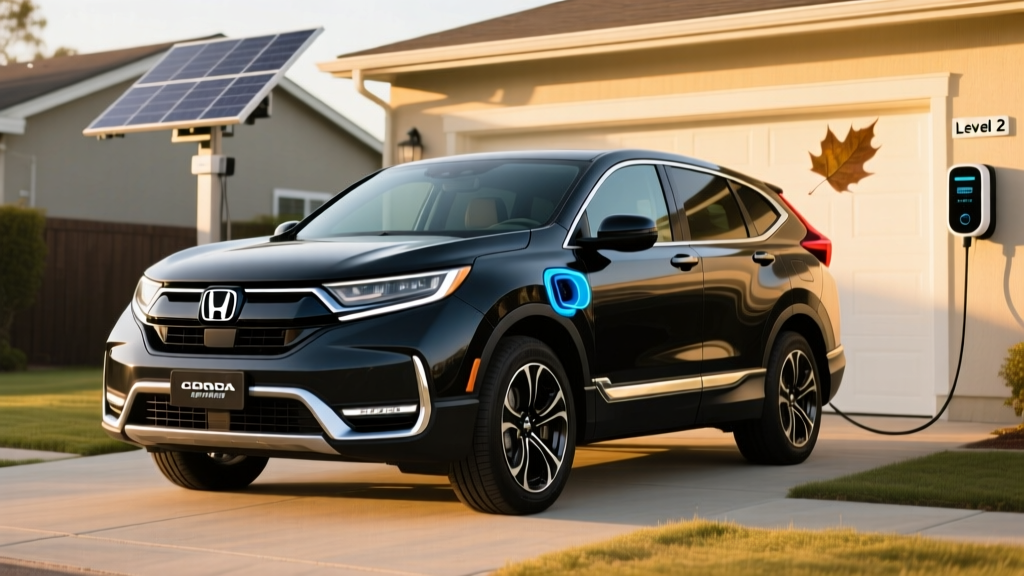
The Honda CR-V Hybrid remains one of the best-selling electrified compact SUVs in America, and for good reason: it delivers strong fuel economy without requiring any change to your daily routine. No plugs, no charging apps, no range anxiety — just fill up with gas and go. But how does the CR-V Hybrid's MPG hold up beyond the EPA sticker, and does it make more financial sense than a plug-in hybrid rival or a full battery-electric vehicle?
This guide breaks down the 2026 Honda CR-V Hybrid's real-world fuel economy, powertrain details, battery longevity, pricing, and where it fits in the broader hybrid-versus-PHEV-versus-EV decision. If you're researching Honda CR-V Hybrid MPG to decide whether this is the right electrified SUV for your garage, you'll find exact numbers and honest trade-offs below.
Honda CR-V Hybrid MPG: EPA Ratings and Real-World Results
The 2026 Honda CR-V Hybrid pairs a 2.0-liter Atkinson-cycle four-cylinder engine with a two-motor hybrid system. Front-wheel-drive (FWD) models earn slightly higher EPA ratings than all-wheel-drive (AWD) variants, which most buyers opt for.
| Drivetrain | City MPG | Highway MPG | Combined MPG | Annual Fuel Cost* |
|---|---|---|---|---|
| FWD (Sport / Sport Touring) | 43 | 36 | 40 | ~$1,350 |
| AWD (Sport / Sport Touring) | 40 | 34 | 37 | ~$1,450 |
*Based on 15,000 miles/year at $3.50/gallon regular unleaded. Source: fueleconomy.gov
Powertrain Specs: How the CR-V Hybrid Makes Its Power
Honda's fourth-generation two-motor hybrid system is the heart of the CR-V Hybrid. Unlike some competitors that use a traditional planetary gearset, Honda's system operates primarily as a series hybrid at low speeds (the engine generates electricity for the drive motor) and switches to a direct parallel-drive mode at highway cruising speeds for efficiency.
| Specification | Detail |
|---|---|
| Engine | 2.0L Atkinson-cycle 4-cylinder |
| Combined System Horsepower | 204 hp |
| Combined System Torque | 247 lb-ft (drive motor) |
| Drive Motor Output | 181 hp / 247 lb-ft |
| Generator Motor | Integrated starter-generator |
| Hybrid Battery | ~1.06 kWh lithium-ion (HEV) |
| Transmission | Direct-drive (no conventional transmission) |
| 0–60 mph | ~7.6 seconds |
| Towing Capacity | 1,000 lbs |
The 204 combined horsepower is competitive with the Toyota RAV4 Hybrid (219 hp) and Hyundai Tucson Hybrid (226 hp). The CR-V Hybrid's advantage is its smooth, electric-like low-speed behavior — the drive motor handles most city acceleration, making it feel responsive off the line despite modest peak numbers.
CR-V Hybrid vs. Plug-In Hybrid vs. Full EV: Which Fits You?
One of the most common questions we field: should you buy the standard CR-V Hybrid (HEV), a plug-in hybrid like the Toyota RAV4 Prime, or go full electric with something like the Hyundai Ioniq 5? The answer depends entirely on your driving pattern and charging access.
HEV (CR-V Hybrid)
- No plug needed
- 37–40 MPG combined
- No electric-only range
- Best for: apartment dwellers, no home charging
- Price: ~$35,000–$42,000
PHEV (e.g., RAV4 Prime)
- Plug in for ~42 mi electric
- 38 MPG after battery depletes
- Needs Level 2 home charging to maximize value
- Best for: short commutes + road trips
- Price: ~$44,000–$52,000
BEV (e.g., Ioniq 5)
- ~300 mi EPA range
- 0 gas, 0 oil changes
- Needs reliable home or workplace charging
- Best for: home chargers, daily drivers
- Price: ~$42,000–$55,000
- Choose the CR-V Hybrid (HEV) if you don't have access to a Level 2 charger at home or work, you want maximum simplicity, or you drive more than 300 miles per week in mixed conditions.
- Choose a PHEV if your daily round-trip commute is under 40 miles, you can charge at home overnight, and you still want gas flexibility for road trips.
- Choose a full EV if you have reliable home Level 2 charging, your daily driving is under 250 miles, and you want the lowest per-mile fuel cost and minimal maintenance.
Does the Honda CR-V Hybrid Qualify for a Federal Tax Credit?
This is where many buyers get confused. The standard Honda CR-V Hybrid (HEV) does not qualify for the federal §30D clean vehicle tax credit. Under current IRS rules, only plug-in electric vehicles — battery-electric vehicles (BEVs) and plug-in hybrids (PHEVs) with at least 7 kWh of battery capacity — are eligible. The CR-V Hybrid's ~1.06 kWh battery is far below that threshold.
- ✅ Vehicle must be a BEV or PHEV with ≥7 kWh battery — CR-V Hybrid does NOT qualify
- ✅ MSRP cap: $80,000 for SUVs/vans/pickups; $55,000 for sedans
- ✅ Buyer income cap: $150K single / $225K head of household / $300K joint
- ✅ Battery critical minerals and component sourcing requirements
- ✅ Point-of-sale transfer available (dealer applies credit at purchase)
Source: IRS.gov — Clean Vehicle Credits
However, some states offer their own incentives for conventional hybrids. For example, certain utility companies provide small rebates ($200–$500) for purchasing any electrified vehicle. Check your state energy office and local utility for current programs.
Battery Warranty, Lifespan, and Replacement Cost
Hybrid battery longevity is the number-one concern among first-time hybrid buyers. Here's the reassuring data: Honda's hybrid batteries are designed to last the life of the vehicle, and failure rates in modern Honda hybrids are very low.
- Hybrid Battery: 8 years / 100,000 miles (10 years / 150,000 miles in CARB states including CA, NY, MA, and others)
- Hybrid System Components: 8 years / 100,000 miles
- Powertrain: 5 years / 60,000 miles
- Capacity Retention Threshold: Honda warrants against defects and abnormal degradation; no specific percentage threshold published (unlike EV batteries)
If the hybrid battery does need replacement out of warranty — which data from third-generation CR-V Hybrids suggests is rare before 200,000 miles — expect to pay between $2,000 and $4,000 for a refurbished or new unit plus labor. That's dramatically less than a full EV battery replacement ($10,000–$20,000+), because the CR-V Hybrid's battery is roughly 1 kWh versus an EV's 60–100 kWh pack.
The CR-V Hybrid's battery is small and operates within a narrow state-of-charge window (roughly 40–80%), which is the least stressful operating range for lithium-ion cells. This shallow-cycling strategy is why hybrid batteries routinely outlast 15 years in real-world use.
Pricing, Trim Levels, and Value
The 2026 Honda CR-V Hybrid is available exclusively in the sporty Sport and Sport Touring trims. Here's the current MSRP breakdown:
| Trim | Drivetrain | MSRP | Key Features |
|---|---|---|---|
| Sport Hybrid | FWD | ~$35,350 | 19" wheels, wireless CarPlay/Android Auto, Honda Sensing suite |
| Sport Hybrid | AWD | ~$36,850 | Same as FWD + real-time AWD |
| Sport Touring Hybrid | AWD | ~$40,850 | Leather, Bose 12-speaker audio, wireless charging, heated steering wheel, navigation |
Compared to the gas-only CR-V EX-L (~$37,000), the Hybrid Sport FWD is actually less expensive while delivering 10+ MPG better fuel economy. The hybrid premium pays for itself in roughly 2–3 years for a driver covering 15,000 miles annually at current gas prices.
✅ Pros
- 40 MPG combined (FWD) exceeds EPA in real city driving
- No charging infrastructure needed
- Smooth, EV-like low-speed acceleration
- Spacious cabin: 39.3 cu ft cargo (rear seats up)
- Top IIHS safety pick with Honda Sensing standard
- Strong resale value — CR-V Hybrids hold value well
❌ Cons
- No federal tax credit (HEV, not PHEV)
5-Year Ownership Cost: CR-V Hybrid vs. Gas CR-V
The financial case for the CR-V Hybrid is compelling when you look at total cost of ownership. Here's a five-year comparison assuming 15,000 miles per year and $3.50/gallon gas:
| Category | CR-V Hybrid AWD | CR-V Gas AWD (EX-L) |
|---|---|---|
| MSRP (approx.) | $36,850 | $37,350 |
| Fuel (5 yrs / 75K mi) | ~$7,250 (37 MPG) | ~$9,375 (29 MPG) |
| Maintenance (5 yrs) | ~$2,800 | ~$3,200 |
| Insurance (5 yrs avg.) | ~$8,500 | ~$8,200 |
| Estimated Depreciation | ~$14,000 | ~$15,500 |
| Total 5-Year Cost | ~$55,400 | ~$58,625 |
| Savings with Hybrid | ~$3,225 over 5 years | |
The Hybrid actually costs less upfront than a comparably equipped gas model and saves over $3,000 in five years. The advantage grows if gas prices rise, and the hybrid's lower depreciation (strong used demand) adds to the savings. Data from IIHS confirms the CR-V's strong safety performance across all trims.
Frequently Asked Questions
How many MPG does the Honda CR-V Hybrid actually get in real driving?
The EPA rates the 2026 CR-V Hybrid AWD at 40 city / 34 highway / 37 combined MPG. In real-world city driving, many owners report 42–45 MPG thanks to regenerative braking. Highway cruising at 75+ mph typically yields 32–35 MPG. Cold weather and short trips can reduce efficiency by 5–10%.
Does the CR-V Hybrid need to be plugged in?
No. The CR-V Hybrid is a conventional hybrid (HEV), not a plug-in hybrid (PHEV). Its small battery recharges through regenerative braking and the gasoline engine. You never need to plug it in — just fill up at any gas station.
Is the Honda CR-V Hybrid reliable? What about battery replacement costs?
Honda's hybrid system has an excellent reliability track record across the Accord Hybrid, CR-V Hybrid, and Civic Hybrid lineups. The hybrid battery is warrantied for 8 years/100,000 miles (10/150,000 in CARB states). Out-of-warranty replacement runs $2,000–$4,000, but data shows most Honda hybrid batteries last well past 200,000 miles with minimal degradation.
How does the CR-V Hybrid compare to the Toyota RAV4 Hybrid on MPG?
The 2026 Toyota RAV4 Hybrid AWD is rated at 41 city / 38 highway / 40 combined MPG — slightly higher than the CR-V Hybrid AWD's 40/34/37. The RAV4 Hybrid's advantage is primarily on the highway due to its different powertrain calibration. In real-world mixed driving, the gap narrows to 1–2 MPG.
Does the Honda CR-V Hybrid qualify for any tax credit?
The standard CR-V Hybrid does not qualify for the federal §30D clean vehicle tax credit, which requires a plug-in vehicle with at least 7 kWh of battery capacity. Some state or utility rebates may apply — check your local programs. Honda does not currently offer a CR-V plug-in hybrid in the U.S. market.
Is the CR-V Hybrid slower than the gas version?
No — the CR-V Hybrid's 204 combined horsepower and 247 lb-ft of electric motor torque make it noticeably quicker off the line than the 190-hp turbo gas model. The 0–60 mph time of ~7.6 seconds is about a half-second quicker than the gas CR-V AWD. The hybrid feels more responsive in city driving due to instant electric torque.