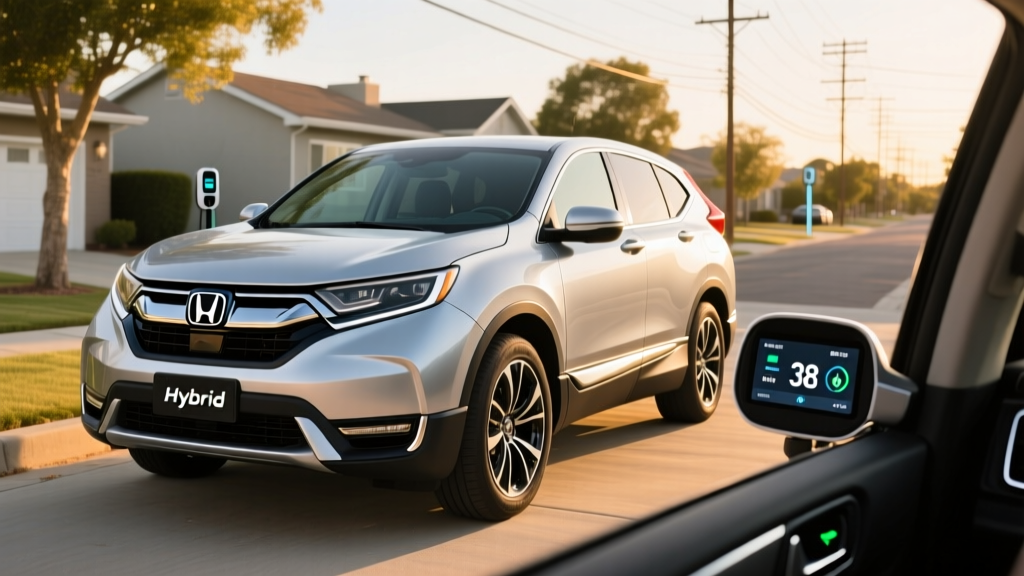
The Honda CR-V Hybrid has become one of the best-selling electrified compact SUVs in the United States, and for good reason: it delivers meaningful fuel savings over its gas-only sibling without requiring any change in driving habits. No plugs, no range anxiety, no charging apps — just better mileage from the same gas station you already use. But what kind of fuel economy can you actually expect once you leave the dealer lot?
We break down the EPA numbers, real-world driving observations, powertrain details, and total ownership picture for the current-generation Honda CR-V Hybrid so you can decide whether it's the right move for your next vehicle.
Honda CR-V Hybrid Gas Mileage: EPA Numbers vs. Real-World Results
The EPA rates the front-wheel-drive (FWD) Honda CR-V Hybrid at 43 MPG city, 36 MPG highway, and 40 MPG combined. The all-wheel-drive (AWD) variant, which is far more popular in the U.S. market, drops slightly to 40 MPG city, 34 MPG highway, and 37 MPG combined, according to fueleconomy.gov.
| Drivetrain | City MPG | Highway MPG | Combined MPG | Fuel Tank | EPA Total Range |
|---|---|---|---|---|---|
| FWD | 43 | 36 | 40 | 15.3 gal | ~612 mi |
| AWD | 40 | 34 | 37 | 15.3 gal | ~566 mi |
These are strong numbers for a compact SUV, but the EPA sticker only tells part of the story.
Real-World MPG: Where the CR-V Hybrid Shines (and Where It Doesn't)
Hybrid powertrains behave differently than conventional gas engines across driving conditions. The CR-V Hybrid's two-motor system excels in stop-and-go city driving, where regenerative braking recaptures energy and the electric motors handle low-speed propulsion. Many owners report real-world city mileage of 41–45 MPG in the FWD model, sometimes exceeding the EPA city estimate — a rare occurrence in the automotive world.
Highway driving is a different equation. At sustained speeds above 65 mph, the 2.0-liter Atkinson-cycle engine carries most of the load with less assistance from the electric motors. Expect real-world highway figures of 32–35 MPG for AWD models, particularly in windy conditions or with a loaded cargo area. Cold weather further reduces efficiency — winter blends of gasoline, increased engine idling for cabin heat, and reduced battery efficiency can drop combined real-world figures by 10–15%, putting AWD models in the 31–34 MPG range during freezing temperatures.
HEV vs. PHEV vs. EV: Which Powertrain Fits Your Life?
Before we dig deeper into the CR-V Hybrid's powertrain, it's worth clarifying exactly what it is — and what it isn't. Honda currently sells the CR-V Hybrid as a conventional hybrid electric vehicle (HEV). There is no plug-in hybrid (PHEV) version of the current CR-V in the U.S. market, and it is not a battery electric vehicle (BEV).
| Feature | HEV (CR-V Hybrid) | PHEV (e.g., Toyota RAV4 Prime) | BEV (e.g., Tesla Model Y) |
|---|---|---|---|
| Plug-in charging? | No — gas only | Yes — Level 1/2 | Yes — Level 1/2/DC |
| Electric-only range | ~1 mi at low speed | 30–42 mi typical | 250–330 mi |
| Fuel/energy source | Gasoline | Gasoline + electricity | Electricity only |
| Home charging needed? | No | Recommended | Essential |
| Federal tax credit (§30D) | Not eligible | Up to $7,500* | Up to $7,500* |
| Typical starting price | $35,000–$37,000 | $43,000–$47,000 | $44,000–$52,000 |
*§30D tax credit eligibility depends on MSRP caps, buyer income limits, battery component sourcing, and point-of-sale transfer rules. See IRS.gov for current-year requirements.
Choose the CR-V Hybrid (HEV) if: You don't have access to home or workplace charging, want a lower purchase price, prefer no change in refueling habits, and drive a mix of city and highway miles.
Consider a PHEV if: You can install a Level 2 charger at home, your daily commute is under 40 miles (so you rarely burn gas), and you want the option of electric-only driving for errands.
Go full EV if: You have reliable home charging, your daily driving is under 250 miles, and you want zero tailpipe emissions with minimal maintenance.
Powertrain Breakdown: How the CR-V Hybrid Makes Its Power
The current-generation CR-V Hybrid uses Honda's fourth-generation two-motor hybrid system paired with a 2.0-liter Atkinson-cycle four-cylinder engine. This is a series-parallel hybrid architecture — meaning the vehicle can operate in electric-only mode at low speeds, engine-only mode at steady highway cruising, or a combination of both under hard acceleration.
| Specification | Detail |
|---|---|
| Engine | 2.0L Atkinson-cycle DOHC 4-cylinder |
| Engine output | 145 hp / 138 lb-ft torque |
| Electric motors | Dual-motor system (propulsion + generator) |
| Combined system output | 204 hp / 247 lb-ft torque |
| Transmission | e-CVT (no traditional gears) |
| Drivetrain options | FWD or AWD (torque-vectoring rear motor on AWD) |
| 0–60 mph | ~7.6 seconds (FWD), ~7.8 seconds (AWD) |
| Towing capacity | 1,000 lbs |
The combined 204 horsepower is a meaningful step up from the non-hybrid CR-V's 190 hp turbocharged 1.5L engine. More importantly, the hybrid system's 247 lb-ft of torque is available nearly instantly from the electric motors, giving the CR-V Hybrid stronger low-speed acceleration than its gas counterpart. The e-CVT eliminates shift shock entirely — power delivery is smooth and linear.
The AWD system is worth noting: rather than a mechanical driveshaft, the rear axle is powered by a dedicated electric motor that engages when slip is detected or when additional traction is needed. This means AWD operation adds minimal weight and mechanical drag compared to traditional all-wheel-drive systems, which is why the AWD fuel economy penalty is only about 3 MPG combined.
Pricing, Trims, and Tax Credit Eligibility
The 2026 Honda CR-V Hybrid is available across several trim levels. Pricing has crept upward with each model year, but it remains competitive within the hybrid compact SUV segment.
| Trim | Drivetrain | MSRP (approx.) |
|---|---|---|
| Sport | FWD | $35,400 |
| Sport | AWD | $36,900 |
| Sport-L | AWD | $38,900 |
| Sport Touring | AWD | $41,400 |
Does the CR-V Hybrid Qualify for a Federal Tax Credit?
No. The Honda CR-V Hybrid is a conventional HEV, not a plug-in vehicle. The federal §30D Clean Vehicle Credit applies only to battery electric vehicles (BEVs) and plug-in hybrids (PHEVs) that meet battery sourcing, MSRP, and buyer income requirements. Conventional hybrids like the CR-V Hybrid do not qualify for the $7,500 federal credit or the $4,000 used-EV credit.
Some states and local utilities offer modest rebates or incentives for conventional hybrids — typically $250–$1,000 — but these vary widely by jurisdiction. Check your state energy office or utility provider for current programs. A tax professional can confirm any applicable state-level credits on your return.
Battery Warranty, Reliability, and Replacement Cost
Hybrid battery longevity remains one of the top concerns for first-time hybrid buyers. The CR-V Hybrid uses a lithium-ion battery pack (approximately 1.1 kWh usable capacity) located beneath the cargo floor. Because the battery is small and the hybrid system manages charge cycles conservatively — never fully depleting or fully charging the pack — degradation is minimal over the vehicle's lifespan.
• Hybrid battery: 8 years / 100,000 miles (10 years / 150,000 miles in CARB states including CA, NY, MA, and others)
• Powertrain: 5 years / 60,000 miles
• Hybrid system components: 8 years / 100,000 miles
Honda's hybrid battery warranty covers capacity loss below a functional threshold (typically below 60–70% state of health) and outright failure. In practice, Honda's hybrid battery packs have demonstrated strong longevity. Data from fleet operators and owner surveys suggest most Honda hybrid batteries retain 90%+ capacity after 100,000 miles, with failures before 150,000 miles being uncommon.
What Does a Hybrid Battery Replacement Cost?
If your CR-V Hybrid battery fails outside warranty, replacement costs typically range from $2,000 to $4,000 including parts and labor at a Honda dealer. Independent hybrid specialists may offer refurbished or reconditioned packs for $1,500–$2,500. This is dramatically less than BEV battery replacement ($10,000–$20,000+) because the hybrid pack is small — roughly 1/60th the capacity of a long-range EV battery.
For context, a conventional CR-V's automatic transmission replacement can cost $3,500–$5,000 out of warranty. The hybrid system's e-CVT has fewer wear components than a traditional transmission, which partially offsets the battery cost concern over a 10+ year ownership period.
CR-V Hybrid vs. Competitors: Mileage and Value Comparison
The compact hybrid SUV segment is competitive. Here's how the CR-V Hybrid stacks up against its primary rivals on the metrics buyers care about most.
| Model | Combined MPG (AWD) | Combined HP | Starting MSRP (AWD) | Battery Warranty |
|---|---|---|---|---|
| Honda CR-V Hybrid | 37 | 204 | $36,900 | 8 yr / 100k mi |
| Toyota RAV4 Hybrid | 39 | 219 | $35,200 | 10 yr / 150k mi |
| Ford Escape Hybrid | 39 | 210 | $36,500 | 8 yr / 100k mi |
| Hyundai Tucson Hybrid | 38 | 226 | $37,100 | 10 yr / 100k mi |
| Kia Sportage Hybrid | 38 | 227 | $36,500 | 10 yr / 100k mi |
The CR-V Hybrid sits in the middle of the pack on fuel economy but leads in cargo volume (36.3 cu ft behind the rear seats) and interior space. The Toyota RAV4 Hybrid edges it out by 2 MPG combined, while the Hyundai Tucson Hybrid and Kia Sportage Hybrid offer more horsepower and longer battery warranties. The right choice depends on which trade-offs matter most to you.
✓ Pros
- Strong real-world city MPG (often exceeds EPA)
- Spacious cargo area and rear seat
- Smooth, linear power delivery from e-CVT
- No plug-in charging required
- Honda Sensing safety suite standard
- Strong resale value
✗ Cons
- Highway MPG trails city figures noticeably
- No PHEV option for electric-only commuting
- Not eligible for federal §30D tax credit
- 1,000-lb towing limit (lower than some rivals)
- Road noise at highway speeds
- AWD fuel economy penalty of ~3 MPG
Who Should Buy the CR-V Hybrid — and Who Shouldn't
The CR-V Hybrid occupies a specific niche: it's for drivers who want better fuel economy and smoother acceleration than a gas SUV without changing their refueling routine. Here's a practical decision framework:
Decision Framework
Choose the CR-V Hybrid if:
- You drive 10,000–18,000 miles per year in a mix of city and highway conditions
- You lack access to home or workplace Level 2 charging
- You want a compact SUV with strong cargo space and family practicality
- You plan to keep the vehicle 7–12 years (warranty covers the battery)
- You value fuel savings without a large price premium over gas models
Look elsewhere if:
- Your commute is under 20 miles round-trip and you have home charging — a PHEV or BEV will save more on fuel
- You tow regularly — the 1,000-lb limit is restrictive; consider a hybrid truck or larger SUV
- You primarily drive highway miles at 75+ mph — the hybrid advantage shrinks significantly at high sustained speeds
- You want the maximum available tax incentives — only plug-in vehicles qualify for §30D
Frequently Asked Questions
How many MPG does the Honda CR-V Hybrid get?
The FWD CR-V Hybrid is EPA-rated at 43 city / 36 highway / 40 combined MPG. The AWD version, which is more common, rates at 40 city / 34 highway / 37 combined. In real-world city driving, many owners see 41–45 MPG in the FWD model. Highway and cold-weather figures will be lower than the EPA sticker.
Does the Honda CR-V Hybrid need to be plugged in?
No. The CR-V Hybrid is a conventional hybrid (HEV). It charges its small battery through regenerative braking and the gasoline engine. You simply fill up at a gas station as you would with any other vehicle.
Is there a plug-in hybrid (PHEV) version of the CR-V?
Not in the U.S. market as of the 2026 model year. Honda has not announced a CR-V PHEV for North America. If you want a plug-in hybrid compact SUV, the Toyota RAV4 Prime (42 miles electric-only) and Hyundai Tucson PHEV (33 miles electric-only) are the leading alternatives.
How reliable is the CR-V Hybrid battery?
Honda's hybrid battery packs have demonstrated strong longevity. The lithium-ion pack is managed conservatively — never fully charged or fully depleted — which reduces degradation stress. Honda covers the hybrid battery for 8 years/100,000 miles (10 years/150,000 miles in CARB states). Most packs retain over 90% capacity at 100,000 miles based on fleet and owner data.
What does it cost to replace the CR-V Hybrid battery?
Out-of-warranty replacement typically costs $2,000–$4,000 at a Honda dealer, or $1,500–$2,500 for a refurbished pack from an independent hybrid specialist. This is far less than a full EV battery replacement because the hybrid pack is small (~1.1 kWh).
Does the CR-V Hybrid qualify for any tax credit?
The CR-V Hybrid does not qualify for the federal §30D Clean Vehicle Credit, which applies only to plug-in vehicles (BEVs and PHEVs). Some states and utilities offer small rebates ($250–$1,000) for conventional hybrids. Check your state energy office for current programs.
How does the CR-V Hybrid compare to the gas-only CR-V on fuel economy?
The non-hybrid 2026 CR-V with the 1.5L turbo engine and AWD rates at approximately 28 city / 34 highway / 30 combined MPG. The hybrid AWD model's 37 combined MPG represents a 23% improvement in combined fuel economy, with an even larger gap in city driving (40 vs. 28 MPG). At current fuel prices, that translates to roughly $400–$600 in annual fuel savings for a driver covering 15,000 miles per year.