Why Dimensions Matter When Shopping the CR-V Hybrid
Compact SUV buyers cross-shop on two axes: fuel economy and physical footprint. The 2026 Honda CR-V Hybrid threads a needle that explains its sales dominance — it delivers genuine hybrid efficiency without shrinking the cabin or cargo hold that families depend on. If you've been searching for Honda CR-V Hybrid dimensions to see whether it fits your garage, your stroller, or your weekend gear, this guide puts every measurement in context with real-world usability and efficiency data.
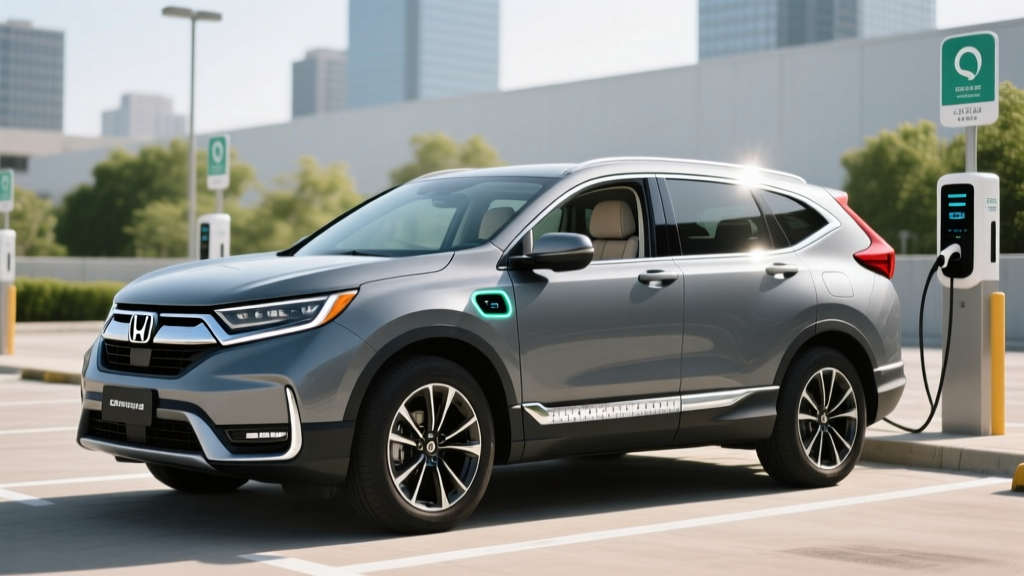
The CR-V Hybrid is a conventional hybrid (HEV), not a plug-in. That means you never plug it in; the gasoline engine and regenerative braking recharge a small battery automatically. We'll clarify what that means for your wallet versus a PHEV or full EV further below.
Exterior Dimensions and Garage Fit
Honda stretched the current-generation CR-V slightly versus its predecessor, improving rear legroom and cargo volume while keeping the footprint manageable for urban parking. Here are the official exterior measurements for the 2026 CR-V Hybrid across all trims (Sport, Sport-L, Sport Touring):
| Measurement | Value |
|---|---|
| Wheelbase | 106.3 in |
| Overall Length | 185.3 in |
| Overall Width (without mirrors) | 73.4 in |
| Overall Height | 66.5 in (66.7 in with roof rails) |
| Ground Clearance (FWD) | 8.0 in |
| Ground Clearance (AWD) | 8.3 in |
| Curb Weight | 3,814–3,957 lb (trim dependent) |
At 185.3 inches long, the CR-V Hybrid slots between the Toyota RAV4 Hybrid (180.9 in) and the Hyundai Tucson Hybrid (182.3 in) in perceived size, though the Tucson is slightly shorter. The 73.4-inch width fits comfortably in standard US garage bays (typically 96–108 in wide) with room to open doors. If you're parking in a tight single-car garage, measure your depth carefully: you'll need about 20 feet of clear space to close the door behind it.
Interior Volume and Cargo Capacity
The dimension story that actually sells the CR-V Hybrid is inside. Honda's packaging engineers maximized cabin space, and the hybrid battery sits under the cargo floor without meaningfully compromising volume.
| Measurement | Value |
|---|---|
| Front Headroom | 38.2 in |
| Front Legroom | 41.3 in |
| Rear Headroom | 38.2 in |
| Rear Legroom | 41.0 in |
| Cargo Volume (rear seats up) | 36.3 cu ft |
| Cargo Volume (rear seats folded) | 76.5 cu ft |
| EPA Interior Volume | 140.7 cu ft |
That 41.0 inches of rear legroom is genuinely class-leading — adults over six feet tall sit behind tall drivers without knee contact. The 36.3 cu ft cargo area behind the second row swallows two large suitcases and a week of groceries. Fold the 60/40 split rear seats and 76.5 cu ft opens up, competitive with midsize SUVs from a generation ago.
Fuel Economy: EPA Numbers and Real-World MPG
The CR-V Hybrid pairs a 2.0-liter Atkinson-cycle four-cylinder engine with two electric motors in Honda's fourth-generation two-motor hybrid system. Total system output is 204 horsepower and 247 lb-ft of torque, routed through an electronically controlled continuously variable transmission (e-CVT). Front-wheel drive is standard; real-time AWD is available (and standard on the Sport Touring trim).
| Drivetrain | City | Highway | Combined |
|---|---|---|---|
| FWD | 43 MPG | 36 MPG | 40 MPG |
| AWD | 40 MPG | 34 MPG | 37 MPG |
Source: fueleconomy.gov.
Real-World MPG vs. the EPA Sticker
Conventional hybrids like the CR-V tend to exceed their EPA city rating in stop-and-go driving because regenerative braking recaptures energy that a gas car wastes as heat. In mixed suburban driving with frequent stops, owners regularly report 42–45 MPG in warm weather on FWD trims. Highway driving is the opposite story: sustained 75-mph cruising reduces the hybrid system's advantage, and expect 32–34 MPG AWD on flat interstate runs.
Cold weather costs all hybrids efficiency. In sub-freezing temperatures, the engine runs more frequently to generate cabin heat, and the battery's charge/discharge efficiency drops. Plan for a 10–15% fuel economy penalty in winter — roughly 33–35 MPG combined on AWD trims in January in the Midwest. This is still substantially better than the gas-only CR-V AWD, which EPA-rates at 28 MPG combined.
HEV vs. PHEV vs. EV: Which Powertrain Fits You?
The CR-V Hybrid is an HEV — a conventional hybrid. Honda does not currently sell a plug-in hybrid (PHEV) CR-V in the US market. Understanding the distinction prevents costly purchase mistakes.
No plug. Self-charging via engine + regen. 37–40 MPG combined. Lowest upfront cost. No range anxiety.
Plugs in. 30–42 mi electric-only, then hybrid. Requires home charging to justify premium. Eligible for partial tax credit if rules qualify.
Electric only. 250–350 mi range. Lowest fuel cost if home charging available. Highest upfront cost. No gas engine backup.
Choose the CR-V Hybrid (HEV) if: You lack reliable home or workplace charging access, you want hybrid efficiency without lifestyle change, and you prefer the lowest purchase price in the compact SUV segment.
Consider a PHEV instead if: You have a garage with a 120V or 240V outlet and your daily commute is under 35 miles — you'd drive mostly on electricity and only use gas on road trips.
Consider a full EV instead if: You have Level 2 home charging, your daily driving is predictable, and you want to eliminate oil changes and tailpipe emissions entirely.
Powertrain Specs and Driving Character
| Specification | Value |
|---|---|
| Engine | 2.0L Atkinson-cycle DOHC 4-cylinder |
| Engine Horsepower | 145 hp @ 6,100 rpm |
| Electric Motors | Dual-motor (one propulsion, one generator) |
| Motor Output | 181 hp / 247 lb-ft torque |
| Combined System Output | 204 hp / 247 lb-ft |
| Transmission | e-CVT (no fixed gears) |
| Hybrid Battery | ~1.06 kWh lithium-ion (under cargo floor) |
| 0–60 mph (est.) | 7.6 seconds |
| Towing Capacity | 1,000 lb |
Because the CR-V Hybrid's battery is small (~1.06 kWh usable), it cannot drive on electricity alone for meaningful distances. At very low speeds (parking lots, brief stoplight creep), the motors can move the car electrically for a few hundred yards, but the engine engages quickly. This is by design: the battery acts as a buffer to smooth engine operation and recapture braking energy, not as a traction reservoir.
Acceleration feel is surprisingly responsive. Electric motors deliver peak torque from zero RPM, so the CR-V Hybrid pulls away from stops more eagerly than its 204-hp figure suggests. The e-CVT avoids the rubber-band drone of older Honda hybrids; under hard acceleration, the engine holds a steady rev while the motors manage the ratio. It's not sporty — the steering is light and body roll is present — but it's composed and quiet for the segment.
Pricing, Trims, and Tax Credit Reality
The 2026 Honda CR-V Hybrid is offered in three trims. Pricing below includes the mandatory destination charge:
| Trim | MSRP (incl. destination) | Drivetrain |
|---|---|---|
| Sport | $36,395 | FWD or AWD (+$1,500) |
| Sport-L | $39,195 | FWD or AWD (+$1,500) |
| Sport Touring | $42,195 | AWD standard |
Federal Tax Credit Eligibility
The CR-V Hybrid does not qualify for the federal §30D clean vehicle tax credit (up to $7,500). That credit applies only to plug-in electric vehicles — battery-electric vehicles (BEVs) and plug-in hybrids (PHEVs) with a minimum battery capacity of 7 kWh. The CR-V Hybrid's ~1 kWh battery falls far below that threshold. No federal purchase incentive is available for conventional hybrids in 2026.
Some states offer their own hybrid incentives or HOV lane access, but these vary by jurisdiction and change frequently. Check your state's energy office or department of transportation for current programs. A tax professional can advise on any applicable state-level deductions.
The CR-V Hybrid's lithium-ion battery pack is covered by Honda's hybrid battery warranty: 8 years / 100,000 miles (10 years / 150,000 miles in CARB states including California, New York, Massachusetts, and others that follow California emissions standards). This warranty covers capacity loss below a defined threshold and manufacturing defects. Source: Honda Warranty Information.
Battery Replacement Cost
Hybrid battery failures on modern Honda systems are rare. The CR-V's small battery undergoes shallow charge/discharge cycles (it rarely drops below 40% or above 80% state of charge), which dramatically extends cell life. If replacement is needed out of warranty, dealer pricing for a new hybrid battery typically ranges from $2,000 to $4,000 including labor. Independent hybrid specialists often offer refurbished packs for $1,200–$2,000. For context, the battery in a Toyota RAV4 Hybrid or Prius — comparable systems — routinely lasts 150,000–200,000 miles before meaningful degradation.
Reliability and Long-Term Ownership
Honda's two-motor hybrid system is now in its fourth generation and has accumulated billions of real-world miles across the Accord Hybrid, CR-V Hybrid, and Civic Hybrid lineups. The system eliminates several failure-prone components found in conventional cars: there is no traditional automatic transmission (the e-CVT has no gears, belts, or clutch packs to wear), no starter motor, and no alternator. Brake pad life extends significantly because regenerative braking handles most deceleration — 60,000+ mile brake pad life is common.
The IIHS has historically rated the CR-V a Top Safety Pick, and NHTSA five-star ratings carry forward from the platform's prior testing. Honda Sensing (adaptive cruise, lane-keeping, automatic emergency braking) is standard on every trim — note that this is a Level 1/2 driver-assist system, not autonomous driving, and requires continuous driver attention.
- Class-leading rear legroom (41.0 in)
- 40 MPG combined (FWD) in real-world driving
- No plugging in — zero lifestyle change vs. gas
- Strong 8yr/100k battery warranty (10yr in CARB states)
- Competitive cargo volume (36.3 / 76.5 cu ft)
- Standard Honda Sensing ADAS suite
- No PHEV option with electric-only range
- No federal tax credit eligibility
- AWD fuel economy drops to 37 MPG combined
- 1,000 lb towing capacity (low for the segment)
- Engine drone under hard acceleration
- Sport Touring trim pushes past $42K
Frequently Asked Questions
How many MPG does the Honda CR-V Hybrid actually get?
The EPA rates the FWD CR-V Hybrid at 43 city / 36 highway / 40 combined MPG, and the AWD version at 40/34/37 MPG. In real-world suburban driving, expect to meet or slightly exceed the combined figure in warm weather. Highway-only driving and cold weather reduce efficiency by 8–15%.
Does the Honda CR-V Hybrid need to be plugged in?
No. The CR-V Hybrid is a conventional hybrid (HEV). It charges its own small battery through the gasoline engine and regenerative braking. You fuel it exactly like a regular gas car. If you want plug-in capability with electric-only driving range, you'd need to look at a PHEV like the Toyota RAV4 Prime or a full BEV.
Is there a plug-in hybrid (PHEV) version of the CR-V?
As of the 2026 model year, Honda does not offer a PHEV CR-V in the United States. The CR-V e:PHEV exists in some international markets but has not been confirmed for US sale. Buyers wanting a Honda PHEV should look at the Honda Clarity (discontinued) or wait for future announcements, or cross-shop the Toyota RAV4 Prime (42 mi electric range) or Hyundai Tucson PHEV (33 mi electric range).
How long will the CR-V Hybrid battery last?
Honda covers the hybrid battery for 8 years/100,000 miles (10 years/150,000 miles in CARB states). Real-world data from Honda's hybrid fleet suggests the battery routinely lasts 150,000+ miles with minimal degradation. The small battery operates in a narrow state-of-charge window, which preserves cell health far better than a full EV battery that cycles between 10% and 90%.
How much does it cost to replace the hybrid battery?
Out-of-warranty dealer replacement runs $2,000–$4,000. Independent hybrid shops offer refurbished batteries for $1,200–$2,000. Given the battery's longevity, most original owners will never face this cost, and the vehicle's residual value at 100,000+ miles makes a full battery replacement an economic question worth evaluating case-by-case.
Does the CR-V Hybrid qualify for any tax credit?
No federal tax credit is available for the CR-V Hybrid. The IRS §30D credit (up to $7,500) applies only to plug-in vehicles with at least 7 kWh of battery capacity. Some states offer modest hybrid incentives or HOV lane stickers — check your state's energy office for current programs.
What are the Honda CR-V Hybrid's dimensions compared to the RAV4 Hybrid?
The CR-V Hybrid is longer (185.3 in vs. 180.9 in), slightly wider (73.4 in vs. 73.0 in), and offers more rear legroom (41.0 in vs. 37.8 in) and more cargo space behind the second row (36.3 cu ft vs. 37.5 cu ft — the RAV4 has a slightly wider cargo floor). The CR-V's advantage is rear passenger comfort; the RAV4's advantage is a PHEV option (RAV4 Prime) and slightly higher ground clearance.
Is the CR-V Hybrid good in snow?
AWD-equipped CR-V Hybrids perform competently in snow. The real-time AWD system can send up to 50% of torque to the rear wheels, and the hybrid system's instant electric torque provides smooth, controlled starts on slippery surfaces. Ground clearance is 8.3 inches on AWD trims — adequate for plowed roads and moderate accumulation. For severe winter conditions, dedicated winter tires make a larger difference than the AWD system alone.