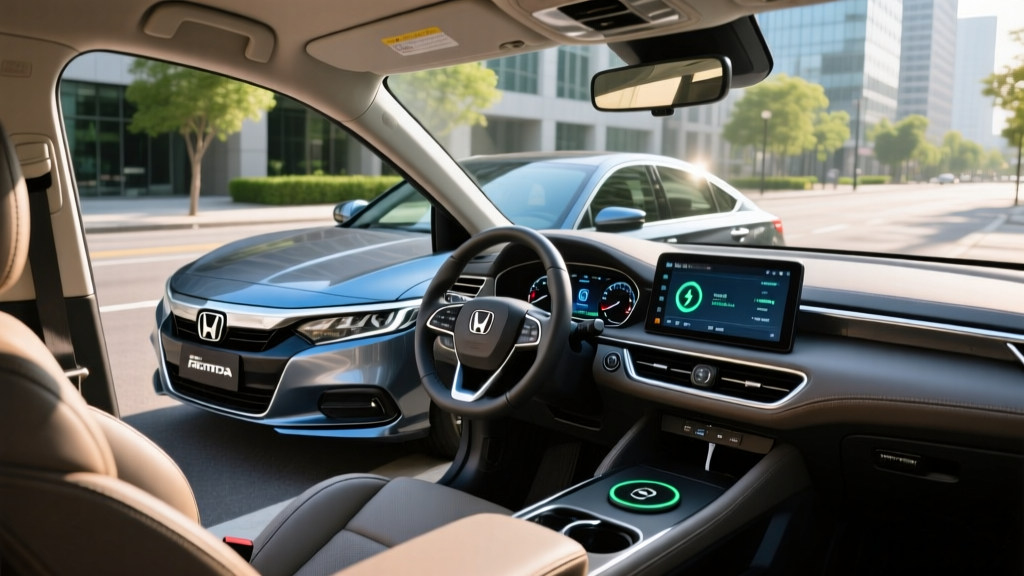
The Honda CR-V has been the best-selling compact crossover in America for years, and its hybrid variant is the version most buyers should actually consider. The 2026 Honda CR-V Hybrid compact SUV pairs a 2.0-liter Atkinson-cycle engine with a two-motor hybrid system to deliver 40 MPG city, 35 highway, and 37 combined — numbers that make it one of the most efficient vehicles in its class without requiring a plug, a lifestyle change, or a steep price premium.
This guide breaks down every spec that matters: real-world fuel economy versus the EPA sticker, the hybrid powertrain's 204 horsepower output, battery longevity and warranty coverage, pricing across all four trims, and whether the CR-V Hybrid is the right electrified choice for your driving pattern — or if you should look at a PHEV or full EV instead.
HEV vs. PHEV: What the CR-V Hybrid Actually Is
Before diving into specs, it's essential to clarify what you're buying. The Honda CR-V Hybrid is a conventional hybrid electric vehicle (HEV). It does not plug in. There is no charging port, no electric-only range to manage, and no home charger to install. The small lithium-ion battery recharges itself through regenerative braking and the gasoline engine.
Conventional Hybrid (HEV) — Honda CR-V Hybrid: No plug. Battery charges via regen and engine. You simply fill up with gas. EPA 37 MPG combined. No federal tax credit.
Plug-in Hybrid (PHEV) — e.g., Toyota RAV4 Prime: Plugs in. Larger battery (18.1 kWh) gives ~42 miles electric-only before the gas engine kicks in. Eligible for up to $7,500 federal credit if sourcing and income rules are met. Requires home or public charging access to realize value.
Battery Electric (BEV) — e.g., Hyundai Ioniq 5: No gas engine. 250-320+ miles of all-electric range. Must charge from the grid. Eligible for up to $7,500 federal credit. Lowest operating cost if you can charge at home.
Honda discontinued the CR-V PHEV variant in the U.S. market after the 2023 model year. If you want a plug-in compact SUV from Honda, you'd need to look at the Accord PHEV (sedan) or consider competitors like the Toyota RAV4 Prime or Mitsubishi Outlander PHEV. The 2026 CR-V lineup is strictly HEV alongside the standard 1.5L turbo gas model.
EPA Fuel Economy and Real-World MPG
The EPA rates the 2026 Honda CR-V Hybrid compact SUV at the following figures, consistent across the Sport, Sport-L, and Sport Touring trims:
| Metric | FWD | AWD |
|---|---|---|
| City | 43 MPG | 40 MPG |
| Highway | 36 MPG | 34 MPG |
| Combined | 40 MPG | 37 MPG |
Source: EPA Fuel Economy
Real-World MPG: What Owners Actually See
Hybrids shine in stop-and-go driving because regenerative braking recaptures energy that a gas car wastes as heat. In real-world city driving, many CR-V Hybrid owners report 41-45 MPG on commutes with frequent stops — exceeding the EPA city estimate. This is a consistent pattern with Toyota and Honda hybrid systems: the city number is conservative because the EPA test cycle doesn't fully capture the regen benefit of dense urban traffic.
On the highway, expect the opposite. Sustained 75-80 MPH cruising yields 31-34 MPG in the AWD Sport Touring. The hybrid system's advantage diminishes at constant high speed because there's little braking to recapture energy, and the 2.0L engine is doing most of the work. Cold weather (below 35°F) knocks another 2-4 MPG off combined figures as the engine runs more frequently for cabin heat and battery warming.
Real-world expectation: FWD models average 38-42 MPG combined year-round. AWD models average 35-38 MPG combined. City-heavy drivers will beat the EPA sticker; highway-heavy drivers will fall 2-4 MPG short.
Powertrain: Engine, Motors, and 204 Horsepower
The CR-V Hybrid uses Honda's fourth-generation two-motor hybrid system, which operates primarily in series-hybrid mode at low and moderate speeds (the engine generates electricity for the drive motor) and switches to direct parallel drive at highway cruising speeds where the engine is most efficient.
| Specification | Detail |
|---|---|
| Engine | 2.0L DOHC Atkinson-cycle 4-cylinder |
| Engine output | 145 HP @ 6,100 RPM / 138 lb-ft torque |
| Drive motor | 181 HP / 247 lb-ft torque |
| Combined system output | 204 HP / 247 lb-ft torque |
| Transmission | e-CVT (single-speed direct drive w/ lock-up clutch) |
| Drivetrain | FWD standard; Real Time AWD available |
| 0-60 MPH | ~7.6 seconds (independent testing) |
| Hybrid battery | ~1.06 kWh lithium-ion (sealed, self-charging) |
| Towing capacity | 1,000 lbs (all hybrid trims) |
The 204 combined horsepower is a meaningful step up from the standard 1.5L turbo gas CR-V (190 HP), and the hybrid's 247 lb-ft of torque — available from the electric motor essentially from zero RPM — gives it noticeably stronger off-the-line acceleration. The e-CVT is smooth and avoids the rubber-band drone of some competitors because Honda's system locks the engine directly to the wheels above ~45 MPH, eliminating the CVT slip entirely at cruising speed.
Pricing, Trims, and Tax Credit Eligibility
The 2026 Honda CR-V Hybrid is available in four trims. Hybrid powertrain is standard on Sport, Sport-L, and Sport Touring; the base LX and mid-tier EX remain gas-only.
| Trim | MSRP (FWD) | MSRP (AWD) |
|---|---|---|
| Sport | $35,850 | $37,350 |
| Sport-L | $38,350 | $39,850 |
| Sport Touring | $41,350 | $42,850 |
Source: Honda CR-V Hybrid Official Page
Federal Tax Credit Status
The Honda CR-V Hybrid does not qualify for the federal §30D clean vehicle tax credit. Under current IRS rules, the §30D credit of up to $7,500 applies only to plug-in electric vehicles (BEVs and PHEVs) with a battery capacity of at least 7 kWh. The CR-V Hybrid's ~1 kWh battery falls far short of this threshold, and as a conventional HEV, it is categorically ineligible.
Some states and local utilities offer modest rebates for conventional hybrids — typically $250-$500 — but these vary by jurisdiction. Check your state energy office or utility provider for current programs. Do not rely on dealer claims about hybrid tax credits; the federal incentive is plug-in only.
Battery Warranty, Lifespan, and Replacement Cost
Honda Hybrid Battery Warranty:
- Duration: 8 years / 100,000 miles (10 years / 150,000 miles in California and states adopting CARB standards)
- Coverage: Defects and capacity loss below functional threshold
- Replacement cost (out of warranty): $2,500-$4,000 for the hybrid battery pack, plus ~$500-$800 labor
Honda's hybrid battery warranty is competitive with Toyota's (10 years/150,000 miles across all states for Toyota). The CR-V Hybrid's lithium-ion pack is small (~1.06 kWh) and operates within a narrow state-of-charge window — typically between 40-80% SoC — which minimizes degradation stress. Honda has been building two-motor hybrids since the 2014 Accord Hybrid, and failure rates on the battery packs have been low based on long-term owner data.
If you keep the vehicle beyond 150,000 miles, budget $3,000-$4,800 for a potential battery replacement. In practice, many Honda and Toyota hybrid batteries last 200,000+ miles with gradual capacity loss rather than sudden failure. The hybrid system will continue to function with a degraded battery — you'll simply see a modest MPG decline (2-4 MPG) as the pack loses its ability to store regen energy efficiently.
Who Should Buy the CR-V Hybrid vs. a PHEV or Full EV
✓ Pros
- 40 MPG city without plugging in — zero lifestyle change
- Strong 247 lb-ft torque from electric motor for confident merging
- Lower MSRP than comparable PHEVs (RAV4 Prime starts ~$44,500)
- Proven Honda reliability and 8-10 yr battery warranty
- Excellent cargo space (36.3 cu ft behind rear seats)
- No range anxiety, no charging infrastructure dependence
✗ Cons
- No federal tax credit (saves you $0 at purchase vs. $7,500 for qualifying PHEVs/EVs)
- Highway MPG drops to 31-34 at 75+ MPH
- 1,000-lb towing limit (gas model: 1,500 lbs)
- No electric-only driving mode — always burning some fuel
- AWD hybrid costs $1,500 more than FWD across all trims
- Hybrid only on upper trims — no budget LX Hybrid option
Decision Framework
Choose the CR-V Hybrid if: You drive 12,000-18,000 miles/year in mixed city/highway conditions, don't have reliable home charging access, and want maximum fuel savings without plugging in. The ~$1,500 hybrid premium over the gas EX pays back in roughly 2-3 years at 15,000 miles/year and $3.40/gallon.
Choose a PHEV (RAV4 Prime, Tucson PHEV) if: You can install a Level 2 home charger, your daily commute is under 40 miles round-trip (you'll drive almost entirely on electricity), and you want the $7,500 federal credit to offset the higher MSRP.
Choose a full EV (Ioniq 5, Model Y) if: You have home charging, drive under 300 miles/day, want the lowest per-mile fuel cost (~$0.04/mile on home electricity vs. ~$0.09/mile in the CR-V Hybrid), and want to eliminate oil changes and spark plugs entirely.
CR-V Hybrid vs. Key Competitors
| Vehicle | Combined MPG | HP | Starting MSRP |
|---|---|---|---|
| Honda CR-V Hybrid AWD | 37 | 204 | $37,350 |
| Toyota RAV4 Hybrid AWD | 39 | 219 | $33,575 |
| Hyundai Tucson Hybrid AWD | 38 | 232 | $38,260 |
| Kia Sportage Hybrid AWD | 38 | 232 | $34,090 |
| Ford Escape Hybrid AWD | 39 | 210 | $36,500 |
The RAV4 Hybrid edges the CR-V by 2 MPG combined and starts ~$3,800 lower, but the Honda's interior quality, ride refinement, and cargo space (36.3 vs. 37.6 cu ft — nearly identical) make it the more polished daily driver. The Tucson and Sportage hybrids offer more horsepower but sacrifice 1-2 MPG and have shorter track records for hybrid system reliability.
Ownership Costs: 5-Year Fuel Savings
At 15,000 miles per year and $3.40/gallon regular unleaded, the CR-V Hybrid AWD (37 MPG combined) costs approximately $1,378 per year in fuel. The equivalent gas-only CR-V AWD (28 MPG combined) costs roughly $1,821 per year. That's a savings of $443/year or $2,215 over five years — enough to recoup the hybrid's ~$1,500 price premium within the first two years of ownership.
Maintenance costs are nearly identical between the hybrid and gas models. The hybrid uses the same engine oil, filters, and brake components. In fact, brake pad life is often longer on the hybrid because regenerative braking handles most deceleration, reducing wear on the friction brakes. Honda's maintenance minder system typically calls for oil changes every 7,500-10,000 miles.
Frequently Asked Questions
How many MPG does the Honda CR-V Hybrid get?
The 2026 Honda CR-V Hybrid is EPA-rated at 40 MPG combined (43 city / 36 highway) with FWD and 37 MPG combined (40 city / 34 highway) with AWD. In real-world driving, city-heavy commuters often see 41-45 MPG, while highway-heavy drivers at 75+ MPH typically see 31-34 MPG.
Does the CR-V Hybrid need to be plugged in?
No. The CR-V Hybrid is a conventional (self-charging) hybrid. It has no charging port. The battery recharges through regenerative braking and the gasoline engine. You simply fill it with regular unleaded fuel.
Does the Honda CR-V Hybrid qualify for a tax credit?
No. The federal §30D clean vehicle credit applies only to plug-in vehicles (BEVs and PHEVs) with batteries of at least 7 kWh. The CR-V Hybrid's ~1 kWh battery makes it ineligible. Some state and utility programs offer small hybrid rebates ($250-$500), but the federal credit is not available.
How long will the CR-V Hybrid battery last?
Honda covers the hybrid battery for 8 years/100,000 miles (10 years/150,000 miles in CARB states). Based on historical Honda hybrid data, these batteries typically last 150,000-200,000+ miles with gradual degradation. Out-of-warranty replacement runs $2,500-$4,000 for the battery pack plus $500-$800 in labor.
Is the CR-V Hybrid better than the gas CR-V?
For most buyers, yes. The hybrid delivers 37 MPG combined vs. 28 MPG for the gas AWD model — a 32% improvement — while producing 204 HP vs. 190 HP. The $1,500 price premium pays for itself in fuel savings within 2-3 years at 15,000 miles/year. The only advantage the gas model retains is a slightly higher towing capacity (1,500 lbs vs. 1,000 lbs).
Hybrid vs. PHEV vs. EV — which is right for me?
If you can't charge at home, the CR-V Hybrid (HEV) is the right call — zero infrastructure needed, excellent MPG. If you can install a home charger and commute under 40 miles daily, a PHEV like the RAV4 Prime lets you drive mostly on electricity while keeping the gas backup, plus the $7,500 federal credit. If you have home charging, drive under 300 miles/day, and want the lowest operating cost, a full EV eliminates gas entirely at roughly $0.04/mile on home electricity.
Is the CR-V Hybrid reliable?
Honda's two-motor hybrid system has been in production since 2014 (Accord Hybrid) and has a strong reliability record. The system has fewer moving parts than a conventional automatic transmission — there's no torque converter, no multi-speed gearbox, and the e-CVT is mechanically simple. IIHS and NHTSA have consistently rated the CR-V highly for safety, which correlates with Honda's conservative engineering approach across the platform.
All pricing, MPG, and specification data reflects 2026 model year figures from Honda and the EPA. Tax credit rules reflect current IRS §30D guidance and are subject to change. Verify eligibility with a tax professional before purchasing. Real-world fuel economy varies with driving conditions, temperature, and driving style.