Quick Verdict: The CR-V Hybrid in 2026
The Honda CR-V Hybrid remains one of the most practical compact SUVs on the market, pairing a 2.0-liter Atkinson-cycle engine with a two-motor hybrid system for a combined 204 horsepower and up to 40 MPG in the city. For 2026, Honda continues to offer the CR-V Hybrid in Sport and Sport Touring trims with standard all-wheel drive (AWD), a generous cargo area, and a mature suite of driver-assistance features under the Honda Sensing umbrella. If you're researching Honda CR-V Hybrid colours, trims, and real-world efficiency, this guide covers every number that matters before you sign the paperwork.
2026 Honda CR-V Hybrid — Key Specs at a Glance
| Attribute | Specification |
|---|---|
| Powertrain | 2.0L 4-cyl Atkinson + 2-motor hybrid (AWD standard) |
| Combined Horsepower | 204 hp / 247 lb-ft torque |
| EPA MPG (City / Hwy / Combined) | 40 / 34 / 37 (AWD) |
| Fuel Tank Capacity | 15.3 gallons |
| Total Driving Range | ~566 miles (EPA est.) |
| 0–60 mph | ~7.7 seconds |
| Cargo Volume (rear seats up / down) | 36.3 / 76.5 cu ft |
| Towing Capacity | 1,000 lbs |
| Hybrid Battery Warranty | 8 years / 100,000 miles |
| Base MSRP (Sport AWD) | ~$36,700 |
| Federal Tax Credit (§30D) | Not eligible (conventional HEV) |
2026 Honda CR-V Hybrid Colours by Trim
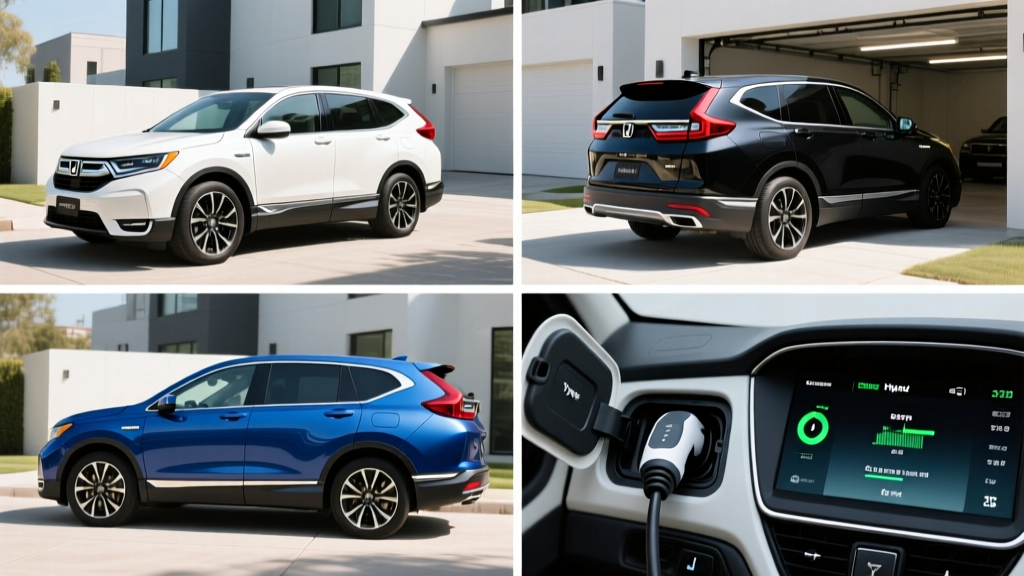
Exterior paint availability varies by trim level. Honda typically reserves metallic and pearlescent finishes for the Sport Touring, while the Sport trim offers a slightly narrower palette. Below is the expected 2026 colour lineup based on Honda's current offerings (confirm with your local dealer, as mid-year adjustments are common).
Sport Trim Colours
- Crystal Black Pearl — no-cost solid black; hides dirt well, popular for fleet and resale.
- Platinum White Pearl — pearlescent white; adds ~$395 premium on some model years.
- Solar Silver Metallic — classic silver metallic; excellent at concealing minor scratches.
- Canyon River Blue Metallic — a muted blue-grey metallic that reads as upscale without being flashy.
- Meteoroid Gray Metallic — dark grey metallic; sophisticated and widely available.
- Urban Gray Pearl — pearlescent warm grey with subtle metallic flake.
Sport Touring Trim Colours (all Sport colours plus)
- Radiant Red Metallic — deep red with metallic flake; Sport Touring exclusive in most years.
- Still Night Pearl — dark blue-black pearl; premium appearance, Sport Touring exclusive.
Interior colourways are trim-dependent: the Sport typically comes with a black cloth interior, while the Sport Touring upgrades to black or grey leather. Honda does not currently offer a tan or brown interior on the CR-V Hybrid in the US market.
HEV vs PHEV: Where the CR-V Hybrid Fits
One of the most common points of confusion among SUV shoppers is the difference between a conventional hybrid (HEV) and a plug-in hybrid (PHEV). The 2026 CR-V Hybrid is a conventional hybrid (HEV) — it does not have a charge port and cannot be plugged in. The hybrid system recovers energy through regenerative braking and the gasoline engine to charge a small lithium-ion battery pack (approximately 1.1 kWh usable). You simply fuel it like any other car.
HEV vs PHEV vs EV — Which Fits Your Lifestyle?
| Factor | Conventional Hybrid (HEV) | Plug-in Hybrid (PHEV) | Battery Electric (BEV) |
|---|---|---|---|
| Plug in to charge? | No | Yes (Level 1/2) | Yes (Level 1/2/DC) |
| Electric-only range | None (motor assists engine) | 20–45 miles typical | 200–400+ miles |
| Gas engine? | Yes (primary power) | Yes (backup + highway) | No |
| Home charging needed? | No | Recommended (Level 2) | Essential |
| Federal tax credit (§30D)? | No | Up to $7,500 (if eligible) | Up to $7,500 (if eligible) |
| Best for | No home charging access; long trips | Short commutes + road trip flexibility | Home charging + daily driving under 300 mi |
Honda does not currently offer a CR-V PHEV in the United States (a plug-in variant was available in earlier generations in select markets). If you need electric-only commuting with a gas backup, competitors like the Toyota RAV4 Prime (42 miles electric-only) are worth cross-shopping.
Fuel Economy: EPA Ratings and Real-World MPG
The EPA rates the 2026 Honda CR-V Hybrid AWD at 40 MPG city / 34 MPG highway / 37 MPG combined, per fueleconomy.gov. Front-wheel drive (if available in your market) bumps the city figure to 43 MPG.
EPA MPG Breakdown — 2026 CR-V Hybrid
| Drivetrain | City | Highway | Combined |
|---|---|---|---|
| AWD (Sport / Sport Touring) | 40 MPG | 34 MPG | 37 MPG |
| FWD (if available) | 43 MPG | 36 MPG | 40 MPG |
Real-World MPG: What to Actually Expect
Conventional hybrids like the CR-V tend to exceed their EPA city rating in stop-and-go driving because regenerative braking recovers energy that a gas car wastes as heat. In mixed suburban driving, many owners report 38–42 MPG. Highway driving is a different story: at sustained 70–80 mph, expect 30–33 MPG, as the electric motor contributes less and aerodynamic drag dominates.
In cold weather (below 30°F), expect a 5–10% efficiency drop due to increased engine idling for cabin heat and reduced battery efficiency. Using the seat heaters and steering wheel heater instead of cranking the cabin heat can recover 1–2 MPG in winter.
Powertrain Deep Dive: Engine, Motors, and Drivetrain
The CR-V Hybrid uses Honda's fourth-generation two-motor hybrid system. Here's how the hardware breaks down:
- Engine: 2.0-liter DOHC Atkinson-cycle inline-4, producing 145 hp and 134 lb-ft of torque independently.
- Drive Motor: 181 hp / 247 lb-ft — this motor does the majority of the actual propulsion.
- Generator Motor: Starts the engine, generates electricity, and provides seamless engine-motor transitions.
- Combined System Output: 204 hp / 247 lb-ft (limited by system power electronics, not a simple sum).
- Transmission: No conventional gearbox — Honda uses an e-CVT with a lock-up clutch for direct engine drive at highway speeds.
- AWD System: A mechanical driveshaft connects the front hybrid powertrain to a rear differential, providing torque to the rear wheels when slip is detected. This is not a dedicated rear electric motor system.
The driving experience is smooth and quiet at low speeds (the electric motor handles launches), with the engine engaging audibly under hard acceleration. Honda has improved the sound insulation on the current generation, making it one of the quieter hybrid SUVs in the segment.
Pricing, Trims, and Tax Credit Eligibility
The 2026 CR-V Hybrid is offered in two trims in the US market:
- Sport AWD: Starting around $36,700 MSRP (including destination). Includes 18-inch alloy wheels, 9-inch touchscreen with wireless Apple CarPlay/Android Auto, heated front seats, and Honda Sensing ADAS.
- Sport Touring AWD: Starting around $41,000 MSRP. Adds leather interior, Bose 12-speaker audio, wireless phone charging, hands-free power liftgate, heated rear seats, and a heated steering wheel.
Federal Tax Credit: Does the CR-V Hybrid Qualify?
No. The Honda CR-V Hybrid is a conventional hybrid (HEV), not a plug-in vehicle. Under IRS §30D Clean Vehicle Credit rules, only plug-in electric vehicles (PHEVs and BEVs) with sufficient battery capacity are eligible for the up-to-$7,500 federal tax credit. The CR-V Hybrid's small battery pack does not meet the minimum 4 kWh threshold.
Some states offer separate rebates or reduced registration fees for hybrids — check your state's energy office or AFDC state incentives database for local programs.
Reliability, Battery Lifespan, and Warranty
Honda's hybrid system has proven durable over multiple generations. The lithium-ion hybrid battery pack is covered under a federal emissions warranty of 8 years / 100,000 miles in most states, and 10 years / 150,000 miles in California Air Resources Board (CARB) states (CA, CT, ME, MA, NJ, NY, OR, RI, VT, WA, and others adopting CARB standards).
Battery Replacement Cost
If the hybrid battery fails outside of warranty, replacement costs typically range from $2,000 to $4,000 including labor at a Honda dealership. Third-party refurbishment shops offer reconditioned packs for $1,500–$2,500. In practice, Honda hybrid battery failures before 150,000 miles are uncommon — most degradation is gradual capacity loss that slightly reduces fuel economy rather than causing a complete failure.
Overall Reliability
The CR-V Hybrid consistently earns above-average reliability ratings. IIHS typically awards the CR-V its Top Safety Pick designation when equipped with the standard LED headlights. The hybrid powertrain adds minimal complexity over the gas model — there is no starter motor, no alternator, and no conventional transmission to fail, which actually reduces long-term maintenance costs.
Pros
- 40 MPG city with AWD — class-leading efficiency
- No plug-in charging required — fuel and go
- Generous cargo space (36.3 cu ft rear up)
- Smooth, quiet electric-motor launches
- Strong resale value and reliability track record
- Standard Honda Sensing ADAS across trims
Cons
- Highway MPG drops to 30–33 at 75+ mph
- No PHEV option for electric-only commuting
- Engine noise under hard acceleration
- 1,000-lb towing limit (lower than some competitors)
- No federal tax credit eligibility
- Colour palette limited vs. some rivals
Who Should Choose the CR-V Hybrid (and Who Shouldn't)
The CR-V Hybrid is right for you if:
- You don't have access to home or workplace charging but want better fuel economy.
- You regularly take road trips exceeding 300 miles and don't want to plan around charging stations.
- You live in a cold climate where EV range loss is a concern.
- You want AWD capability with minimal fuel-economy penalty.
- You prioritize long-term reliability and low maintenance costs.
Consider a PHEV or full EV instead if:
- You have home Level 2 charging and a commute under 40 miles (a PHEV like the RAV4 Prime or a BEV like the Hyundai Ioniq 5 could eliminate most gasoline use).
- You want to qualify for the $7,500 federal tax credit under §30D rules (requires a PHEV or BEV with eligible battery sourcing).
- You want one-pedal driving and the instant torque of a full electric powertrain.
Frequently Asked Questions
How many MPG does the 2026 Honda CR-V Hybrid get?
The EPA rates the AWD CR-V Hybrid at 40 city / 34 highway / 37 combined MPG. Real-world mixed driving typically yields 36–42 MPG depending on driving style, terrain, and temperature. City driving often exceeds the EPA rating thanks to regenerative braking.
Is the CR-V Hybrid a plug-in? Do I need to charge it?
No. The CR-V Hybrid is a conventional hybrid (HEV). There is no charge port. The battery charges through regenerative braking and the gasoline engine. You simply fill up at a gas station like any other vehicle.
How far can the CR-V Hybrid go on a full tank?
With a 15.3-gallon fuel tank and a 37 MPG combined EPA rating, the CR-V Hybrid can travel approximately 566 miles between fill-ups in mixed driving. Highway-heavy trips will reduce this to around 500 miles; city-heavy driving can push it past 600 miles.
Does the Honda CR-V Hybrid qualify for any tax credit?
The CR-V Hybrid does not qualify for the federal §30D Clean Vehicle Credit because it is not a plug-in vehicle. Some states offer modest hybrid incentives — check the AFDC state laws database for programs in your area.
Is the CR-V Hybrid reliable? What about the battery?
Honda's hybrid system has a strong reliability record. The hybrid battery is warranted for 8 years/100,000 miles (10 years/150,000 miles in CARB states). Out-of-warranty replacement costs $2,000–$4,000, but failures before 150,000 miles are uncommon.
What are the available Honda CR-V Hybrid colours for 2026?
The Sport trim is available in Crystal Black Pearl, Platinum White Pearl, Solar Silver Metallic, Canyon River Blue Metallic, Meteoroid Gray Metallic, and Urban Gray Pearl. The Sport Touring adds Radiant Red Metallic and Still Night Pearl. Always confirm availability with your dealer, as Honda may adjust the palette mid-year.
How does the CR-V Hybrid compare to the Toyota RAV4 Hybrid?
The RAV4 Hybrid offers slightly higher combined output (219 hp vs. 204 hp), a higher towing capacity (1,750 lbs vs. 1,000 lbs), and an available PHEV variant (RAV4 Prime, 42 miles electric-only). The CR-V Hybrid counters with more cargo volume, a quieter cabin, and slightly better city MPG. Both are excellent choices — the decision often comes down to brand preference and which dealer is closer.
What is the 0–60 time on the CR-V Hybrid?
The 2026 CR-V Hybrid AWD reaches 60 mph in approximately 7.7 seconds. That's adequate for highway merging and everyday driving, though it trails the RAV4 Hybrid (~7.4 seconds) and the RAV4 Prime (~5.7 seconds).