Quick Verdict: The CR-V Hybrid's Sweet Spot
The 2026 Honda CR-V Hybrid remains one of the most practical compact SUVs for buyers who want electrified efficiency without plugging in. With an EPA-rated 40 MPG combined, a proven two-motor hybrid system producing 204 horsepower, and a starting MSRP around $36,395, it occupies a compelling middle ground between a conventional gas SUV and a full battery-electric vehicle. For 2026, Honda continues the sixth-generation CR-V Hybrid across four trims — Sport, Sport-L, Sport Touring, and the new Sport-L AWD — with a refreshed palette of exterior colors and interior options that this guide breaks down in full.
Before we get into the color options and trim-by-trim details, let's establish what the CR-V Hybrid actually is — and what it isn't.
HEV vs. PHEV: Where the CR-V Hybrid Fits
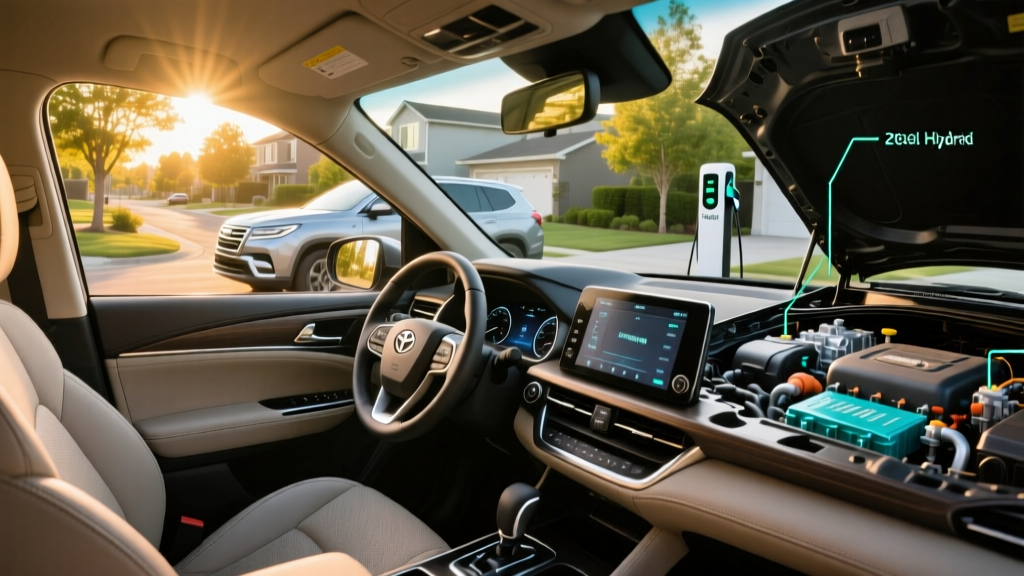
Conventional Hybrid (HEV): The CR-V Hybrid is a self-charging hybrid. It uses a small lithium-ion battery (approximately 1.06 kWh) that recharges through regenerative braking and the gasoline engine. You never plug it in. The electric motor assists the engine during acceleration and can propel the vehicle at low speeds for brief distances, but there is no meaningful electric-only range.
Plug-in Hybrid (PHEV): Honda does not currently offer the CR-V as a plug-in hybrid in the U.S. market. Competitors like the Toyota RAV4 Prime (42 miles electric-only, 94 MPGe) fill that niche. If you want a Honda PHEV, the closest option is the discontinued Clarity PHEV or waiting for Honda's next-generation PHEV platform.
Full EV (BEV): The Honda Prologue (EPA range ~296 miles, starting ~$47,400) is Honda's current battery-electric SUV, built on GM's Ultium platform. It requires home or public charging infrastructure.
2026 Honda CR-V Hybrid Colors: Exterior and Interior Options
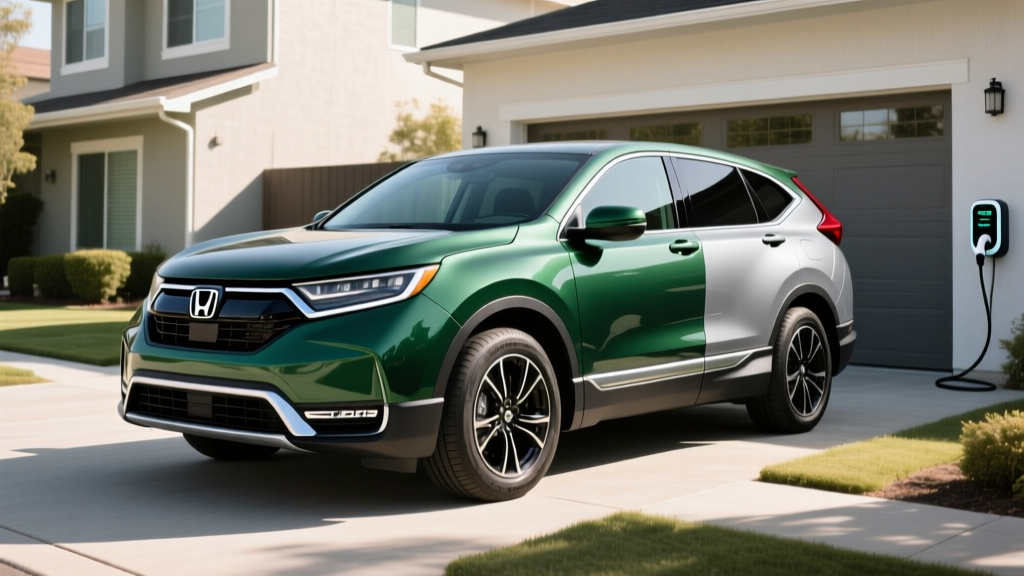
Color selection is one of the most-searched topics for CR-V Hybrid buyers, and Honda offers a curated range for 2026. Availability varies by trim, so we've mapped every exterior color to its corresponding trim levels below.
| Exterior Color | Sport | Sport-L | Sport Touring |
|---|---|---|---|
| Crystal Black Pearl | ✓ | ✓ | ✓ |
| Platinum White Pearl | ✓ | ✓ | ✓ |
| Meteorite Gray Metallic | ✓ | ✓ | ✓ |
| Canyon River Blue Metallic | ✓ | ✓ | ✓ |
| Urban Gray Pearl | ✓ | ✓ | — |
| Radiant Red Metallic | ✓ | ✓ | — |
| Solar Silver Metallic | — | ✓ | ✓ |
| Deep Scarlet Pearl (new for 2026) | — | — | ✓ |
Interior color options are more limited and trim-dependent. The Sport trim comes standard with a black cloth interior. The Sport-L adds black leather-trimmed seating, while the Sport Touring offers a choice of black leather or an available gray leather option. Honda does not currently offer a brown or tan interior on the CR-V Hybrid lineup.
Practical note on color and efficiency: Darker colors like Crystal Black Pearl absorb more solar heat, which increases cabin cooling load in hot climates. While the effect on MPG is marginal (typically less than 1%), it can affect cabin comfort during summer parking. Lighter colors like Platinum White Pearl and Solar Silver Metallic reflect more solar radiation, reducing A/C demand slightly.
Fuel Economy: EPA Ratings and Real-World MPG
| Drivetrain | City MPG | Highway MPG | Combined MPG |
|---|---|---|---|
| FWD (Sport, Sport-L) | 43 | 36 | 40 |
| AWD (all trims available) | 40 | 34 | 37 |
Source: EPA Fuel Economy Guide
The CR-V Hybrid's two-motor system excels in stop-and-go city driving, where regenerative braking recaptures energy constantly. In real-world city commuting, many owners report 42–45 MPG in FWD models — exceeding the EPA city rating. However, sustained highway driving at 70+ MPH tends to yield 32–35 MPG for AWD models, slightly below the EPA highway figure. Cold weather (below 35°F) typically reduces hybrid efficiency by 8–15% due to increased engine runtime for cabin heating and reduced battery efficiency. Expect 34–37 MPG combined in winter conditions for AWD models.
Powertrain Specs: Engine, Motors, and Performance
| Specification | Value |
|---|---|
| Engine | 2.0L DOHC Atkinson-cycle 4-cylinder |
| Engine Output | 146 HP @ 6,100 RPM / 134 lb-ft torque |
| Electric Motors | Two-motor hybrid system (drive + generator) |
| Drive Motor Output | 181 HP / 247 lb-ft torque |
| Combined System Output | 204 HP / 247 lb-ft torque |
| Hybrid Battery | ~1.06 kWh lithium-ion (not plug-in) |
| Transmission | e-CVT (electronic continuously variable) |
| 0–60 MPH | ~7.6 seconds (FWD) |
| Drivetrain | FWD standard; Real Time AWD available |
| Towing Capacity | 1,000 lbs |
| Cargo Volume | 39.3 cu ft (behind rear seats) / 76.5 cu ft (seats folded) |
Honda's fourth-generation two-motor hybrid system operates differently than a traditional parallel hybrid. In most driving conditions below ~45 MPH, the gasoline engine acts primarily as a generator, producing electricity that powers the drive motor. At highway speeds, a lock-up clutch mechanically connects the engine to the front wheels for more efficient cruising. This series-parallel architecture is why the CR-V Hybrid delivers such strong city MPG — the electric drive motor handles the inefficient stop-start work while the engine operates in its optimal RPM range.
Pricing, Trims, and Tax Credit Eligibility
| Trim | Drivetrain | MSRP (incl. destination) |
|---|---|---|
| Sport | FWD | $36,395 |
| Sport | AWD | $37,895 |
| Sport-L | FWD | $38,895 |
| Sport-L | AWD | $40,395 |
| Sport Touring | AWD (standard) | $43,195 |
Federal Tax Credit: Does the CR-V Hybrid Qualify?
No. The Honda CR-V Hybrid is a conventional hybrid (HEV), not a plug-in hybrid or battery-electric vehicle. Under current IRS §30D Clean Vehicle Credit rules, only plug-in electric vehicles with a battery capacity of at least 7 kWh qualify for the federal tax credit (up to $7,500 for new EVs/PHEVs, up to $4,000 for used). The CR-V Hybrid's ~1.06 kWh battery does not meet this threshold.
However, some states offer rebates or reduced registration fees for conventional hybrids. Check your state's energy office or DMV for local incentives. The fuel savings alone — approximately $600–$900 per year versus a gas-only CR-V (28 MPG combined) at current fuel prices — often offset the hybrid premium within 3–5 years of ownership.
Battery Reliability, Warranty, and Replacement Cost
Honda Hybrid Battery Warranty
Coverage: 8 years / 100,000 miles (10 years / 150,000 miles in CARB states including CA, CO, CT, ME, MA, NJ, NY, OR, RI, VT, WA)
What's covered: Defects in materials/workmanship and capacity loss below a specified threshold (typically ~60–70% of original capacity)
Estimated out-of-warranty replacement: $2,000–$4,000 for the hybrid battery pack (parts + labor at a Honda dealer)
Honda's hybrid powertrain has demonstrated strong long-term reliability. The fourth-generation two-motor system has been in production since 2023, and earlier Honda hybrid systems (in the Accord Hybrid, Insight, and previous CR-V) have shown battery pack longevity well beyond the warranty period. The lithium-ion hybrid battery is relatively small (~1.06 kWh) and operates within a narrow state-of-charge window managed by the vehicle's battery management system — it never fully charges or fully depletes — which significantly reduces degradation compared to the larger batteries in plug-in hybrids and full EVs.
Realistic lifespan expectation: Based on historical Honda hybrid data and industry degradation studies, the CR-V Hybrid's battery pack should last 150,000–200,000+ miles before any significant capacity loss affects performance. Because the battery is small and the system defaults gracefully to engine-only operation if hybrid battery capacity declines, a degraded battery is an efficiency problem, not a mobility problem.
CR-V Hybrid vs. PHEV vs. Full EV: Which Is Right for You?
Decision Framework
Choose the CR-V Hybrid (HEV) if:
- You don't have access to home or workplace charging (apartment, street parking, no garage outlet)
- You want better fuel economy with zero behavioral change — no plugging in, no route planning around chargers
- Your budget is under $45,000 and you want a proven, reliable compact SUV
- You drive a mix of city and highway and want the simplicity of a single energy source (gasoline)
Choose a PHEV (like the Toyota RAV4 Prime) if:
- You can install a Level 2 charger at home and your daily commute is under 40 miles
- You want electric-only driving for daily errands but gas flexibility for road trips
- You qualify for the federal tax credit (up to $7,500 depending on income, MSRP caps, and battery sourcing — see IRS §30D rules)
- You're willing to pay a $5,000–$8,000 premium over the CR-V Hybrid for the PHEV powertrain
Choose a full EV (like the Honda Prologue or Tesla Model Y) if:
- You have reliable home Level 2 charging and your daily driving is under 250 miles
- You want to eliminate gasoline entirely and reduce per-mile energy costs to $0.03–$0.05/mile
- You qualify for federal and state EV incentives that meaningfully reduce the purchase price
- You're comfortable with public DC fast charging for road trips (plan around 20–30 minute charge stops)
Pros and Cons at a Glance
Pros
- Excellent real-world city MPG (42–45 observed)
- No plug-in required — zero lifestyle change vs. gas car
- Smooth electric-motor torque from stoplights
- Strong 8yr/100k-mile hybrid battery warranty (10yr in CARB states)
- Spacious cargo area (39.3 cu ft) with no battery intrusion
- Honda Sensing safety suite standard on all trims
Cons
- No PHEV variant available — no electric-only range
- No federal tax credit eligibility
- AWD highway MPG drops to 34 EPA (32–35 real-world)
- e-CVT can drone under hard acceleration
- 1,000-lb towing capacity is limited for the class
- Sport Touring trim approaches $44K, encroaching on PHEV territory
Frequently Asked Questions
How many MPG does the 2026 Honda CR-V Hybrid get?
The FWD CR-V Hybrid achieves an EPA-rated 43 city / 36 highway / 40 combined MPG. The AWD version is rated at 40 city / 34 highway / 37 combined. In real-world city driving, FWD models commonly achieve 42–45 MPG thanks to the regenerative braking system. Highway efficiency at 70+ MPH typically falls to 32–35 MPG for AWD models.
Does the CR-V Hybrid need to be plugged in?
No. The CR-V Hybrid is a conventional hybrid (HEV). Its small lithium-ion battery recharges through regenerative braking and the gasoline engine. You fuel it like any other gas car — there is no plug, no charging cable, and no electric-only driving range to manage.
How far can the CR-V Hybrid go on electric power alone?
Effectively zero miles in any practical sense. The hybrid system can propel the CR-V at very low speeds (under 15 MPH) for short distances — such as creeping through a parking lot — but the ~1.06 kWh battery depletes within a few hundred yards. This is not a plug-in hybrid and does not have a meaningful electric-only range. If electric-only commuting is a priority, look at the Toyota RAV4 Prime (42 miles EV range) or a full BEV.
Is the Honda CR-V Hybrid reliable, and what does a battery replacement cost?
Honda's hybrid systems have a strong reliability track record. The hybrid battery is covered by an 8-year/100,000-mile warranty (10 years/150,000 miles in CARB states). Based on historical data from Honda's hybrid lineup, the battery pack typically lasts 150,000–200,000+ miles. Out-of-warranty replacement costs are estimated at $2,000–$4,000 at a Honda dealership — significantly less than a full EV battery replacement because the pack is small (~1.06 kWh).
Does the 2026 CR-V Hybrid qualify for any tax credit?
No federal tax credit is available. The IRS §30D Clean Vehicle Credit requires a plug-in vehicle with a minimum 7 kWh battery. The CR-V Hybrid's ~1.06 kWh battery does not qualify. Some states may offer small rebates for conventional hybrids — check your state energy office. The primary financial benefit is fuel savings: at 40 MPG combined versus the gas CR-V's 28 MPG, you'll save roughly $600–$900 annually on fuel (based on 12,000 miles/year and $3.50/gallon).
What are the 2026 CR-V Hybrid color options?
Honda offers up to 8 exterior colors for the 2026 CR-V Hybrid depending on trim: Crystal Black Pearl, Platinum White Pearl, Meteorite Gray Metallic, Canyon River Blue Metallic, Urban Gray Pearl, Radiant Red Metallic, Solar Silver Metallic, and the new-for-2026 Deep Scarlet Pearl (Sport Touring exclusive). Interior options include black cloth (Sport), black leather (Sport-L), and black or gray leather (Sport Touring).
How does the CR-V Hybrid compare to the gas CR-V?
The gas-only 2026 CR-V (1.5L turbo) achieves 29 city / 36 highway / 31 combined MPG (FWD). The hybrid adds 9 MPG combined (FWD) for a premium of approximately $2,500–$3,000 over equivalent gas trims. At current fuel prices, the hybrid premium pays for itself in roughly 3–5 years for an average driver covering 12,000 miles annually. The hybrid also delivers smoother acceleration from stops and quieter low-speed operation.
Pricing and specifications reflect Honda's published data for the 2026 model year as of publication. MSRPs include destination charges but exclude dealer fees, taxes, and registration. Fuel economy figures are EPA estimates — your actual mileage will vary based on driving conditions, climate, and driving habits. Tax credit and incentive rules are subject to change; consult a tax professional and the IRS for current eligibility.