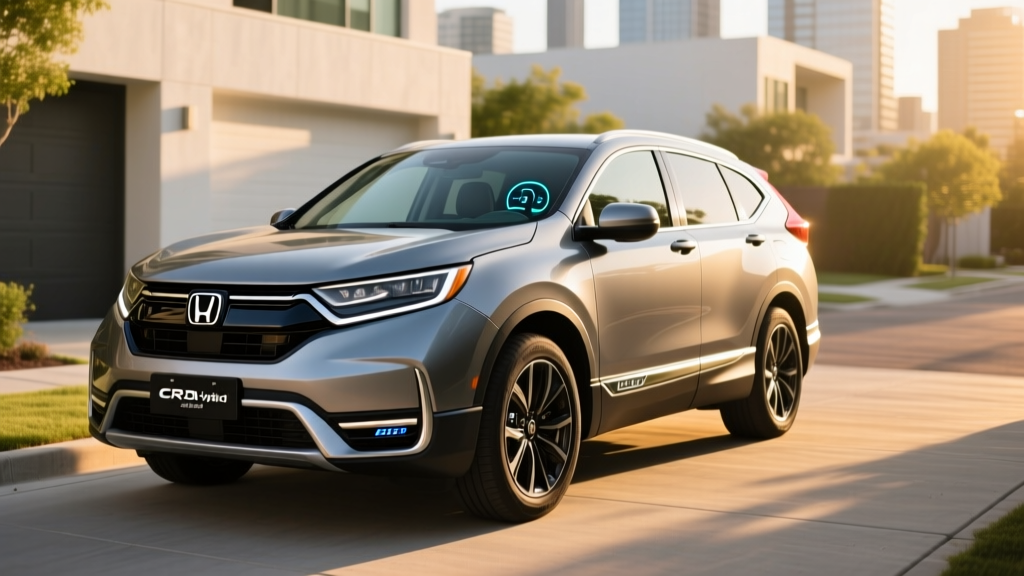
The 2023 Honda CR-V Hybrid represents the sixth generation of Honda's best-selling compact SUV, and for the first time, the hybrid powertrain is positioned as the volume play rather than a niche trim. Honda made the CR-V Hybrid standard on the two highest trims — Sport and Sport Touring — signaling that electrification isn't an afterthought here. If you've been searching for a honda cr-v hybrid 2023 and want hard numbers on fuel economy, real-world efficiency, battery longevity, and whether this SUV qualifies for any tax incentives, this guide breaks it all down with the data you need to decide.
HEV vs PHEV: What the 2023 CR-V Hybrid Actually Is
Before diving into specs, let's clear up a common point of confusion. The 2023 Honda CR-V Hybrid is a conventional hybrid electric vehicle (HEV), not a plug-in hybrid (PHEV). That distinction matters enormously for ownership expectations:
Conventional Hybrid (HEV)
- No plug — the battery charges via regenerative braking and the gas engine
- Small battery (typically 1-2 kWh usable)
- Cannot drive on electric power alone for meaningful distances
- Optimized for fuel economy across all driving conditions
- No range anxiety, no charging infrastructure needed
Plug-in Hybrid (PHEV)
- Has a charge port — plugs into Level 1 or Level 2 chargers
- Larger battery (typically 10-20 kWh)
- 20-40 miles of electric-only range before the engine kicks in
- Requires home or workplace charging to maximize value
- Higher upfront cost; may qualify for federal tax credits
The CR-V Hybrid has no plug, no charge port, and no electric-only driving range to speak of. You fuel it with gas and drive. The hybrid system works behind the scenes to slash fuel consumption — particularly in stop-and-go city driving where electric motors are most efficient. If you need plug-in capability, Honda does not currently offer a CR-V PHEV in the US market; you'd need to look at competitors like the Toyota RAV4 Prime or the Hyundai Tucson PHEV.
EPA Fuel Economy: City, Highway, and Combined MPG
The 2023 CR-V Hybrid uses Honda's two-motor hybrid system paired with a 2.0-liter Atkinson-cycle four-cylinder engine. The EPA rates it differently depending on drivetrain:
| Trim / Drivetrain | City MPG | Highway MPG | Combined MPG |
|---|---|---|---|
| Sport (FWD) | 43 | 36 | 40 |
| Sport (AWD) | 40 | 34 | 37 |
| Sport Touring (AWD standard) | 40 | 34 | 37 |
Source: EPA Fuel Economy
For context, the non-hybrid 2023 CR-V with the 1.5L turbo engine and AWD is rated at 28 city / 34 highway / 30 combined. The hybrid's advantage is massive in city driving — a 12 MPG improvement — and moderate on the highway, where the gas engine does most of the work at sustained speeds.
Real-World MPG: What Owners Actually See
EPA estimates are a starting point, not a guarantee. Based on aggregated owner reports and independent testing, here's what to expect from the 2023 CR-V Hybrid in real conditions:
- City / suburban driving: 38-44 MPG. Hybrids shine here. The electric motor handles low-speed acceleration, and regenerative braking recaptures energy at every stop. Many owners report exceeding the EPA city estimate in warm weather.
- Highway cruising (70-80 mph): 32-36 MPG. At sustained high speeds, the aerodynamic drag dominates and the engine runs continuously. Expect results close to or slightly below the EPA highway number.
- Cold weather (below 35°F): 30-34 MPG combined. The engine runs more frequently to generate cabin heat and warm up the hybrid battery. This 10-15% drop is typical for all hybrids and is not a defect.
- Overall observed average: Most owners land between 35-39 MPG combined across mixed driving, which tracks closely with the EPA combined rating for AWD trims.
Range Reality Check: With a 15.2-gallon fuel tank and 37 MPG combined (AWD), the 2023 CR-V Hybrid delivers roughly 560 miles of total range per fill-up. In cold weather or heavy city traffic, expect 500-530 miles. That's comparable to or better than most EVs' real-world range and eliminates any charging-infrastructure dependency.
Powertrain Specs: Horsepower, Engine, and Motor Details
| Specification | 2023 CR-V Hybrid |
|---|---|
| Engine | 2.0L Atkinson-cycle 4-cylinder |
| Engine Power | 145 hp @ 6,100 rpm |
| Drive Motor Power | 184 hp (135 kW) / 247 lb-ft torque |
| Combined System Output | 204 hp / 247 lb-ft torque |
| Transmission | e-CVT (no traditional gears) |
| Drivetrain | FWD (Sport) or AWD (Sport, Sport Touring) |
| 0-60 mph | ~7.6 seconds (independent testing) |
| Towing Capacity | 1,000 lbs (hybrid trims) |
| Hybrid Battery | ~1.06 kWh lithium-ion (not user-accessible capacity) |
| Cargo Volume | 36.3 cu ft (behind rear seats) / 76.5 cu ft (seats folded) |
The two-motor hybrid system is the heart of this powertrain. One motor primarily generates electricity from the engine; the other drives the wheels. At low speeds, the CR-V Hybrid operates almost entirely on electric power, with the engine acting as a generator. At highway speeds, a lock-up clutch connects the engine directly to the wheels for efficiency. This is fundamentally different from a traditional transmission — the e-CVT has no fixed gear ratios, which is why acceleration feels linear and smooth.
One trade-off worth noting: the hybrid's towing capacity is limited to 1,000 pounds, down from the 1,500-pound rating on non-hybrid AWD trims. If you need to tow a small trailer, the hybrid can handle a light utility trailer or a couple of dirt bikes, but it won't pull a boat or camper.
Pricing, Trims, and Tax Credit Eligibility
The 2023 CR-V Hybrid is available in two trims, both positioned at the top of the lineup:
- Sport Hybrid (FWD): $34,595 MSRP (including destination)
- Sport Hybrid (AWD): $36,095 MSRP
- Sport Touring Hybrid (AWD): $39,845 MSRP
For comparison, the base non-hybrid CR-V LX AWD starts around $34,295, meaning the hybrid premium is modest — roughly $1,800 more for the Sport Hybrid AWD over a similarly equipped non-hybrid EX AWD. Given the fuel savings, the payback period is typically 2-4 years for average drivers.
Does the 2023 CR-V Hybrid Qualify for a Federal Tax Credit?
No. Under IRS §30D rules, the federal clean vehicle credit applies only to plug-in electric vehicles — battery-electric vehicles (BEVs) and plug-in hybrids (PHEVs) with a minimum battery capacity of 7 kWh and a charge port. Since the CR-V Hybrid is a conventional HEV with no plug and a ~1 kWh battery, it does not qualify for the federal EV tax credit.
§30D Federal Tax Credit Requirements (2026 rules):
- Vehicle must be a BEV or PHEV with ≥ 7 kWh battery — CR-V Hybrid does NOT qualify
- MSRP cap: $80,000 for SUVs / $55,000 for sedans
- Buyer income cap: $300K joint / $225K head of household / $150K single
- Battery components and critical minerals must meet US-sourcing thresholds
- Credit can be applied at point of sale or claimed on tax return
Source: IRS Clean Vehicle Credits
However, some states offer their own incentives for hybrid vehicles, though these are increasingly rare as state programs shift focus to full EVs. Check your state's energy office or department of environmental quality for current programs. A few utility companies also offer rebates for purchasing any electrified vehicle, including conventional hybrids.
Battery Warranty, Reliability, and Replacement Cost
Hybrid battery longevity is the single most common concern among prospective hybrid buyers. Here's what Honda covers and what the data shows:
Honda Hybrid Battery Warranty
- Coverage: 8 years / 100,000 miles (10 years / 150,000 miles in CARB states including CA, NY, MA, and others that follow California emissions standards)
- What's covered: Hybrid battery pack, hybrid control module, and related components against defects and excessive capacity loss
- Transferable: Yes, the warranty transfers to subsequent owners
Honda's two-motor hybrid system has been in production since the early 2000s (starting with the Insight and Accord Hybrid), and the technology is mature. Unlike early hybrid batteries that used nickel-metal hydride (NiMH) chemistry, the 2023 CR-V uses a lithium-ion pack that's more compact and better managed thermally. Real-world failure rates for Honda hybrid batteries are low — most units last well beyond the warranty period.
If replacement is needed outside warranty, expect to pay between $2,000 and $4,000 for a new or refurbished hybrid battery pack, plus labor. This is significantly less than a full EV battery replacement ($10,000-$20,000+) because the hybrid battery is small (~1 kWh vs 60-100 kWh in a BEV). Independent hybrid battery repair shops can often replace individual failed cells for $500-$1,500, extending the pack's life at a fraction of the full-replacement cost.
For overall reliability, the 2023 CR-V earned strong marks. The model holds top ratings from the IIHS (Top Safety Pick) and competitive scores from NHTSA. Honda Sensing — the brand's ADAS suite including adaptive cruise, lane-keeping, and automatic emergency braking — comes standard on all trims. Note that Honda Sensing is an SAE Level 2 driver-assistance system, meaning the driver must remain fully engaged at all times. It is not self-driving.
Hybrid vs PHEV vs EV: Which Powertrain Fits You?
The 2023 CR-V Hybrid competes against three categories of alternatives. Here's a decision framework based on your driving patterns and infrastructure access:
Choose the CR-V Hybrid (HEV) If:
- You don't have access to home or workplace charging (apartment, street parking)
- You want maximum fuel savings with zero behavior change — just fill up with gas
- You take frequent long road trips and don't want to plan around chargers
- Your budget is under $40K and you want a well-equipped compact SUV
- You drive 10,000-15,000 miles/year and want to save $600-$900 annually on fuel vs the non-hybrid
Choose a PHEV (RAV4 Prime, Tucson PHEV) If:
- You can install a Level 2 charger at home and most daily trips are under 30-40 miles
- You want to drive on electricity most days but need gas flexibility for road trips
- You qualify for the federal tax credit (up to $7,500) to offset the higher purchase price
- You're willing to pay $5,000-$8,000 more upfront for the PHEV powertrain
Choose a Full EV (Ioniq 5, Model Y, EV6) If:
- You have reliable home Level 2 charging and your daily commute is under 200 miles
- You want the lowest per-mile energy cost (typically $0.03-$0.05/mile vs $0.10-$0.14/mile for hybrid)
- You qualify for the $7,500 federal credit and potentially state incentives
- You're comfortable planning road trips around DC fast-charging stops
- You want minimal maintenance (no oil changes, no engine, fewer moving parts)
The math is straightforward: the CR-V Hybrid saves you fuel money immediately with no infrastructure investment. A PHEV or EV saves more per mile on electricity but requires charging access and a higher upfront outlay. For buyers without home charging, the CR-V Hybrid is arguably the most practical electrified SUV on the market.
Pros and Cons at a Glance
Pros
- 40 MPG combined (FWD) is class-leading for a compact hybrid SUV
- No plug, no charging dependency — works with existing gas-station infrastructure
- Strong city efficiency where most daily driving happens
- 204 hp provides confident acceleration for merging and passing
- Generous cargo space (36.3 cu ft) with no battery intrusion
- Honda Sensing ADAS standard on all trims
- 8-year / 100K-mile hybrid battery warranty (10yr/150K in CARB states)
- IIHS Top Safety Pick rating
Cons
- No PHEV option — cannot drive on electric-only power
- Hybrid only available on two upper trims (Sport, Sport Touring) — no budget-friendly hybrid
- 1,000-lb towing capacity is lower than non-hybrid AWD trims
- Does not qualify for federal §30D tax credit
- AWD hybrid gets 3 MPG less combined than FWD (37 vs 40)
- Engine drone under hard acceleration (e-CVT characteristic, not a defect)
- Highway MPG advantage over non-hybrid is modest (34 vs 34 for turbo AWD)
Frequently Asked Questions
How many MPG does the 2023 Honda CR-V Hybrid get?
The EPA rates the FWD Sport Hybrid at 43 city / 36 highway / 40 combined MPG. The AWD Sport and Sport Touring trims are rated at 40 city / 34 highway / 37 combined. Real-world results typically fall between 35-39 MPG combined for AWD models, with city driving often exceeding the EPA estimate and highway driving coming in slightly below.
Can the 2023 CR-V Hybrid be plugged in to charge?
No. The 2023 CR-V Hybrid is a conventional hybrid (HEV), not a plug-in hybrid (PHEV). It has no charge port. The small hybrid battery charges automatically through regenerative braking and the gasoline engine. You never plug it in — you simply fill the gas tank as you would with any conventional vehicle.
How far can the CR-V Hybrid drive on electric power alone?
Essentially zero miles in any meaningful sense. The hybrid system uses the electric motor at very low speeds (parking lots, initial acceleration from a stop) for brief moments, but the engine engages almost immediately. There is no EV mode button and no electric-only range. If electric-only driving matters to you, you need a PHEV like the Toyota RAV4 Prime (42 miles electric-only) or a full BEV.
Is the CR-V Hybrid reliable and what does battery replacement cost?
Honda's hybrid system is one of the most proven in the industry, with over two decades of production history. The lithium-ion hybrid battery is covered by an 8-year/100,000-mile warranty (10 years/150,000 miles in CARB states). Out-of-warranty replacement costs $2,000-$4,000 for the pack. Real-world data suggests most Honda hybrid batteries last 150,000+ miles without significant issues.
Does the 2023 CR-V Hybrid qualify for any federal tax credit?
No. The IRS §30D clean vehicle credit requires a plug-in vehicle with a battery capacity of at least 7 kWh. The CR-V Hybrid has no plug and a ~1 kWh battery, making it ineligible. Some state or utility incentives may apply — check your local programs — but there is no federal tax benefit for purchasing a conventional hybrid under current law.
How much does it cost to fuel the CR-V Hybrid vs the non-hybrid?
At $3.50/gallon and 12,000 miles/year: the hybrid (37 MPG combined AWD) costs approximately $1,135/year in fuel. The non-hybrid turbo AWD (30 MPG combined) costs about $1,400/year. That's roughly $265 in annual savings with the hybrid, with a payback period of about 3-4 years on the ~$1,800 hybrid premium. At higher gas prices or more annual miles, the payback shortens.
Is the CR-V Hybrid AWD system good in snow?
The AWD hybrid uses a rear-mounted electric motor to power the rear wheels, providing torque-vectoring all-wheel drive. It's effective for light snow, wet roads, and moderate winter conditions. It's not a dedicated off-road system and won't match a Subaru Outback in deep snow, but for typical winter commuting in most US climates, the CR-V Hybrid AWD performs competently. Winter tires make a bigger difference than the AWD system itself.