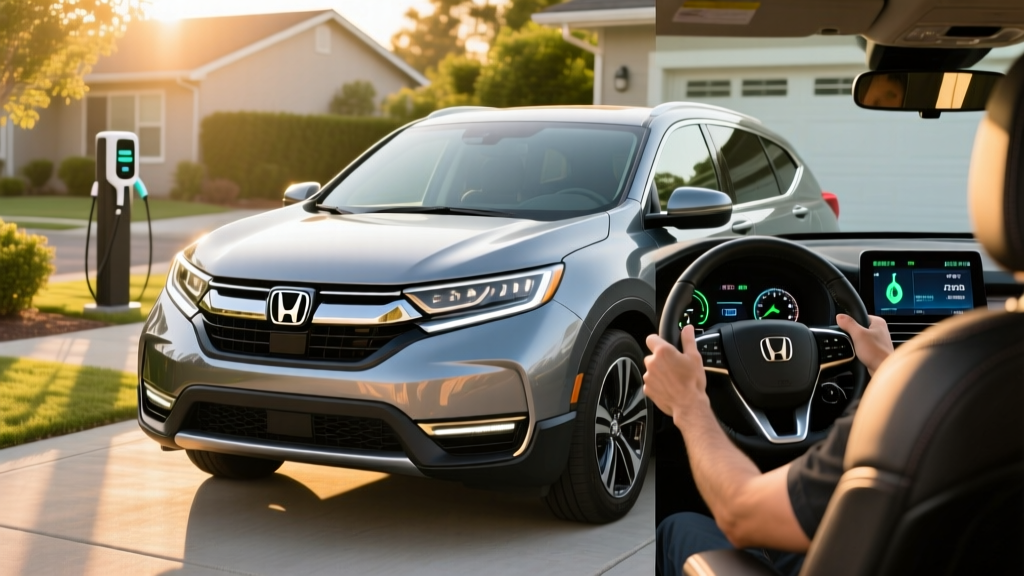
The 2021 Honda CR-V Hybrid arrived as a late addition to the fourth-generation CR-V lineup, pairing Honda's two-motor hybrid system with the compact SUV's proven practicality. Now that we're well into 2026, enough time has passed to evaluate this hybrid's long-term ownership story — from real-world fuel economy to battery longevity. If you're shopping the used market or simply want to understand what Honda's hybrid system delivers, here's the complete data-driven breakdown.
2021 Honda CR-V Hybrid: Core Specifications
| Specification | Value |
|---|---|
| Powertrain | 2.0L Atkinson-cycle 4-cyl + two-motor hybrid system |
| Combined Horsepower | 212 hp |
| Engine Output | 143 hp @ 6,200 rpm / 129 lb-ft torque |
| Electric Motor Output | 181 hp / 232 lb-ft torque (drive motor) |
| Transmission | Electronic CVT (e-CVT, no fixed gears) |
| Drivetrain | AWD standard (all trims) |
| EPA MPG (City / Hwy / Combined) | 40 / 35 / 38 |
| Fuel Tank | 14.0 gallons |
| Total Range | ~532 miles (EPA combined) |
| Hybrid Battery | ~1.4 kWh lithium-ion (non-plug-in HEV) |
| 0-60 mph | ~7.5 seconds |
| Cargo Volume (behind rear seats) | 33.2 cu ft |
| Cargo Volume (rear seats folded) | 68.7 cu ft |
| Original MSRP (EX base) | $30,560 |
| Original MSRP (Touring top trim) | $36,350 |
HEV vs. PHEV vs. EV: Where Does the CR-V Hybrid Fit?
Before examining fuel economy, it's essential to clarify what the 2021 CR-V Hybrid is — and what it isn't. Honda offered this model exclusively as a conventional hybrid electric vehicle (HEV). There was no plug-in hybrid (PHEV) version of the fourth-generation CR-V in the U.S. market. This distinction matters because it dictates everything from how you fuel it to what tax incentives apply.
| Feature | HEV (2021 CR-V Hybrid) | PHEV (e.g., Toyota RAV4 Prime) | BEV (e.g., Tesla Model Y) |
|---|---|---|---|
| Plug-in Required? | No — gas only | Yes — Level 1 or Level 2 | Yes — Level 2 or DC fast |
| Electric-Only Range | None (motor assists engine) | 25–42 mi typical | 250–330 mi typical |
| Total Range | ~532 mi | ~500–600 mi combined | 250–330 mi per charge |
| Federal Tax Credit (§30D) | Not eligible | Up to $7,500 (if eligible) | Up to $7,500 (if eligible) |
| Home Charging Needed? | No | Recommended | Essential |
| Best For | No home charging access, simplicity | Short commutes + road trips | Home charging + lower running costs |
The CR-V Hybrid is ideal for buyers who want better fuel economy without changing their refueling habits. You fill up at any gas station, and the hybrid system handles the rest. There is no plug, no charging cable, and no range planning. If you can install a Level 2 charger at home and have a short commute, a PHEV or full BEV may save more on fuel — but the CR-V Hybrid eliminates that decision entirely.
Fuel Economy: EPA Ratings vs. Real-World MPG
The EPA rates the 2021 Honda CR-V Hybrid at 40 mpg city, 35 mpg highway, and 38 mpg combined across all trims (EX, EX-L, Touring), all of which come with standard AWD. These numbers come from fueleconomy.gov, the official EPA source.
| Driving Scenario | EPA Rating | Real-World Expectation |
|---|---|---|
| City | 40 mpg | 38–43 mpg (hybrids often exceed EPA in stop-and-go) |
| Highway (70 mph) | 35 mpg | 31–34 mpg (aerodynamic drag reduces hybrid advantage) |
| Combined | 38 mpg | 34–39 mpg depending on driving mix |
| Cold Weather (below 30°F) | — | 30–34 mpg (engine runs more for cabin heat) |
The real-world story for conventional hybrids like the CR-V is that city driving is where they shine. The two-motor system recovers energy during braking and frequently runs the electric motor alone at low speeds, so urban commuters often see MPG figures that exceed the EPA city rating. Highway driving is different — at sustained 70+ mph speeds, the gasoline engine carries most of the load, and the hybrid advantage narrows.
Cold weather deserves a specific callout. In sub-freezing temperatures, the gasoline engine runs more frequently to generate cabin heat (the CR-V Hybrid does not use a heat pump, unlike some full EVs). Owners in northern climates should budget for a 10–20% fuel economy penalty during winter months.
How the Two-Motor Hybrid Powertrain Works
Honda's hybrid system in the 2021 CR-V is fundamentally different from Toyota's planetary-gear hybrid design. Honda uses a series-dominant two-motor architecture: the gasoline engine primarily acts as a generator, producing electricity that feeds the drive motor. In most driving conditions, only the electric motor turns the wheels.
At higher highway speeds, a lock-up clutch connects the engine directly to the wheels for efficiency. This means the CR-V Hybrid drives more like an EV in everyday conditions — smooth, responsive electric torque with no traditional gear shifts. The e-CVT is not a belt-and-pulley CVT; it's a direct-drive system with a single fixed ratio for engine-direct mode.
The combined 212 hp output makes the CR-V Hybrid noticeably quicker than the non-hybrid 1.5L turbo CR-V (190 hp). The electric motor's 232 lb-ft of torque is available instantly, which gives confident acceleration from stops and during passing maneuvers. The 0–60 mph time of roughly 7.5 seconds is adequate for the segment, though it trails some turbocharged competitors.
Battery Warranty, Lifespan, and Replacement Cost
Hybrid battery longevity is consistently the top concern among buyers considering a used hybrid. Here's what Honda provides and what the data shows.
Honda Hybrid Battery Warranty
- Standard coverage: 8 years / 100,000 miles (most states)
- CARB states: 10 years / 150,000 miles (California, New York, Massachusetts, and other states that follow California emissions standards)
- Coverage threshold: Battery capacity loss resulting in failure or significant degradation below functional limits
- Hybrid system components: Inverter, electric motors, and control electronics also covered under the hybrid system warranty
For a 2021 model purchased new, the standard 8-year/100,000-mile warranty remains active through 2029 or until the odometer hits 100,000 miles — whichever comes first. In CARB states, that extends to 2031 or 150,000 miles. This means most used 2021 CR-V Hybrids on the market in 2026 still carry factory hybrid battery coverage.
Honda's lithium-ion hybrid battery pack is relatively small at approximately 1.4 kWh. Unlike full EV batteries, it operates in a narrow state-of-charge window (roughly 20–80%) managed by the vehicle's computer, which significantly reduces degradation stress. Real-world data from Honda hybrid owners shows minimal capacity loss even at high mileage — the battery management system's conservative cycling strategy is a key reason.
If a replacement is needed out of warranty, a new Honda hybrid battery pack typically costs between $2,000 and $4,000 including labor at a dealership. Third-party refurbishment options exist for less. This is far lower than EV battery replacement costs ($5,000–$20,000+) because the pack is small and simpler.
Tax Credits and Incentives: What Applies in 2026?
This is where the HEV vs. PHEV distinction has direct financial consequences. The 2021 Honda CR-V Hybrid is a conventional hybrid — it does not plug in. Under current IRS §30D rules, conventional hybrids do not qualify for the federal Clean Vehicle Credit of up to $7,500. That credit is reserved for plug-in electric vehicles (BEVs and PHEVs) that meet battery sourcing, MSRP caps, and buyer income limits.
On the used market, the federal used clean vehicle credit (up to $4,000 under §25E) also applies only to plug-in vehicles, not conventional hybrids. So buying a used 2021 CR-V Hybrid in 2026 carries no federal tax incentive.
Some states offer their own hybrid incentives, but these vary widely and change frequently. Check your state's energy office or department of environmental quality for current programs. A few states have offered rebates on hybrids in the past, but most incentive dollars have shifted toward plug-in vehicles.
The trade-off: while you don't get a tax credit, you also don't pay for a larger battery pack, a charging system, or the premium that PHEVs and EVs command. The 2021 CR-V Hybrid originally started at $30,560 — significantly less than comparable PHEVs like the Toyota RAV4 Prime (which started around $39,220 before credits). On the used market in 2026, expect to find well-equipped 2021 CR-V Hybrid EX-L models in the $22,000–$27,000 range depending on mileage and condition.
Who Should Buy the 2021 CR-V Hybrid — and Who Shouldn't
Pros
- Strong city MPG (often exceeds 40 mpg in stop-and-go traffic)
- Standard AWD on all trims — no FWD penalty
- 212 hp provides confident acceleration with smooth EV-like low-speed driving
- No charging infrastructure needed — works with existing gas-station habits
- Generous cargo space (33.2 cu ft) with no battery-pack intrusion
- Honda Sensing suite standard (adaptive cruise, lane keeping, auto emergency braking)
- Hybrid battery warranty likely still active on most 2021 examples in 2026
Cons
- Highway MPG drops to low 30s at sustained 70+ mph speeds
- No electric-only driving mode — always burns some fuel
- No federal tax credit eligibility (HEV, not PHEV)
- Cold-weather MPG penalty of 10–20% without a heat pump
- Infotainment system feels dated by 2026 standards (no wireless CarPlay on lower trims)
- Road noise is noticeable at highway speeds
- No DC fast charging capability (not applicable — no plug)
Decision Framework
Choose the 2021 CR-V Hybrid if: You don't have access to home charging, your commute is primarily city or suburban driving, you want AWD with strong fuel economy, and you prefer the simplicity of gas-station refueling with no behavioral change.
Choose a PHEV (like the RAV4 Prime) instead if: You can install a Level 2 home charger, your daily commute is under 40 miles round-trip (so you can drive mostly on electricity), and you want federal tax credit eligibility.
Choose a full BEV (like the Hyundai Ioniq 5) instead if: You have reliable home charging, you want the lowest cost-per-mile, you qualify for the full $7,500 federal credit, and you're comfortable with public charging for road trips.
Reliability and Long-Term Ownership Data
Honda's two-motor hybrid system has been in production since the 2014 Accord Hybrid, and by 2026, there's a substantial track record. The system has fewer wear components than a traditional powertrain — no conventional automatic transmission, no starter motor, no alternator. Regenerative braking reduces wear on the friction brake pads, and many hybrid owners report brake pad life exceeding 80,000 miles.
The IIHS rated the 2021 CR-V as a Top Safety Pick when equipped with specific headlights, and NHTSA awarded it a 5-star overall safety rating. Honda Sensing — the standard ADAS suite — includes forward collision warning, automatic emergency braking, lane departure warning, lane keeping assist, and adaptive cruise control. This is an SAE Level 1 driver-assistance system; the driver must remain fully engaged at all times.
Common owner-reported issues for the 2021 CR-V Hybrid are minor: some reports of infotainment screen lag, occasional 12V auxiliary battery drain if the vehicle sits unused for weeks, and road noise at highway speeds. The hybrid powertrain itself has proven durable, with no widespread reports of motor or inverter failures.
Frequently Asked Questions
How many MPG does the 2021 Honda CR-V Hybrid actually get?
The EPA rates it at 40 city / 35 highway / 38 combined. In real-world driving, city commuters often see 38–43 mpg, while sustained highway driving at 70+ mph typically yields 31–34 mpg. Cold weather reduces these figures by 10–20%.
Can the 2021 CR-V Hybrid drive on electric power alone?
Only at very low speeds (under ~25 mph) for short distances. The hybrid system is designed to assist the gasoline engine, not replace it. There is no plug and no meaningful electric-only range. This is a conventional HEV, not a PHEV.
Does the 2021 CR-V Hybrid qualify for any tax credit?
No. Under current IRS §30D rules, only plug-in electric vehicles (BEVs and PHEVs) qualify for the federal Clean Vehicle Credit. Conventional hybrids like the CR-V Hybrid are not eligible for federal tax credits. Some states may offer separate incentives, but these vary by jurisdiction.
How long will the hybrid battery last, and what does replacement cost?
Honda warranties the hybrid battery for 8 years/100,000 miles (10 years/150,000 miles in CARB states). For a 2021 model, this warranty likely remains active in 2026. Real-world data shows Honda's hybrid batteries degrade very slowly due to conservative state-of-charge management. Out-of-warranty replacement costs $2,000–$4,000 at a dealership.
Is the 2021 CR-V Hybrid better than the gas-only CR-V?
For most buyers, yes. The hybrid gets roughly 38 mpg combined versus the gas model's ~30 mpg combined, produces more power (212 hp vs. 190 hp), and comes with standard AWD. The fuel savings over 5 years of ownership at 15,000 miles/year can total $1,500–$2,500 depending on local gas prices, partially offsetting any price premium on the used market.
Should I buy a used 2021 CR-V Hybrid in 2026 or look at newer models?
The 2021 CR-V Hybrid is a strong used-market value. However, the redesigned 2023+ CR-V Hybrid (sixth generation) offers updated styling, a more modern interior, and slightly improved fuel economy (40/35/37 mpg EPA for the newer generation with different AWD tuning). If budget allows, the newer generation is a better daily driver. If value is the priority, the 2021 model delivers nearly identical powertrain performance at a lower price.