Quick Verdict: The Honda CR-V EX-L Hybrid at a Glance
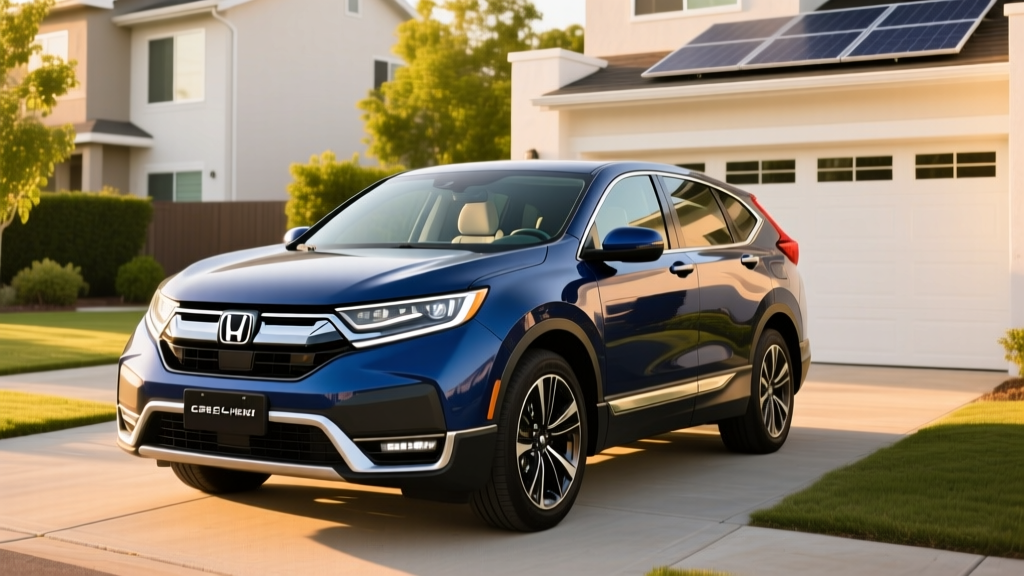
The Honda CR-V EX-L Hybrid occupies a pragmatic middle ground in the compact SUV segment. It pairs a 2.0-liter Atkinson-cycle four-cylinder with a two-motor hybrid system for a combined 204 horsepower and 247 lb-ft of torque, delivering an EPA-estimated 40 MPG combined with standard all-wheel drive. For buyers who want meaningful fuel savings without changing their refueling habits — no plugs, no range anxiety, no charging apps — the CR-V EX-L Hybrid is one of the most rational choices in the 2026 model year.
Before we break down the numbers, it is essential to clarify what this vehicle is and is not.
HEV vs PHEV: What You Need to Know
The Honda CR-V Hybrid is a conventional hybrid electric vehicle (HEV). It cannot be plugged in. Its small lithium-ion battery (approximately 1.1 kWh usable) recharges exclusively through regenerative braking and the gasoline engine. You drive it exactly like a normal gas car — fill up at any station, no charger required.
A plug-in hybrid (PHEV), by contrast, has a larger battery (typically 15-25 kWh) that you charge from a wall outlet or charging station, giving 25-50 miles of electric-only driving before the gas engine engages. Honda does not currently offer a PHEV version of the CR-V in the United States. If you want plug-in capability from Honda, you would look at the discontinued Clarity PHEV or wait for future product announcements.
Bottom line: The CR-V EX-L Hybrid never needs a plug. If you were hoping for electric-only commuting, this is not that vehicle.
EPA Fuel Economy and Real-World MPG
According to fueleconomy.gov, the 2026 Honda CR-V Hybrid AWD carries the following EPA estimates:
| Driving Cycle | EPA Estimate | Real-World Expectation |
|---|---|---|
| City | 43 MPG | 42–46 MPG (hybrids often beat EPA in stop-and-go) |
| Highway | 36 MPG | 33–37 MPG (aerodynamic drag reduces hybrid advantage) |
| Combined | 40 MPG | 37–41 MPG depending on driving mix |
Why Hybrids Often Exceed EPA City Estimates
The EPA city cycle involves frequent stops and low average speeds — exactly where a hybrid system thrives. Regenerative braking recovers kinetic energy that a conventional car wastes as heat, and the electric motor handles low-speed acceleration where gasoline engines are least efficient. Owners who drive predominantly in urban and suburban conditions regularly report 42-46 MPG in warm weather, occasionally beating the sticker.
Highway driving tells a different story. At 70+ MPH, aerodynamic drag dominates and the hybrid system's advantages diminish. Expect 33-36 MPG on sustained freeway trips, especially with roof cargo boxes or headwinds. Cold weather (below 35°F) typically shaves 3-5 MPG off combined figures due to increased engine idling for cabin heat and reduced battery efficiency.
Total Range Reality
With a 15.2-gallon fuel tank and 40 MPG combined, the CR-V Hybrid delivers roughly 540–600 miles per tank in mixed driving. Highway-heavy road trips will see that drop toward 490-510 miles. Cold-weather winter driving can reduce it further to around 470 miles.
Powertrain and Performance Specifications
| Specification | 2026 Honda CR-V EX-L Hybrid |
|---|---|
| Powertrain | 2.0L Atkinson-cycle I-4 + two-motor hybrid system |
| Combined Horsepower | 204 hp |
| Combined Torque | 247 lb-ft (electric motor peak) |
| Transmission | e-CVT (electronic continuously variable) |
| Drivetrain | AWD standard (rear-mounted electric motor) |
| 0–60 MPH | ~7.6 seconds (est.) |
| Battery Type | Lithium-ion (~1.1 kWh usable) |
| Towing Capacity | 1,000 lbs |
| Cargo Volume | 36.3 cu ft (rear seats up) / 76.5 cu ft (rear seats folded) |
Honda's fourth-generation two-motor hybrid system uses one motor primarily as a generator and the second as the primary drive motor. At highway speeds, a lock-up clutch allows the gasoline engine to directly drive the front wheels for improved efficiency. The AWD system uses a dedicated rear electric motor — there is no mechanical driveshaft connecting front and rear axles. This setup provides responsive torque vectoring in low-traction conditions without the parasitic drivetrain losses of a traditional mechanical AWD system.
Acceleration is adequate rather than thrilling. The 247 lb-ft of electric torque is available from near-zero RPM, giving the CR-V Hybrid a responsive feel around town that belies its 7.6-second 0-60 time. Highway passing maneuvers are confident, though the e-CVT can produce the characteristic "rubber-band" drone under hard acceleration — a common trait of Honda's hybrid systems.
Pricing, Trims, and Tax Credit Eligibility
The 2026 Honda CR-V EX-L Hybrid carries an MSRP of approximately $38,950 (including destination charge). This positions it roughly $1,500-$2,000 above the equivalent gas-only CR-V EX-L AWD, a premium you typically recoup through fuel savings within 2-3 years depending on mileage and local gas prices.
Federal Tax Credit: The Honest Answer
The Honda CR-V Hybrid does not qualify for the federal §30D Clean Vehicle Credit. Under current IRS rules, only battery electric vehicles (BEVs) and plug-in hybrid electric vehicles (PHEVs) with a minimum battery capacity of 7 kWh are eligible. As a conventional HEV with a ~1.1 kWh battery, the CR-V Hybrid falls outside the program's scope.
§30D Credit Requirements (for reference)
- Must be a BEV or PHEV (not a conventional HEV)
- PHEVs require minimum 7 kWh battery capacity
- Vehicle MSRP caps: $80,000 for SUVs, $55,000 for sedans
- Buyer income caps: $150K single / $300K joint filers (modified AGI)
- Battery components and critical minerals must meet North American sourcing thresholds
- Point-of-sale transfer available at participating dealers
For the latest rules, consult IRS.gov §30D guidance.
Some states and utilities offer rebates for conventional hybrids, though these are increasingly rare as incentive programs shift toward BEVs and PHEVs. Check your state energy office or utility provider for current programs.
Battery Longevity, Warranty, and Replacement Cost
Hybrid battery anxiety is the number-one concern we hear from prospective buyers. Here is what the data actually shows.
Honda Hybrid Battery Warranty
Duration: 8 years / 100,000 miles (10 years / 150,000 miles in CARB states including California, New York, Massachusetts, and others adopting California emissions standards)
Coverage: Defects and capacity loss below functional thresholds
Transferable: Yes, warranty transfers to subsequent owners
Real-World Degradation Data
Honda's hybrid battery is small (~1.1 kWh) and the system's software carefully manages the state of charge, never allowing the battery to fully deplete or fully charge. This shallow-cycling strategy dramatically extends cell life. Based on long-term fleet data from Honda and Toyota hybrid systems, meaningful degradation (below 80% capacity) typically does not appear until 150,000-200,000+ miles or 12-15 years of service.
The CR-V Hybrid's battery is fundamentally different from a full EV's large pack. It is not subjected to the deep charge-discharge cycles that accelerate wear in BEVs. Many first-generation Honda and Toyota hybrids from the early 2000s are still running on their original batteries at well over 200,000 miles.
Replacement Cost If Needed
If the hybrid battery does fail outside of warranty, a replacement from Honda typically costs between $2,500 and $4,000 including labor. Third-party refurbished battery options are available for $1,500-$2,500. Given the battery's track record, most owners will sell the vehicle long before a replacement becomes necessary.
Who Should Buy the CR-V EX-L Hybrid (and Who Shouldn't)
Not every buyer benefits equally from a hybrid. Here is a decision framework based on driving patterns and priorities.
Choose the CR-V EX-L Hybrid If:
- You drive 12,000+ miles per year and want lower fuel costs without behavioral change
- Your commute involves significant stop-and-go or suburban driving (where the hybrid advantage peaks)
- You live in an apartment or lack home charging access (no plug needed)
- You want AWD capability without the fuel penalty of a conventional AWD SUV
- You plan to own the vehicle 8+ years and value proven reliability
Consider a PHEV Instead If:
- You have home charging and a commute under 30 miles (a PHEV can cover most trips on electricity alone)
- You want to reduce gasoline consumption by 60-80% rather than 25-30%
- You want access to the §30D federal tax credit (up to $7,500 for qualifying PHEVs)
Consider a Full EV (BEV) Instead If:
- You have reliable home Level 2 charging and want zero tailpipe emissions
- Your daily driving is under 250 miles and you rarely road-trip beyond DC fast-charger coverage
- You want to eliminate oil changes, spark plugs, and transmission fluid entirely
- You qualify for the full $7,500 federal credit and state incentives
Ownership Cost Snapshot: 5-Year Fuel Savings
Assuming 15,000 miles per year, $3.50/gallon gas, and a gas-only CR-V AWD at 28 MPG combined vs. the Hybrid at 40 MPG combined:
| Cost Factor | CR-V Gas AWD (28 MPG) | CR-V Hybrid AWD (40 MPG) |
|---|---|---|
| Annual fuel cost | $1,875 | $1,313 |
| 5-year fuel cost | $9,375 | $6,563 |
| 5-year fuel savings | — | $2,812 |
| Purchase price premium | — | ~$1,500–$2,000 |
| Net 5-year savings | — | ~$800–$1,300 |
The hybrid premium pays for itself within roughly 2.5 years at this mileage. Drivers who keep the vehicle longer or drive more miles see increasingly favorable economics. The hybrid also tends to hold resale value well, further improving total cost of ownership.
Reliability, Safety, and What Owners Report
Honda's hybrid powertrain has been in production since the early 2000s (Insight, Civic Hybrid, Accord Hybrid) and is among the most proven in the industry. The fourth-generation two-motor system used in the current CR-V has been in service since the 2023 model year with no widespread reliability concerns reported by NHTSA or major owner forums.
The CR-V earned top safety marks from the IIHS, including a Top Safety Pick designation, with standard Honda Sensing suite (adaptive cruise control, lane-keeping assist, automatic emergency braking, and road departure mitigation). Note that Honda Sensing is an SAE Level 2 driver-assist system — it requires continuous driver attention and hands on the steering wheel. It is not a self-driving system.
Pros
- 40 MPG combined with AWD — among the best in the compact SUV class
- No plug required; drives exactly like a conventional car
- Strong reliability track record for Honda's hybrid system
- 8-year/100K-mile battery warranty (10 yr/150K in CARB states)
- Spacious cargo area and comfortable ride quality
- Standard AWD with electric rear motor — no fuel penalty vs FWD
Cons
- No federal tax credit eligibility (HEV, not PHEV)
- e-CVT drone under hard acceleration
- Highway MPG advantage narrows significantly vs. gas model
- Towing limited to 1,000 lbs (insufficient for most trailers)
- No PHEV variant available for electric-only commuting
- Purchase premium over gas model takes ~2.5 years to recoup
Frequently Asked Questions
How many MPG does the Honda CR-V EX-L Hybrid get?
The EPA rates the 2026 CR-V Hybrid AWD at 43 city / 36 highway / 40 combined MPG. In real-world driving, owners frequently see 42-46 MPG in city conditions and 33-37 MPG on sustained highway trips. Cold weather reduces combined figures by roughly 3-5 MPG.
Can I plug in the Honda CR-V Hybrid to charge it?
No. The CR-V Hybrid is a conventional HEV, not a PHEV. It charges its small battery internally through regenerative braking and the gasoline engine. You never plug it in — you simply refuel at a gas station like any other vehicle.
Is the CR-V Hybrid reliable? What about battery replacement cost?
Honda's hybrid system is one of the most proven in the industry, with decades of production history. The hybrid battery is warrantied for 8 years/100,000 miles (10 years/150,000 in CARB states). Real-world data suggests the battery often lasts 150,000-200,000+ miles. If replacement is needed out of warranty, expect $2,500-$4,000 from a Honda dealer, or $1,500-$2,500 for a refurbished unit.
Does the Honda CR-V Hybrid qualify for any tax credit?
No. The federal §30D Clean Vehicle Credit applies only to BEVs and PHEVs with at least 7 kWh of battery capacity. The CR-V Hybrid's ~1.1 kWh battery does not qualify. Some state or utility programs may offer small incentives for hybrids, but these vary by jurisdiction and are becoming less common.
How does the CR-V Hybrid compare to the Toyota RAV4 Hybrid?
The Toyota RAV4 Hybrid AWD is rated at 41 city / 38 highway / 41 combined MPG — slightly higher highway and combined figures. The RAV4 Hybrid also offers 219 hp vs. the CR-V's 204 hp. However, the CR-V Hybrid offers a more refined interior, slightly more cargo volume, and a more modern infotainment system in the EX-L trim. Both are excellent choices; the decision often comes down to brand preference, dealer proximity, and interior aesthetics.
Is the hybrid worth the extra cost over the gas CR-V?
For most buyers driving 12,000+ miles per year, yes. The ~$1,500-$2,000 premium over the gas-only CR-V AWD is typically recouped in fuel savings within 2-3 years. Beyond the financials, you gain smoother low-speed acceleration from the electric motor, standard AWD with no fuel penalty, and the satisfaction of fewer emissions per mile.