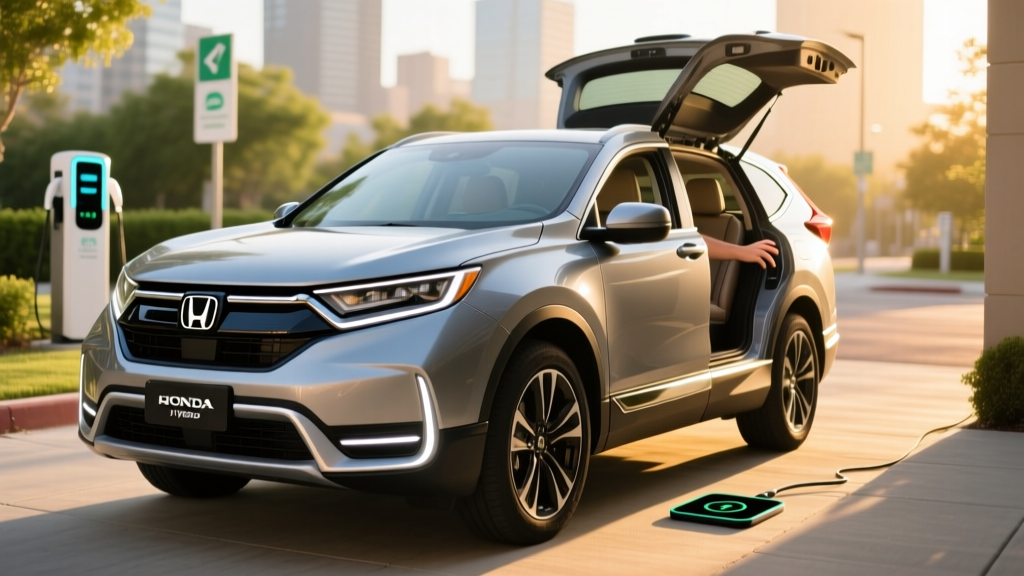
The 2025 Honda CR-V Hybrid SUV occupies a narrow but important lane in the compact crossover market: it delivers genuine hybrid fuel economy without asking buyers to plug in, change their habits, or pay a steep premium. With the hybrid powertrain now available across four trims, Honda has positioned the CR-V Hybrid as the volume play in a lineup that also includes a conventional gas model and, notably, no plug-in hybrid variant for the US market.
This guide breaks down the 2025 CR-V Hybrid's real-world efficiency, powertrain specs, pricing, battery longevity, and how it stacks up against PHEV and full-EV alternatives — so you can decide whether this HEV is the right electrified vehicle for your driveway.
HEV vs PHEV vs EV: Where the CR-V Hybrid Fits
Before digging into specs, it's essential to understand what the 2025 CR-V Hybrid is — and what it is not. Honda offers this model as a conventional hybrid electric vehicle (HEV). It cannot be plugged in. There is no charging port, no electric-only driving mode for meaningful distances, and no federal tax credit eligibility.
HEV vs PHEV vs BEV — Quick Reference
| Feature | HEV (CR-V Hybrid) | PHEV (e.g., Toyota RAV4 Prime) | BEV (e.g., Hyundai Ioniq 5) |
|---|---|---|---|
| Plugs in? | No | Yes | Yes |
| Electric-only range | ~1 mi (low speed) | 25–42 mi typical | 250–350 mi |
| Fuel source | Gasoline only | Gasoline + grid electricity | Grid electricity only |
| Home charging needed? | No | Recommended (Level 2) | Essential |
| Federal tax credit (§30D) | Not eligible | Up to $7,500 if sourcing rules met | Up to $7,500 if sourcing rules met |
| Price premium vs gas | ~$1,500–$3,000 | ~$5,000–$8,000 | ~$8,000–$15,000 |
Honda does not currently sell a CR-V PHEV in the United States. If plug-in capability is a dealbreaker, you'll need to look at competitors like the Toyota RAV4 Prime (42 miles electric-only, 94 MPGe) or the Hyundai Tucson PHEV (33 miles electric-only).
Fuel Economy: EPA Ratings and Real-World MPG
The 2025 CR-V Hybrid pairs a 2.0-liter Atkinson-cycle four-cylinder engine with two electric motors and a lithium-ion battery pack, sending power to all four wheels through Honda's Real Time AWD system. AWD is standard on every hybrid trim — there is no front-wheel-drive hybrid option.
| Metric | EPA Rating |
|---|---|
| City | 40 MPG |
| Highway | 34 MPG |
| Combined | 37 MPG |
| Fuel tank | 14.0 gallons |
| Total range | ~518 miles |
Source: fueleconomy.gov
Real-World MPG vs EPA Sticker
Honda's hybrid system excels in stop-and-go city driving, where the electric motors handle low-speed propulsion and regenerative braking recaptures energy. In real-world testing, owners frequently report 38–42 MPG in city and suburban driving, exceeding the EPA city estimate. However, sustained highway driving at 70–80 mph drops efficiency to roughly 30–33 MPG, below the EPA highway figure. Cold weather (below 35°F) can reduce combined fuel economy by 10–15%, as the engine runs more frequently to heat the cabin and maintain battery temperature. Expect an annual average of 35–38 MPG combined for most drivers in mixed use.
Powertrain Specs: Horsepower, Motors, and Drivetrain
| Spec | Value |
|---|---|
| Engine | 2.0L DOHC Atkinson-cycle 4-cylinder |
| Engine output | 145 hp / 134 lb-ft torque |
| Electric motors | Dual-motor hybrid system |
| Combined system output | 204 hp / 247 lb-ft torque |
| Transmission | e-CVT (no traditional gears) |
| Drivetrain | Real Time AWD (standard) |
| 0–60 mph | ~7.6 seconds (est.) |
| Towing capacity | 1,000 lbs |
| Hybrid battery | ~1.06 kWh lithium-ion (self-charging) |
The two-motor system operates differently than a traditional hybrid. One motor primarily generates electricity from the engine; the other drives the wheels. At highway speeds, a lock-up clutch connects the engine directly to the wheels for efficiency. The result is smooth, responsive acceleration around town with none of the rubber-band feeling that older CVTs produced.
One limitation: the 1,000-pound towing capacity is modest. If you need to tow a small trailer or boat, the gas-only CR-V (1,500 lbs) or a competitor like the RAV4 Hybrid (1,750 lbs) offers more capability.
Pricing, Trims, and Tax Credit Eligibility
The 2025 CR-V Hybrid is available in four trims. Here's the MSRP breakdown (destination charge included):
| Trim | MSRP (incl. destination) |
|---|---|
| Sport Hybrid | $36,395 |
| Sport-L Hybrid | $38,745 |
| Sport Touring Hybrid | $41,845 |
Pricing per Honda's official site. Verify with your dealer as prices may vary.
Federal Tax Credit: Not Eligible
The 2025 Honda CR-V Hybrid is a conventional HEV and does not qualify for the IRS §30D Clean Vehicle Credit. That credit — up to $7,500 — applies only to plug-in electric vehicles (BEVs and PHEVs) that meet battery sourcing, MSRP caps, and buyer income limits as defined by the IRS.
Some states and utilities offer rebates for conventional hybrids, but these vary by jurisdiction. Check your state energy office or local utility for current programs.
Battery Warranty, Reliability, and Replacement Cost
Hybrid battery longevity is consistently the top concern among first-time hybrid buyers. Here's what Honda provides:
2025 CR-V Hybrid — Battery & Powertrain Warranty
- Hybrid battery warranty: 8 years / 100,000 miles (10 years / 150,000 miles in CARB states — CA, CO, CT, MA, MD, ME, NJ, NY, OR, RI, VT, WA)
- Powertrain warranty: 5 years / 60,000 miles
- Limited vehicle warranty: 3 years / 36,000 miles
- Hybrid system components: Covered under the 8-year/100,000-mile hybrid battery warranty
The CR-V Hybrid's lithium-ion battery pack is small (~1.06 kWh) compared to a PHEV or BEV, which works in its favor for longevity. Smaller batteries experience less stress per cycle and are managed by Honda's thermal system to avoid extreme states of charge. Based on data from Honda's earlier hybrid systems (Insight, Accord Hybrid), degradation is typically minimal — expect less than 10% capacity loss over 150,000 miles under normal use.
Battery replacement cost: If the hybrid battery fails outside of warranty, replacement currently runs between $2,000 and $4,000 including parts and labor at a Honda dealer. Third-party hybrid battery refurbishers offer reconditioned units for $1,200–$2,000. However, out-of-warranty failures are rare on Honda's current-generation hybrid systems, which have been in production since the 2023 model year refresh.
For reliability data, the CR-V has consistently scored well with IIHS Top Safety Pick ratings. Honda's two-motor hybrid system has fewer moving parts than a traditional automatic transmission (no torque converter, no planetary gearset), which reduces long-term mechanical complexity.
Who Should Buy the CR-V Hybrid vs a PHEV or Full EV
Choose the CR-V Hybrid If…
- You don't have access to home or workplace charging
- You want 37+ MPG without changing any habits
- You live in a region with extreme cold (hybrids lose less efficiency than EVs in winter)
- Your budget tops out around $38,000–$42,000
- You want AWD as standard equipment
- You take frequent long road trips and don't want to plan charging stops
Consider a PHEV or EV Instead If…
- You have reliable Level 2 home charging and a short commute (<35 miles)
- You want to drive on electricity alone most days (PHEV or BEV)
- You qualify for the full $7,500 federal tax credit (reduces PHEV/BEV effective cost)
- You want one-pedal driving and instant torque (BEV)
- Your state offers additional EV/PHEV rebates that hybrids don't qualify for
- You want to eliminate gasoline use entirely (BEV)
Decision Framework: CR-V Hybrid vs the Competition
CR-V Hybrid vs Toyota RAV4 Hybrid: The RAV4 Hybrid offers slightly more power (219 hp), higher towing capacity (1,750 lbs), and a marginally lower starting price. The CR-V Hybrid counters with a more refined interior, slightly better city MPG, and a more car-like ride. Both are strong picks — test-drive both.
CR-V Hybrid vs Toyota RAV4 Prime (PHEV): The RAV4 Prime delivers 42 miles of electric-only range and 94 MPGe, plus it qualifies for the $7,500 federal credit (verify current sourcing rules). But it starts at ~$44,000 before incentives and has limited availability. If you can charge at home and find one in stock, the RAV4 Prime is the more capable electrified SUV — but the price gap is significant.
CR-V Hybrid vs a BEV (Hyundai Ioniq 5, Tesla Model Y): Full EVs eliminate fuel costs and maintenance but require reliable charging access. If you can install a Level 2 home charger and your daily driving is under 250 miles, a BEV offers lower running costs. If charging access is uncertain, the CR-V Hybrid is the safer choice.
Ownership Costs: 5-Year Estimate
| Category | CR-V Hybrid (Sport) | CR-V Gas (EX AWD) |
|---|---|---|
| Purchase price (MSRP) | $36,395 | $34,395 |
| Fuel cost (15,000 mi/yr) | ~$7,100 | ~$9,700 |
| Maintenance (5 yr) | ~$2,200 | ~$2,800 |
| Insurance (est. avg) | ~$7,500 | ~$7,200 |
| Total estimated | ~$53,195 | ~$54,095 |
Fuel cost assumes $3.40/gallon regular unleaded, 15,000 miles/year, 55% city/45% highway mix. Gas model rated at 30 MPG combined EPA. Insurance varies significantly by driver profile and state. Source: EPA data via fueleconomy.gov.
The hybrid's $2,000 price premium is typically recovered through fuel savings within 3–4 years of average driving, after which the hybrid costs less to operate than the gas model. The hybrid also eliminates the traditional automatic transmission, which can reduce long-term repair risk.
Frequently Asked Questions
How many MPG does the 2025 Honda CR-V Hybrid get?
The EPA rates the 2025 CR-V Hybrid at 40 MPG city, 34 MPG highway, and 37 MPG combined. Real-world results vary: city and suburban drivers often see 38–42 MPG, while sustained highway driving at higher speeds yields 30–33 MPG. Cold weather can reduce combined efficiency by 10–15%.
Does the CR-V Hybrid need to be plugged in?
No. The 2025 CR-V Hybrid is a conventional HEV. It charges its small lithium-ion battery through regenerative braking and the gasoline engine. There is no charging port and no plug. You simply fill it with gasoline like any other car.
Is there a plug-in hybrid (PHEV) version of the CR-V?
Not in the United States. Honda does not offer a CR-V PHEV for the US market as of the 2025 model year. If you want a compact PHEV SUV, the Toyota RAV4 Prime (42 miles electric-only) and Hyundai Tucson PHEV (33 miles electric-only) are the closest competitors.
Is the CR-V Hybrid reliable, and what does a battery replacement cost?
Honda's two-motor hybrid system has a strong reliability track record, with fewer moving parts than a conventional automatic transmission. The hybrid battery is warrantied for 8 years/100,000 miles (10 years/150,000 miles in CARB states). Out-of-warranty battery replacement runs $2,000–$4,000 at a dealer, but failures are uncommon on current-generation Honda hybrids.
Does the 2025 CR-V Hybrid qualify for a federal tax credit?
No. The IRS §30D Clean Vehicle Credit applies only to plug-in vehicles (BEVs and PHEVs) that meet specific battery sourcing, MSRP, and buyer income requirements. Conventional hybrids like the CR-V Hybrid are not eligible. Check with your state energy office for any local hybrid incentives, which vary by jurisdiction.
How does the CR-V Hybrid compare to the RAV4 Hybrid?
The Toyota RAV4 Hybrid offers 219 hp (vs 204 hp), 1,750 lbs towing (vs 1,000 lbs), and a slightly lower starting price. The CR-V Hybrid delivers slightly better city MPG, a quieter cabin, and a more car-like ride quality. Both are excellent hybrid SUVs — the choice often comes down to test-drive feel and dealer availability in your area.
Can the CR-V Hybrid run on electric power alone?
Only for very short distances at low speeds (roughly under 1 mile at speeds below 25 mph). The hybrid system uses the electric motor to assist acceleration and enable brief engine-off coasting, but it cannot sustain electric-only driving like a PHEV or BEV. The gasoline engine is always available and frequently active.