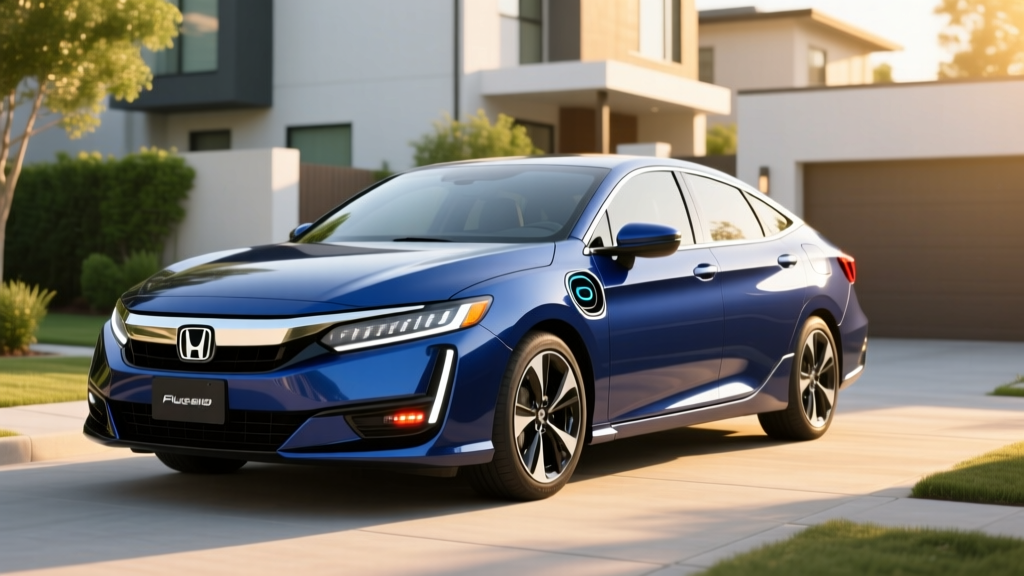
The Honda Clarity Plug-In Hybrid occupies a specific niche: drivers who want meaningful electric-only commuting without the range limitations of a full battery-electric vehicle. Originally produced from 2018 through 2022, the Clarity PHEV remains one of the most practical used plug-in hybrids on the market in 2026, offering a class-leading 47 miles of EPA-rated electric range paired with a proven two-motor hybrid system. If you're researching the Honda Clarity Plug-In Hybrid as a daily driver, this guide covers every spec that matters — from real-world MPG to battery longevity and tax-credit eligibility.
Honda Clarity PHEV at a Glance: Key Specifications
| Specification | Detail |
|---|---|
| Powertrain | 1.5L Atkinson-cycle 4-cylinder + 2-motor hybrid system |
| Combined Horsepower | 212 hp (net system output) |
| Electric Motor Output | 181 hp / 232 lb-ft torque |
| Battery Capacity | 17.0 kWh total (14.0 kWh usable), lithium-ion |
| EPA Electric-Only Range | 47 miles |
| EPA Combined Range (EV + Gas) | 340 miles |
| EPA MPGe (EV Mode) | 110 MPGe combined |
| EPA MPG (Hybrid Mode) | 44 city / 40 highway / 42 combined |
| Charging (Level 1, 120V) | ~12 hours (0–100%) |
| Charging (Level 2, 240V/32A) | ~2.5 hours (0–100%) |
| DC Fast Charging | Not supported (CCS/CHAdeMO not available) |
| Fuel Tank | 7.0 gallons |
| 0–60 mph | ~7.7 seconds |
| Cargo Volume | 15.5 cu ft |
| Original MSRP (2022) | $33,400 (base) / $36,620 (Touring) |
| 2026 Used Market Range | $18,000 – $28,000 depending on mileage and condition |
HEV vs PHEV: Understanding the Clarity's Place
Before evaluating the Clarity, it's essential to distinguish between conventional hybrids (HEVs) and plug-in hybrids (PHEVs), because Honda confusingly marketed both under the Clarity nameplate.
Conventional Hybrid (HEV)
A standard HEV like the Toyota Prius or Honda Accord Hybrid uses a small battery (typically 1–2 kWh) that recharges exclusively through regenerative braking and the gasoline engine. You never plug it in. Electric-only driving is limited to brief low-speed bursts. Expect 48–57 MPG combined with no plug-in requirement.
Plug-In Hybrid (PHEV) — The Clarity PHEV
The Honda Clarity Plug-In Hybrid carries a much larger 17.0 kWh battery pack that you charge by plugging into a wall outlet or Level 2 station. This enables 47 miles of genuine highway-capable electric-only driving before the gasoline engine engages. Once the battery depletes, it operates as a conventional hybrid at 42 MPG combined. You get the best of both worlds — EV commuting with gas-engine road-trip flexibility.
Key distinction: The Clarity was also sold as a fuel-cell vehicle (Clarity Fuel Cell) and a pure battery-electric vehicle (Clarity Electric, 89-mile range) — both California-only and now discontinued. When shopping used, verify you're looking at the Plug-In Hybrid variant specifically. The VIN and badging will confirm it.
Electric Range, MPG, and Real-World Efficiency
| Driving Mode | EPA Rating | Real-World Expectation |
|---|---|---|
| Electric-Only Range | 47 miles | 38–45 mi (highway/cold); up to 52 mi (city, mild weather) |
| EV Efficiency | 110 MPGe (31 kWh/100 mi) | 95–115 MPGe depending on conditions |
| Hybrid Mode — City | 44 MPG | 42–50 MPG (hybrids often exceed EPA in city) |
| Hybrid Mode — Highway | 40 MPG | 37–42 MPG |
| Hybrid Mode — Combined | 42 MPG | 40–46 MPG |
Real-World Range Note: The EPA's 47-mile electric range is achievable in mixed city/suburban driving at moderate temperatures. In our experience and owner reports, expect 38–42 miles of electric range at sustained highway speeds (70+ mph) and as low as 32–35 miles in freezing weather (below 30°F) due to cabin heating demands and reduced battery efficiency. Conversely, city driving in mild weather with frequent regenerative braking can push the electric range past 50 miles. The Clarity's hybrid-mode MPG is remarkably consistent — many owners report 44–48 MPG in city driving, where the two-motor system excels at low-speed efficiency. Source: fueleconomy.gov — 2022 Honda Clarity PHEV.
How Far Can the Honda Clarity PHEV Go on Electric Only?
The EPA-rated 47 miles of electric-only range is the highest of any mainstream PHEV sedan from its generation. For context, the Toyota Prius Prime (2017–2022 generation) offered 25 miles, and the Hyundai Ioniq PHEV offered 29 miles. The newer 2023+ Prius Prime reaches 44 miles, still slightly below the Clarity.
What does 47 miles cover? According to FHWA data, the average American drives roughly 37 miles per day. That means most commuters can complete their daily driving entirely on electricity, only engaging the gasoline engine for longer weekend trips or errands. If you charge nightly at home, you may go weeks between fill-ups.
Charging the Clarity PHEV: What You Need to Know
The Clarity PHEV uses a standard J1772 connector for AC charging. Here's what to expect at each charging level:
| Charging Level | Power | Time (0–100%) | Miles of Range Added per Hour |
|---|---|---|---|
| Level 1 (120V household outlet) | ~1.4 kW | ~12 hours | ~4 miles/hr |
| Level 2 (240V, 32A) | ~7.2 kW (onboard charger max) | ~2.5 hours | ~19 miles/hr |
| DC Fast Charging | N/A | N/A | N/A — not supported |
Critical detail: The Clarity PHEV does not support DC fast charging. There is no CCS or CHAdeMO port. All charging is AC-only through the J1772 inlet. This is typical for PHEVs with smaller batteries — the 17.0 kWh pack charges quickly enough on Level 2 that DC fast charging was deemed unnecessary by Honda.
Home charging recommendation: A Level 2 home charger (240V, 32A) is strongly recommended. At 7.2 kW, you'll fully replenish the battery in about 2.5 hours, meaning even midday top-ups are practical if you work from home. Installation typically costs $500–$1,500 depending on your electrical panel's capacity and the run length from panel to charger location. Most Clarity PHEV owners find that plugging in nightly on a Level 2 unit makes the electric range effectively "free" daily mileage.
On Level 1 (a standard 120V wall outlet), you'll recover roughly 4 miles of range per hour of charging. An overnight session (10–12 hours) can still fully recharge the battery, making Level 1 viable for low-mileage commuters who don't want to invest in a Level 2 installation.
Powertrain, Performance, and Driving Experience
The Clarity PHEV pairs a 1.5-liter Atkinson-cycle four-cylinder engine (103 hp on its own) with Honda's two-motor hybrid system. The primary drive motor produces 181 hp and 232 lb-ft of torque, for a net system output of 212 hp. Unlike some PHEVs that feel sluggish once the battery depletes, the Clarity's larger electric motor ensures strong acceleration in all modes.
The 0–60 mph time of approximately 7.7 seconds is respectable for a midsize sedan focused on efficiency. More importantly, the instant torque from the electric motor makes the Clarity feel quicker in city driving than the 0–60 number suggests. The transition between electric and hybrid modes is seamless — most drivers won't notice when the engine engages.
Three driving modes are available:
- EV Mode: Pure electric driving up to ~100 mph (engine stays off unless you floor the accelerator)
- HV Mode: Hybrid operation that preserves battery charge for later use — ideal for highway segments before entering a city
- Sport Mode: Sharper throttle response and combined engine/motor output for spirited driving
Regenerative braking is adjustable via steering-wheel paddles, offering four levels of regen intensity. While not quite one-pedal driving, the highest regen setting provides significant deceleration when you lift off the accelerator, recovering energy efficiently in stop-and-go traffic.
Battery Warranty, Reliability, and Replacement Costs
Honda Clarity PHEV Battery Warranty
- Hybrid battery warranty: 8 years / 100,000 miles (10 years / 150,000 miles in CARB states — CA, NY, MA, CT, RI, VT, ME, NJ, OR, WA, MD, CO, and others adopting California emissions standards)
- Capacity threshold: Honda covers the battery if it falls below approximately 70% of original capacity within the warranty period
- Powertrain warranty: 5 years / 60,000 miles
- Original MSRP (2022 base): $33,400
Is the Honda Clarity PHEV Reliable?
Honda's two-motor hybrid system is one of the most proven in the industry, shared across the Accord Hybrid, CR-V Hybrid, and Insight. The Clarity's 17.0 kWh lithium-ion battery pack uses NMC (nickel-manganese-cobalt) chemistry, which has demonstrated strong longevity in Honda's hybrid lineup.
Owner reports on platforms like ClarityForum and Reddit's r/HondaClarity indicate minimal battery degradation — most owners report losing 5–8% of electric range over 3–5 years and 50,000–80,000 miles. This is consistent with industry data showing NMC batteries retaining 85–92% capacity after 5 years of typical PHEV use.
Common issues reported by owners are relatively minor:
- Infotainment glitches: The 8-inch touchscreen can be slow to respond; Apple CarPlay/Android Auto occasionally disconnects
- Rear visibility: The split rear window (with a spoiler element) creates a blind spot — the standard backup camera helps
- Cargo space: The battery pack reduces trunk volume to 15.5 cu ft, and the rear seats do not fold flat (a 60/40 split fold is available but with a pass-through step)
Battery Replacement Cost
If the hybrid battery requires replacement out of warranty, expect to pay between $3,000 and $5,500 for a refurbished or new OEM battery pack plus labor. Independent hybrid-battery specialists can often refurbish the existing pack for $2,000–$3,500. Given that Honda's 8–10 year warranty covers most vehicles still on the road in 2026 (the newest Clarity PHEVs are 2022 models, meaning they're still under warranty through at least 2030), out-of-pocket replacement is unlikely for most current buyers.
Tax Credits and Incentives: What Applies in 2026?
When new, the Honda Clarity PHEV qualified for the full $7,500 federal tax credit under the pre-2023 rules (IRC §30D). However, the Inflation Reduction Act of 2022 overhauled the credit structure, adding battery-sourcing, critical-mineral, MSRP cap, and buyer income requirements.
§30D Federal Tax Credit — Key Rules for Used PHEVs (2026)
- Used EV/PHEV credit (IRC §25E): Up to $4,000 or 30% of the sale price (whichever is lower) for qualified used plug-in hybrids purchased from a dealer
- Sale price cap: Vehicle must be sold for $25,000 or less to qualify for the used-vehicle credit
- Buyer income limits: Adjusted gross income must not exceed $75,000 (single), $112,500 (head of household), or $150,000 (married filing jointly)
- Vehicle age requirement: Must be at least 2 model years old (all Clarity PHEVs qualify)
- Battery capacity: Must have at least 7 kWh (Clarity's 17.0 kWh qualifies)
- Point-of-sale transfer: The credit can be applied at the dealership as a price reduction, not just at tax filing
- Frequency limit: One used-vehicle credit per buyer every 3 years
Source: IRS.gov — Previously-Owned Clean Vehicle Credit. Always verify current rules with a tax professional.
What this means for Clarity PHEV buyers in 2026: With used prices ranging from $18,000–$28,000, many Clarity PHEVs fall at or near the $25,000 used-vehicle credit threshold. If you find one priced at $25,000 or below and meet the income requirements, you could qualify for up to $4,000 off (30% of $18,000 = $5,400, but capped at $4,000). This can make the Clarity PHEV one of the most affordable ways into plug-in hybrid ownership.
Who Should Choose the Clarity PHEV vs. a Full EV or Gas Car?
Choose the Honda Clarity PHEV If:
- Your daily commute is under 45 miles round-trip and you can charge at home
- You take regular road trips (200+ miles) where charging infrastructure is sparse
- You want to reduce fuel costs without committing to full EV ownership
- You live in an apartment or area where home charging is possible but DC fast charging access is limited
- You want a comfortable midsize sedan with Honda reliability at a used-market bargain
Choose a Full EV (BEV) Instead If:
- You have reliable home Level 2 charging and rarely drive more than 250 miles in a day
- You want zero tailpipe emissions and minimal maintenance (no oil changes, no engine)
- You qualify for the full $7,500 new-EV federal credit on a current model
- You prefer the latest tech, ADAS features, and over-the-air updates
Choose a Conventional Hybrid (HEV) Instead If:
- You cannot charge at home or at work (no plug-in access)
- You want maximum simplicity — no charging cables, no plug-in routine
- Your budget is tighter and you want a newer vehicle (new HEVs like the Accord Hybrid start around $30,000)
Stick with a Gas Car If:
- You drive very few miles per year (under 5,000) — the fuel savings won't justify the premium
- You live in an extremely cold climate where EV range loss is severe and your trips are short
Pros
- Class-leading 47-mile EPA electric range among PHEV sedans of its era
- Seamless EV-to-hybrid transition with no range anxiety
- Strong 212 hp system output — not sluggish like some PHEVs
- 42+ MPG in hybrid mode is excellent for a midsize sedan
- Honda Sensing suite (adaptive cruise, lane-keeping, auto emergency braking) is standard
- Spacious rear seat with adult-friendly legroom
- Used-market pricing makes it a strong value in 2026
Cons
- No DC fast charging capability
- Cargo space compromised by battery (15.5 cu ft, no flat-fold rear seat)
- Infotainment system feels dated compared to 2024+ competitors
- Discontinued after 2022 — no new models available
- Rear visibility hampered by split rear window design
- Only available as a used vehicle; warranty coverage varies by remaining term
Frequently Asked Questions
How many MPG does the Honda Clarity Plug-In Hybrid get?
In hybrid mode (after the battery is depleted), the EPA rates the Clarity PHEV at 44 MPG city, 40 MPG highway, and 42 MPG combined. In electric-only mode, it achieves 110 MPGe combined. Real-world owners frequently report 44–48 MPG in city driving, where the hybrid system's regenerative braking and electric-motor dominance deliver peak efficiency.
How far can the Honda Clarity PHEV go on electric only?
The EPA rates the Clarity PHEV at 47 miles of electric-only range. Real-world results vary from approximately 32 miles in freezing weather at highway speeds to over 50 miles in mild-weather city driving. The total combined range (electric + gasoline) is 340 miles.
Does the Honda Clarity PHEV qualify for a tax credit in 2026?
As a used vehicle, the Clarity PHEV may qualify for the federal Previously-Owned Clean Vehicle Credit (IRC §25E) of up to $4,000, provided the sale price is $25,000 or less and the buyer meets income requirements. It no longer qualifies for the new-vehicle §30D credit. Always consult IRS guidelines and a tax professional for your specific situation.
Is the Honda Clarity PHEV reliable?
Yes. Honda's two-motor hybrid system is well-proven, and the Clarity's battery has demonstrated minimal degradation (typically 5–8% over 3–5 years). The hybrid battery is covered by an 8-year/100,000-mile warranty (10 years/150,000 miles in CARB states). Most 2018–2022 models in 2026 still have partial warranty coverage remaining.
What does it cost to replace the Clarity PHEV battery?
Out-of-warranty battery replacement costs approximately $3,000–$5,500 for a new or refurbished OEM pack including labor. Independent hybrid specialists can refurbish the existing pack for $2,000–$3,500. However, given the 8–10 year warranty and typical battery longevity, most owners never face this expense.
Can the Honda Clarity PHEV use DC fast chargers?
No. The Clarity PHEV only supports AC charging via a J1772 connector — Level 1 (120V) and Level 2 (240V). It has no DC fast charging port. This is common for PHEVs with smaller battery packs that charge fully in 2.5 hours on Level 2.
Hybrid vs PHEV vs EV — which should I choose?
If you can charge at home and your commute is under 45 miles, the Clarity PHEV offers the best of both worlds: daily electric driving with gas-engine backup for road trips. If you can't charge at home, a conventional HEV (like the Accord Hybrid) is simpler. If you have home charging and rarely exceed 250 miles daily, a full EV (BEV) offers lower running costs and less maintenance.