The 2018 Honda Clarity Plug-In Hybrid occupies a unique space in the used electrified-car market. Discontinued after the 2021 model year, it remains one of the most compelling PHEV sedans available on the pre-owned lot — offering 47 miles of EPA-rated electric-only range, a spacious midsize cabin, and the ability to function as an efficient hybrid once the battery depletes. For buyers in 2026 who want electric commuting without range anxiety, the Clarity PHEV is worth a serious look.
This guide covers everything a used-car shopper needs to know: real-world range and MPG, battery health and warranty, charging logistics, and how the Clarity stacks up against full EVs and conventional hybrids.
HEV vs PHEV: Understanding What the Clarity Actually Is
Before diving into specs, it's critical to distinguish between the two main hybrid architectures, because Honda sold the Clarity in three distinct variants during its production run:
Conventional Hybrid (HEV)
A standard hybrid like the Toyota Prius uses a small battery (typically 1–2 kWh) that recharges through regenerative braking and the engine. You never plug it in. It improves fuel economy but offers no meaningful electric-only driving.
Plug-In Hybrid (PHEV) — The Clarity
The Clarity Plug-In Hybrid carries a much larger 17.0 kWh battery pack that you charge by plugging in. This enables 47 miles of pure electric driving before the 1.5-liter gasoline engine kicks in as a generator and hybrid assist. Once the battery is depleted, it operates like a conventional hybrid.
Honda also briefly offered a fully electric Clarity EV (89-mile range, discontinued after 2019) and a hydrogen fuel-cell Clarity (lease-only in California). When shopping used, verify you're looking at the Plug-In Hybrid variant — the badging and charge port make it easy to confirm.
2018 Clarity PHEV: Full Powertrain and Efficiency Specs
| Specification | 2018 Honda Clarity Plug-In Hybrid |
|---|---|
| Powertrain | 1.5L Atkinson-cycle 4-cyl + electric motor |
| Combined System Output | 212 hp |
| Electric Motor Output | 181 hp / 232 lb-ft torque |
| Battery Capacity | 17.0 kWh (lithium-ion) |
| EPA Electric-Only Range | 47 miles |
| EPA MPGe (electric + gas) | 110 MPGe |
| EPA MPG (gas-only, battery depleted) | 44 city / 40 hwy / 42 combined |
| Total Combined Range | ~340 miles (EV + gas tank) |
| 0–60 mph | ~7.5 seconds |
| Transmission | E-CVT (single-speed direct drive) |
| Drivetrain | Front-wheel drive |
| Fuel Tank | 7.0 gallons |
| Original MSRP (Base / Touring) | $33,400 / $37,400 |
Electric-Only Range and Real-World Efficiency
EPA vs Real-World Range
EPA Rated: 47 miles electric-only
Real-World Expectation: 38–45 miles in mixed driving; 30–35 miles at sustained highway speeds (70+ mph) or in cold weather (below 40°F). Owners who precondition the cabin while plugged in and drive conservatively in EV mode regularly report hitting or exceeding the EPA figure in moderate-temperature city commuting.
The Clarity's 47-mile electric range was class-leading when it launched and remains competitive in 2026 against newer PHEVs like the Toyota RAV4 Prime (42 mi) and Hyundai Tucson PHEV (33 mi). For most commuters with a sub-40-mile round trip, the Clarity can function as a daily EV — you may go weeks without visiting a gas station.
Once the battery is depleted, the 1.5L engine and hybrid system deliver an EPA-rated 42 MPG combined. According to fueleconomy.gov, real-world owner-reported MPG for the Clarity PHEV in hybrid mode clusters around 40–45 MPG combined, with city driving often exceeding the EPA estimate thanks to regenerative braking. Highway-only driving at 75+ mph may drop to 37–39 MPG.
| Driving Scenario | EPA Estimate | Real-World Expectation |
|---|---|---|
| City (hybrid mode) | 44 MPG | 42–48 MPG |
| Highway (hybrid mode) | 40 MPG | 37–41 MPG |
| Combined (hybrid mode) | 42 MPG | 40–44 MPG |
| Electric-Only Range | 47 miles | 35–45 miles (weather/terrain dependent) |
| Combined MPGe | 110 MPGe | Varies with plug-in frequency |
Charging: What You Need to Know as a Used PHEV Owner
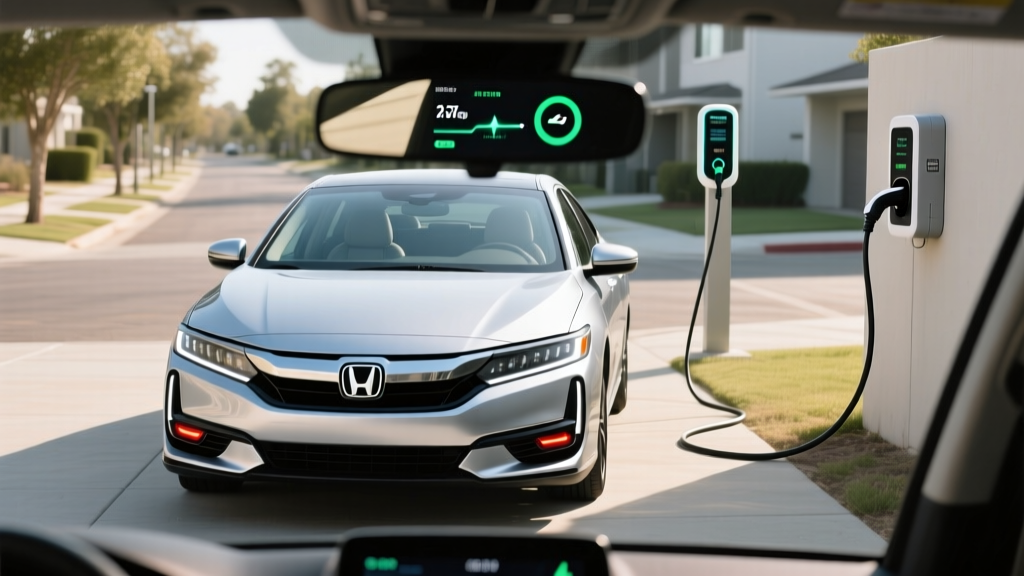
The Clarity PHEV uses a standard J1772 connector for AC charging. It does not support DC fast charging — a common limitation among PHEVs due to their smaller battery packs.
| Charging Level | Power | 0–100% Time | Notes |
|---|---|---|---|
| Level 1 (120V household outlet) | ~1.4 kW | ~12 hours | Trickle charge; adequate for overnight if daily use is low |
| Level 2 (240V home/public) | ~3.3 kW (onboard charger limit) | ~2.5 hours | Recommended for daily use; a 32A Level 2 station is more than sufficient |
| DC Fast Charge | N/A | N/A | Not supported — J1772 AC only |
The Clarity's onboard charger maxes out at 3.3 kW, meaning even a 48A Level 2 station will only deliver 3.3 kW to the battery. A basic 16A/240V home circuit (such as a NEMA 6-20 outlet) delivers roughly the same rate and is perfectly adequate. Installation for a dedicated 240V circuit typically costs $500–$1,500 depending on panel proximity and local electrician rates — far less than a full EV home-charging setup since no panel upgrade is usually needed for this low draw.
Pro tip: Set the Clarity's charge timer to take advantage of off-peak electricity rates. Many utilities offer time-of-use plans where overnight charging costs 3–5¢ per kWh, making your electric-only miles cost roughly $0.04–$0.07 per mile — a fraction of gasoline.
Battery Health, Warranty, and Replacement Cost
Honda Hybrid Battery Warranty
Original Coverage: 8 years / 100,000 miles (10 years / 150,000 miles in CARB states including CA, CT, ME, MA, NJ, NY, OR, RI, VT, WA)
Capacity Threshold: Honda warrants against abnormal degradation — typically defined as falling below ~70% of original capacity.
For a 2018 model in 2026: The 8-year/100k warranty has expired for most vehicles. CARB-state 10-year coverage may still apply through 2028 if under 150,000 miles.
The Clarity's 17.0 kWh lithium-ion pack uses NMC (nickel manganese cobalt) chemistry. Based on data from PHEV fleets and owner forums, Honda's lithium-ion packs have demonstrated strong longevity — most Clarity owners report minimal degradation (5–10% capacity loss) after 80,000–100,000 miles. The relatively small battery and conservative charge management (Honda maintains a buffer at the top and bottom of the pack) contribute to this durability.
Battery replacement cost: If the pack does fail out of warranty, a replacement 17.0 kWh battery from Honda runs approximately $4,000–$6,000 for the part, with labor adding $500–$1,000. Third-party and refurbished options may reduce this. However, catastrophic battery failure on the Clarity PHEV is uncommon — most used examples still retain 90%+ of original capacity based on OBD2 scan data shared by owners.
Before buying used: Request an OBD2 battery health report or have a Honda dealer perform a battery capacity test. Compare the current electric-only range (fully charged, in EV mode, at moderate temperature) against the original 47-mile spec. A reading of 40+ miles indicates healthy battery condition.
Reliability, Safety, and Ownership Costs
The Clarity PHEV shares its powertrain architecture with Honda's well-proven hybrid systems. The 1.5L Atkinson-cycle engine is lightly stressed in hybrid operation, and the E-CVT has no traditional gears or belts to wear. NHTSA crash testing and Honda's standard Honda Sensing suite (forward collision warning, automatic emergency braking, lane-keeping assist, adaptive cruise control) make it a safe family sedan.
Common issues reported by owners:
- Infotainment system lag and occasional freezing (Honda's older interface is dated by 2026 standards)
- Road noise at highway speeds — insulation is adequate but not luxury-grade
- Low ground clearance (5.1 inches) — watch for speed bumps and steep driveways
- No spare tire — the Clarity uses a tire-inflation kit to save weight
Insurance: Expect premiums comparable to a Honda Accord Hybrid — typically $1,200–$1,800/year depending on your profile. PHEVs generally don't carry the insurance surcharge that some full EVs do.
Maintenance: The Clarity PHEV requires standard hybrid maintenance — oil changes every 7,500–10,000 miles (the engine runs less than a gas car, so oil stays cleaner longer), brake pad replacement intervals are extended thanks to regenerative braking (many owners report 80,000+ miles on original pads), and cabin air filter swaps. Expect $400–$700/year in routine maintenance.
Tax Credits and Used PHEV Incentives in 2026
When new, the 2018 Clarity PHEV qualified for the full $7,500 federal tax credit under the original §30D program. That credit is no longer available for new purchases of this discontinued model. However, used buyers in 2026 may qualify for the Used Clean Vehicle Credit under the current IRS rules:
- Credit Amount: 30% of the sale price, up to a maximum of $4,000
- Vehicle Price Cap: Sale price must be $25,000 or less
- Vehicle Age: Must be at least 2 model years old (2018 qualifies)
- Buyer Income Limits: AGI ≤ $75,000 (single) / $112,500 (head of household) / $150,000 (joint)
- Dealer Requirement: Must purchase from a licensed dealer (private-party sales don't qualify)
- Transfer Option: Credit can be applied at point of sale to reduce purchase price
At typical 2026 used prices of $14,000–$20,000 for a 2018 Clarity PHEV, the maximum $4,000 credit is achievable if your income qualifies and you buy through a dealer. Verify current rules at IRS.gov, as income thresholds and program details are subject to legislative change.
Some states also offer additional rebates for used PHEVs — California's CVRP program and Colorado's state tax credit are notable examples. Check your state energy office for current programs.
Who Should Buy the Clarity PHEV vs a Full EV or Conventional Hybrid?
Choose the 2018 Clarity PHEV If:
- Your daily commute is under 40 miles round-trip and you can charge at home
- You want electric daily driving but take road trips where charging infrastructure is sparse
- You live in an apartment or area where reliable public DC fast charging isn't available
- You want a spacious, comfortable sedan rather than a crossover
- Your budget is $14,000–$20,000 and you want maximum electrification per dollar
Choose a Full EV (e.g., used Chevy Bolt, Tesla Model 3) If:
- You have reliable home Level 2 charging and rarely drive more than 200 miles in a day
- You want zero gasoline expenses and minimal maintenance (no oil changes, no engine)
- You want DC fast charging for road trips
Choose a Conventional Hybrid (e.g., Toyota Prius, Honda Accord Hybrid) If:
- You cannot charge at home or at work
- You want simplicity — no plug, no charging routine, no battery-health monitoring
- Your budget is tighter and you want proven long-term reliability with minimal complexity
Pros
- 47-mile EV range covers most commutes entirely on electricity
- 42 MPG combined in hybrid mode — efficient even without plugging in
- Spacious midsize cabin with 15.5 cu ft trunk (battery doesn't intrude)
- Smooth, quiet EV driving experience with 232 lb-ft of instant electric torque
- Honda Sensing safety suite standard on all trims
- Used pricing ($14k–$20k) makes it one of the best-value PHEVs available
- Eligible for up to $4,000 used EV tax credit
Cons
- No DC fast charging — Level 2 only, capped at 3.3 kW
- Dated infotainment system (no wireless CarPlay, sluggish interface)
- Low ground clearance (5.1 in) limits rough-road capability
- Discontinued — no new models, parts availability could narrow long-term
- Engine noise under hard acceleration (1.5L is adequate but not refined at high RPM)
- No spare tire
Frequently Asked Questions
How many MPG does the 2018 Honda Clarity Plug-In Hybrid get?
The EPA rates the Clarity PHEV at 44 city / 40 highway / 42 combined MPG when operating in hybrid mode (battery depleted). In real-world driving, city MPG often exceeds the EPA estimate — many owners report 44–48 MPG in stop-and-go traffic thanks to aggressive regenerative braking. Highway cruising at 75+ mph typically yields 37–40 MPG. Combined with the 47-mile electric range, drivers who plug in regularly see effective efficiency well above 100 MPGe.
How far can the Clarity PHEV go on electric only?
The EPA rates it at 47 miles of electric-only range. Real-world results vary: expect 40–45 miles in moderate-temperature city driving, 35–40 miles in mixed driving, and as low as 30–33 miles at sustained highway speeds or in freezing weather. Preconditioning the cabin while plugged in helps preserve range in cold conditions.
Can the Clarity PHEV charge at a DC fast charger?
No. The Clarity PHEV only supports AC charging via its J1772 port, at a maximum rate of 3.3 kW on Level 2 (240V). A full charge from empty takes approximately 2.5 hours on Level 2 or about 12 hours on a standard 120V household outlet. This is typical for PHEVs — the battery is small enough that overnight Level 2 charging fully replenishes it.
Is the 2018 Clarity Plug-In Hybrid reliable? What about battery replacement cost?
The Clarity PHEV has a strong reliability record. Honda's hybrid powertrain is proven across multiple models, and the lithium-ion battery pack uses conservative charge management to minimize degradation. Most 2018 examples on the road in 2026 still retain 90%+ of original battery capacity. Out-of-warranty battery replacement, if ever needed, costs approximately $4,500–$7,000 including labor. The original hybrid battery warranty was 8 years/100,000 miles (10 years/150,000 miles in CARB states), meaning some CARB-state vehicles may still carry partial coverage through 2028.
Does the 2018 Clarity PHEV qualify for any tax credit in 2026?
Not the original $7,500 new-vehicle credit — that's long expired. However, used buyers purchasing from a licensed dealer may qualify for the federal Used Clean Vehicle Credit: 30% of the sale price up to $4,000, subject to income limits ($75k single / $150k joint) and a $25,000 vehicle price cap. At current used prices, many buyers can claim the full $4,000. Check IRS.gov for current eligibility rules.
How does the Clarity PHEV compare to a conventional hybrid like the Accord Hybrid?
The Accord Hybrid gets 48 MPG combined without ever plugging in, but it offers zero electric-only range. The Clarity PHEV gives you 47 miles of EV driving — effectively making it a part-time EV for commuters — plus 42 MPG when the battery is depleted. If you can charge at home, the Clarity will use far less gasoline on a daily basis. If you can't charge, the Accord Hybrid is the simpler, equally efficient choice.
What should I check before buying a used 2018 Clarity PHEV?
Priority items: (1) Request an OBD2 battery health scan to check capacity retention — aim for 90%+ State of Health. (2) Verify the charge port door opens and closes smoothly and the J1772 connector seats properly. (3) Test the transition from EV mode to hybrid mode — it should be seamless with no shuddering. (4) Check for Honda Sensing calibration (adaptive cruise and lane-keeping should function without dashboard warnings). (5) Confirm the tire-inflation kit is present and unexpired, since there's no spare.