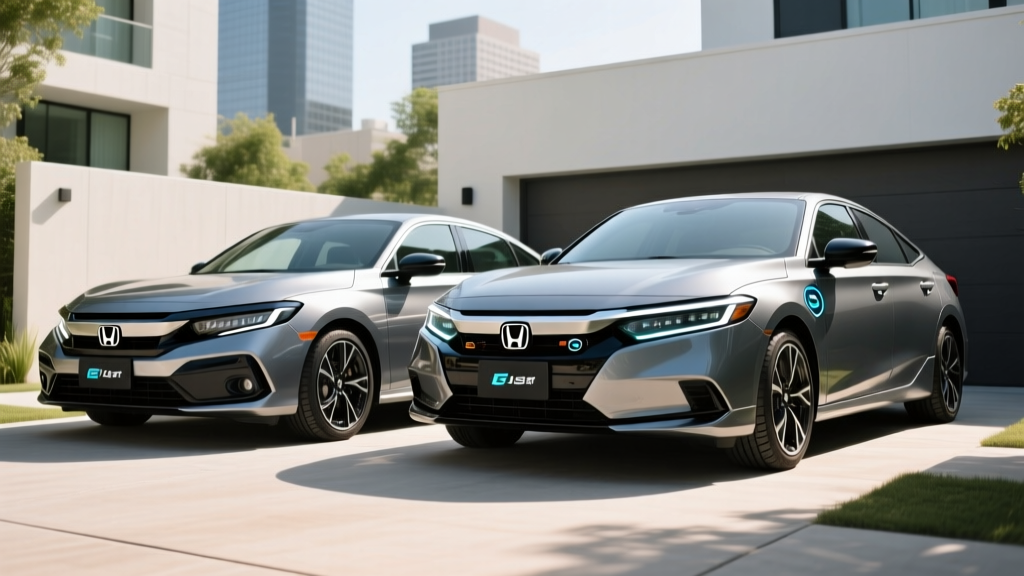
The Honda Insight was discontinued after the 2022 model year, but it remains one of the most fuel-efficient sedans Honda ever built — and a popular choice on the used market. Meanwhile, the current-generation Honda Civic Hybrid has returned for 2025 and carries into 2026 with an updated two-motor hybrid system that effectively replaces the Insight in Honda's lineup. If you're searching for a Honda Civic vs Insight hybrid comparison, you're likely deciding between a brand-new Civic Hybrid and a well-maintained used Insight. This guide breaks down the exact numbers — EPA MPG, real-world efficiency, powertrain output, battery warranties, and total cost — so you can make an informed choice.
HEV vs PHEV: What Both Hondas Actually Are
Both the Civic Hybrid and the Insight are conventional hybrids (HEVs). Neither is a plug-in hybrid (PHEV). That means:
- No plug required. The battery recharges through regenerative braking and the gasoline engine. You never need to find a charger.
- No electric-only range. These vehicles can creep short distances on battery at low speeds, but they cannot sustain EV-only driving at highway speeds or for meaningful distances.
- No federal §30D tax credit. The IRS new clean vehicle credit applies only to BEVs and PHEVs with sufficient battery capacity and qualifying sourcing. Conventional HEVs do not qualify.
If you want a Honda with plug-in capability, the closest current option is the Honda Clarity PHEV (discontinued after 2022, available used) with approximately 47 miles of electric-only range. For a new Honda PHEV, Honda has not yet released one in the US market as of the 2026 model year.
EPA Fuel Economy: Civic Hybrid vs Insight by the Numbers
| Metric | 2026 Honda Civic Hybrid (Sport Touring) | 2022 Honda Insight (Touring) | 2022 Honda Insight (EX/LX) |
|---|---|---|---|
| EPA City MPG | 50 MPG | 51 MPG | 55 MPG |
| EPA Highway MPG | 47 MPG | 45 MPG | 49 MPG |
| EPA Combined MPG | 49 MPG | 48 MPG | 52 MPG |
| Fuel Tank Capacity | 10.6 gallons | 10.6 gallons | 10.6 gallons |
| Total Driving Range | ~519 miles | ~509 miles | ~551 miles |
Source: EPA fueleconomy.gov
The Insight's lighter-duty EX/LX trim squeezes out 52 MPG combined — 3 MPG more than the new Civic Hybrid Sport Touring. But the Civic Hybrid's 50/47/49 split is remarkably close, and the Sport Touring trim includes all-wheel drive availability, a more powerful engine, and significantly upgraded technology. The Insight Touring, with its larger wheels and heavier equipment load, drops to 48 combined.
Real-World MPG: What Owners Actually Report
Honda's hybrid system excels in city driving, where the electric motor handles low-speed propulsion and regenerative braking recaptures energy at every stop. In real-world use:
- City driving (Civic Hybrid): Owners on fueleconomy.gov's My MPG tracker report averaging 48–53 MPG in mixed urban commuting, with some exceeding the 50 MPG EPA city estimate.
- Highway driving (Civic Hybrid): Expect 43–46 MPG at sustained 70–80 mph speeds. Hybrids lose their advantage at high constant speeds because the engine runs continuously without regenerative braking events.
- Cold weather penalty: Both vehicles lose roughly 5–10% fuel economy in sub-40°F temperatures due to increased engine idling for cabin heat and reduced battery efficiency.
- Insight real-world: Drivers report 47–54 MPG combined, with the EX/LX trim consistently hitting or beating its 52 MPG EPA sticker in moderate climates.
Powertrain and Performance Specs
| Specification | 2026 Honda Civic Hybrid | 2022 Honda Insight |
|---|---|---|
| Engine | 2.0L Atkinson-cycle 4-cylinder | 1.5L Atkinson-cycle 4-cylinder |
| Hybrid System | Two-motor (e:HEV 4th gen) | Two-motor (i-MMD 3rd gen) |
| Combined System Output | 200 HP / 232 lb-ft torque | 151 HP / 197 lb-ft torque |
| Transmission | e-CVT (direct drive) | e-CVT (direct drive) |
| Drivetrain | FWD (AWD available on Sport Touring) | FWD only |
| 0–60 mph | ~6.5 seconds | ~7.7 seconds |
| Curb Weight | ~3,150 lbs | ~3,078 lbs |
The 2026 Civic Hybrid's 2.0-liter engine and fourth-generation two-motor system deliver a substantial 49 HP advantage over the Insight. This translates to confident highway merging and passing — areas where the Insight's 151 HP can feel strained with passengers and cargo. The Civic Hybrid's available AWD (on the Sport Touring Hybrid) also adds all-weather capability the Insight never offered.
Pricing: New Civic Hybrid vs Used Insight
| Model & Trim | MSRP / Market Price |
|---|---|
| 2026 Civic Hybrid Sport | ~$29,845 |
| 2026 Civic Hybrid Sport Touring | ~$32,845 |
| 2022 Insight EX (used, avg.) | $19,000–$23,000 |
| 2022 Insight Touring (used, avg.) | $22,000–$26,000 |
The Insight's discontinuation means you're shopping the used market, where well-maintained examples with under 40,000 miles still command strong prices due to their reputation for efficiency. The new Civic Hybrid costs roughly $7,000–$10,000 more but includes a full factory warranty, Honda Sensing 2.0 safety suite, updated infotainment with wireless Apple CarPlay/Android Auto, and current crash-test ratings.
Tax Credit Eligibility
Neither vehicle qualifies for the federal §30D new clean vehicle credit. The IRS credit applies exclusively to battery electric vehicles (BEVs) and plug-in hybrids (PHEVs) that meet battery sourcing, critical mineral, MSRP cap, and buyer income requirements. Conventional HEVs like the Civic Hybrid and Insight are excluded regardless of price or efficiency.
Some states offer hybrid-specific rebates or HOV lane access (California's Clean Air Vehicle decal program previously included certain hybrids but now requires PHEVs or BEVs). Check your state's energy or DMV website for current programs.
Battery Warranty, Lifespan, and Replacement Cost
Honda Hybrid Battery Warranty:
- 2026 Civic Hybrid: 8 years / 100,000 miles (10 years / 150,000 miles in CARB states including CA, CT, ME, MA, NJ, NY, OR, RI, VT, WA)
- 2022 Insight (remaining coverage): Original 8-year/100,000-mile warranty transfers to subsequent owners. A 2022 model purchased new would retain coverage through 2030 or 100,000 miles, whichever comes first.
- Capacity threshold: Honda's warranty covers the hybrid battery if capacity drops below a level that triggers a malfunction indicator — typically around 60–70% of original capacity based on owner reports.
How Long Do Honda Hybrid Batteries Actually Last?
Honda's lithium-ion hybrid battery packs in both the Civic Hybrid and Insight are relatively small (approximately 1.0–1.2 kWh usable) because they serve as a buffer for the electric motor rather than providing sustained EV driving. This small size means:
- Lower thermal stress: Smaller packs experience less heat buildup during charge/discharge cycles.
- Shallow cycling: The system rarely charges to 100% or discharges to 0%, keeping the battery in a healthy middle state of charge.
- Proven longevity: Honda hybrid batteries from earlier generations (2010s Civics, first-gen Insights) commonly reach 150,000–200,000 miles before significant degradation.
Battery Replacement Cost
If a hybrid battery does fail outside warranty:
- OEM replacement (dealer): $2,500–$4,000 including parts and labor
- Refurbished/aftermarket: $1,500–$2,500 from independent hybrid specialists
- Cell-level repair: Some shops replace individual degraded cells for $500–$1,200, though this is less common for Honda than for Toyota Prius packs
For context, a well-maintained Insight or Civic Hybrid should not need a battery replacement within normal ownership timeframes. The gasoline engine, CVT, and standard maintenance items (brakes, tires, fluids) are more likely service needs over 10+ years.
Reliability and Ownership Costs
Both vehicles benefit from Honda's strong reliability reputation. Key ownership considerations:
2026 Civic Hybrid — Pros
- 200 HP provides confident acceleration
- Available AWD for snow/rain regions
- Full factory warranty (3yr/36k bumper-to-bumper, 8yr/100k hybrid)
- Honda Sensing 2.0 with updated ADAS
- Current IIHS Top Safety Pick+ eligible
- Latest infotainment with wireless connectivity
2026 Civic Hybrid — Cons
- $30K+ starting price
- No federal tax credit
- Slightly lower EPA MPG than Insight EX
- Heavier curb weight affects efficiency marginally
Used Insight — Pros
- 52 MPG combined (EX/LX) is best-in-class
- $19K–$26K entry price saves thousands upfront
- Proven, simple powertrain with low maintenance costs
- Lightweight, nimble handling
- Remaining factory hybrid warranty on low-mile examples
Used Insight — Cons
- No longer in production — parts availability long-term uncertainty
- 151 HP feels underpowered for highway passing
- Older infotainment (no wireless CarPlay on most trims)
- Pre-2023 Honda Sensing suite (less refined than current)
- FWD only — no AWD option
- Depreciation curve uncertain for discontinued model
Who Should Choose Which — And When to Consider a Full EV Instead
Choose the 2026 Civic Hybrid if:
- You want a new car with full warranty coverage and the latest safety tech
- You need AWD for winter climates
- You regularly carry passengers or drive highway-heavy routes where the 200 HP matters
- You plan to keep the car 8+ years and want to start the warranty clock fresh
Choose a used 2022 Insight if:
- Your budget is under $25,000
- Your commute is city-heavy, where the 52+ MPG shines brightest
- You drive under 15,000 miles per year and can find a low-mileage example
- You value maximum fuel efficiency over power and technology
Consider a full EV (BEV) instead if:
- You have reliable home Level 2 charging access
- Your daily driving is under 250 miles (within most EV ranges)
- You want to eliminate gasoline costs entirely and may qualify for the $7,500 federal credit on qualifying BEVs
- You want near-zero routine maintenance (no oil changes, fewer brake replacements due to regen)
Consider a PHEV instead if:
- You want 25–45 miles of electric-only commuting but need gas-engine range flexibility
- You can charge at home overnight but take longer road trips regularly
- Models like the Toyota Prius Prime (44 mi EV range) or Hyundai Tucson PHEV (33 mi EV range) match your needs
5-Year Cost of Ownership Comparison
| Cost Category (5 years / 75,000 miles) | 2026 Civic Hybrid Sport Touring | 2022 Insight Touring (Used) |
|---|---|---|
| Purchase Price | $32,845 | $24,000 (avg.) |
| Fuel Cost ($3.50/gal avg.) | $5,357 | $5,469 |
| Insurance (est. avg.) | $7,500 | $6,000 |
| Maintenance (oil, tires, brakes) | $3,200 | $4,000 |
| Federal Tax Credit | $0 | $0 |
| Estimated Depreciation | $12,000 | $6,000 |
| 5-Year Total | ~$60,902 | ~$45,469 |
Fuel costs based on EPA combined MPG and 15,000 miles/year. Insurance and maintenance are estimates; actual costs vary by driver profile and location. Depreciation is approximate.
The used Insight's lower purchase price dominates the 5-year calculation, saving roughly $15,000 even with slightly higher maintenance costs as the vehicle ages. The Civic Hybrid's advantage lies in warranty protection, modern safety technology, and the peace of mind that comes with a new vehicle. Your choice depends on whether upfront savings or long-term reliability coverage matters more.
Frequently Asked Questions
How many MPG does the Honda Civic Hybrid get in real-world driving?
The 2026 Civic Hybrid is EPA-rated at 50 city / 47 highway / 49 combined MPG. Real-world owners report 48–53 MPG in city-dominant commuting and 43–46 MPG on sustained highway trips. Cold weather (below 40°F) reduces efficiency by approximately 5–10% due to engine warm-up idling and cabin heating demand.
Does the Honda Insight need to be plugged in to charge?
No. The Insight is a conventional hybrid (HEV), not a plug-in hybrid (PHEV). Its small lithium-ion battery recharges through regenerative braking and the gasoline engine. You simply fill it with gas and drive — no charging cable or outlet is needed.
Is the Honda Insight still being made?
No. Honda discontinued the Insight after the 2022 model year and shifted its hybrid sedan strategy to the Civic Hybrid, which launched for the 2025 model year and continues into 2026. Used 2020–2022 Insights remain available on the pre-owned market.
Is the hybrid battery reliable, and what does replacement cost?
Honda hybrid batteries are highly reliable, with many lasting 150,000–200,000 miles. The battery is covered by an 8-year/100,000-mile warranty (10 years/150,000 miles in CARB states). If replacement is needed out of warranty, expect $2,500–$4,000 for an OEM pack or $1,500–$2,500 for a refurbished unit.
Does the Honda Civic Hybrid qualify for any tax credit?
No. The federal §30D new clean vehicle credit applies only to plug-in hybrids (PHEVs) and battery electric vehicles (BEVs) with qualifying battery sourcing. Conventional hybrids like the Civic Hybrid and Insight are not eligible. Check IRS.gov for current credit rules and eligible vehicle lists.
Should I buy the Civic Hybrid or a full EV like the Chevy Equinox EV?
If you have home Level 2 charging and your daily driving stays under 250 miles, a BEV like the Equinox EV (EPA 319 miles, starting ~$33,000, potentially eligible for the $7,500 federal credit) can offer lower per-mile energy costs and near-zero maintenance. If you lack reliable charging access, frequently drive over 300 miles between stops, or live in an area with limited public charging infrastructure, the Civic Hybrid eliminates range concerns while still delivering nearly 50 MPG.